Finding Aid: March/April 1987

The complete issue

Vol. VIII, No. 5
(32 pages)


Print edition: Visit our store to check availability
Digital edition: Visit JSTOR.org to purchase
Subscribe to MI
Explore the MI Archives: Browse | Advanced search | Tutorial

Inside

Cover image
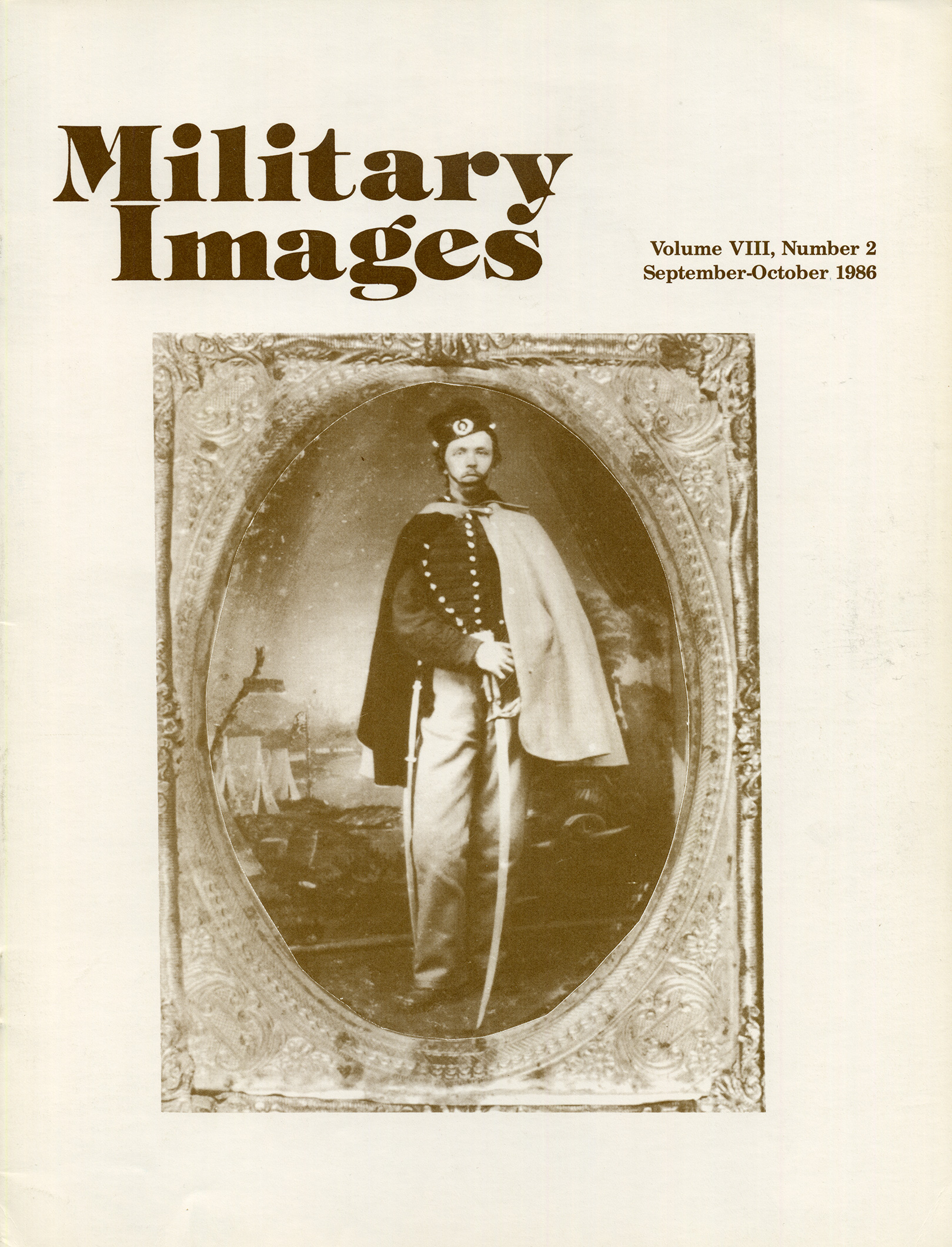
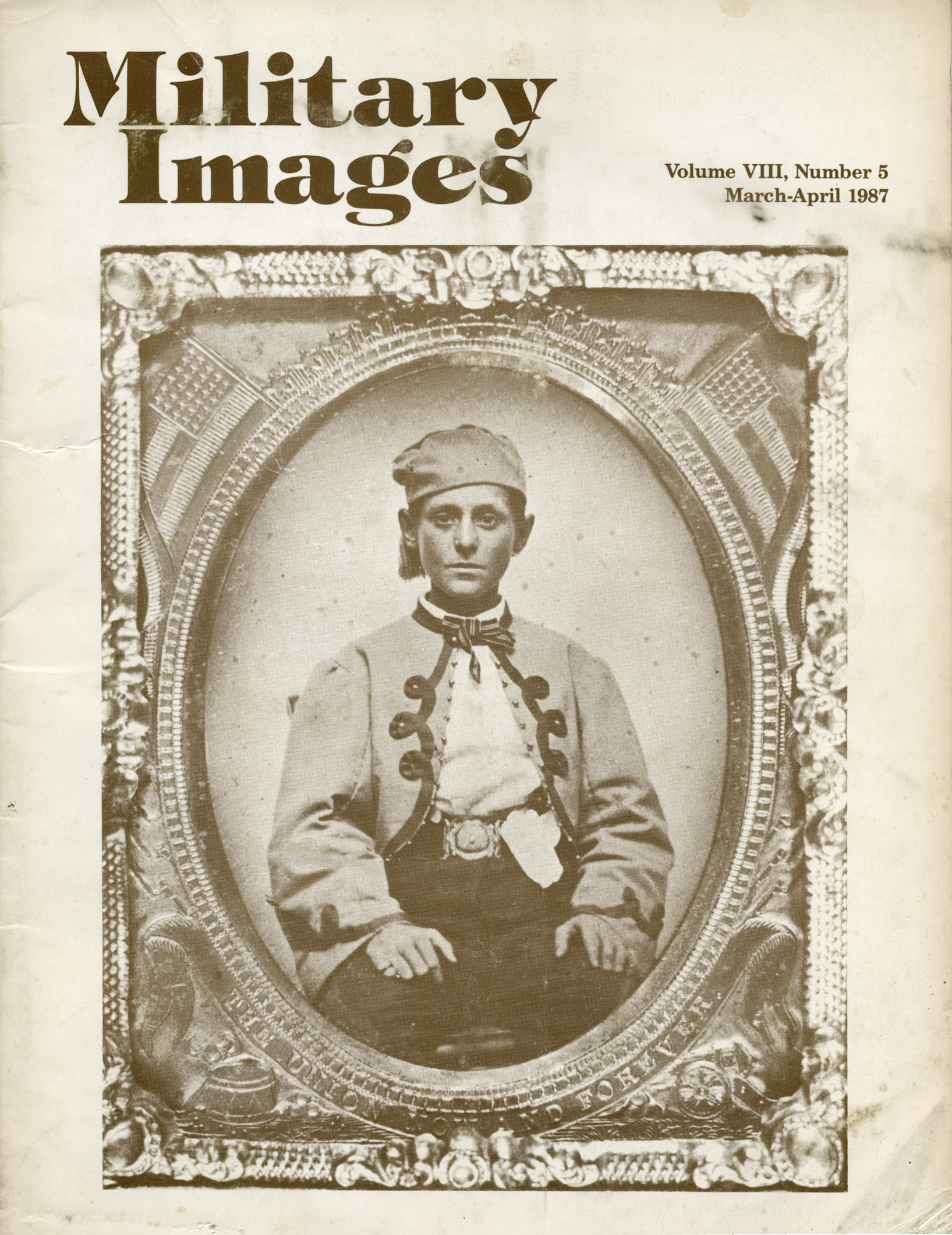
The ninth-plate ambrotype on the front cover is of a very young Zouave cadet, taken about 1861.

Editor’s Desk (p. 1)
The editor provides guidance on how to best copy images for submission to Military Images.

Mail Call (p. 3)
Some corrections to captions for some of the Ronn Palm images from the previous issue are noted, along with an explanation of why the magazine stands by the captioning in an article from the November-December 1986 issue.

Passing in Review (pp. 4-5)
A total of seven publications are reviewed in this issue of MI beginning with Bold Dragoon: the Life of J.E.B. Stuart by Emory M. Thomas. This work covers the entire life of Stuart and examines not only his successes, but also his failures as the cavalry chief of the Army of Northern Virginia. Simpson Speaks on History by Col. Harold R. Simspon is an anthology of six of the author’s public presentations on a wide variety of topics that would be entertaining for most readers. Flashman and the Dragoon by George MacDonald Fraser is the seventh memoir by Brigadier Sir Harry Flashman, this time with Flashman ending up in the midst of the Taiping Rebellion in 1860. Two reprinted volumes are reviewed together: The Custer Myth by W.A. Graham and With Custer’s Cavalry by Katherine Gibson Fougera. The first is a comprehensive collection of information about the Battle of Little Bighorn as of 1953 while the second is a memoir of one of Custer’s officer’s wife, providing an excellent glimpse into family life of the cavalry on the Plains. Custer’s Field: “A Scene of Sickening, Ghastly Horror” by Francis R. Taunton in collaboration with Brian C. Pohanka in its third edition is next, attempting to use archaeological as well as contemporary accounts of the battle to explain some of the questions about the battle. Finally, The Man Who Tried to Burn New York by Nat Brandt is reviewed. The book tells the story of Captain Robert Cobb Kennedy, late of the 1st Louisiana Infantry, and how he became engaged in the Confederate secret service plot to burn New York in 1864 in protest against the wealth of the city while the South was suffering from the war.

The Sharps Rifle in the Civil War by Richard Carlile (pp. 6-9)
The favorite weapon of Civil War sharpshooters, the article examines the acquisition of the Sharps rifle by “Berdan’s Sharpshooters” of the 1st and 2nd U.S. Sharpshooters. It began with Private Truman Head, known as “California Joe” of Company C, 1st Regiment of Sharpshooters, who purchased a M1859 model on his own. Not happy with their standard issue Colt five-shot revolving rifle, the men decided they liked the weapon, and Colonel Hiram Berdan pressured for its procurement. To keep it within cost, the rifles ordered by Berdan had some modifications; many Sharps rifles found in images are rarely the Berdan type. The article is accompanied by 12 images which show both Berdan and other manufactures of Sharps rifles.

Some Sailing Men… by John A. Stacey (pp. 10-12)
Eleven different images of sailors from 1866 to World War I show a variety of uniforms, often with non-regulation application of insignia. One photograph shows four soldiers on liberty, two of the soldiers being members of the same ship. They are, however wearing different names on their hat ribbons, as the German vessel Kronen Prinzess Cecilie was taken by the U.S. Navy and renamed the Mount Vernon; the names show the transition from one name to the other. Another image shows the mascot from the U.S.S. Ohio, the pet goat wearing several different naval insignia.

John C. Black: A Medal of Honor Winner from Illinois by Bill McFarland (pp. 13-15)
Beginning with two tintypes of a supposed Jacob Black of the Illinois Greyhounds, the author eventually came to the conclusion that the two images were of the man who eventually became General John C. Black, whose service during the Civil War began with a three-month enlistment in the Zouaves of the 111th Indiana. Afterward, the young man whose family was acquainted with Abraham Lincoln returned to Danville, Illinois and organized what became Company K of the 37th Illinois Infantry. John was the major of the regiment, his brother William a captain, and a step-brother a lieutenant. Both of the brothers were awarded the Medal of Honor for their actions (William at the Battle of Pea Ridge and John at Prairie Grove), the only pair of brothers other than Thomas and George Custer to be so recognized.

Zou Zou!: More photos of American Zouaves and Chasseurs by Irena Zogoff (pp. 16-21)
A compilation of 18 different images shows the wide variety and popularity of these types of units, from a pair of small boys in Zouave uniform, to a Collis Zouave in an image with his father, to a group of Zouaves frolicking for the camera. Captions to each image provide the reader with information regarding the uniform and its unit identification.

Other Zouave Images: Contemporary Lithographs as a Reference Tool by Howard Michael Madaus (pp. 22-24)
Using lithographs and woodcut images to identify Zouave units rather than only photographic images is the topic of this article. Many of these other types of images were taken from photographs, some of which are lost to history, such as the lithograph of the Tremont Zouaves of Massachusetts which was featured on a songsheet cover early in the Civil War. However, the image probably used to create a lithograph of a Zouave on an envelope is likely taken from an image of First Sergeant Louis N. Tucker of the “Boston Light Infantry” about 1861. There is enough similarity as well as a slogan used by Tucker’s unit (“Death or an Honorable Life”) to assume the connection. What the lithographs show that the photographic images do not is the coloration of the uniforms, allowing the modern viewer a more complete understanding of what these elaborate and unique uniforms looked like, making lithographs another source of information for the identification of Civil War uniforms.

Lt. Sydnum Bridgers: An Officer in the 47th North Carolina Infantry by Barry I. Mickey (p. 25)
The vignette of the soldier shown in the carte de visite image tells the story of a unit that was organized early in 1862 without weapons or many supplies, and did not see any real action until New Bern in May 1863. At Gettysburg, the 47th and Lt. Bridgers was part of Pickett’s Charge, led by General Pettigrew. Bridgers survived that charge, and was one of the 400 men left in his unit. It was in October at Bristoe Station in Virginia that Lt. Bridgers was wounded, and left on the field overnight. Transferred to one of Richmond’s military hospitals, Sydnum Bridgers died a month later.

Stragglers (pp. 27-31)
The “Stragglers” in this issue of Military Images presents eight different images from the humorous to those that have many questions arising from them. One of these is a scene that might be in California; the American flag in the image shows 28 stars under magnification, indicating that it probably comes from the Mexican War era. Another is of a soldier wearing a black hat with an ostrich feather including the letters “RRCS” and epaulettes that are made up of dark tight braid. Two other images show soldiers sitting on the ground; one can see that their boots include hobnails and heelplates.

Back Image
Two unidentified soldiers, one a Confederate and the other a Massachusetts militiaman, surround a sixth-plate daguerreotype of Lt. William Spencer, 2nd U.S. Infantry, from 1855-58.

Finding Aid: January/February 1987

The complete issue

Vol. VIII, No. 4
(32 pages)


Print edition: Visit our store to check availability
Digital edition: Visit JSTOR.org to purchase
Subscribe to MI
Explore the MI Archives: Browse | Advanced search | Tutorial

Inside

Cover image
A Union cavalryman plays his banjo from a sixth-plate tintype from the collection of Ronn Palm.

Editor’s Desk (p. 1)
This issue of Military Images is the first that is made up of selected images from one collection: “The Best of the Palm Collection.” Many of the included items are from his wide variety of images featuring Pennsylvania troops. The editor asks for feedback on this idea of featuring one person’s collection in an issue.

Passing in Review (pp. 2-3)
The five publications reviewed in this issue of MI begins with Historical Times Illustrated Encyclopedia of the Civil War, edited by Patricia L. Faust. This volume includes 2,000 entries that provide depth and detail that should appeal to the beginner and the experienced reader of Civil War information. It should be a companion to the Civil War Dictionary written by Mark Boatner. Second is The Cavalry at Gettysburg by Edward G. Longacre, who provides a long-needed description of the cavalry beginning in mid-June with Brandy Station through skirmishes leading up to the fighting at East Cavalry Field and the retreat ending in mid-July 1863. Longacre covers individuals like Stuart and Buford as well as others who are not as familiar to some readers. Third is The Fiery Trail, edited by Richard Harwell and Philp N. Racine, who take the letters and diary entries of Major Thomas W. Osborn of the Union Army of the Tennessee and provide them with detailed context and thus produce a detailed description of Sherman’s March. Fourth is The United States Navy: 200 Years by Edward L. Beach. Not intended to be a comprehensive history of the Navy, Beach looks at the people and incidents that had long-term impact on the future actions at sea, such as the fact that shots fired by the Monitor used only half charges. Last but not least is U.S. Army Uniforms and Equipment, 1889. This is a republication of the original Quartermaster Corps guide to all items ranging from barracks chairs to buttons, complete with line drawings and detailed descriptions. Collectors interested in this era’s items must have this publication.

Mail Call (p. 3)
Readers provided a few corrections from the survey of corps badges in the previous issue. One reader included an additional example of the crescent badge as worn by XI Corps, while another identifies an “unidentified” officer.

Interview with Ronn Palm (pp. 4-5)
The very first issue of MI in 1979 included a selection from his collection, and this issue begins with an interview with Ronn Palm. He discusses how he began collecting Civil War images and how he began to specialize in certain types of images. Part of the interview covers how he stores his collection of over 2,200 images of all types, as well as where he finds new images. He has made friendships with many dealers and most of his transactions now involve trading rather than outright purchases. The cost of images, he said, can be discouraging to new collectors, but he provides some suggestions for how new hobbyists can begin.

Infantry (pp. 6-11)
Ronn Palm’s image collection begins with 21 different images of Union soldiers who served in the infantry. The images range from carte de visite portraits of known and unknown individual soldiers to small group ambro- or tintypes images. A variety of uniform types and different weapons are displayed in these images. Most of the images have the typical backdrops used in period images, however one shows a soldier inside of a photographer’s tent, showing a very different glimpse of the era.

Zouaves and Chausseurs (pp. 12-14)
This selection of 10 images is also a mixture of individual and group portraits, including one that looks like it was taken outside, almost giving one the sense that it was taken during action. The wide variety of fancy and plain uniforms is shown as well. A pair of soldiers from the 62nd Pennsylvania shows how the uniform of that unit changed, from the plain uniform worn by Private Willis T. Benedict in 1861 to the epaulettes worn by Sergeant Abasha Cowen during his third year of service as noted by the chevrons on his sleeve.

Prisoners of War (p. 15)
Three images show both Union and Confederate prisoners of war. The group of five Confederates were held at Camp Douglas, Illinois, while the five Federal officers were held at Andersonville, Georgia. A single Connecticut soldier, Captain Billie Mays of the 23rd Connecticut, is shown upon his release from a POW camp in Texas; he has his gear and looks ready to go home.

Cavalry (pp. 16-21)
This section of the collection shows 22 different images of cavalrymen. Many of the images are individual portraits, with the first pages showing the men ready with a wide variety of weapons. While many of the men are unidentified, a few are known, such as Colonel Richard Rush and Captain Robert Mitchell, both of the 6th Pennsylvania Cavalry, also known as “Rush’s Lancers.” Palm’s collection includes some posed outdoor images with cavalry mounts, including two that show the same five men. In one image two are mounted while three lounge on the ground, their faces visible between the horses’ legs and bellies; they switch places in the next image. Colonel Alexander Hays and his staff (63rd Pennsylvania) are also featured in a half-plate tintype. The last five individual images in this section feature soldiers holding the M1855 pistol-carbine, a rare collector’s item and appears even more rarely in images, although it may be a photographer’s prop for these soldiers.

Musicians (pp. 22-23)
Indoor, outdoor, and in a tent are where the images of musicians were taken for these two pages. Featuring a trio of horns, a drummer boy, a bugler, and a band outside at parade rest join a pair of older militia musicians with fife and drum.

Outdoor Images (pp. 24-27)
At one time, outdoor images were a passion for collector Ronn Palm, and it is easy to see why. The first image presented by MI here is captioned as being the “finest image” in his collection. It is a quarter-plate ambrotype of a company of Union soldiers lined up in an unidentified town. The detail provided by the civilians watching the soldiers in their ranks adds interest to the image for modern viewers. The other outdoor images featured include men relaxing (including one eating eggs with his meal), artillery at the ready, and two other units standing in ranks. One was taken shortly before the start of the Gettysburg campaign.

Officers (pp. 28-30)
The final selection of images from Ronn Palm’s collection includes 10 images of officers, both individual and group portraits. Two that stand out includes Captain John Laughlin of the 104th Pennsylvania who is the subject of a carte de visite while holding a model of a siege gun. The other is Lt. Col. J.W. Lyman of the 203rd Pennsylvania with his toddler daughter, Libbie; Lyman was killed at Fort Fisher in January 1865.

Back Image
A half-plate ambrotype image features a militia officer who looks a great deal like General Daniel Harvey Hill of the Army of Northern Virginia.

Finding Aid: November/December 1986

The complete issue

Vol. VIII, No. 3
(32 pages)


Print edition: Visit our store to check availability
Digital edition: Visit JSTOR.org to purchase
Subscribe to MI
Explore the MI Archives: Browse | Advanced search | Tutorial

Inside

Cover image
An unidentified Union field-grade officer, wearing his corps badge hanging from a ribbon, which denotes him as a staff officer.

Editor’s Desk (p. 1)
In this issue, the editor explains that issues of Military Images beginning with the January-February 1986 issue will be included in the ABC-CLIO index and abstract service. Abstracts of articles will be published in Historical Abstracts as well.

Mail Call (p. 3)
The controversy regarding the photograph of the unidentified Confederate Marine is concluded with a letter from a motion picture special effects artist. He took the images and ran them through some detailed photographic tests and found that the image is indeed that of Lt. David Raney. Brian Pohanka also provides newly found evidence that expands on his biography of Miles Keogh from the previous issue of MI: a letter that proves the rumor that Keogh had a premonition about his death. Other letters include questions regarding Missouri militia battle shirts and a request for help finding information about a Texan in the 9th Texas Cavalry.

Passing in Review (p. 5)
Two items are included, beginning with the addition of five books written by Philip Katcher to the Man-at-Arms series by Osprey. His contributions include four books on the uniforms and equipment of the Civil War and one on the U.S. Cavalry on the Plains. The book WAR by Gwynne Dwyer is the second item reviewed. The volume, which covers the history of warfare from Armageddon in 1480 B.C. to the current era of nuclear warfare, also following his miniseries of the same name. A short note at the end of the feature lets readers know that Son of the Morning Star: Custer and the Little Bighorn by Evan Connell has been released again in paperback with 24 photographs.

More Georgians in Gray: Brief Biographies of Confederate Soldiers, Part II by Keith Bohannon (pp. 6-13)
Fifteen different images, including some of siblings, illustrate the stories of these soldiers who fought for Georgia during the Civil War. The men came from a variety of backgrounds, from young farm boys to school teachers to the sons of the landed elite, and saw action from First Manassas to the horrific fighting at the Devil’s Den at Gettysburg to the surrender at Appomattox. A few died of disease, some in battle, and many resumed their lives as honored members of their communities after the war.

Massachusetts Mystery Medal by Howard Michael Madaus (pp. 14-15)
This article describes a very unique device worn by members of the 1st Massachusetts Volunteer Infantry, apparently first in use during the summer of 1863. Seen on the uniforms of five members of the unit, the medal appears to be a complete minie ball attached to a ribbon with a dark diagonal stripe on a square ribbon, with a bar attachment to a second piece of the same ribbon which is attached to a metal shield. The author of the article requests any information from the readership that could provide more light on the meaning of this interesting mystery medal.

Corps Badges of the Civil War, Part III: XI through XXV Corps by Wendell W. Lang, Jr. (pp. 16-26)
The final fifteen remaining Federal corps badges are the topic of this article. The author reminds the readers that a few of the corps (XIII and XXI) never adopted a corps badge and that some of the new corps adopted an old badge (the XX took on the badge of the XII) and others adopted new badges. Some of the men would wear their old corps badge even when their corps was integrated into a new one, so identification can be confusing at times. It is suggested that care be taken by collectors to use a magnifying glass to get as much detail about a corps badge as possible in order to make correct identification; some manufacturers even would put symbols on metal discs, which can also lead to misidentifications. The images included with the article show the crescent of the XI Corps, the five-pointed star of the XII Corps, the acorn of the XIV, the cartridge box of the XV, the symbol of the XVI (a circle which is said to have four minie ball cuts to make a rough cross), the second badge (an arrow) of the XVII Corps, the “foliate” cross badge of the XVIII, the initial four-pointed star of the XIX Corps, the unofficial five-leafed cross of the XXII, the escutcheon of the XXIII Corps, the heart-shaped badge of the XXIV, and the square within a square of the XXV Corps.

The Tenth Legion by Robert W. Fulmer (p. 29)
The Civil War saw the attempt to raise “legion” sized combined arms units, with approximately 1000 men organized into eight infantry companies along with a company of cavalry and one of artillery batteries. The Confederate legions (Hampton’s and Cobb’s Legions) are generally well-known, but the Union also raised one as well. The Tenth Legion was raised from Orange and Sullivan counties in New York, and its members wore a large shield with an “X” emblazoned on it, not to be confused with the X Corps badge. The color of the shield designated the combat arm the soldier belonged to: sky blue for infantry, green for rifle companies, orange for cavalry, red for artillery. The end of 1861 saw the recognition that a legion was unwieldy for the kind of fighting that was underway, so the Tenth Legion was broken up and its component parts being redistributed.

Stragglers (p. 31)
Military Images published in July-August 1981 (Vol. III, No. 1) a photograph of what was said to be a relaxed “Stonewall” Jackson standing along a fence in camp. The original quarter-plate ambrotype, stolen from the estate of Louise Briscoe, caused a sensation, with many not believing that the scruffy man wearing no rank could be Jackson. MI asked the reader who made the definitive identification of Lt. Raney (see “Mail Call”) to do the same kind of photo identification of this image. Mr. Fleming compared the image to four known images of “Stonewall” and his verdict: the figure in question is most definitely Thomas J. Jackson.

Back Image
The back of the issue features a ninth-plate ambrotype of an unidentified antebellum militia infantryman in a uniform typical of militia from North Carolina and Virginia. The bugle insignia was used by militia to designate rifle companies.

Finding Aid: September/October 1986

The complete issue

Vol. VIII, No. 2
(32 pages)


Print edition: Visit our store to check availability
Digital edition: Visit JSTOR.org to purchase
Subscribe to MI
Explore the MI Archives: Browse | Advanced search | Tutorial

Inside

Cover image
The full-length image of Christopher John Smith of the 3rd New Jersey Cavalry Regiment, also known as the 1st United States Hussars is the featured image on the cover of the issue. The 3rd New Jersey was also known as the “Butterfly Regiment” due to their elaborate uniforms, which can be easily seen in this image.

Editor’s Desk (p. 1)
The editor begins by introducing this second all-cavalry issue of Military Images, providing an overview of the featured articles. He also describes some of the highlights of the year’s Gettysburg exhibit over the July 4th weekend, including an educational exhibit by William Adams of Massachusetts that featured a collection of faked items such as muskets and frock coats, hoping to show collectors how to spot actual period items from reproductions. The editor announced the collaboration of MI with the Japanese military history magazine PX; they will be reprinting Japanese translations of MI articles in their publication. Lastly, the editor encourages the readership to contact their U.S. Senator and voice support for the donation of the Taney Farm to the Gettysburg NPS site.

Mail Call (pp. 2-3)
Letters to the editor include some corrections on identifications of past images as well as some congratulatory letters from readers. One reader from South Africa provided some background information on the development of Hussar uniforms. Two lengthy letters continue the discussion regarding the possible identity of a Confederate States Marine Corps lieutenant as being Lt. David Raney of Mobile, Alabama.

The Darkroom (p. 4)
Guidance regarding the repair of wooden cases which have broken hinges covered by paper is provided.

Passing in Review (p. 5)
Two different publications are reviewed, beginning with Old Abe the War Eagle by Richard H. Zeitlin. “Old Abe” was the mascot of the 8th Wisconsin Infantry Regiment during the Civil War, and this volume does more than provide a history of the famous bald eagle. It is a well-recommended regimental history of the 8th that takes it past the Civil War and into its history in the West, relying on many primary source accounts. The second publication is Civil War Commanders by Dean S. Thomas, a small reference of 105 Union and Confederate commanders. The intention was to highlight a number of notable commanders along with some uncommon images, although the reviewer does admit that a few choices made by the author seem unusual. Identical information is provided about each commander (e.g. basic biographical information, West Point attendance and standing, battle and campaign participation, etc.) making this a very nice short reference.

Vignette: John Ring, His Mark by Chris Nelson (pp. 6-7)
An image of a Union cavalryman in confident pose and a copy of enlistment papers provide the background of the story of John Ring, a South African sailor who volunteered for service in the United States Army on July 6, 1864. Private Ring was 26 years of age and while it is not known why he left the sea to join the 4th Massachusetts Cavalry, it can be inferred that he was an illiterate, as his “mark” serves as his signature on the enlistment paperwork. His service record shows that Ring served as a courier and orderly for most of his time in service, including a stint in the “Flying Hospital” at Camp Lee in Richmond. Like many servicemen, he apparently left the army when he felt his time had been served; his service record shows he left about August 13, 1865 with approximately $69.11 worth of ordnance and supplies in his possession. Nothing more is heard of from Private John Ring until 1923, when a request from a Massachusetts congressional member led to desertion charges being dropped.

Teddy’s Troopers: A look at the Rough Riders of 1898 by John Sickles (pp. 8-10)
A collection of five images shows some of the take of the independent cavalry regiment organized by Theodore Roosevelt. The article outlines some of the eclectic mix of Americans collected to form the “Rough Riders” who served with Roosevelt in the Spanish-American War under the leadership of Leonard Wood and former Confederate general “Fighting Joe” Wheeler. Fearing that they might not make it to the fight, two of the images show the Tampa encampment and then the troopers on the crowded deck and rigging of the Yucatan; they left the horses behind to get on a transport to Cuba.

The 1st D.C. Cavalry by Richard Carlile (pp. 11-13)
The only regiment of cavalry recruited in the District of Columbia was originally to only be used in that location, under the command of the War Department. Known as “Baker’s Mounted Rangers” and recruited between June and December 1863, Colonel Lafayette C. Baker’s men were an unusual group, actually made up of mostly Maine men. As they were armed with the powerful Henry repeating rifle, only half of the regiment was initially mounted. They also ended up serving outside of the District, taking part in the Weldon Railroad in May 1864 and the Siege of Petersburg later that year. Eventually, the Maine elements were transferred to the First Maine Cavalry, leaving the D.C. companies to remain with the Army of the Potomac. Seven images of D.C. Cavalry troopers accompany the article.

Vignette: Henry Seafferman, 7th Cavalry by George Hart (p. 14)
Born in France and immigrating to Indiana as a child, Henry Seafferman served with the 2nd United States Cavalry before the Civil War began. During the Civil War, he was with the 5th as it was redesignated, serving in the Army of the Potomac. The sixth-plate tintype image that accompanies this vignette shows a young man armed with a bayonetted rifle and pistol taken during this time. After the war, Seafferman enlisted with the 7th Cavalry under Custer. Noted by the First Sergeant of G troop as being one of the best shots in the unit, Seafferman was killed during the Battle of Little Bighorn on June 25, 1876.

Myles Keogh by Brian Pohanka (pp. 15-24)
Ten images accompany this biographic article that recounts the life and career of Myles Keogh, the Irish-born cavalry officer who was part of George Armstrong Custer’s 7th Cavalry. Coming from a comfortable background, Keogh joined 1400 other Irishmen to fight in defense of Pope Pius IX against Giuseppe Garibaldi’s revolutionaries in May 1860. The article follows Keogh’s progress as a lieutenant in the Zouaves of the Papal Guard, known as the Company of St. Patrick to his coming to the United States and his career as a member of several generals’ staffs, including John Buford and George Stoneman. Captured and exchanged at one point during the war, Keogh was known not only for his dashing appearance, but for his bravery on the field of battle. The article also details his career after the war in the service of the 7th Cavalry, but also delves into some of the more private side of Keogh, including his melancholy, apparent alcoholism, and his disappointment in romance. Keogh is often remembered as the owner of the cavalry mount Commanche, the only “survivor” of the Little Bighorn disaster. That is but one chapter of a much storied career.

The Search for Lt. Crow by John Ertzgaard (p. 25)
The image accompanying the article was the subject of a long search, and was eventually found to be that of Lt. William Porter Crow, Company B of the 6th Kentucky Cavalry, under the command of John Hunt Morgan. The author of the article outlines his search and provides the military background of Lt. Crow, who was captured during Morgan’s raid into Ohio in the summer of 1863. The long incarceration following his capture led to his early death from lung disease in November of 1865.

Stragglers (pp. 26-28)
This issue’s version of “Stragglers” includes two images that are offered as “Pop Quiz No. 317” and “Pop Quiz No. 318” along with an image of three Federal artillerists posing while playing cards. The background of the two quiz images highlight groups that often were given military-type organizations, such as the Western Union Telegraphic Expedition (No. 317) and possibly the Masonic group called the Knights of Gideon (No, 318).

Back Image
A unique carte de visite image shows a Union cavalryman holding onto the rein of a horse painted onto a backdrop of canvas.

Finding Aid: March/April 2005

The complete issue

Vol. XXVI, No. 5
(40 pages)


Print edition: Visit our store to check availability
Digital edition: Visit JSTOR.org to purchase
Subscribe to MI
Explore the MI Archives: Browse | Advanced search | Tutorial

Inside

Cover image
A sixth-plate ambrotype from the David W. Vaughan collection is a portrait of Pvt. James M. Hart of Crenshaw’s Virginia Battery. This may be the only known image of a soldier clad in Confederate regulation rain gear.

Table of Contents (p. 1)

Editor’s Desk (p. 2)
The editor notes the 143rd anniversary of the Battle of Antietam and highlights the collection of Brian Boeve, who has long had an interest in this pivotal engagement. A letter to the editor discusses a 75th anniversary Gettysburg Reunion Medal worn by a bugler pictured in the last issue.

Cover Story (p. 3)
James Malcolm Hart, who suffered a wound at the Battle of Fredericksburg, is the subject of a biographical sketch.

Passing in Review (pp. 4-5)
Two books are reviewed. Custer’s Southern Officer: Captain George D. Wallace, 7th U.S. Cavalry by John D. Mackintosh praises the author for giving Wallace his due after years of obscurity. The Civil War Up Close: Thousands of Curious, Obscure, and Fascinating Facts About the War America Could Never Win by Donald Cartmell is described as a useful book even though it sheds little new light on familiar topics.

Shiloh, “Place of Peace” by Brian Boeve (pp. 6-12)
A gallery of nine soldier portraits is presented, each illustrated with informative captions. All of the men are identified. They include John Keppel, John Eichelberger and Lemuel Donovan of the 2nd Iowa Infantry, Christie Babbitt and James Robbins of the 55th Illinois Infantry, Edward Cooper of the 23rd Missouri Infantry, George Reiflin of the 24th Indiana Infantry, Charles A. Johnson of the 12th Illinois Infantry and Jesse Sherer of the 5th Ohio Cavalry.

Review at Fort Smith, Arkansas, November 12, 1864 by Jules Martino (pp. 13-17)
A brief history of Fort Smith during the Civil War years is illustrated by six quarter-plate outdoor tintypes that include soldiers from the 12th and 13th Kansas infantries and the 2nd Kansas Battery. Also included is a Library of Congress photo of Union Gen. Francis J. Herron, who inspected the soldiers shown in the tintypes.

Long Soldier by Charles G. Markantes (pp. 18-19)
A famous photograph of Lt. Col. George A. Custer and friends taken in July 1875 includes a Native American originally identified as Bloody Knife. He served Custer as a scout. An article in the Spring 2004 issue of Past Times magazine suggested that the Native American was unidentified. The author suggests that the man is actually Long Soldier and supports his theory with primary source material and other information.

Finding Major Robert C. Wallace of the 5th Michigan Cavalry by John Peter Beckendorf (pp. 20-24)
In this first part of Wallace’s story, the author tells the story of the life and military experiences of the Scottish-born soldier who left behind his memoirs upon his death in 1928. Three portraits of Walter Stevenson, which were at one time thought to be likenesses of Wallace, are included. Also included are two actual portraits of Wallace and two staff images in which Wallace is pictured.

Five Dilley Brothers Go to War by J. Dale West (pp. 25-31)
The wartime odyssey of the five Dilley brothers from Yazoo County, Mississippi, traces the service of Joseph Andrew, Robert William and Samuel Usher Dilley, who all served in the 12th Mississippi Infantry, Abraham Thomas Dilley, who served in Jones’ Cavalry, Mississippi State Troops, and Eugene Perry Dilley of the 29th Mississippi Infantry. Illustrations include a wartime ambrotype of Robert and Samuel, a portrait of Abraham in uniform and a post-war image of Joseph.

Uniforms & History by Michael J. McAfee (p. 32)
In “The First Regiment of Mounted Rifles, New York Volunteers,” McAfee presents a brief history of the regiments and a description of the uniforms worn by the men. A carte de visite of two soldiers from the 1st, wearing distinctive caps adorned with the brass letters MR, illustrates the text.

The Confederate Soldier (p. 33)
A sixth-plate ambrotype from the David W. Vaughan collection is a portrait of two young soldiers who served in Capt. T.B. Ferguson’s Company of the 3rd South Carolina Infantry.

Stragglers (pp. 34-38)
Nine images are featured in this issue, including four unidentified Confederates and two identified Union soldiers, Principal Musician Charles E. Hastings of the 106th New York Infantry and Capt. William Howland of the 127h New York Infantry. Another Civil War image is a double exposure carte de visite of an elderly man named John S. Wilkerson or Wilkenson. In one half of the image he plays a fife and in the other a drum. Two post-Civil War images include an 1898 portrait of Corp. Adrian Ellery Riley of the Astor Battery and a World War I era soldier named Alphonse Bissonett.

Sutler’s Row (p. 39)

The Last Shot (p. 40)
A tintype from the Bill Lee collection pictures an unidentified Union musician with his drum. In the foreground can be seen the leg and arm of a soldier in a chair, perhaps waiting to have his photograph made. In the background two overlapping backdrops are visible.

Finding Aid: Spring 2016

The complete issue

Vol. XXXIV, No. 2
(64 pages)

Print edition: Visit our store to check availability
Digital edition:
Visit JSTOR.org to purchase
Digital edition (premium access)
Subscribe to MI
Explore the MI Archives: Browse | Advanced search | Tutorial

Inside

Cover image
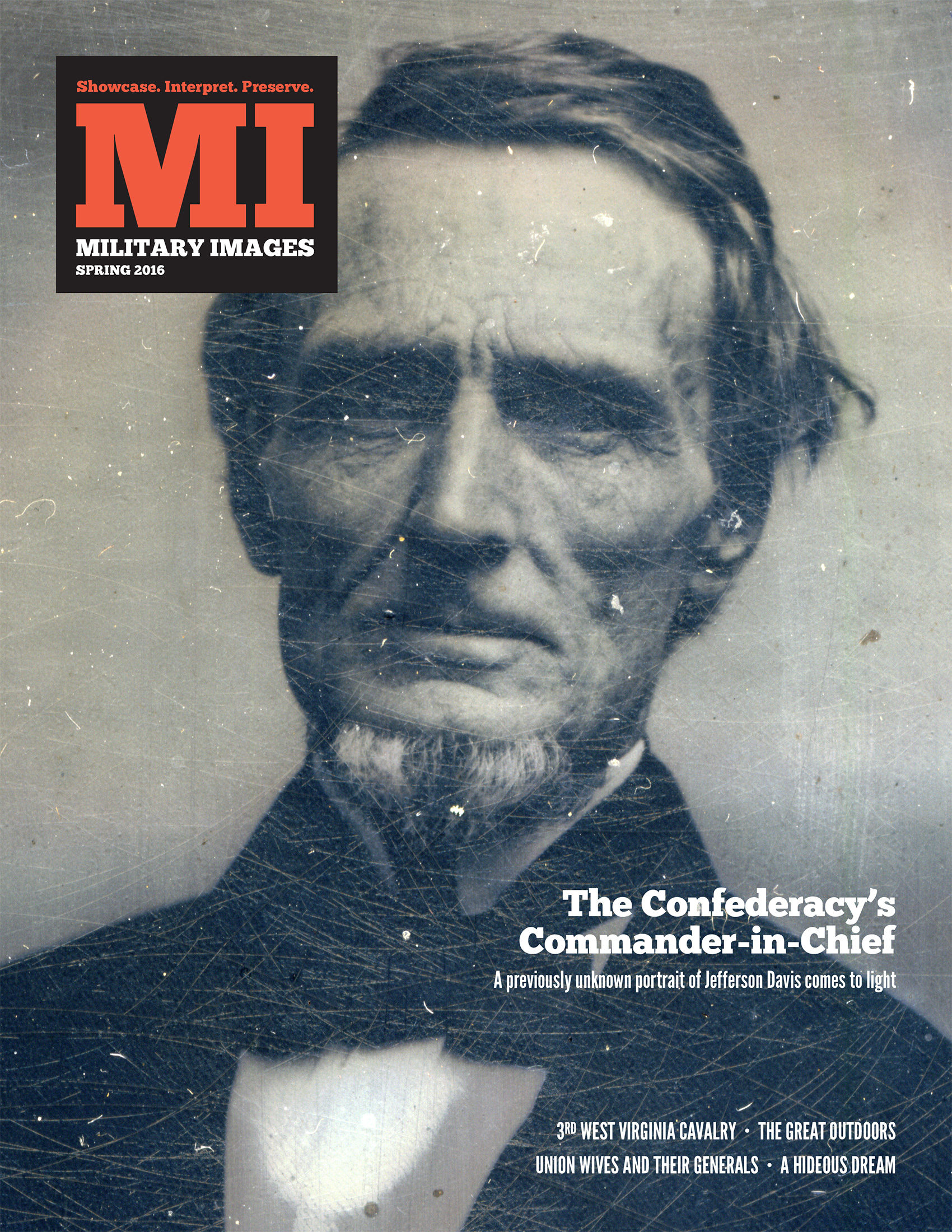
A previously unpublished quarter-plate tintype of Jefferson Davis attributed to photographer Jesse H. Whitehurst of Washington, D.C., from the collection of John O’Brien.
Download (free)

Table of Contents (p. 1)
Download (free)

Editor’s Desk (p. 2)
The editor notes that thousands of portrait photographs of soldiers and sailors have been published in the magazine since it was founded in 1979. Enlisted men from all walks of life and of all ranks compose the vast majority of images, though likenesses of nurses, vivandières and patriotic persons have graced our pages. In every case, each image and its associated narrative is a microhistory —a historical investigation on the individual level. They are windows that shed light on the larger themes of the American experience.
Download (free)

Mail Call (p. 3)
Feedback includes a misidentified Zouave, a Wisconsin infantryman, more on a local Civil War hero and efforts to honor his memory and a note about surcingles.
Download (free)

Passing in Review (p. 4)
Soldier stories are freshly mined nuggets of history in a new book by John Banks, Hidden History of Connecticut Union Soldiers (Arcadia Publishing). A longtime journalist and blogger, Banks maximizes his skill as a reporter and writer to tell representative stories of Connecticut Yankees. His compelling narratives better our appreciation of the human cost of war for soldiers and families.
Download (free)

On the Eve of War: Previously Unknown Portraits of Jefferson and Varina Davis Come to Light by John O’Brien (pp. 6-9)
Previously unpublished portraits capture future Confederate Commander-In-Chief Jefferson Davis and first lady Varina Howell Davis at a critical moment in history. The pair of quarter-plate tintypes, part of the John O’Brien, have an extraordinary provenance that traces to an unexpected source—U.S. Secretary of the Navy Gideon Welles.

The Absolute Truth of Photos by William C. Davis (p. 10)
A reflection on the Jefferson Davis tintype: “Today, we are the first Americans to see, for the first time, the weary and pained face of the man destined to lead a lost cause whose echoes reverberate still, and whose issues at root still trouble our society in the 21st century.”

On the Eve of a Crossroads by Joan E. Cashin (p. 11)
A reflection on the Davis tintypes with emphasis on the portrait of Varina Howell Davis: “They were both pro-slavery, believing that the Constitution protected the institution, but she did not share his growing hostility towards the North.”

Custer’s West Virginia Red Ties: The Life and Times of the 3rd West Virginia Cavalry by Richard A. Wolfe (pp. 12-17)
The history of the 3rd begins with a military company formed in the pro-Union western counties of Virginia and ends in the Shenandoah Valley fighting under the command of flamboyant Maj. Gen. George Armstrong Custer.

The Honored Few (p. 18)
Hilary Beyer, a second lieutenant in Company H of the 90th Pennsylvania Infantry, proved his courage in the infamous Cornfield at the Battle of Antietam. His actions resulted in the Medal of Honor.

The Great Outdoors: Civil War Soldiers at Work, Rest and Play by C. Paul Loane (pp. 20-30)
Images of soldiers pictured in camp, on campaign and other locations have always held a special interest for collector C. Paul Loane. “There is more going on than just the soldiers standing there,” Loane explains. “They are particularly helpful in seeing just what kind of environment the soldiers were in or what gear they really did use,” he observes.

Antebellum Warriors (p. 31)
A sixth-plate daguerreotype from the Ron Field collection pictures a man dressed in clothing that makes it difficult to discern whether he is a soldier or a civilian.

Held Hostage in Virginia: A Union Captain Becomes a Casualty in a Battle of Wits Between Jefferson Davis and John Pope by Scott Valentine (pp. 32-34)
Samuel Miller Quincy suffered a wound and fell into enemy hands after his 2nd Massachusetts Infantry was routed at the Battle of Cedar Mountain on Aug.9, 1862. He could not have known that he would be treated not as a prisoner of war, but as a hostage in a deadly game with no ground rules.

Union Wives and Their Generals by Tom Glass (pp. 35-43)
Nearly all the generals who served the North during the Civil War were married. Left behind at home, their wives cared for families, farms, businesses and relatives. A few accompanied their husbands into fields of action. Many generals seemed eager to have their betrothed with them as frequently as possible. And often, the wives of generals had greater access to headquarters than junior officers. A representative sample of portraits of these military couples.

“A Hideous Dream” by John Banks (pp. 44-46)
In an exclusive excerpt from Hidden History of Connecticut Union Soldiers by John Banks, a family is divided by two brothers, one who fought for the North and another for the South.

Stragglers (pp. 47-50)
A total of eight distinctive and unique images from MI contributors includes a full-plate ambrotype of a Louisiana officer, a sixth-plate tintype of a Chausser, a sixth-plate ambrotype of a federal infantryman with his pocket watch and a carte de visite of Harper’s Weekly illustrator Theodore R. Davis seated upon Lookout Mountain with a group of Union staff officers.

Photo Sleuth by Kurt Luther (pp. 52-54)
The gift of a soldier carte de visite with distinctive markings—red ink numbers in the lower left corner and brass clips at the top and bottom of the mount—is the starting point for the story of the Dead Letter Office, a special branch of the U.S. Post Office charged with solving undeliverable mail mysteries.

An Album of Ardent Patriots: Company B, 33rd Illinois Infantry by Jim Hennessey (pp. 56-57)
Untold numbers of albums filled with soldier photos are scattered across the country, and they have survived more than 150 years. Here are the stories of the men pictured in one of them.

Words Exchanged in an Ambulance by Ronald S. Coddington (pp. 58-60)
In the wake of fighting in Virginia during the spring campaign of 1864, two wounded soldiers shared an ambulance. A grizzled New Hampshire sergeant lay on one side and a young South Carolina private on the other. The two soldiers conversed and found common ground on the way to an uncertain future.

Uniforms & History by Michael J. McAfee (pp. 61-62)
Napoleon purportedly commented that an army travels on its stomach. If that was the case, the commissary officers keep it moving. Likewise, ordnance officers maintain the flow of weapons and ammunition, and inspectors make certain the men and their equipment are up to snuff and ready for action. The vital work of officers of both the General Staff and regimental staffs is often overlooked by the average Civil War buff. McAfee explores the variations of uniforms of these underappreciated staffers.

The Last Shot (p. 64)
Collector Gary Bart shares an unusual carte de visite of a New York man dressed in a dress and shawl. The image is dated June 11, 1865, about a month after Confederate President Jefferson Davis was captured wearing his wife’s overcoat.

Finding Aid: November/December 2004

The complete issue

Vol. XXVI, No. 3
(40 pages)


Print edition: Visit our store to check availability
Digital edition: Visit JSTOR.org to purchase
Subscribe to MI
Explore the MI Archives: Browse | Advanced search | Tutorial

Inside

Cover image
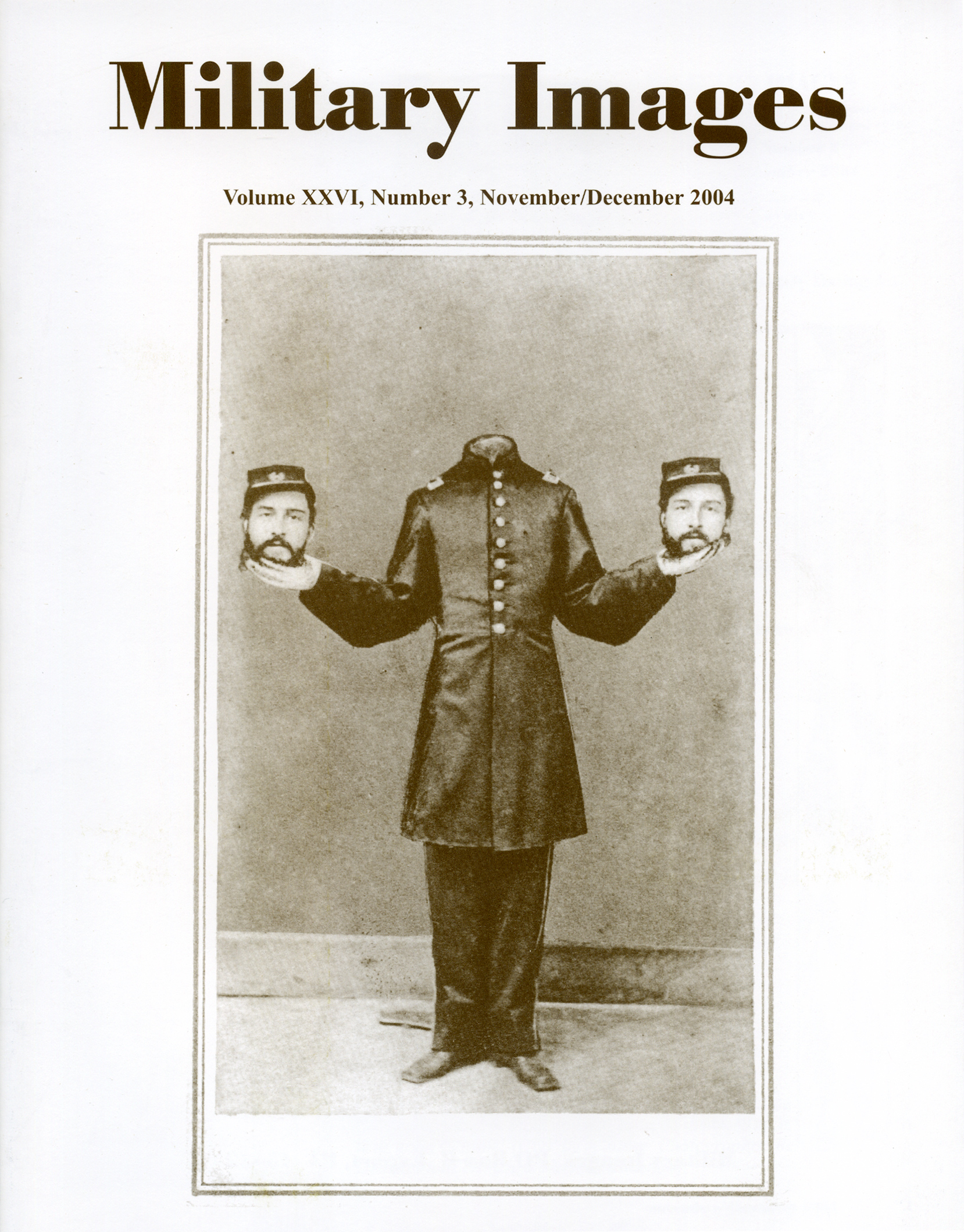
From the collection of Chris Nelson, an unusual unidentified trick photography carte de visite by J. Jones, Rendezvous of Distribution, Va.

Table of Contents (p. 1)

Editor’s Desk (p. 2)
The editor is gratified by the overwhelmingly positive response to the recent Georgia issue and notes that an Ohio-themed state issue will be featured next.

Passing in Review (pp. 4-5)
Two books are reviewed and both are recommended. Faces of the Civil War: An Album of Union Soldiers and Their Stories by Ronald S. Coddington offers “valuable insights into the experiences of seventy-seven Union ‘faces of war.’” Great Maps of the Civil War, Pivotal Battles and Campaigns Featuring 32 Removable Maps by William J. Miller is a “handsomely produced volume” that is well-researched and colorful.

The Flag of the 17th Texas Consolidated Cavalry by John Sickles (pp. 6-7)
A photograph taken at Lufkin, Texas, on Sept. 21, 1929, depicts the bullet and shell torn flag of the regiment held by two of its veterans, W.P. Fears and E.W.H. Parker. A one-page history of the 17th is included.

“Slow Trot” Thomas Between Wars: Accurately Dating an Antebellum Image by Gregory J.W. Urwin (pp. 8-11)
An 1853-1854 daguerreotype by Mathew B. Brady of future Civil War Gen. George Henry Thomas pictures the officer as a brevet major in the 3rd U.S. Artillery. A three-part narrative accompanies the image. “The Man” is a biographical sketch of Thomas from his beginnings in Virginia to his rise to fame as “The Rock of Chickamauga” and his post-war years. “The Image” is a physical description of the image and case. “Dating the Image” is a description of how the author, a professor of history at Temple University, concluded that the image was made by Brady in the 1853-1854 timeframe—a year earlier than the 1855 date given by the curator of photographs at the National Portrait Gallery in the late 1970s.

The 12th Kansas Infantry “Jayhawkers” by J. Dale West (pp. 12-17)
An album of 25 soldiers who served in the regiment includes 8 identified men: 1st Lt. William A. Welles of Company C, Capt. Nick L. Benter of Company C, Sgt. Maj. Clarkson Reynolds, 1st Lt. and Regimental Quartermaster Joshua Clayton, 2nd Lt. Samuel S. Kirkham of Company C, 1st Lt. William B. Nichols of Company C, Pct. Enos Ingle of Company D and Brig. Gen. John Edwards.

The Death of John Kent C.S.A. by Mahlon Nichols (p. 18)
A biographical sketch of Kent, a private in the 2nd Missouri Infantry, includes a touching obituary with his final words, “I die in a good cause; tell my friends good-bye.” The sketch is illustrated with a hard-plate image of Kent in civilian dress.

“Red,” The Story of Lt. James D. Bebout: Gridiron Star, All-American Hero by John W. Turner (pp. 19-21)
A standout football player at Penn State from 1910-1914, Bebout graduated with a degree in agriculture and went to work for the federal government. After war was declared against Germany during World War I, he joined the U.S. army as an officer and was assigned to Company D of the 318th Infantry of the 80th Division. In May 1918, Bebout sailed for France with his division. Four months later, on Sept. 29, he was killed during the fighting at Bethincourt. Included in the story is a 1919 letter written by Bebout’s friend and fellow officer, Capt. E.C. Shively. It describes Bebout’s death and other wartime reflections of the late Penn State star.

Contributions to the War Effort from Shrewsbury, New Jersey by Thomas J. Moeller (pp. 23-25)
The identities of the veterans pictured in a circa 1884 photograph of the members of Grand Army of the Republic Post 61 in Shrewsbury, N.J., are not known. The author however has a list of the names of all the membership, and notes that “their personal stories run the spectrum of New Jersey’s military service during the Civil War. Several stories follow, with wartime images of 2nd Lt. William Conover and 1st Lt. William H. Foster of the 14th New Jersey Infantry and Capt. Samuel Tucker Sleeper of the 11th New Jersey Infantry.

William Worth Belknap, Fallen Hero by Thomas Gaard (pp. 26-31)
Belknap, the author states, “is best known as the Secretary of War in the Grant Administration. He was charged with corruption, resigned his position and was impeached by the House of Representatives.” His fall from grace overshadows a distinguished war record that includes the Battle of Shiloh, during which he suffered a serious wound, and the campaigns of Vicksburg and Atlanta. Belknap’s story is illustrated with an early war albumen print of him as an officer in the 15th Iowa Infantry, an image of Belknap as a brigadier general with two orderlies, a group portrait of the general with his staff officers and other images.

Uniforms & History by Michael J. McAfee (pp. 32-33)
In the “165th New York Volunteer Infantry, 1862-1865, Second Duryea Zouaves,” McAfee recounts the history of the regiment and describes their distinctive uniforms. Three portraits are included, an unidentified private, 1st Lt. Gustavus F. Linquist and 2nd Lt. Charles Carville.

Stragglers (p. 34-38)
A total of 16 images are featured—Nine from the Civil War, one from about 1901, and six from World War I. Several of the latter portraits are identified. The identities of two of men in a group of nine generals in a circa 1918-1919 portrait are known: Benjamin Foulois, Chief of the Air Service, AEF, and Manus McCloskey, a field artillery brigade commander in the 77th Division. Other identified men included a Japanese-American Doughboy, Pvt. Hatsuko Kasagi, Pvt. Stephen Savko of the Medical Department of Base Hospital #80 and Pvt. Frank Berkavich.

Sutler’s Row (p. 39-40)

Finding Aid: May/June 2005

The complete issue

Vol. XXVI, No. 6
(40 pages)


Print edition: Visit our store to check availability
Digital edition: Visit JSTOR.org to purchase
Subscribe to MI
Explore the MI Archives: Browse | Advanced search | Tutorial

Inside

Cover image
Brig. Gen. George Armstrong Custer taken on or about Jan. 25, 1864, shortly before he returned to his home state of Michigan to marry Elizabeth Bacon. Albumen print from the John Beckendorf collection.

Table of Contents (p. 1)

Editor’s Desk (p. 2)
The editor summarizes features in this issue, and highlights upcoming plans for issues dedicated to Ohio and Alabama. A letter to the editor is also included.

Passing in Review (pp. 4-5)
Two books are reviewed and both are recommended. G.A. Custer, His Life and Times by Glenwood J. Swanson is “a must have book, a real thing of beauty, and on a scale of one to ten this reviewer gives it a ten and then some.” The Bloody Crucible Of Courage: Fighting Methods and Combat Experience in the Civil War by Brent Nosworthy is “chock full of great information and penetrating analysis.”

The CDV Album of Major Robert C. Wallace, 5th Michigan Cavalry by John Peter Beckendorf (pp. 6-20)
In this second part of the Wallace’s story, the author explains how he found the album and shares key details of the post-war years of Wallace (1844-1928). The introduction is illustrated by a carte de visite of Wallace in uniform from the Mike Hogle collection and an albumen print from the Terry Reilly collection of officers of the 5th at Stevensburg, Va., during the winter of 1863-1864. The personal carte de visite album is published in its entirety. It includes 18 wartime images—15 identified images and 3 unidentified. The named men are Capt. Benjamin Axtell, Maj. Crawley P. Dake, Capt. Horace W. Dodge, Capt. George Drake, Capt. George N. Dutcher, Capt. Hiram H. Hall, 2nd Lt. George H. Hill, Capt. Robert F. Judson, Capt. William T. Magoffin, Capt. David Oliphant, Maj. Stephen P. Purdy, Capt. William H. Rolls, Capt. Charles H. Safford and Acting Ensign Robert M. Wagstaff. Two postwar images are also included. The subject is Charles Y. Osburn, and officer in the 5th and a close friend of Maj. Wallace.

Daniel E. Bedford and the 12th Illinois Cavalry by John Robella (pp. 21-23)
Civil War soldier, army scout and Wild West performer, Bedford’s story reads more like a Hollywood movie script than a real life narrative. The story is illustrated with three portraits of Bedford (1846-1929) from the author’s collection: An early war tintype, a carte de visite taken shortly after the war, and a late life likeness.

Witness by Scott Valentine (pp. 24-26)
Capt. Zabdiel Boylston Adams of the 56th Massachusetts Infantry suffered a serious wound to his left leg and fell into enemy hands during the Battle of the Wilderness, Va., on May 6, 1864. Taken to a makeshift Confederate hospital, he was placed next to an unconscious Union brigadier general. The high-ranking officer was James Wadsworth, who had been mortally wounded in the head by a bullet. After Wadsworth died, Adams cut a lock of the general’s hair. He was eventually released and returned to Boston, where he presented the lock of hair to Wadsworth’s widow.

Arad Wilbar, 102nd Pennsylvania Infantry by Paul S. Johnson (p. 27)
The author recounts how he came to identify a carte de visite of an unnamed soldier published in a 1993 issue of Military Images. The soldier, Arad Wilbar, served in Company E the 102nd Pennsylvania Infantry. He survived wounds on two Virginia battlefield, at Fair Oaks in 1862 and the Wilderness in 1864, and lived until 1926.

Military and Patriotic Photographic Mats, Preservers, and Cases of the Civil War Period by Paul K. Berg (pp. 28-34)
A follow-up to the author’s first article in this subject in the January-February 1999 issue of Military Images, this survey is introduced with a brief history of hard plate photographs. The rest of the article is divided into sections for mats, preservers and cases, including examples and basic information.

Uniforms & History by Michael J. McAfee (pp. 35-36)
In “The Wearing of the Harp,” McAfee traces the Civil War use of Irish harp as an official insignia—or rather the lack of it—in images. He shares scant wartime and a post-war example of soldiers wearing the harp pin and concludes that they were a standard piece of military goods found in the store of the camp sutler.

The Confederate Soldier (p. 37)
A sixth-plate ambrotype from the Mike Medhurst collection pictures Sam Harris of the 9th Mississippi Infantry.

Stragglers (p. 38)
Three images are featured in this issue, including a late war image of an unidentified Union major or lieutenant colonel wearing a 15th Army Corps badge and a mourning ribbon, a group of soldiers in camp and an unidentified sergeant in Company E of the 14th Brooklyn Infantry.

Sutler’s Row (p. 39)

The Last Shot (p. 40)
An unidentified Union soldier holding a bottle of ‘Oh be joyful” in one hand and a mucket to drink it in the other is the subject of this sixth-plate tintype from the John Robella collection.

Finding Aid: July/August 1986

The complete issue

Vol. VIII, No. 1
(32 pages)


Print edition: Visit our store to check availability
Digital edition: Visit JSTOR.org to purchase
Subscribe to MI
Explore the MI Archives: Browse | Advanced search | Tutorial

Inside

Cover image
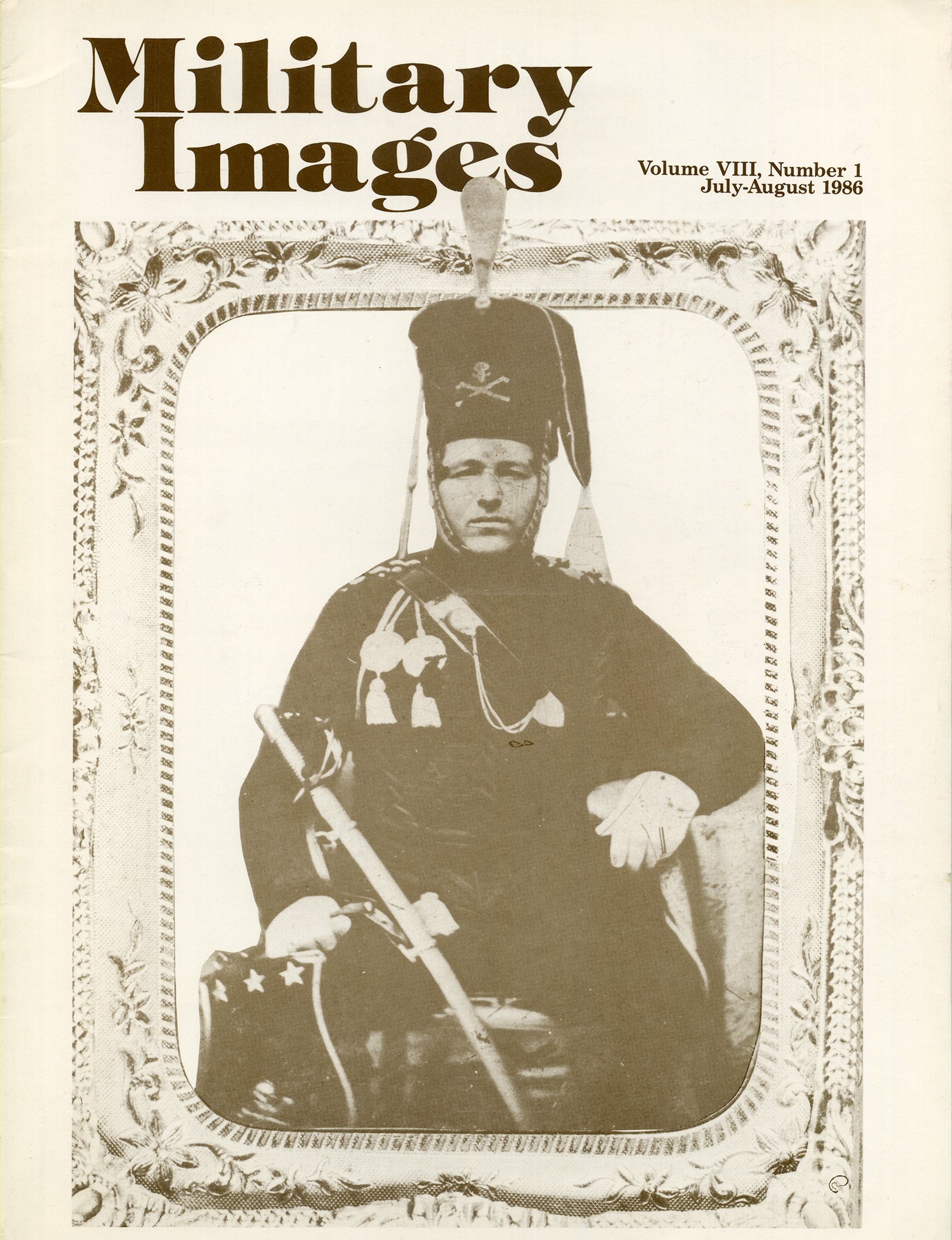
The cover of the current issue is an American hussar from about 1860, complete with the fur headgear with the death’s head insignia.

Editor’s Desk (p. 1)
The editor discusses the problem that the publication team had with saving and using back issues of Military Images. He writes with high praise for the work of Frank Jasek, who bound each volume into a hardcover set. The editor also discussed some of the upcoming features planned for future issues.

Mail Call (pp. 2-3)
A lengthy letter from a reader questions the identification of an individual in as Lt. David Raney, Confederate States Marines, providing a great deal of information to put the positive identification back into question. Another article disputes the assertion that the Colt revolving rifle saw limited and unpopular use during the war, using the history of the Michigan Cavalry Brigade as evidence.

Passing in Review (pp. 3-4)
Four volumes are presented for review in this issue of Military Images. First is Recollections of a Naval Officer by Captain William H. Parker, which is a quality reprint of the memoirs of a Confederate naval officer who had many memorable experiences; it is reprinted as part of the Classics in Naval Literature series. Next is Soldiers: A History of Men in Battle by John Keegan and Richard Holmes. The volume is a companion book to a British television series and devotes considerable space to discussions of the American Civil War and the lessons that were “too often ignored by professional soldiers in Europe.” Third is History of the First Delaware Volunteers by William P. Seville, another reprint of the original and only history of the unit written in 1884. Last is a review of an audiotape, Battlefields and Campfires, by the 97th Regimental String Band. Created by reenactors. The tape includes many of the songs of the era, played as they would have likely been played by soldiers of the Civil War.

The Darkroom (p. 5)
George Hart answers a question from a reader regarding the best way to repair damaged daguerreotype cases and how collectors store or clean their images. He responds with a list of products and suggested reading, and also explains that the means used by museums to control the environments of their collections are beyond the means of collectors. He describes how a pistol case can be used to protect images that are within cases and also cautions collectors to use “acid free” products that might come into contact with albumen images in particular.

Izzat a Chaplain or what?: Masonic Uniforms of the Civil War Period by Jacques Noel Jacobsen, Jr. (pp. 6-7)
A part of American history that goes back to before the Revolution, the fact that there were organized military lodges of Masons among both Union and Confederate soldiers should come as no surprise. The story is frequently told of captured or wounded Masons giving the sign of distress to their captors in order to receive protection while captured during the Civil War. What is more unusual is to see some of the Masonic badges and symbols from this era. The article includes six different images which describe the insignia, from the simple Masonic square and compass to the more elaborate insignia worn by Knights Templar and even a Master Mason. Two images from the post-Civil War era are also included.

Corps Badges of the Civil War, Part II: VI through X Corps by Wendell Lang (pp. 8-15)
The second of the series on the Corps badges worn by Federal soldiers begins with a short description of how the felt insignia were supposed to be worn, which was on the front or top of the cap, or the side of wide-brimmed hat. As seen by the images included in the article, the men had other ways of wearing their corps badges. Often purchasing more elaborate pins or even cockades, the men would also wear their badges with pride on their chest. One image shows a private of the 10th Vermont Infantry wearing the badges of both III and VI Corps, along with another shield-shaped badge, showing the movement of units between corps. The article shows thirteen soldiers wearing the VI Corps badge, a vertical Greek or Swiss cross, in a number of forms. There was no badge adopted for VII Corps (the Department of Arkansas) during the war, but a five-pointed star riding on a crescent was approved after the war was over and before the corps was disbanded; no photographic image is included. VIII Corps also had no official corps badge, but the men adopted the six-pointed star, as shown in the image included with the article. The badge for IX Corps was a badge shape with cannon and anchor imposed on it, reflecting the “amphibious operations” of this corps in North Carolina at the start of the war. The last badge presented in the article is for X Corps, a “square with an extended point at each corner” which represents the overhead view of a typical fort “with four bastions.”

The Militia of ’61: U.S. Army Uniforms of the Civil War, Part VIII by Michael J. McAfee (pp. 16-24)
Providing an overview of the history of militia in the United States, the author intends to show that there was no one “militia” in existence at the time of the Civil War. Tracing back to the “common” militia under which the different states could design their own militia system, the reader finds out that this system was in great decline by 1861. However, the “volunteer” militia, which were basically private clubs that were attached to the “common” militia. By the decade prior to the Civil War, states such as Massachusetts and New York tried to instill a regimental spirit by imposing uniforms, but this was largely unsuccessful, as the competitive nature of these groups prevailed. To make things more complicated for the collector, there were also units that had a military air to them, but were not actual militia units. They were more of a social club, many of which would perform as drill or marching societies. Militia uniforms could take three forms: “modern” units would wear variations of the 1851 U.S. Regular Army uniform; “traditional” units would wear the older type of uniform with high collars, tight sleeves, and tailed coats; “specialized” units would have more elaborate uniforms and could include hussars, Highlanders, and Zouaves. The twenty images that accompany the article, including one of Brig. Gen. Benjamin Butler of the Massachusetts Volunteer Militia in 1861, provide an excellent visual overview of the discussion.

“Up, Alabamians!”: The 4th Alabama Infantry at Manassas by Gregory Starbuck (pp. 25-29)
Eleven images of the men of the 4th Alabama illustrate the account of the first engagement that this unit underwent. Under the command of General Bernard Bee on Henry House Hill , the unit lost 40 killed and 170 wounded. The article recounts the stories of those who survived, such as Private Joe Angell who was knocked unconscious by a cannonball that hit his knapsack, and those who did not, like Colonel Egbert Jones who had undergone the embarrassment of a petition by his men because they had not seen enough action and wanted to redeem himself in battle. It also includes the story of two men who were not supposed to be there. Dr. Samuel Vaughn had been visiting relatives in the 4th when the unit moved out to Manassas from Winchester; he and his servant, James Jefferson (one of the few documented cases of a slave fighting for the Confederacy), accompanied the unit and fought with the regiment in this first frightening step into the Civil War.

Stragglers (p. 30)
Two images—a “before” and “after” pair—show the crew of a ship identified only by a banner in the second image with “O.Y.C.” The first image shows the crew cleaning up for their photograph, wearing undershirts and getting shaved, brushing hair and teeth, and generally in a relaxed mood. The second image shows the same crew with their banner and American flag, posing for their photograph in uniform and looking “shipshape.”

Back Image
1st Lt. James Young of Company K, 4th Alabama who was involved in the fighting of the 4th Alabama at First Manassas.

Finding Aid: May/June 1986

The complete issue

Vol. VII, No. 6
(32 pages)


Print edition: Visit our store to check availability
Digital edition: Visit JSTOR.org to purchase
Subscribe to MI
Explore the MI Archives: Browse | Advanced search | Tutorial

Inside

Cover image
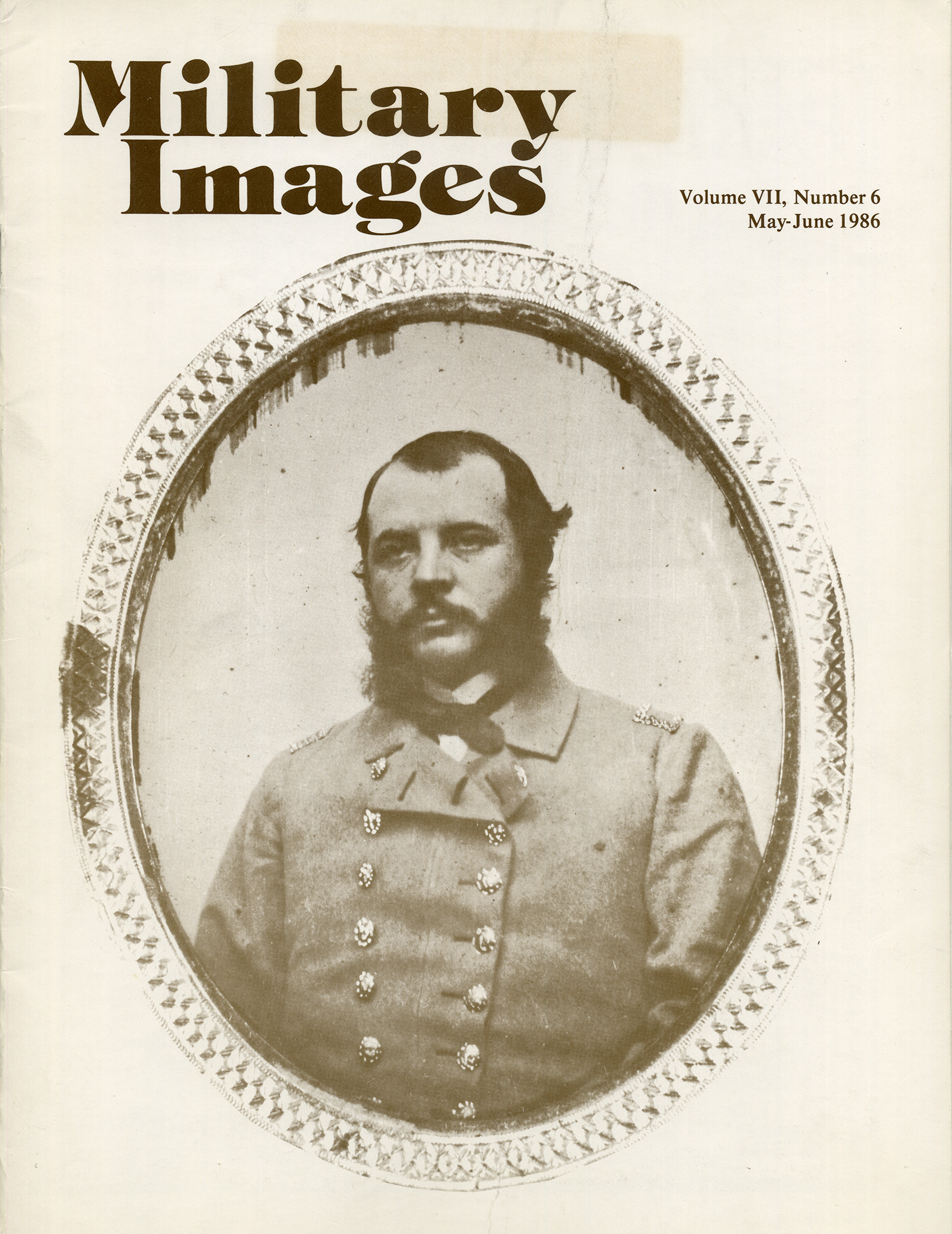
The oval image on the front cover is an unidentified Confederate who might be James D. Bulloch, who was in charge of the European shipbuilding program during the Civil War.

Editor’s Desk (p. 1)
The editor notes that an article in the current issue is topical based on continuing news from South Africa and Ireland. The upcoming 125th anniversary of the Battle of Bull Run will also be followed by Military Images; the editor provides a short overview of what readers can expect.

Mail Call (p. 2)
Letters to the editor include an explanation of label codes found on Military Images address labels and a clarification of the different cavalry regiments assigned to the U.S. Colored Troops are included. The editor also included a letter from William C. Davis which objected to the “Passing in Review” (March-April 1986) claim that persons other than the author selected the images for his work; the editor extended his apologies for the assertion and thanked Mr. Davis for his courtesy.

Passing in Review (p. 3)
Two publications are reviewed for the benefit of the readership in the issue. First is All for the Union edited by Robert Hunt Rhodes. Although subtitled to suggest it to be a history of the 2nd Rhode Island Volunteer Infantry, it is more a collection of diary entries, letters, and images from the collection of Elisha Hunt Rhodes, who served from 1861-1865. Second is Dear Friends at Home: The Letters and Diary of Thomas James Owen, Fiftieth New York Volunteer Regiment, During the Civil War edited by Dale E. Floyd. This volume does not come across as favorably as the first. It focuses mainly on a short period of time in 1864 from City Point during the siege of Petersburg, and does not provide much insight into the activities of the unit, but more on the political views of the author.

The 18th Louisiana Infantry: Acadians in Gray by Michael D. Jones (pp. 5-7)
This unit was much like other Confederate volunteers, but in one aspect they were very different. The men of the 18th Louisiana were French-speaking descendants of exiles sent out of Nova Scotia in 1755 as they refused to swear allegiance to the British king. The regiment represented the elite of Louisiana in the person of Colonel Alfred Mouton, who was a 1850 graduate of West Point and the son of a former Louisiana governor. It also represented the typical resident of the state: farmers, laborers, workmen from mostly the southern part of the state. The 18th Louisiana fought bravely at Shiloh, losing many at the Hornet’s Nest. They were sent then to the Trans-Mississippi Department, where they eventually took part in the Lafourche campaign and the Battle of Bayou Teche. While their last major battle was at Sabine Cross Roads, they remained together to become one of the last Confederate units to surrender in June 1865.

Pards: Photos of Friends, Partners, and Pals by Richard Carlile (pp. 8-13)
Twenty different images are presented of soldiers in the field or in the photographer’s studio. They were all comrades frequently displaying their arms, and all marking their Civil War friendships for posterity.

Chicago’s Wild Geese: Irish Volunteers in the Boer War by Kevin Young (pp. 14-15)
Some hatred die hard, and this article focuses on the continuing enmity felt by the Irish toward the British, this time taking the form of Irish-Americans who left Chicago to take up arms against the British in the Boer War in 1900. They fought with the deeply religious Boers, Protestants who looked upon the hard drinking and swearing Irish-Catholics from Chicago with some distain. However, the Boers needed fighters, and once the “Chicago Ambulance Corps” landed at Pretoria, they were handed guns under the leadership of John Y.F. Blake, a West Point graduate (1880) who had been in the 6th Cavalry and served, as had many of the Chicagoans, in the Spanish-American War. The Red Cross took away their flag and the American ambassador to South Africa protested, but the Chicagoans fought hard and provided rear guard support during Boer retreats. A monument to the first two casualties from the unit was erected in Mount Carmel Cemetery in Chicago to commemorate this group of Irish who took the fight to the British in South Africa.

Corps Badges of the Civil War, Part I: I, II, III, IV, V Corps by Wendell Lang (pp. 16-25)
This first of three articles about the Union corps badge begins with the story of how General Philip Kearny wanted to be able to identify “any of his officers who shirked or straggled” in the retreat across Virginia in the summer of 1862. He took his own red wool blanket and had his officers wear a red square for identification. After his death at the Battle of Chantilly on September 1, 1862, the men of his corps began to wear the badge as a memorial, gradually changing the shape until it was more of a diamond rather than a square. Joseph Hooker standardized this practice in March 1863. Today, our military wears identification patches to show their unit affiliation in an extension of this tradition. Twenty-six different images illustrate the different ways that the circle of I Corps, the trefoil (shamrock) of II Corps, the diamond of III Corps, the triangle of IV Corps, and the Maltese cross of V Corps. The insignia were often felt and sewn to soldiers’ kepis or worn on their uniform coats. Others were manufactured with bullion edging or made out of brass and attached with pin backs. The article shows the wide variety of corps badges and the many ways in which they were worn.

Stragglers (p. 25)
A soldier from Company H, 7th Pennsylvania Emergency Militia, a unit called up for the Battle of Antietam is the only image featured.

Whitfield’s Cavalry: A Texas-Arkansas Battalion in the Western Confederacy by Barry Mickey (pp. 27-29)
After routing Federal forces at Wilson’s Creek in August of 1861, commanding General Ben McCollough was in a hard place. His troops were from Arkansas and had not enlisted in the Confederate army, but had enlisted to serve in Missouri as state troopers. Only 18 of the men who fought at Wilson’s Creek decided to enlist as CSA soldiers. One small unit, Murphy’s Company of Arkansas Cavalry, was mustered in October 1861 and eventually merged with John W. Whitfield’s “Whitfield Rifles” from Texas and two other Texas companies to become the 4th Battalion, Texas Cavalry with Major Whitfield commanding. They fought against Union-supporting Indians and fought at Pea Ridge, before being reorganized as Whitfield’s Legion with the addition of seven more companies from Texas and one from Arkansas. Under the command of General Van Dorn this dismounted unit was sent to assist in Western Tennessee after Shiloh when the unit was again reorganized. This time, the Arkansans were grouped together and detached as Company H of the 1st Battalion Arkansas Cavalry. Both the Texas and Arkansas units saw extensive service, with the Arkansas fighting in pivotal engagements such as Vicksburg and the Texans fighting in the Battle of Iuka and the raid at Holly Springs, both in Mississippi.

Back Image
A cavalry trooper astride his mount graces the back cover.