Finding Aid: July/Aug. 1982

1982-v4-01-iv-cover

The complete issue

Vol. 4, No. 1
(32 pages)

Print edition: Visit our store to check availability
Digital edition: Visit JSTOR.org to purchase
Subscribe to MI
Explore the MI Archives: Browse | Advanced search | Tutorial

Inside

Cover Image
The magazine cover shows an extremely rare 1898 image of three Spanish infantrymen in Cuba, with Mausers from 1893.

Editor’s Corner (inside front cover)
The editor explains the reason for featuring non-American military on the cover of the current issue. Due to its rarity and the fact that they were adversaries to American soldiers in the Spanish-American War, the editor felt it was a significant image and should grace the cover. The editor also announces a special drawing for another rare item: the premier issue of Military Images. Readers can submit the survey form on page 31 to enter a raffle to win a copy of the out-of-print issue, or an extension of their subscription by one year.

Mail Call (p. 2)
The readership provides clarification on the identification of a Tennessee Confederate officer, further information about the Lincoln family of Virginia, complaints (too many Yanks, not enough trans-Mississippi Yanks), and a reader who finds out that he most likely did see General Charles King when he was a child at a parade in Milwaukee in 1931. A request for information about the uniform worn by the 23rd Illinois (“Mulligan’s Chicago Irish Brigade”) was also made.

Passing in Review (p. 3, 5)
Three different publications are reviewed in this issue, beginning with Quartered in Hell: The Story of the American North Russian Expeditionary Force, 1918-1919 by Dennis Gordon. Told in the words of the men who were part of this campaign against the Bolsheviks after the end of World War One, the book provides insight into a little-known part of American military history. Next is The Guns of ’62, volume II of The Images of War: 1861-1865, edited by William C. Davis. With three errors noted in the review, the book was found to be a worthy text with some rare photographs included. Finally, a lengthy review of Attack and Die: Civil War Military Tactics and the Southern Heritage by Grady McWhiney and Perry D. Jamieson. The thesis of the work is that the South lost in the Civil War due to their tactics, which favored the offensive and was a reflection of the Scots-Irish heritage and culture that predominated in the South. While the reviewer disagreed with this assessment (and provided rationale for this disagreement), the book was still thought to be a very worthwhile and thought-provoking read.

Babes in Arms: A Photo Survey of Children in Patriotic Attire by Carol Villa (pp. 6-11)
Collected from reader submissions, the article is a pictorial featuring 23 different images of children wearing attire ranging from an antebellum sheriff with his four siblings to would-be Zouaves to a doctor and nurse wearing appropriate World War One outfits. One image may be of a member of a Baltimore Zouave unit made up of boys from age 9 to 14, while others are patriotic Yankee toddlers or little loyal Southern belles. Spanish-American War uniforms include a few soldiers and a sailor, while the siblings (boy and girl) wearing Indian garb and both holding different types of BB guns in a cabinet photo showed how they were interpreted at the start of the 20th century. The makes of the different air rifles and BB guns are also indicated, providing additional interest.

“Lee broke today…” by Alan J. Sessarego (pp. 12-13)
The author describes a recent find of his in an antique store, where he came across a pocket diary belonging to an employee of Alexander Gardner. John L. Cameron’s diary was purchased on December 30, 1865 and the entries ended in April 1866. Although not much is known about Cameron, it is known that he worked as a printer and grader of glass in the Gardner studio… and that a negative of General Robert E. Lee broke while he was grading it on March 28.

Three Rebs and Three Yanks by Thomas P. Sweeney and Robert J. Willey (pp. 14-15)
Thomas Sweeney provides information on two images that show all three of the Duval sons of Missouri, all three which would be killed in action while serving the Confederacy in the Missouri State Guard and then the 3rd Missouri Infantry. Both Henderson and Thomas would be killed at Champion’s Hill in 1863, while Lt. William Duval was killed at Corinth in 1862. Robert Willey provide the same for three Indiana friends who had to go north into Michigan to find a unit that would enlist all three. Andrew Kingsley was the first of the three to leave Company C of the 4th Michigan Infantry, being discharged for disability in a few months before Frank Spelman was killed at White Oak Swamp in 1862; the letter informing his father of this death was included with the article. Only Eugene Vaughn survived of the three, mustering out with the end of his enlistment in June 1964.

Pennsylvanians in Gray: Early Civil War Uniforms in the Keystone State by Michael J. Winey (pp. 16-23)
Sixteen different images detail the discussion regarding the different Pennsylvania units that began the Civil War wearing gray rather than blue. Sometimes it was due to the militia uniform that the men wore and sometimes it was due to the sheer volume of recruits and the more expensive blue dye needed to produce blue uniforms, but many Pennsylvanians went to war wearing a hue that was associated with the Confederates they were fighting. The article discusses the existence of swatch books, which show the colors used in uniform production until a standard Federal uniform could be provided. One very interesting pair of photographs shows a soldier and his family at Camp Slocum in Virginia, with soldiers in the background also wearing the same lighter colored uniform. The article provides a great deal of detail, outlining the various reasons for Pennsylvanians in gray, making the case for collectors to look closely and research their images.

Gettysburg Mystery Photo: A Second Look by Lawrence G. Bixley (pp. 24-25)
In a follow-up article to one printed in the March-April 1982 issue of Military Images, the author is able to provide additional detail regarding each of the two main questions that remained from the investigation of the Gutekunst image. Firstly, the tent in the original article is established as the embalming tent of Dr. Thomas Holmes, as it was identified as such in a Mathew Brady image. The question that arose from this second image, which is assumed to be a later image, is why the tent was moved a short distance from where it was in the Gutekunst image. Secondly, the author of the current article provides a definitive image of Marie “French Mary” Tepe, which shows her wearing the Kearny Cross which she was awarded for bravery shown during the Battle of Fredericksburg. With the veracity of that part of the previous article answered, the question of the details surrounding her two marriages are addressed. Her first husband did not die in her arms at Gettysburg, but was taken prisoner on the first day, eventually spending six months in a Confederate prison. The question of her second husband is still not resolved.

Stragglers (pp. 26-29)
The submissions by the readers include two World War One machine gunners of the 322nd Machine Gun Battalion, 86th Division aiming at the camera in 1917, Marines relaxing under the shadow of a tent fly among the headstones of fallen comrades in Cuba in 1898, and a very rare 1861 tintype image of the Main Plaza in San Antonio, Texas in 1861 as Federal military gather to leave after their surrender by General David Twigg in February of that year.

Back Image
The back image is of a very small “Confederate” standing at attention in a sixth-plate tintype.

Finding Aid: May/June 1982

1982-v3-06-iii-cover

The complete issue

Vol. 3, No. 6
(32 pages)

Print edition: Visit our store to check availability
Digital edition: Visit JSTOR.org to purchase
Subscribe to MI
Explore the MI Archives: Browse | Advanced search | Tutorial

Inside

Cover Image
This issue features an enlargement of a carte de visite image of what appears to be the formation of an infantry company during the Civil War.

Editor’s “Corner” (inside front cover)
Due to an increase in the amount of advertising in the current issue, the editor is limited to just a small space, where he announces a change to a higher gloss paper, the increase of subscribers, and that there are subscribers in all states and ten foreign countries.

Mail Call (p. 2)
Readers provide clarification on two issues: the identification of a Coast Artillery Reserve badge in use between 1910 and 1917 and the manufacture of Pennsylvania battle flags during the Civil War.

Company D, 4th Texas Cavalry: A look at the “Ellis County Bengal Tigers” by Danny Sessums (p. 3)
The photograph presented by the author was made in either late 1863 or early 1864, and shows the recruitment effort for a trans-Mississippi company of the Arizona Brigade, 4th Texas Cavalry. The article describes the uniforms, weaponry, and accoutrements used by the men in the image. The value of this rare image, as stated by the author, is that it challenges the belief that trans-Mississippi units were not well-armed.

Battle at Bacalod: Action in the Philippine Islands, 1903 by George M. Cress (pp. 4-7)
Six pictures taken by the unit chaplain illustrate the challenges facing Captain John J. “Black Jack” Pershing and his 15th Cavalry soldiers during their fighting at the fortress outside Bacalod on the island of Mindanao. Complete with moats, parapets, and walls as thick as they were tall, the Americans were fighting Moro guerillas who were challenging U.S. occupation. The article also includes images of Hospital Steward Charles Lincoln Leonard, his military awards and insignia, and a portrait of him in a St. Louis Fire Department uniform when he returned from his service in 1905.

Samuel Dana Greene, U.S.N.: Executive Officer of the Monitor by Charles S. Schwartz (pp. 8-9)
With a lineage of military and public service behind him, including Nathaniel Greene of the American Revolution, Samuel Dana Greene was the second in command of the Monitor during her famed battle against C.S.S. Virginia in the Civil War. He directed each shot fired by the Monitor and when the machinery failed during the fighting, he personally directed the positioning of the turret by hand when the mechanism broke. Taking command of the vessel when the commander was injured, the erroneous perception, outlined in the article, that Greene retreated from the fight dogged him for years. One may assume that this unrelenting criticism led to his suicide at the age of 44 in 1884.

U.S. Army Uniforms of the Civil War, Part IV: The Jacket by Michael J. McAfee (pp. 10-15)
This pictorial article provides the background of the military jacket as worn by Federal enlisted soldiers. Originally beginning with the shell jacket, which was to end at the natural waistline of the soldier, the jacket was adapted to the “uniform” jacket, which extended a few inches lower, generally below the beltline. Often discussed interchangeably, there are distinctions, and as the 16 images provided in the article show, there were also many variations. Some were for specific reasons, such as to accommodate the wearing of a saber belt, but others were personalized and still others were very unusual.

Johnny Came Marching Home: Recollections of Company E. 3rd Army Composite Regiment by Merwin Silverthorn and John A. Stacey (pp. 16-19)
Based on interviews with Lt.Gen. Silverthorn, U.S.M.C., Ret. along with his personal papers and photographs, the author describes the experience of the unit, which was designed to serve as a ceremonial unit and honor guard for General John J. Pershing, Commander of the American Expeditionary Forces, at the end of World War One. The article describes the process and training of the company, of which 1Lt. Silverthorn was deputy officer. The photographs include a panoramic image of the company with an enlargement of the commanders, images from a few of the celebratory parades in which the regiment took part, and some of the enlisted men of Company E.

Passing in Review (p. 20)
The first of three reviews in this issue of Military Images is entitled Regimental Strengths at Gettysburg by John W. Busey and Dr. David Martin. This limited edition of 1000 copies attempts to fine-tune the strengths of both the Federal and Confederate armies that met at Gettysburg. The second publication is E.M. Collar Insignia, 1907-1926 by L. Albert Scipio II, which provides the history, specifications, and other information regarding the collar disks worn by Army personnel in a highly organized format. The final review is of If the South Won Gettysburg by Mark Nesbit. While the first part of the book recounts the facts up to July 2, the second half looks at “what if” Robert E. Lee had followed James Longstreet’s suggestion.

Memoirs of a Rebel, Part II: Chancellorsville and Gettysburg by John Calvin Gorman (pp. 21-25)
Edited by a descendant, the memoirs of Captain John Calvin Gorman of Company B, 2nd North Carolina Regiment follow him through the Battle of Chancellorsville as well as the three days at Gettysburg. The first story is a humorous tale about how two Southern women across a river gave Gorman a clue that the Yankees were going to be crossing soon, which they did the next day. Becoming more serious, the reader gets a sense of what it was like to be part of Jackson’s flanking maneuver that Chancellorsville is known for. Gorman recounts Jackson’s wounding and then is present to receive the congratulations from Jeb Stuart, who took command the next day. The next part of the memoir recounts moving up towards Pennsylvania and how the Confederates were greeted by liberated Southerners and by Union supporters when they got to Martinsburg. Very telling is Gorman’s reflections on the situation at the end of the first day at Gettysburg, which he says would not have ended as it did had “Old Jack” still been with them. He and his men heard the sounds of preparation during the night, and awoke to face the gathered Union Army that had previously been in retreat. He describes the second and third day, and preparations for a moonlight attack which never took place.

Portrait of a General: John Newton by James F. Neel (p. 27)
A cabinet photograph copy of the original carte de visite image taken after his promotion to brigadier at the end of March, 1863, the previously unpublished portrait of John Newton accompanies this biographic article. Newton was known for having accompanied his brigade commander John Cochrane and gone to both Secretary of War Seward and President Abraham Lincoln to remove Ambrose Burnside from command after the disaster at Fredericksburg. After the first day at Gettysburg, Newton was selected to replace fallen General John Reynolds as the commander of I Corps until 1864 and his corps was reorganized out of existence. After the Civil War, Newton returned to his original role as an Army engineer, eventually becoming the commander of the Corps of Engineers. Upon retirement, he was elected the president of the Panama Railroad Company.

Stragglers (pp. 28-31)
This edition of stragglers features several individual images of soldiers with unusual insignia that require identification, and hopes that the readership can provide enlightenment. Also included is a carte de visite outdoor image of Yankees crowded outside of a photographer’s studio, with samples of his work hanging on the walls outside. A large image of a Pawnee chief taken in Mathew Brady’s studio about 1885 completes the reader submissions.

Finding Aid: January/February 1997

The complete issue

Vol. XVIII, No. 4
(40 pages)

Print edition: Visit our store to check availability
Digital edition: Visit JSTOR.org to purchase
Subscribe to MI
Explore the MI Archives: Browse | Advanced search | Tutorial

Inside

Cover image
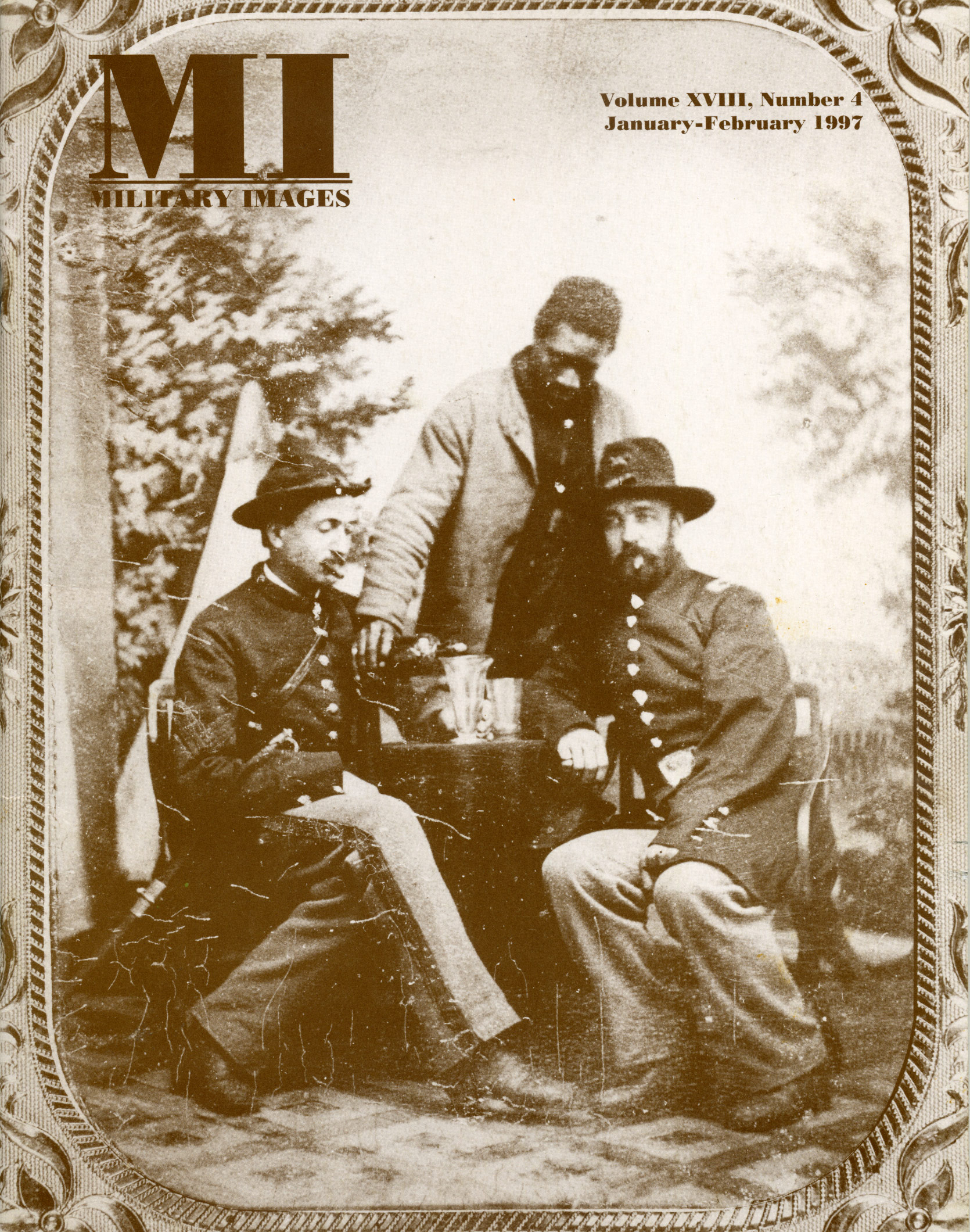
A sixth-plate tintype from the Coby Mack Collection pictures three Yank tipplers at the officers’ mess enjoying a break from endless rounds of drill.

Editor’s Desk (p. 3)
The editor notes work on the Irish Brigade monument at Antietam, Ron Tunison’s medallion bust of Gen. Meagher and new mailing software.

Mail Call (p. 5)
Letters include feedback about hospitals, glass plate negatives, postal issues and “Uncommon Cavalrymen.”

Passing in Review (pp. 6-7)
Five publications are mentioned, including American Civil War Confederate Army (Brassey’s Inc.) by Ron Field, Bentonville: The Final Battle of Sherman and Johnston (University of North Carolina Press) by Nathaniel Cheairs Hughes, Jr., The Alabama and the Kearsarge: The Sailor’s Civil War (University of North Carolina Press) by William Marvel, Photographer Under Fire: The Story of George S. Cook (Historical Resources Press) by Jack C. Ramsay, Jr. and Civil War Firearms (Combined Books) by Joseph G. Bilby.

The Philadelphia National Guards: Antebellum company of uniformed militia by James Durkin (pp. 8-9)
A brief history of the militia company that became a regiment that mustered into federal service during the Civil War as the 19th Pennsylvania Infantry is illustrated with portraits of John T. Durang before and during the war. He was seriously wounded at Gettysburg.

A Search Through Time: Charles Mitchell, Kentucky Confederate soldier by Richard Staley (pp. 10-11)
The author relates his experience on the research trail, hunting for information about a soldier identified in a portrait photograph as Charles B. Mitchell.

“Shell Fever” & Other Zouaves: An album of U.S. troops in baggy trousers by Brian Pohanka, et al (pp.12-17)
A survey of 20 portraits from the collections of our readers highlights the wide variety of Zouave-inspired fashions worn by soldiers as late as 1910.

Uniforms & History by Michael J. McAfee (pp. 18, 35)
In “8th Regiment, Massachusetts Volunteer Militia,” McAfee explores the history and uniforms of this hybrid Zouave regiment. The text is illustrated with a portrait of an enlisted man from the regiment.

George Henry Stevens, Orderly Sergeant, Company B, Milwaukee Light Guard: Winner of Milwaukee’s antebellum drill competition by Alan D. Gaff (p. 19)
A description of how Stevens won the competition is also a lesson in drills of the antebellum period. Stevens went on to fight in the Civil War with the 2nd Wisconsin Infantry and suffered a mortal wound in the fighting at McPherson’s Woods at Gettysburg.

Harpers Ferry to Peking: Journeys of a 19th century soldier, Augustus Corliss by Chris Nelson (pp. 20-30)
The story of “Augie” Corliss spans from 1861 to 1904 and includes numerous anecdotes and life details. The text is illustrated with ten photographs and artworks of Corliss, and images of his cap, coat, revolver and a post-Civil War badge.

The Frozen Prairie: Winter tragedies in Minnesota by Roger Norland (pp. 31-32)
A well-known portrait of Benjamin Franklin of the 2nd Minnesota Cavalry illustrates a story of how he came to lose his legs to frostbite. Also included is an image of Franklin before he lost his legs.

Light & Shadow by Sam Tucibat and Scott Cross (p. 33)
In “The Wet Plate Process Enters the Computer Age,” the authors explain how photos can be retouched using a powerful application by Adobe called “Photoshop.”

The Auction Block (p. 34)
Latest auction news.

Captain Bob’s Caveat Emptorium (p.35)
The Captain tries to pull a fast one over readers with an almost genuine Zouave image.

Stragglers (pp. 36-37)
Solo photos of the odd and unusual from the collections of our readers includes nine Confederate portraits.

Sutler’s Row (pp. 38-40)

Back cover
A sixth-plate tintype from the Michael Albanese Collection pictures a soldier posing with a mug, an apple on a tin plate, and an unknown morsel on the end of his fork.

Finding Aid: March/April 1982

1982-v3-05-iii-cover

The complete issue

Vol. 3, No. 5
(32 pages)

Print edition: Visit our store to check availability
Digital edition: Visit JSTOR.org to purchase
Subscribe to MI
Explore the MI Archives: Browse | Advanced search | Tutorial

Inside

Cover Image
The cover features a “dandy” sixth-plate tintype of a fully armed George Maddox, chief scout for Quantrill’s raiders.

Editor’s Page (inside front cover)
The editor introduces a new feature – “The Bulletin Board” – where events that relate to the study of American military history of any era can be listed. The current issue has a number of Confederate articles, the result of a call for more articles of this type. The editor also highlights upcoming issues that readers can look forward to.

Mail Call (pp. 2-3)
A few corrections are made, suggestions for future articles are put forward, and a cautionary tale about knowing one’s memorabilia is offered. The passing of George E. Gorman III is also noted.

Passing in Review (p. 3, 27)
Uniforms of the Continental Army by Philip Katcher is the first review in this issue of Military Images, and is hailed as the new authority on the uniforms worn by the American army and navy of the Revolutionary War era. The next review is of Bushwhackers of the Border: the Civil War Period in Western Missouri by Patrick Brophy, which provides insight into the complex nature of this area and its history. Lastly, Infantry Regiments of the U.S. Army by James Sawicki is reviewed. While it is considered to be a very comprehensive and detailed work, Civil War readers are cautioned that many volunteer regiments are not included unless they had links to units continuing into the 20th century.

Santa Cruz, 1885 by J. Phillip Langellier (pp. 4-8)
Complete with nine images that present insight into this festive encampment, the article describes the first all-state encampment of the California National Guard between August 15 and 23, 1885. Santa Cruz was chosen as a location that was pleasant and easy to reach from across the state, and each company was given funding for 35 attendees, although more could attend if they could manage the expense on their own. The article provides ample detail on uniforms, weaponry, and activities, as well as highlighting the objection of the inspecting regular Army officer to the late nights and the Chinese lanterns that (in his opinion) diminished the martial nature of the event. The images reveal that not very many of the guardsmen objected.

A Confederate Lincoln by Dale S. Snair (p. 9)
It is common knowledge that relatives of Abraham Lincoln’s wife, Mary Todd Lincoln, chose to fight with the South during the Civil War, but it is not as well-known that Abraham Lincoln himself had extended family that resided in Virginia. In a short biographical article accompanied by an image of Benjamin Franklin Lincoln, the reader learns about how a second cousin of the American President became a member of Company H, 10th Virginia Cavalry, riding under Jeb Stuart. Returning to his home at Lacey Spring at some point in 1864, Private Lincoln died of illness or wounds in November of that year.

Eye of the Collector by Kean Wilcox (pp. 10-15)
The author presents 19 images from his collection of photographic images. Wilcox explains that there was no real rhyme or reason behind his purchases, except that he liked them. Many are in cases and as he recently noticed, many are of military men. The current selections have some sort of unique aspect to them, like the quarter-plate ambrotype of an American militiaman wearing a large bearskin busby reminiscent of British, several images of very young Confederates, and one very sharp image of a Federal soldier in which one can see the reflection of the camera in his eyes. The final image is the author’s favorite: a full-plate ambrotype of an outdoor scene at a military academy. Three smaller details are included in close-up and show one tiny guidon bearer, women watching the review from the roof of the building, and one of the cadets or militiamen in the ranks. The image provides one small snapshot of life at the time with plenty of detail for readers of MI to enjoy.

Gettysburg Mystery Photo by William Gladstone (pp. 16-19)
The author shares his acquisition of a well-known Gettysburg image, positively identifying not only the place it was taken, but establishing the true identity of the photographer. Taken “Looking East from Cemetery Hill” by Frederick Gutekunst of Philadelphia, a more modern attempt to look at the details of the image by using current enlarging equipment available to him, the author finds two revealing things that provide some answers, but bring up even more questions. First, the tent in the image is an embalming tent of an unidentified “surgeon” using “Holmes’s Process.” Is this the tent of Thomas Holmes, who perfected the practice of chemical embalming, or the tent of another embalmer who used his process? Secondly, the person in the middle of the image who is leaning against a fence post, is not a conventional soldier, but a woman dressed in a Zouave uniform, a vivandiere who often accompanied and worked with a unit. The author found that this was not just any vivandiere either, but the well-known Marie “French Mary” Tepe who saw distinguished service with the 114th Pennsylvania Infantry. This led to many questions about Mary’s past and what she might have been doing at that location, where her supposed first husband served with the 27th Pennsylvania. The transcript of a newspaper article announcing her intended divorce from her second husband in 1897 accompanies the article “She Feared Not War” from the New York Sunday World, and provides some (questionable) insight into Mary’s military adventures.

Fighting Confederates: A statistical analysis of late-war uniforms by Philip Katcher (pp. 20-23)
By using nine group images of Confederate soldiers, some of which are included with the article, as well as a number of individual portraits selected from a wide variety of publications, the author conducted a statistical analysis of what the “typical” Confederate soldier would wear. After a discussion of the many sampling errors inherent in a study of this nature such a long time after the occurrence and attempts to correct or adjust for some of them, the author was able to determine a statistical average for hats, packs, coats, and belt plates, thereby allowing a much richer picture of what attire a Confederate soldier would have worn to emerge.

General Charles King by Paul L. Hedren (pp. 24-26)
Beginning with a brief biographical background about the “author-soldier” who served during five wars over a 70 year military career, the MI reader then learns about the literary contributions of Charles King. Beginning in 1880, King wrote fiction, histories, and articles set in the military contexts with which he was intimately familiar for reading audiences which appreciated his ability to bring distant scenes to life for them. The article provides photographs of King at the beginning and end of his military career, a group image with the 5th Cavalry in the Black Hills of Dakota Territory, and two illustrations. One depicts an event in his career while the other is a political cartoon critiquing his combining of pen with command during the Spanish-American War.

Stragglers (pp. 28-31)
Contributions from readers include a member of the Coast Guard with unusual uniform items such as cavalry boots, a rare image of a group image from 1898 that includes an NCO holding both the Heavy Artillery First Class Gunner’s Badge and a cat, a previously unpublished cabinet card of George A. Custer in dress uniform from about 1874, and also a few images that request further information from the readership.

Back Cover
This issue features a group image of Yankees settling down with a picnic basket in an imperial size image, probably taken of Butler’s Army of the James.

Finding Aid: Jan./Feb. 1982

1982-v3-04-iii-cover

The complete issue

Vol. 3, No. 4
(32 pages)

Print edition: Visit our store to check availability
Digital edition: Visit JSTOR.org to purchase
Subscribe to MI
Explore the MI Archives: Browse | Advanced search | Tutorial

Inside

Cover Image
An unidentified New York corporal holding hands with a lady who is probably his wife graces the cover of this issue.

Editor’s Page (inside front cover)
Responding to reader requests for images of the women of the Civil War, the editor explains that the regular “Stragglers” feature is replaced in this issue by a pictorial focusing on the women the soldiers left behind.

Mail Call (p. 2)
The editor responds to letters from readers, who submitted clarifications, corrections, suggestions for articles, and requests for information from the readership.

Passing in Review (p. 3)
The first publication reviewed is Military Uniforms in Canada, 1665-1970 by Jack L. Summers and Rene Chartrand. Consisting of quarto-sized plates to provide images of French, British, and Canadian uniforms, the review feels this would be a very helpful work in identification of uniforms often confused with American militia or Confederate soldiers. The second review is of Gallant Fourteenth: the Story of an Indiana Civil War Regiment by Nancy Niblack Baxter. The author drew from primary source documents such as diaries and letters to compose a regimental history with descriptions of the individuals and battles along with a collection of images. Finally, the book The Hardtack Regiment: an Illustrated History of the 154th Regiment, New York State Infantry Volunteers by Mark H. Dunkelman and Michael J. Winey is reviewed. The volume includes several images of members of the regiment, complete with biographies.

John Hartranft, Defender of the Union by Harry Roach (pp. 4-9)
A little known commander from Pennsylvania, Col. John Frederick Hartranft was often involved in some of the major campaigns of the Civil War. After his 90-day militia regiment left the day before the fighting at First Bull Run (their enlistment had expired), Nartranft remained and fought with valor, eventually receiving the Medal of Honor for his rallying of two Massachusetts regiments at the end of the action. He returned to Pennsylvania and raised the 51st Pennsylvania Infantry, which was often linked with the careers of Edward Ferrero and Ambrose Burnside. Despite being a teetotaler, Hartranft led his hard-drinking 51st at New Bern, during the last push at “Burnside’s Bridge” at Antietam, at Fredericksburg, Chattanooga, and several other campaigns, often without due recognition. He was hailed as the “Hero of Fort Stedman” at the end of the war, culminating his career as Brevet Major General.

Images of the 51st Pennsylvania Infantry (pp. 10-13)
A collection of 19 images of members of 51st Pennsylvania Infantry follows the biographical article of their colonel, John Hartranft.

The Havelock by Don Dillon (pp. 14-15)
The article and accompanying images features the seldom used uniform hat cover, which draped over the back of the neck in order to protect from sunburn and heatstroke. Popularized during the Sepoy Rebellion of 1857 and a staple of the French Foreign Legion, the havelock was only popular at the beginning of the Civil War as it did not provide the air circulation that soldiers preferred. One of the four images includes an alternative to the havelock in the form of a kepi with a brim as worn by the 5th New Hampshire Infantry.

Sunshine Soldiers: New Jersey’s Nine Months Regiments at the Battle of Fredericksburg by Joseph G. Bilby (pp. 16-23, 13)
The author uses many personal stories to describe how New Jersey developed a nine-month system of militia service in parallel with a regimental system requiring three year commitments. The article describes the chaos of training camp and the politics behind the election of officers, using the election of George Mindil as the “Boy Colonel” of the 17th New Jersey due to his recent service with General Phil Kearney, who had recently been killed at the Battle of Chantilly. Mindil got his regiment into disciplined order while training them in the shadow of the U.S. Capitol building, while other nine-month regiments were not as disciplined. As the nine-month regiments moved towards and then into Fredericksburg, the men had different experiences – from participating in looting to experiencing the horrors of the fighting–which augment the overall story of the Battle of Fredericksburg.

The Girl I Left Behind Me by Carol Villa (pp. 24-31)
Thirty-three different images, most of them cartes de visite, ambrotypes or tintypes, illustrate this pictorial of the men who fought in the Civil War with the women for whom they fought. The images provide a wider sense of the more common forms of dress of the era than do the periodicals of the time, which were often the more elaborate “fashion plates” that guided more understated lifestyles. A few of the images are taken outdoors: one was at Lookout Mountain and another is of a woman riding sidesaddle on a horse led by a soldier. However, most are studio images that include wives, sisters, children, and mothers.

Back Image
A touching image of Lt. Col. Judson Kilpatrick of the 2nd New York Cavalry and his wife, who is wearing a fur-trimmed winter mantle with muff.


Finding Aid: Nov./Dec. 1981

1981-v3-03-iii-cover

The complete issue

Vol. 3, No. 3
(32 pages)

Print edition: Visit our store to check availability
Digital edition: Visit JSTOR.org to purchase
Subscribe to MI
Explore the MI Archives: Browse | Advanced search | Tutorial

Inside

Cover Image
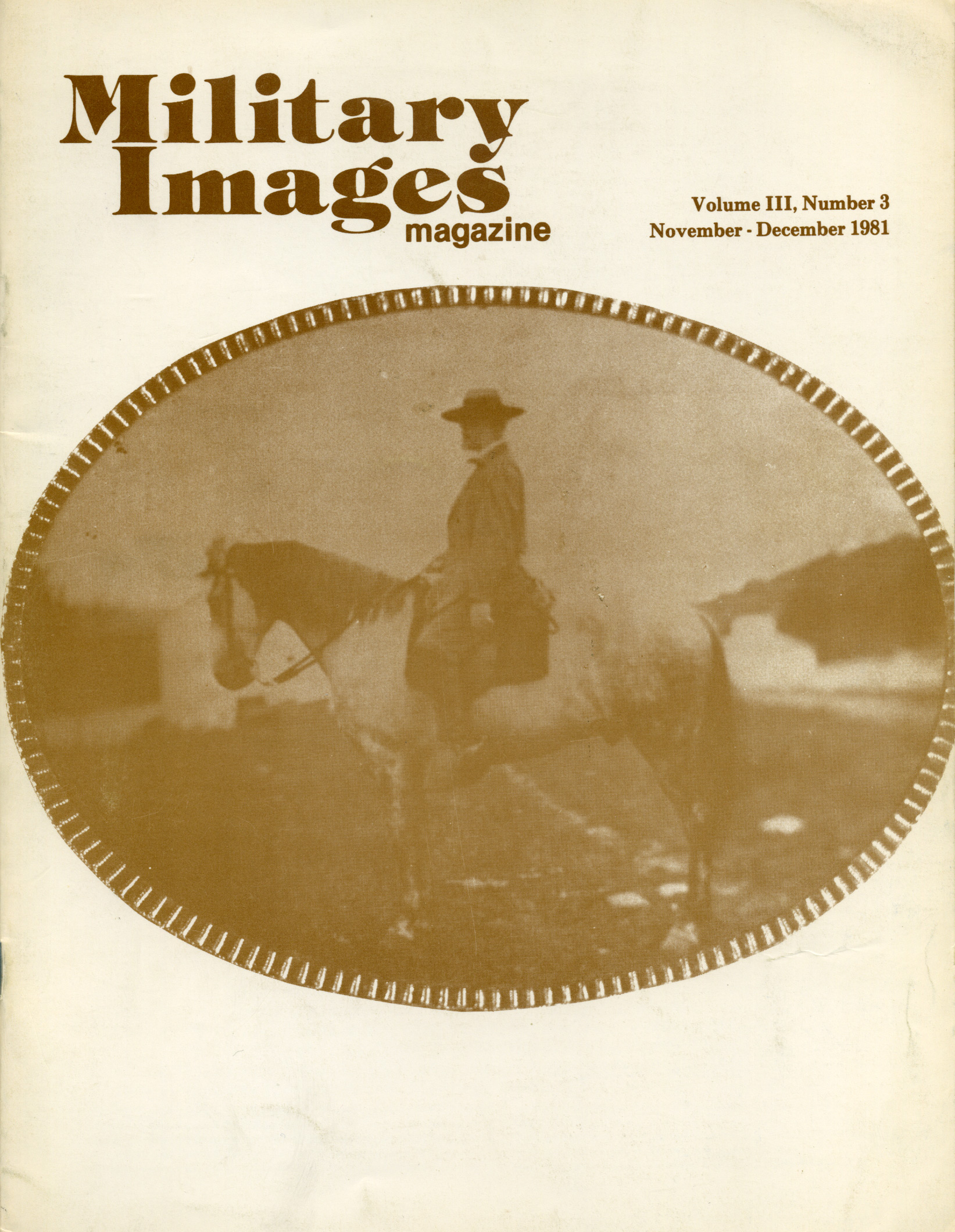
A previously unpublished quarter-plate melainotype taken in 1866 of General Robert E. Lee astride his horse Traveller.

Editor’s Page (inside front cover)
The editor announces not only a change in address, but his marriage to Military Image attorney.

Mail Call (p. 2)
Letters from subscribers provide their comments about past issues and suggestions for those in the future. Of interest was a recently discovered photograph of “Stonewall” Jackson. The editor described how the identification of the casual soldier in a private’s coat was made.

Passing in Review (p. 3)
The feature begins with a review of Autographs of the Confederacy by Michael Reese II, which is based on the collection of autographs compiled by John F. Mayer, who was a clerk in the Confederate War Department. The beautifully bound book contains the signatures of many notable individuals, including all of the Confederate general officers, some of which are extremely rare. The second review is of The Image of War, 1861-1865, Volume 1: The Shadows of the Storm edited by William C. Davis. Containing over 650 images with context provided by noted specialists, this first of a projected six volumes was given high marks.

Memoirs of a Rebel, Part I: South Mountain and Sharpsburg by John Calvin Gorman (pp. 4-6)
Edited by his grandson, George Gorman, North Carolina journalist John C. Gorman wrote out his memoirs of his time as a captain in Company B, 2nd North Carolina Regiment. This first installment for Military Images describes the action at South Mountain and the battle fought at Sharpsburg, including a stirring description of what it was like to fight in the “Bloody Lane” where so many of both sides fell.

The Hanging by William Christen (pp. 7-8)
The author takes the reader on a sleuthing mission to discover the truth behind two postcard photographs found in his grandfather’s collection of World War I photographs. Taken on board the Indiana in 1918, the details of the story behind the gleeful seamen, a lack of officers, and a hanging victim are revealed.

U.S. Army Uniforms of the Civil War, Part III: The Artillery by Robert Borrell, Sr. (pp. 9-15)
A collection of 19 images accompanies this article which describes the uniform requirements of the Federal artillery as worn in the Civil War by both enlisted and officer ranks, and by light and heavy artillery. One trio of images shows the wear of frock and sack coats as well as the shell jacket, while another trio shows the wear of Hardee, kepi, and plug hats. An interesting feature of the pictorial is the close-up images of a gold bullion artillery insignia worn on the kepi of 2d Lt. Eben Hall of the 4th Connecticut Infantry as well as two different commercially purchased badges engraved with a soldier’s name.

The Few, the Forgotten: The Confederate States Marines by David L. Sullivan (pp. 16-21)
Difficult to research as the official records of the Confederate States Marine Corps were burned in Richmond at the end of the Civil War, the article traces the development and history of this little known group. With service as diverse at guarding shipping in dock at New Orleans to participating in on the Virginia as it fought at Hampton Roads to fighting at Saylor’s Creek, the four companies of the Confederate Marines were involved in conflict with the Federals consistently throughout the war. The article includes several images of notable Confederate Marines along with short biographies.

Harvard Crimson to Horizon Blue: The Odyssey of Parker Ellis by Dale Biever (pp. 22-23)
Many young American men, several from Ivy League schools, decided to fight in World War One long before the United States entered the conflict in 1917. One of these was Parker Ellis, who left Harvard in early 1917. Photographs that accompany the article show his transition from an ambulance driver for the American Field Service in France and Italy to his training with the French Foreign Legion. Eventually serving as a lieutenant with the 260th Artillery, he was awarded the Croix de Guerre for bravery for his actions in the field in October 1918, shown in a portrait taken in 1919. He was not yet 22 years of age.

“U.S. Official:” A look at the Signal Corps photos of the First World War by Philip Katcher (pp. 24-26)
Five large format images, each marked with a “U.S. Official” stamp, from the collection of the author show very different aspects of the conflict. From soldiers of the Signal Corps wearing special gas masks that allowed them to communicate normally to camouflaged snipers returning from the trenches to a group of Americans with a captured German Howitzer, these images provide detail that many other images of the time were unable to obtain. The collection also includes a group photograph of a mobile “Dental Car” sent from New York, with dentists ready to apply their skills. The final image of the pictorial is a unique view of troops of different nations from both sides of the conflict – German and Austrian, American and British – apparently celebrating the Armistice that called an end to the fighting of World War One.

Private Benjamin Franklin: Company H, 2d Minnesota Cavalry by William Gladstone (p. 27)
The article presents a fund-raising carte de visite featuring Private Franklin, the only soldier of the era to undergo and survive partial amputation of all four limbs. Caught in a snowstorm after escorting a wagon train as part of his Indian fighting duty, and without shelter or food for a week, Franklin was the only survivor from the detail. He was rescued by friendly Indians and brought to Fort Ridgley for treatment. While provided with a small government pension, Private Franklin sold copies of his carte de visite for a quarter as a way to earn extra income, a “not uncommon practice after the Civil War.”

Stragglers (pp. 28-31)
From Company H, 31st Michigan Infantry celebrating the birthday of General Robert E. Lee in Savannah in 1899 on their way to Cuba to some unique personal additions to regulation uniforms, this edition of “Stragglers” includes some unusual images. A previously unpublished image of Col. Frederick G. D’Utassy of the 39th New York “Garibaldi Guard,” an unofficial “foreign legion” fighting with the Union, is presented. Readers are also given a quiz to test their knowledge: How many of the four images of soldiers in grey are Yanks?

Back Image
The elaborate image of a sergeant in the 2nd Regiment, Wisconsin National Guard, Oshkosh from between 1878 and 1886 is featured.

Finding Aid: Sept./Oct. 1981

1981-v3-02-iii-cover

The complete issue

Vol. 3, No. 2
(32 pages)

Print edition: Visit our store to check availability
Digital edition: Visit JSTOR.org to purchase
Subscribe to MI
Explore the MI Archives: Browse | Advanced search | Tutorial

Inside

Cover Image
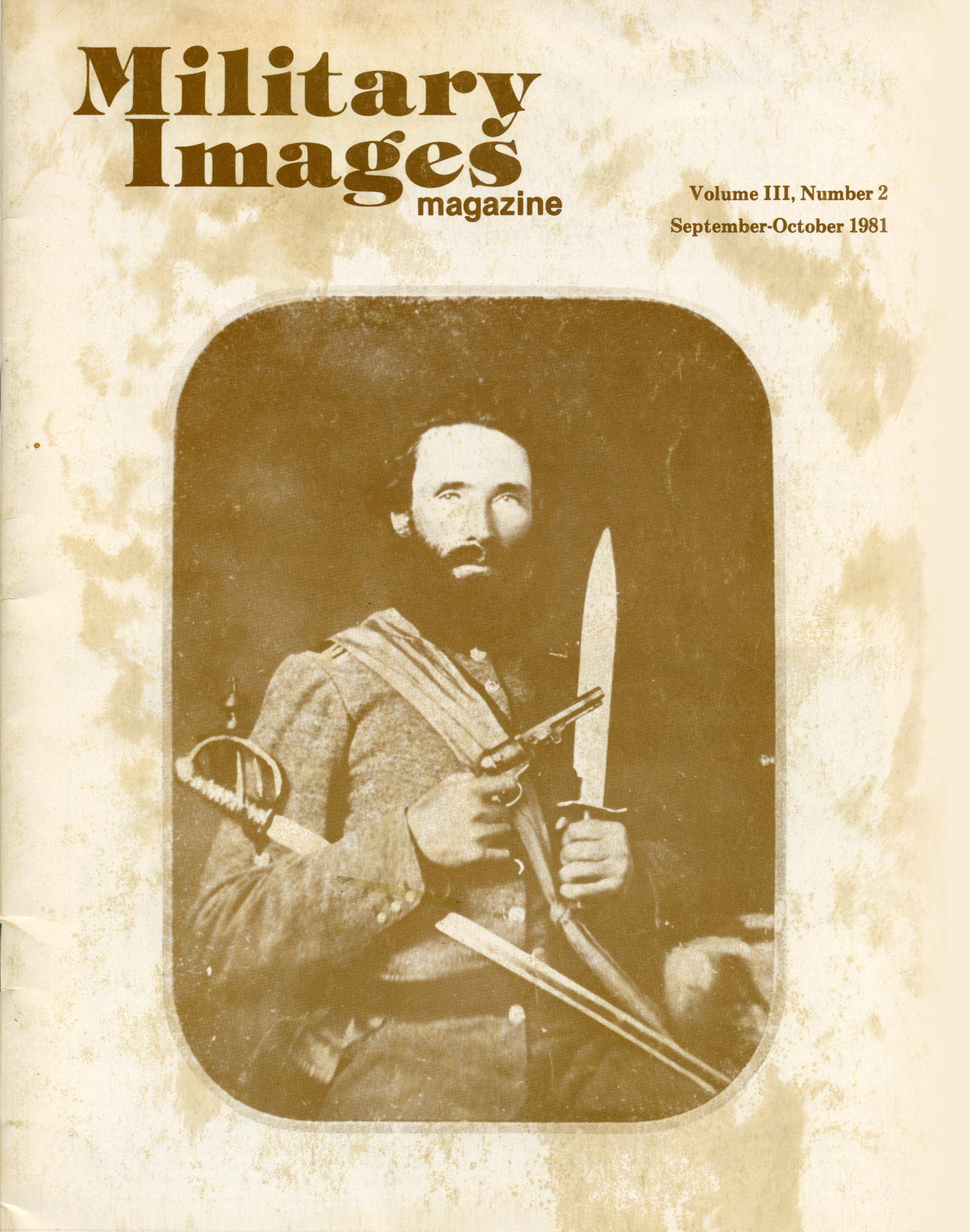
Captain Houston B. Lowerie, adjutant of the 6th North Carolina Infantry, Law’s Brigade, Army of Northern Virginia, killed at Sharpsburg.

Editor’s Page (inside front cover)
The editor addresses the perception of readers that the publication has a Union bias. Most of the MI staff reenact with the 4th Texas Infantry, and he notes that there will be a number of Confederate focused articles in upcoming issues. The editor repeats his call for Confederate stories, as the submissions of the readership determine the contents of the magazine.

Mail Call (p. 2)
A number of readers send in their appreciation for the quality of the publication and for some of the articles in particular. One letter provides additional details on Christian Fleetwood, whose portrait was featured on a recent issue.

Virginia in October: Or Losing the Buckland Races by Alexander S. Barnes (p. 3)
The portrait of Lt. Willard Glazer of the Second Harris Light Cavalry of New York accompanies this article, which describes his capture by the Confederate cavalry led by Stuart and Gordon. Fought outside of Buckland Mills, Virginia on October 19, 1863, the rout of the Federal troops became known by the Rebels as the “Buckland Races.”

Three Views of the Militia by H. Michael Madaus (pp. 4-5)
Taken of different units from the “Old Northwest Territory” between 1860 and 1879, these images of full militia companies are considered quite rare. The first is from the Waukesha Home Guard taken in 1860 prior to the outbreak of the Civil War. They feature grey uniforms with dark trousers which were replaced with the state issue militia uniform when they became Company F, 5th Regiment, Wisconsin Volunteer Infantry in 1861. The second image is of a company of apparently new recruits from during the war, perhaps called up to engage in the Great Sioux Uprising or to become part of a new Union contingent. A notation on the reverse identifies the unit as being from Sheboygan in 1863, but a comparison between the picture and Wisconsin records of the “Lima Home Guards” or the “Sheboygan Falls Home Guard” do not match the weaponry shown. Finally, another enigmatic unit apparently from Illinois is shown, wearing uniforms of the 1872 regulations.

Across the Plains by Mark H. Jordan and Dennis S. Lavery (pp. 6-9)
Excerpted from an upcoming biography on John Gibbon called Iron Brigade General, the article describes the Army convoy that left Fort Leavenworth in June 1860 for Camp Floyd, Utah. The article goes into detail regarding the family life of the Gibbons family during the trek, including humorous incidents that happened along the way, such as buffalo being chased by a lieutenant on a mule (future Confederate General John B. Villepigue) and a colonel who declined to eat a pie made from crow (future Union General Philip St. George Cooke). The others who took part in the journey reads almost like a “who’s-who” of the Civil War, such as Bernard Bee and John Buford, and brings a more relaxed and human image of these men who now have such martial reputations.

A Leatherneck in France, 1917-1919 by Albert E. Powis (pp. 10-15)
The personal recollections of a machine gunner who served with the U.S. Marine Corps in France are published for the first time in this issue of Military Images. Covering his service in the 66th Co., 1st Btn., 5th Marines from training through the trenches of France and then back home, these frank and candid descriptions allow the reader to discover how trenches were built, what the weaponry was like, and what the fighting was like that got his unit called the “U.S. Devil Dogs” by the enemy. It is powerful and compelling reading, accompanied by several of Powis’ collection of photographs of his comrades and officers at war.

Passing in Review (p. 15)
This issue of MI includes reviews of three publications. The first is The 4th Mariends and Soochow Creek: the Legend and the Medal by F.C. Brown, J.E. Lelle, and R.J. Sullivan which describes the “China Marines” that served in the Shanghai International Settlement from 1927 to 1941. The second book is Ten More Texans in Gray, edited by W. C. Nunn, which is a sequel to a previous work. Each of the ten biographies is written by a graduate student of the editor at Texas Christian University and covers a range of influential Texans who fought for the Confederacy. Lastly is a guide entitled Civil War Genealogy by George K. Schweitzer, which provides a wealth of resources for those beginning research on their Civil War ancestry.

Survey: Warriors in Grey by T. Sherman Harding (pp. 16-23)
This pictorial article features 22 separate images of Confederate soldiers, many of them unidentified, from the collection of Mr. Harding as photographed by George Mensch and Ray B. Wooster. Some of the unusual images include a ninth-plate ambrotype of a Confederate with a buttoned up tri-corner hat that converted into a slouch hat when unbuttoned, a sixth-plate ambrotype of fully-equipped soldier with all his equipment, and a sixth-plate ambrotype of two Confederates wearing “militia” shirts.

Memoirs of Carlos W. Colby edited by Joseph Bilby (pp. 24-29)
Serving in Company G of the 97th Illinois Infantry, Colby wrote his memoirs of his service in the Civil War in 1910 when his eyesight began failing. There is no formal history of his unit outside of this memoir, and is of historical value as the 97th Illinois took part in some lesser known campaigns. The editor provides corrections when needed and context to the memoirs. Colby recounts the action at Vicksburg that led to his award of the Congressional Medal of Honor, his many encounters with General Grant, and his exploration around the city of Vicksburg after its surrender. The memoirs provide a great deal of information about a military career that saw a great deal of action, some tragic, some humorous, and some laden with irony.

Stragglers (pp. 30-31)
Five different images are included in this edition of “Stragglers” with two of them posing questions for the readership. A quarter-plate tintype of a Union soldier shows an unusual pistol in his belt and a rare 1858 Enfield rifle; three firearms experts were unable to come to a consensus as to the make of the pistol. A very young Yankee first sergeant wearing a frock coat with very unusual markings was also submitted; another collector has an image of a different soldier wearing the exact same unique frock. Readers are asked to provide their insight to these two puzzling images.

Back Image
An unidentified New York Zouave wearing a plaid shirt is featured.


Finding Aid: July/Aug. 1981

1981-v3-01-iii-cover

The complete issue

Vol. 3, No. 1
(32 pages)

Print edition: Visit our store to check availability
Digital edition: Visit JSTOR.org to purchase
Subscribe to MI
Explore the MI Archives: Browse | Advanced search | Tutorial

Inside

Cover Image
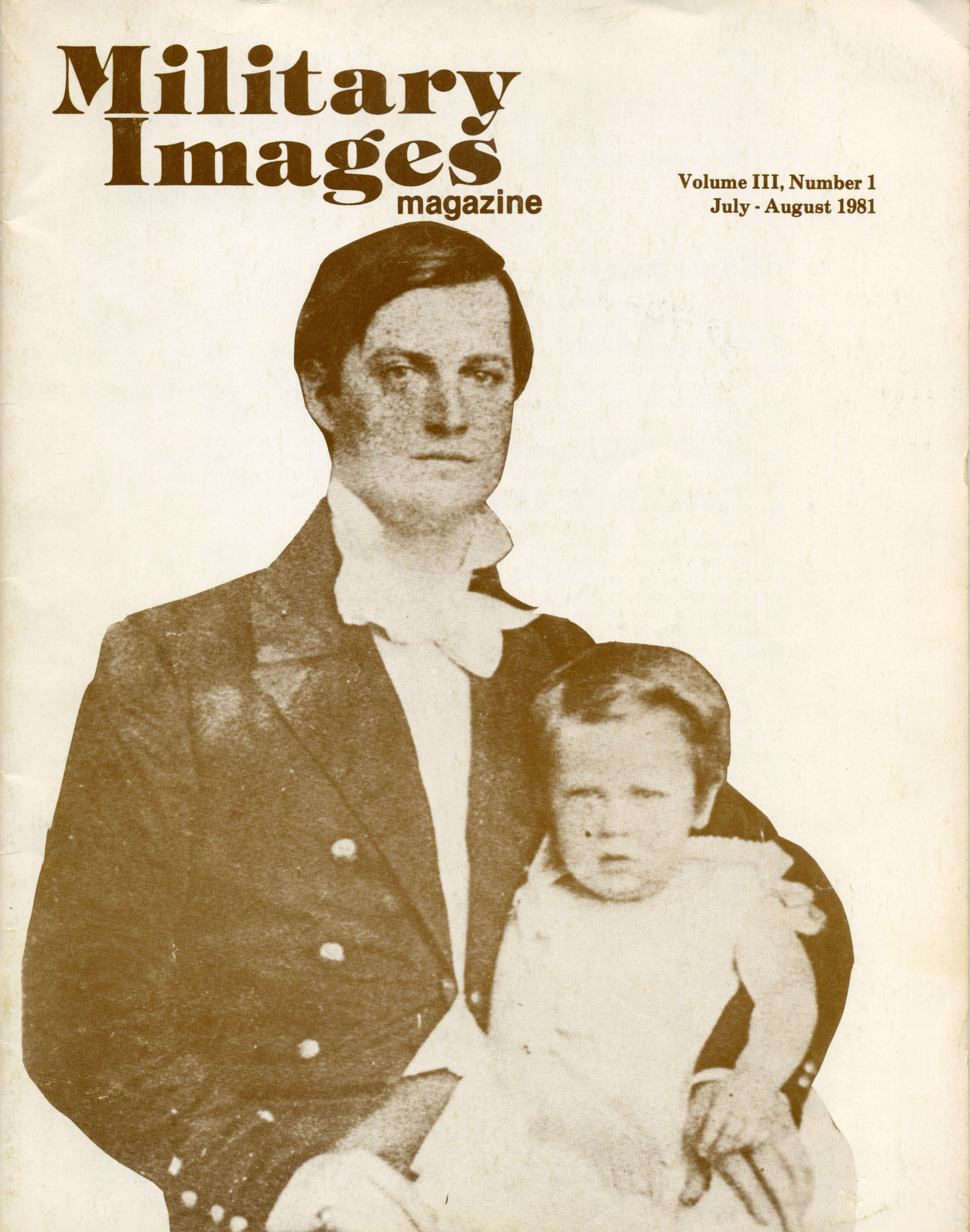
A touching portrait of 1st Lieutenant Winfield Scott Hancock with his three year old son Russell, taken in 1853.

Editor’s Page (inside front cover)
The editor explains the effect of “hard” images, such as daguerreotypes, tintypes, or ambrotypes, and how these led to what today appears to be “backwards” images and why issues of Military Images does not change these from their original appearance.

Mail Call (pp. 2-3)
The readers’ letters include several clarifications to images from previous issues. Of interest is a comparison of the obverse and reverse of two cartes de visite of Sergeant Amos Humiston, father of the “Children of the Battlefield” images from the Civil War. One is a retouched version that was used for fundraising purposes, with the addition of a beard and Army jacket.

“Galloping Jim” Parker: Cavalryman Extraordinaire, 1872-1918 by Gordon Harrower, Jr. (pp. 4-9)
Including ten images spanning the career of “Galloping Jim” Parker and excerpts from an unpublished monography by his son, the reader is treated to an overview of the life of a veteran of the Indian Wars, the Philippine Insurrection, and the Spanish-American War. Parker was also an instructor of cavalry tactics at West Point and eventually commanding the 11th Cavalry. Some of the images are postcard photographs which provide glimpses into the inspection of his cavalry units, from three day recruits to a review at the Texas maneuver camp in 1911 which features a Wright flyer overhead. Not selected to be the commander of the A.E.F. that went into France to fight in World War One, Parker organized can commanded the unit that today is known as the “Big Red One.”

U.S. Army Uniforms of the Civil War, Part II: The Sack Coat by Michael J. McAfee (pp. 10-15)
Essentially the uniform coat worn by the common soldier, the sack coat was a cheaper, mass-produced garment that was to be worn in fatigue situations. Shorter than the frock coat and without a waist seam, this four-button coat was the standard for Union soldiers. The 15 different images provided in this pictorial article show how the uniform was worn, from one “perfect fit” example to many personal alterations done by the soldiers themselves.

William Lytle and the “Boody Tinth” Ohio by James F. Neel (pp. 16-18)
This article was inspired by a junk yard find of a photograph of ten Union soldiers with the inscription on the reverse describing it as the burial party of Brigadier General William H. Lytle, the commander of the 10th Ohio Volunteer Infantry. A graduate of West Point in 1843, Lytle became a lawyer, only leaving to serve during the Mexican War. Lytle became prominent in 1857 not for being named as major general of the Ohio militia, but as a poet, whose work “Antony and Cleopatra” gained national attention. He saw a great deal of hard action and was wounded several times in the Civil War, eventually leaving the 10th for other command although remaining particularly beloved by the “Bloody Tinth” and its Irish contingent from Cincinnati, Ohio. Upon his death during the Chickamauga campaign in October 1863, members of the 10th were selected to return their general to his home of Cincinnati for burial.

Passing in Review (pp. 19, 31)
Three books are featured for review in this issue of Military Images. First is The Horse Soldiers, 1776-1943 by Randy Steffen. This is a four volume set that covers all aspects of how the cavalry was outfitted, and is highly recommended. The second book passing in review is The Civil War Engagement at Cool Spring, July 18, 1864 by Peter J. Meaney, providing a “fully documented account” of this Virginia battle coming after the Battle of the Monocacy. Lastly is The Great War and Modern Memory by Paul Fussell, an academic work that provides insight into aspects of World War One as diverse as poetry and impact on the use of the English language to the psychology and impact of catastrophe on collective memory. Special attention is given to lesser known poets and writers, as well as the familiar, such as Siegfried Sasson or Wilfred Owen, showing a disconnect between the experience of the trenches and civilian perceptions of the experience.

Antebellum Photography in the Collections of the U.S. Army Military History Institute by Michael J. Winey (pp. 20-30)
A pictorial article with 16 images, the author selected the images for what they are able to tell the reader. The first, for example, is an outdoor daguerreotype that depicts Old Fort Howard in Green Bay, Wisconsin, taken between 1849-1852 when the fort was briefly put back into use. Not only can one see the layout of the fortification, but also uniform styles in use that date back to 1829 regulations. Other images provide detail on 1832 general officer uniforms as well as the opportunity to view younger images of well-known Civil War generals such as Major General Cadmus M. Wilcox of the Confederacy as a 2nd lieutenant and Major General John F. Reynolds as Commandant of Cadets at West Point. A group of officers serving as the U.S. military board observing the militaries of the Crimean War, including a young George McClellan, is juxtaposed with what appears to be a wedding portrait of a happy couple, a second lieutenant in dress frock with a smiling young woman at his side.

Perry’s Saints: A History of the 48th New York Volunteers by Dale S. Snair (pp. 32-35)
Focusing on the careers of two of its outstanding officers, Colonel James H. Perry and Captain James M. Nichols, the author tells the story of the 48th New Yorkers. Perry had a background not only as a veteran of the Texas army fighting against the Mexicans, but also as a minister in Brooklyn where his unit of volunteers was recruited. It was his background as a minister that led the 48th to be known as “Perry’s Saints.” Perry died suddenly at Fort Pulaski, Georgia. Nichols was a 2nd lieutenant in Company G when the unit was formed, and eventually became known as the first man to command the use of the machine gun in warfare. Although the Billinghurst-Requa gun was not a success, Capt. Nichols eventually was put in command of the 48th during the fighting at Cold Harbor in 1864 and took part in the assault at the Crater as well. Resigning his commission due to continuing fatigue from malaria, Nichols left the war, but the 48th continued on, taking part in Sherman’s campaign against Johnston.

Two Rare Photographs by Stephen Guglielmi and Mark Katz (pp. 36-37)
Two very rare images are presented for the first time to Military Images readers. A sixth-plate “crayon daguerreotype” of Brevet Lt. Col. Joseph Hooker that dates from 1849 was found in an attic of a Port Arthur, Texas home. The article provides a good deal of information regarding the photographer and the condition of the daguerreotype. In juxtaposition to “Fighting Joe” is another rare image that features “Stonewall” Jackson his adversary at Chancellorsville. This 1862 image is from a quarter-plate ambrotype of a very casual Lt. Gen. Thomas Jonathan Jackson at his camp in Winchester, Virginia, with three others.

Stragglers (pp. 38-39)
Six different images are presented. Two images feature musicians: one has young fife and drummer boys from the Civil War while the other shows a musician holding a rare 1872 pattern helmet. World War One soldiers are in one photograph taken in November 1918 wearing flash goggles and winter gear. A rare image of a Volunteer Maine Militia sailor and an officer wearing an overcoat typical of 1900 are also part of the feature.

Back Image
Confederate Corporal Dillard Crowder is pictured in a sitting pose.

Finding Aid: May/June 1981

1981-v2-06-ii-cover

The complete issue

Vol. 2, No. 6
(32 pages)

Print edition: Visit our store to check availability
Digital edition: Visit JSTOR.org to purchase
Subscribe to MI
Explore the MI Archives: Browse | Advanced search | Tutorial

Inside

Cover Image
Christian A. Fleetwood, Sergeant Major of the 4th U.S. Colored Troops, recipient of the Medal of Honor for gallantry in the Battle of Chaffin’s Farm on September 29, 1864.

Editor’s Page (inside front cover)
The editor provides remarks on the installation of the memorial dedicated to 20th Regiment, New York State Militia, in recognition of its role in the repulse of Pickett’s Charge on July 3, 1863 on the 118th anniversary of the battle.

Mail Call (p. 2)
Readers to the publication provide corrections to past issues as well as some intriguing possibilities for the technique that created a rare photograph featured in a past “Stragglers” feature.

Robert Ramsey, C.S.M.C by David Sullivan (p. 3)
Two images of the same Confederate States Marine Corps officer, Second Lieutenant Robert Ramsey are featured, allowing the reader to get a rare glimpse at the uniform worn by this branch of Confederate service. The article also gives a narrative of Ramsey’s service record, which saw him in Confederate Marine Corps service from October 1861 to July 1862. He did see distinguished service before, during, and after his stint with the Marines, but he also saw trouble, having two court-martials and several other legal charges brought against him.

Fight of the Crows: The 15th New Jersey Infantry at the Battle of Cedar Creek by Joseph G. Bilby (pp. 4-15)
The author provides a detailed accounting of the fighting in the Shenandoah Valley under General Phil Sheridan that culminated in the Battle of Cedar Creek in mid-October 1864. The reader is provided with the opportunity to read about the experiences of many soldiers from the 15th New Jersey, including officers whose images are featured in the article. Some images of the Valley that were taken at the time are also included. Most striking is the image taken of Sergeant Edwin Ulmer, which shows the scars from his hip amputation. Ulmer was one of eight men who survived this extreme surgery. A reunion photograph taken in 1907 accompanies an “Epilogue” which outlines the post-war lives of some of the surviving soldiers from the article.

Black Troops in the U.S. Military, 1862-1918 by Don Dillon (pp. 16-25)
A pictorial with 22 different images, this article ties in with the cover image and gives an overview of different aspects of black service in the U.S. military. The article is broken up into three sections and features the uniforms, individual images, and a discussion of the changes seen in how the military utilized this group of soldiers. For example, a “before and after” series of cartes de visite of Drummer Jackson were produced by abolitionists during the Civil War. The service of blacks between 1866 and 1899 included the “Buffalo” soldier and the arrival of the first black cadet at West Point, featured in an informal photograph of the Class of 1880. The era of 1900 to 1918 saw the restriction of blacks from combat service under Woodrow Wilson, but this did not keep the black soldier or sailor from participating in the U.S. military, as shown by the three photographs at the end of the article.

Passing in Review (p. 25)
Four very different books are reviewed in this issue of Military Images, beginning with Fritz Nagel’s work entitled Fritz: The World War I Memoirs of a German Lieutenant. It recounts the author’s service in a combat-support unit with humor and unexpected tales of his activities, to include smuggling his own wife into his encampment for a five-week visit. The second offering is Collection, Use, and Care of Historical Photographs by Robert A. Weinstein and Larry Booth; while not focused on military photography, it does provide an excellent guide to careful preservation of historical images. Third is the book Muddy Glory: American ‘Indian Wars’ in the Philippines, 1899-1935 by Russell Roth. The book traces the development of the American fighting force from smaller Indian conflicts to one that provided the basis for leadership in World War Two, making a parallel with the Vietnam conflict. Last is Richmond Redeemed: The Siege at Petersburg by Richard J. Sommers, a highly researched academic work which focuses on four days of fighting focusing on Cockade City in a highly readable text.

The 29th Connecticut Infantry by William Gladstone (pp. 26-27)
The author of this brief regimental history purchased five stereo photographs that led him to investigate the black unit they documented: the 29th Connecticut Infantry. The three outdoor images shown are of the unit upon their deployment to Beaufort, South Carolina in April 1864. The stereo photographs are attributed to Sam A. Cooley; other sets of the images are held by both the National Archives and the Library of Congress.

Stragglers (pp. 28-30)
This issues has a combined 14 different images submitted by various readers. Of note is a series of three that depict the same individual (James Krom of the 120th New York Infantry): prior to enlistment, about the time of his wounding at Gettysburg, and after promotion to sergeant. Another is Major Walter A. Van Rensselaer from the unit mentioned on the Editor’s Page of the current issue. A group image of what appears to be Confederates is offered with a request for any clarifying information.

Rear Image
The ninth-plate ambrotype of this soldier, Private Luther Ladd of the 6th Massachusetts Infantry, was used as a negative to reproduce this photograph. It was also used to create memorial issues throughout the Civil War. Private Ladd was killed in the Baltimore riots of April 1861 as his unit made its way to Washington, D.C.

Finding Aid: March/April 1981

1981-v2-05-ii-cover

The complete issue

Vol. 2, No. 5
(32 pages)

Print edition: Visit our store to check availability
Digital edition: Visit JSTOR.org to purchase
Subscribe to MI
Explore the MI Archives: Browse | Advanced search | Tutorial

Inside

Cover Image
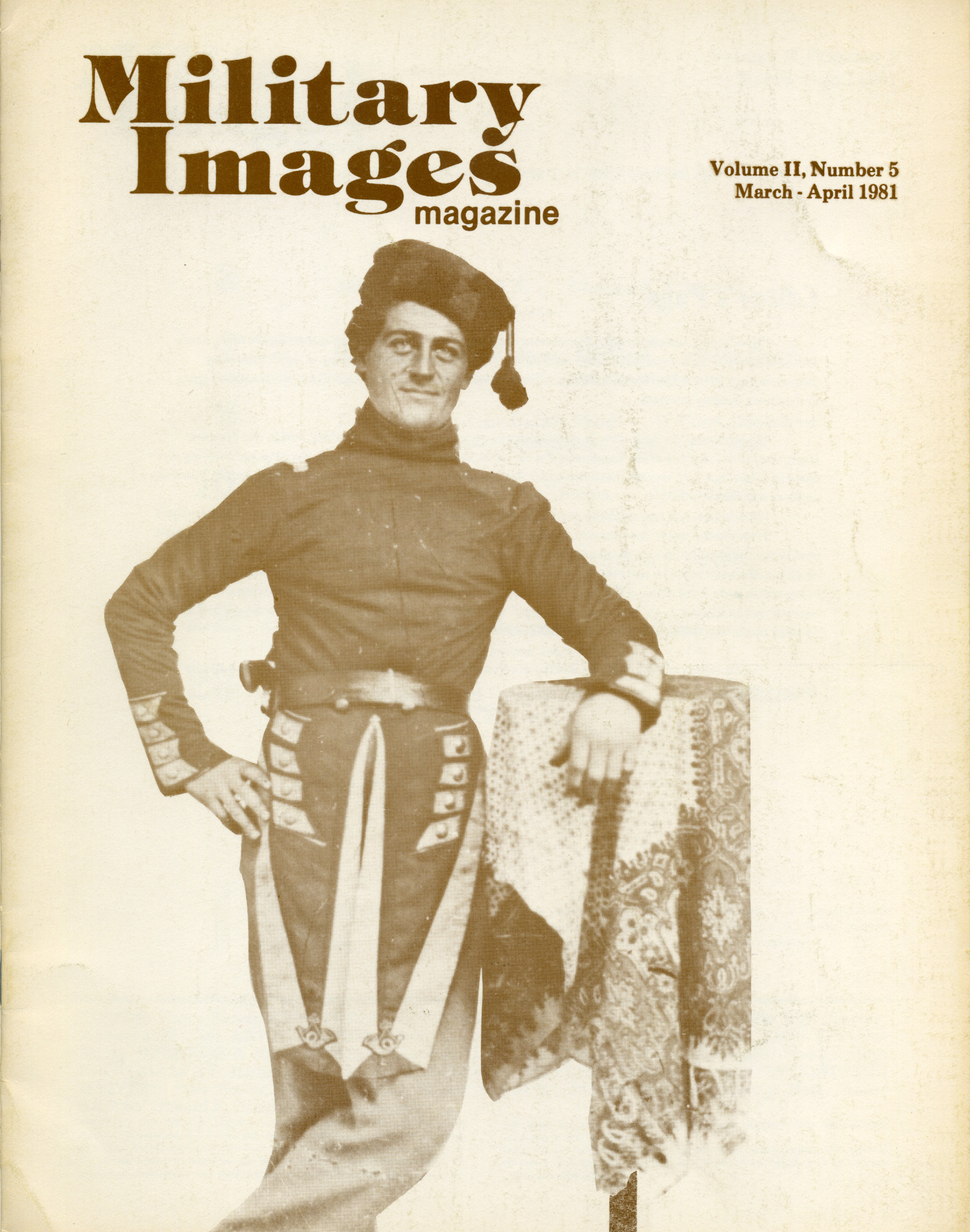
This “April Fools” issue of Military Images features a ninth-plate tintype of a Massachusetts militia man wearing his uniform backwards. It does offer the reader a very good look at the details on the back of the uniform coat.

Editor’s Page (inside front cover)
The editor explains the images found on the front and back of this month’s issue.

Mail Call (p. 2)
The readers contributed a logical solution to one of the cryptic messages found in a previous issue. Another reader writes that he was able to identify the uniform worn by an officer in a recently purchased quarter-plate tintype he had purchased based on an article he had read.

John Stocking, U.S.N: Unsung Hero of the Monitor by Charles S. Schwartz (p. 3)
Accompanied by a full-body carte de visite of Boatswain’s Mate John Stocking, the short article provides the information known about the sailor, who was swept overboard while trying to disconnect his ship, the USS Monitor, which was tied up while being towed by the USS Rhode Island.

Origins of the Confederate Uniform by Philip Katcher (pp. 4-7)
The article shows that there is a distinct European influence on the designs of the Confederate military uniform. Many components, such as the rank on the collar and the intricate lacework on the arms of the officer coat, came from the Austrian military. The lacework or braid was also called the “Austrian knot,” and was also used by the French military to designate rank on the kepi, which the Confederate military also had adopted in part and called the “French pattern.” Some aspects of the Union uniform were kept, such as chevrons for non-commissioned officers and branch of service colors; the exceptions were for the Confederate medical corps which was assigned black and the cavalry which was given yellow. While not all of the dress regulations were able to be effectively enforced, the article does provide a good deal of detail on what the intended Confederate uniform was to look like.

The Children of the Battlefield by William Gladstone (pp. 8-9)
After dying on the streets of Gettysburg, an unidentified soldier grasped an ambrotype image of three children. He was buried, and the image was turned over to Dr. J. Francis Bourns, who had carte de visite images made and saw them distributed so the identity of the fallen soldier could be made and his family notified of where he lay. Philinda Humiston was able to identify her children Franklin, Alice, and Frederick, and her husband Amos was reinterred at the National Cemetery at Gettysburg as a result. A total of five different issues of “The Children of the Battle Field” cartes de visite were issued, creating a fund to support the Soldiers’ Orphans Home in Gettysburg. The Humiston children were brought there for their education, and Mrs. Humiston was employed as matron. The article provides a great deal of information about the Humiston family, details about the different issues, and how fundraising was generated by the distribution of the children’s image.

Yerba Buena Island, California: A Look at the New U.S. Naval Training Station in 1901 by John Stacey (pp. 10-15)
Twelve different images accompany this article about the history behind the training station, the facilities that were provided to the “apprentices and landsmen” who were trained there, the ships they used, what skills they learned, and some of the demographic data about the first year. From sleeping in hammocks to doing wash as a group activity to taking a class on naval mathematics, the photographs included provide a glimpse into the life of a naval trainee at the start of a new century.

“Your affectionate son…:” The Civil War Letters of Pvt. Harley J. Hilborn, 145th Pennsylvania Volunteers by Eileen F. Conklin (pp. 16-21)
This issue of Military Images takes a touching and in-depth look at another popular kind of memorabilia, that of the personal letter written home. The letters that Private Hilborn wrote to different members of his family give the reader a great deal of insight into his life from a new recruit in September 1862 through his experiences fighting up to and including his wounding in Fredericksburg in December. He was transferred to Douglass Hospital in Washington, D.C. and wrote from his hospital bed, describing his experiences and eventually asking his father to come and see him. His father arrived the day before he died of his injuries on January 2, 1863.

Passing in Review (p. 21)
Two books are reviewed in this issue. The first is Cry Comanche by Harold H. Simpson, which provides a history of the Fifth U.S. Cavalry, receiving a mixed review. The second book discussed is the reprinting of The Twentieth Maine: A Volunteer Regiment of the Civil War by John J. Pullen.

Military Monkey Business by Don Dillon (pp. 22-25)
Keeping with the “April Fools” theme from the front cover, this pictorial features ten images of military men letting loose in one way or another. In one photograph from Japan taken between 1908 and 1913 shows sailors and a Marine sharing Kirin Lager in a “wetting down party.” Two forms of punishment are shown, with one man being guarded while being confined to the barrel of a cannon and one man “riding a rail” that was crafted to look like a horse. Different action shots of men in the Civil War staging friendly-looking fights are shown, as is one shot of a Pennsylvania National Guardsman taking aim at a “crazed Moro” at a 1909 encampment.

A Lancaster Lad Goes to War in 1898 by Clifford B. Weaver (pp. 26-27)
The adventures of Private Peter Allabach, Jr. of Company L, 4th Pennsylvania Volunteer Infantry, are the focus of this article as he made his way toward the Spanish-American War. Two photographs, likely taken at home while on furlough, complete the story.

Stragglers (pp. 28-31)
Eighteen different images comprise the “Stragglers” from this issue. An unidentified Marine officer in his immaculate dress uniform taken in Yokohama, Japan in about 1890 leads off. There are many images of Civil War POWs, including “Happy Family, Cell No. 1” consisting of Confederates captured in Morgan’s Raid and a barefoot Union soldier after his release. One of the images includes “Buckskin Charlie,” a Civil War veteran of the G.A.R, along with two other Southern Utes in a photograph taken in Colorado in the 1880s.

Back Image
The image of a soldier taken with a statue of an elephant on the table next to him reveals that he has “seen the elephant.” This was mid-19th century symbolism meaning that he has seen combat and survived.