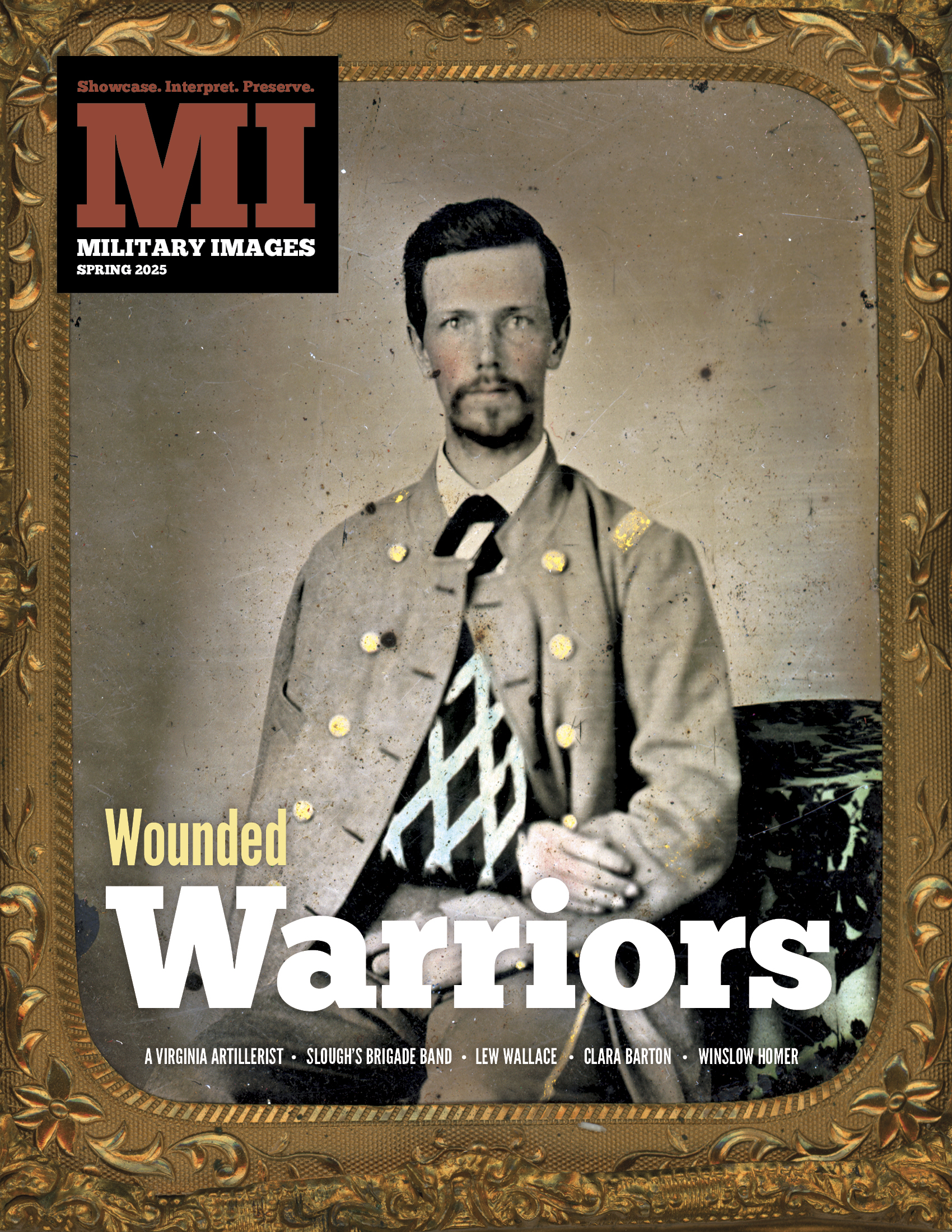
A complete table of contents for the Spring 2025 issue of Military Images magazine, and information about how to purchase single issues and subscriptions.
Vol. XLIII, No. 2
(80 pages)
Print edition: Visit our store to check availability
Digital edition: Visit JSTOR.org to purchase
Subscribe or renew your subscription
Explore the MI Archives:
Browse | Advanced search | Tutorial
Inside
Cover
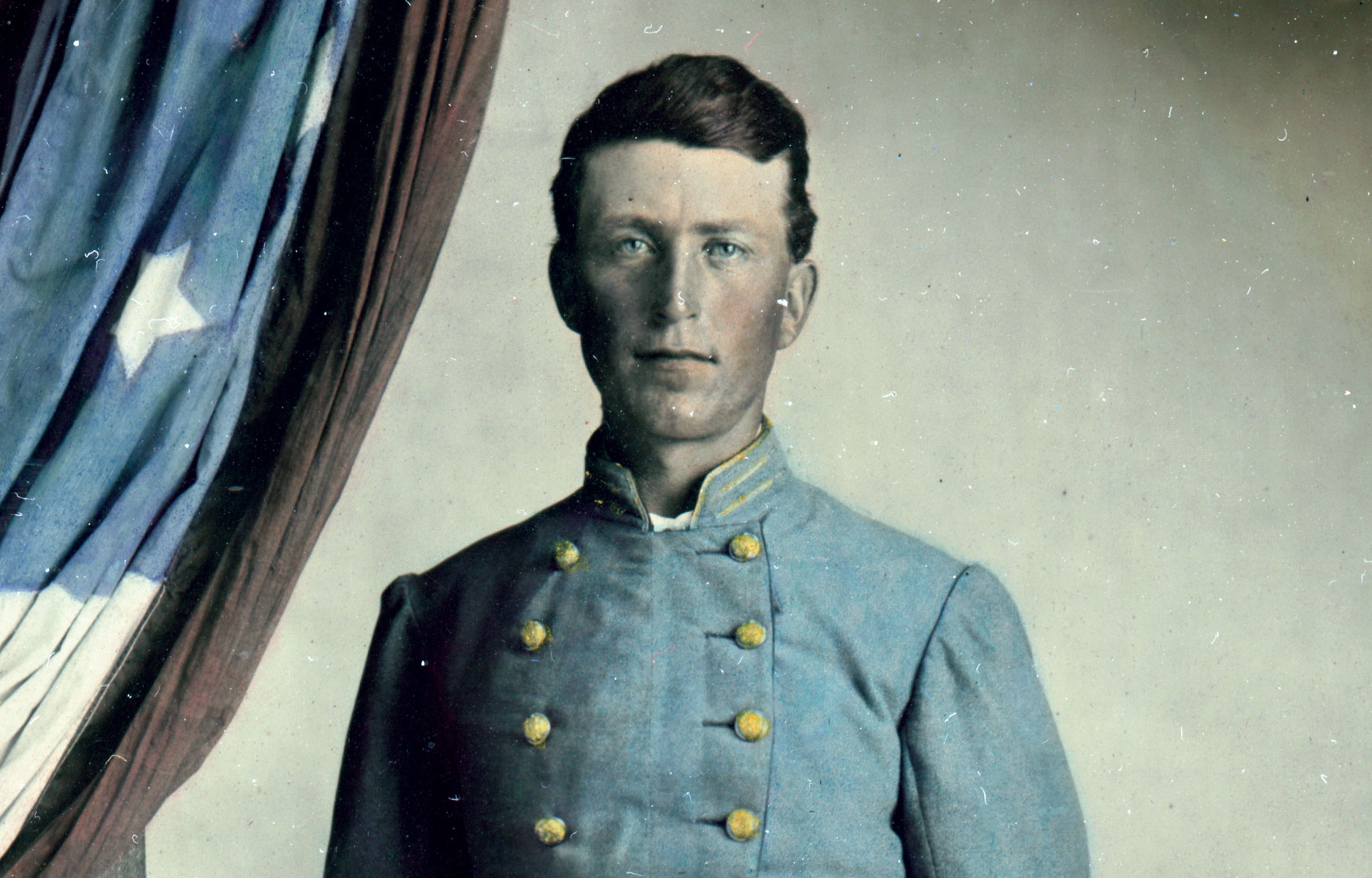
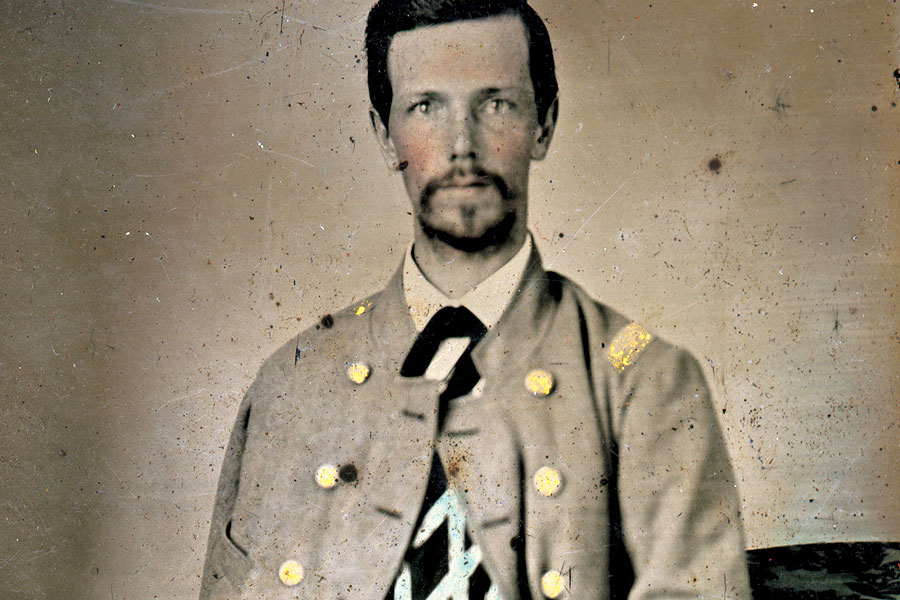
A tintype from the Dan Schwab Collection pictures Confederate Col. Evander Mciver Law recuperating from the wound he suffered at the First Battle of Manassas.
Table of Contents (p. 1)
Editor’s Desk (p. 2)
After Kolt Massie alerted me about a tintype picturing Evander M. Law recovering from his First Manassas wound, I reflected on the thrill of Civil War photography discoveries.
Mail Call (pp. 3-4)
Feedback includes an appreciation for John Walsh’s Fort Donelson feature, Kurt Luther’s Photo Sleuth column, Paul Russinoff’s story about a Michigan cavalryman, and more.
Military Anthropologist (p. 4)
A review of shot fractures of limbs in The Medical and Surgical History of the War of the Rebellion reveals the success rates of conservation, excision, and amputation.
Passing in Review (p. 6)
Righteous Strife by Richard Carwardine, published by Knopf Doubleday, explores how religious nationalism shaped Lincoln’s Union and the Civil War’s moral battles.
Photo Sleuth by Kurt Luther (pp. 8-10)
Photo sleuthing Civil War portraits requires triangulating names, units, and ages to ensure accurate IDs, revealing lost soldier stories and correcting mislabeling.
Antebellum Warriors (p. 12)
A daguerreotype of an unidentified 1840s-50s militia soldier showcases distinctive insignia, a Model 1840-style sword, and period-specific uniform details.
Most Hallowed Ground (p. 14)
Edmund C. Bainbridge, a career U.S. Army officer, served in key Civil War campaigns before retiring as a colonel. He was buried with honors at Arlington.
The Honored Few (p. 16)
At Petersburg, John W. Boutwell of the 18th New Hampshire Infantry rescued a wounded comrade. Decades later, he and another soldier received the Medal of Honor.
The Citizenry (p. 18)
Love of country fills this portrait of a patriotic woman, likely a fundraising image from the 1864 Mississippi Valley Sanitary Fair, featuring the Old Guard’s flag and liberty cap.
Of Arms and Men by Phil Spaugy (pp. 20-22)
Colonel Lew Wallace found a dead Confederate’s ornate Tryon & Co. muzzle-loading rifle at Fort Donelson in 1862, and took it home as a battlefield souvenir.
Wounded Warriors: Slings, crutches, and missing limbs are emblems of personal loss and patriotic sacrifice(pp. 22-36)
A photographic survey of Civil War amputees and other wounded soldiers and sailors, their societal impact, medical treatment, and portraits of the veterans.
Gifted Scholar, Faithful Christian, Reluctant Soldier: The life and times of Virginia professor and artillerist Lewis Minor Coleman by Ronald S. Coddington, with images from the Dave Batalo Collection (pp. 38-45)
Lewis Minor Coleman, an educator turned Confederate officer, sought to balance duty, faith, and the horrors of war. His service culminated at Fredericksburg.
A Useful Life: Sarah Chamberlin Eccleston, Civil War nurse and educator by Sidney Dreese (pp. 46-48)
Sallie Chamberlin defied age restrictions to serve as a Civil War nurse, later pioneering kindergarten education in Argentina. She lived a life of service.
Cruising the Potomac and Elsewhere with Brig. Gen. John P. Slough’s Brigade Band by Ronald S. Coddington, with images from the Mark Jones Collection (pp. 50-55)
Formed from the 60th New York Infantry, Slough’s Brigade Band played at key Civil War events in Alexandria, Va., and Washington, D.C.
Winslow’s Homer’s Use of Portrait Photographs in Civil War Era Illustrations by Rick and Victoria Britton (pp. 57-60)
A recently discovered sketch of Gen. Montgomery Meigs adds to Winslow Homer’s rich artistic legacy. The famed Civil War illustrator captured wartime life in Harper’s Weekly.
Wherever He Went, He Found History: Remembering Alex de Quesada, 1965-2024 by Ronald S. Coddington(pp. 62-64)
Alex de Quesada (1965-2024) was a passionate historian, collector, and author, known for his militaria expertise, vast artifact collection, and love of Star Wars.
Material Culture by Frank Graves (p. 66)
An early 1840s daguerreotype features an unknown man holding a U.S. Model 1805 Harpers Ferry flintlock pistol, the first military handgun made by a U.S. national armory.
Women of War by Melissa A. Wynn (pp. 68-69)
Clara Barton, Civil War nurse and founder of the Missing Soldiers Office, helped families locate lost loved ones and later established the American Red Cross.
Behind the Backdrop by Dave Batalo (p. 70)
A look at a painted camp and forts backdrop that appears in Confederate soldier portraits; it may be connected to a Fredericksburg photographer.
Vignette by Scott Valentine (p. 72)
First Lt. and Adjutant Orett Munger of the 44th New York Infantry was captured at Laurel Hill but freed by Gen. George Armstrong Custer’s cavalry. After the Civil War he settled in Chicago.
Stragglers (p. 74)
Confederate and Union soldiers pose for portraits, showcasing unique uniforms, tinting, and photography techniques by Charles R. Rees and other artists.
The Last Shot (p. 80)
A Confederate captain poses in a rustic studio scene with a tree-trunk chair and table, holstered sidearm, and missing coat button.