Finding Aid: March/April 1983

1983-v4-05-iv-cover

The complete issue

Vol. 4, No. 5
(32 pages)

Print edition: Visit our store to check availability
Digital edition: Visit JSTOR.org to purchase
Subscribe to MI
Explore the MI Archives: Browse | Advanced search | Tutorial

Inside

Cover Image
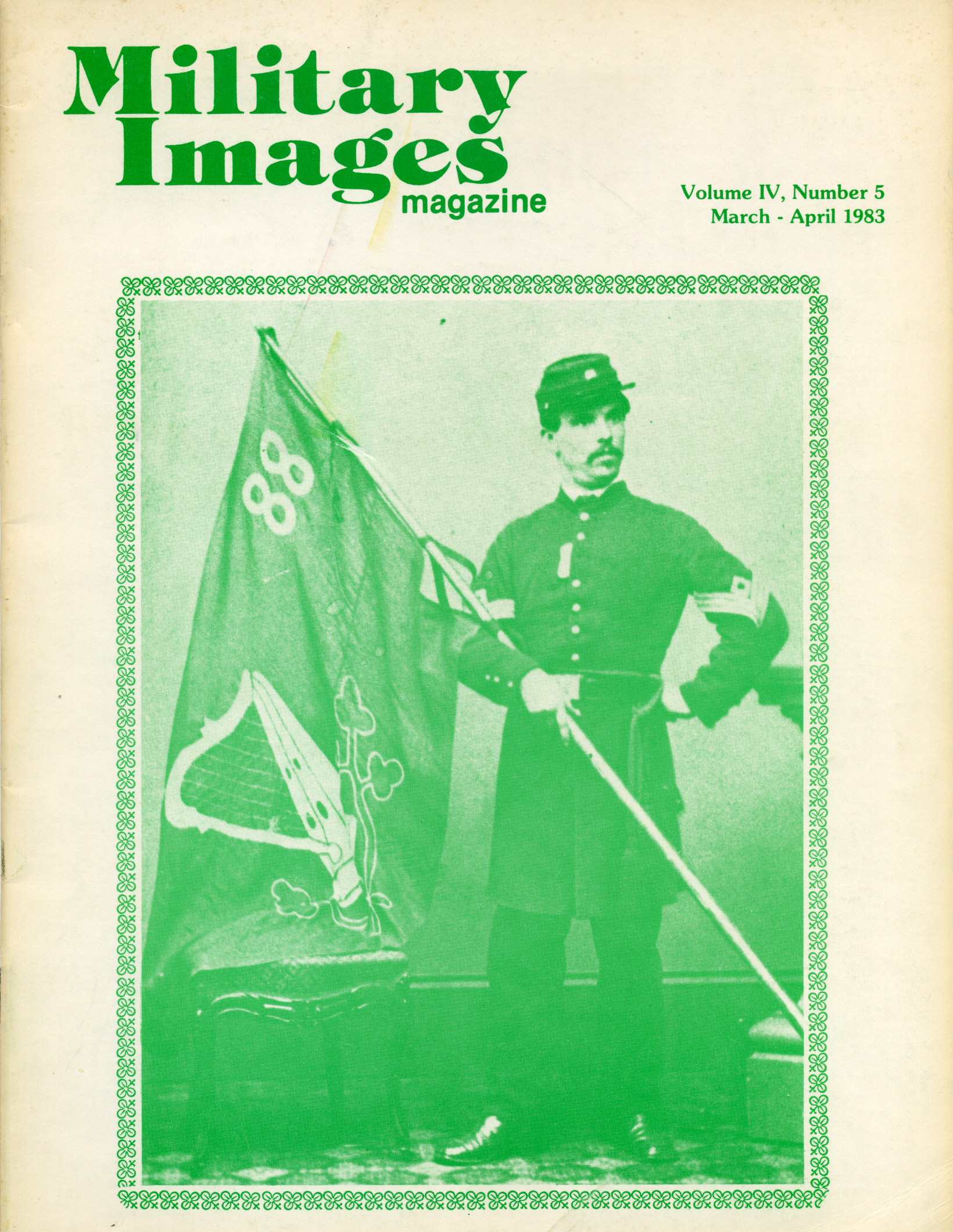
Tinted in green, the cover image features a soldier proudly holding the banner of the 88th New York Infantry – the Irish Brigade of the Army of the Potomac.

Editor’s Desk (inside front cover)
The editor introduces the featured article that ties to the front cover. The magazine takes on an Irish theme with an article by Joseph G. Bilby about the Irish Brigade in the Civil War.

Mail Call (pp. 2-3)
Letters from the readership include various corrections to a few articles, the identification of a “Straggler” item and a photograph from an article, a question regarding a uniform insignia from a member of the 27th Alabama Infantry, two warnings about “fake” cartes de visite and cabinet cards, and a clarification regarding copyright violations.

Company C, 3rd Cavalry by Douglas C. McChristian (pp. 4-6)
The two images presented in this article may appear to be two different units out in the Wild West somewhere, they are actually taken of the same unit on a hill on Fort Davis, Texas, most likely between March 1886 and October 1887. Close-up investigation identifies the men as belonging to Company C of the 3rd U.S. Cavalry. The remainder of the article assesses the equipment used by the men and their horses based on the images: carbine slings, cartridge belts, saber belts, belt plates, holsters, clothing, weapons, horse equipment, etc. The article concludes that the men did not necessarily follow the uniform regulations of General Orders No. 73 as one might have imagined.

Vignette: John H. Carter, 2nd Kentucky Cavalry, C.S.A. by John Ertzgaard (p. 8)
John H. Carter had an adventurous military career, taking part in John Hunt Morgan’s raid on Ohio, as well as being captured (and escaping) three times. The article provides detail on some of his adventures, culminating with Carter riding as an escort during Jefferson Davis’ escape, eventually surrendering at Washington, Georgia in May 1865.

Vignette: Henry Kirby, 15th Iowa Infantry, U.S.A. by Sharon L. Ball (p. 9)
Enlisting as a substitute for a wealthy man from Osceola, Iowa in March 1864, Kirby went with the 15th Iowa soon went south, being part of the push towards Atlanta. His unit was caught in the fighting that led to the death of McPherson, which the article describes in detail. Eventually captured, Henry Kirby was sent to Andersonville, where he contracted typhus, dying after he was exchanged.

Schmaltz: Sentimental Photography at the Turn of the Century by Carol Villa (pp. 10-14)
The article begins with a discussion of how sentimental images became popular at the end of the 19th century, and included military images with the advent of the Spanish-American War. Ending about the time of World War One, the pictorial shows a sampling of the “cute” and the “patriotic” images typical of the time. Postcards showing a small tyke in grown-up uniform captioned with “If McKinley Wants Me, I’ll Serve” or “The Regimental Mascot” are two examples, along with stereo views that told a story of soldiers falling in love, being heroic in battle, and then returning to claim the lady he loves.

Remember Fontenoy!: The 69th New York and the Irish Brigade in the American Civil War by Joseph G. Bilby (pp. 16-24)
Recounting the history of this storied unit, the author takes the reader from the development of the court martial of Colonel Michael Corcoran, who refused to march the 69th New York State Militia Regiment before the Prince of Wales before the outbreak of the Civil War through losses at Bull Run, Antietam, and the wearing of the evergreen at Fredericksburg. The author includes two sidebar articles, with the first providing a brief biography of General Thomas F. Meagher, who led the Irish Brigade until mid-1863. The second provides an outline of the Irish history of participating as exiles in both the French and Spanish armies, in order to fight against the British. The article ends with an accounting of the Irish Brigade at Gettysburg and during the draft riots in New York shortly thereafter. The unit was reconstituted during the winter of 1863-64, but lost its completely Irish composition, serving until the end of the war.

Passing in Review (p. 25)
Two items are offered for review in this issue, one film production and one book publication. The film is Antietam Revisited by the National Park Service. With realistic reenactment of the three major confrontations during the bloodiest day of battle, the film also focuses on Lincoln’s post-battle visit to McClellan and the decision for emancipation. The book is The Embattled Confederacy, Vol. III by William C. Davis in his Images of War series. Generally given a good review, there are a few errors in identification that the readers should be aware of.

Teddy Takes a Ride by Leon Comstock (pp. 26-27)
Edited by Orton Begner, the author describes the time he returned Lt. Colonel Theodore Roosevelt Jr. to his command in Germany after World War One. He was returning after the funeral of his father and Private Leon Comstock was assigned to drive him. With only an Indian motorcycle and a sidecar, Comstock and Roosevelt made their way from village to village, with the popular regimental commander receiving cheers from the units they met along the way. Despite a near crash down a frozen hill into the village of Unterhausen, Private Comstock was able to complete this memorable assignment.

The Ninth’s New Colonel: A humorous tale of Old New York by Robert E. Mulligan Jr. (p. 29)
The tale of how the 9th Regiment of Infantry, National Guard, State of New York avoided disbandment in 1870 involves individuals of power and position, and with connections to Tammany Hall. “Jubilee Jim” Fisk was well-known to New Yorkers and despite his total lack of military ability, he was elected as the colonel of the unit. He was able to use his deep pockets to ensure the continuation of the 9th. The article recounts the events of July 12, 1871: the anniversary of the Battle of the Boyne, which set the Irish and their rival Orangemen against one another. As the Orangemen marched, a number of regiments were ordered to provide them protection, including the 9th. Colonel Jim ended up injured and disguised to escape as gunfire between the marchers, regiments, and the crowd rang out, while four guardsmen, 41 citizens, and no Orangemen lay dead.

Stragglers (pp. 30-31)
This issue of Military Images asks readers to “Find the Fake(s)” within a collection of seven different images, some of which were previously unpublished.

Back Cover
A wedding portrait dating from the 1870s is the subject of the cabinet card featured on the back cover.

Finding Aid: Jan./Feb. 1983

1983-v4-04-iv-cover

The complete issue

Vol. 4, No. 4
(32 pages)

Print edition: Visit our store to check availability
Digital edition: Visit JSTOR.org to purchase
Subscribe to MI
Explore the MI Archives: Browse | Advanced search | Tutorial

Inside

Cover Image
This issue’s cover features a rare image of 2nd Lieutenant John F. Reynolds taken between 1841 and 1846 as a member of the 3rd U.S. Artillery.

Editor’s Desk (inside front cover)
The editor presents the cycloramas made by the Bennett Studios in Wisconsin and resurrected for the readers of Military Images for the first time in the 20th century. They are photographs of post-Civil War paintings instead of the usual content, with the details of the paintings were often directed by veterans of the battles, making these particularly instructive images. Instructions for creating the cycloramas are located on page 15.

Mail Call (p. 2)
A few letters from readers disagree with some assertions made in the magazine. One reader thinks that the “Babes in Arms” pictorial that was panned by readers in the recent survey was a delightful article, while another reader disagrees with the assertion that few soldiers tucked their trouser hems into their socks based on the lack of images showing that practice, as few images could be taken in battle at that time due to technology. The author of the article showing images of George A. Custer disagreed with commentary added by the writing staff, which the editor continued to support.

Passing in Review (p. 3)
Three publications are considered in this issue of Military Images. First is Long Endure: The Civil War Period, 1852-1867which is Volume III of Military Uniforms in America edited by John R. Elting and Michael J. McAfee. The volume consists of 64 color plates that have been reprinted with detail descriptions of the antebellum, Civil War (both North and South), and the Mexican conflict against the French Empire. Second is U.S. Navy Rating Badges, Specialty Marks, and Distinguishing Marks, 1885-1982 by John A. Stacey. The publication outlines the changes in the kinds of jobs performed by navy personnel over time, reflecting changes in technology. Finally is a review of Flashman and the Redskins by George MacDonald Fraser, a work of historical fiction that effectively combines a humorous fictional story with real history. The seventh in the series, the reviewer found the work that places the main character at the Little Bighorn, taking part in Custer’s Last Stand.

Company K, 1st Pennsylvania Reserves: The Hometown Boys of Gettysburg by Richard Tibbals (pp. 4-7)
Preferring to be known as the 1st Reserves rather than the 30th Pennsylvania Volunteer Reserve Corps, these boys from Adams County, Pennsylvania, saw their first fighting during the Seven Days campaign. After removing to defend Washington at Fairfax Court House, Virginia (where the well-known but misidentified photograph of musicians retitled “Talley’s Fifers and Drummers, as described in a sidebar article on page 6, was taken), they ended up following Lee’s forces as they moved up towards Pennsylvania in late June 1863. Finding themselves at home, the article follows the unit who shouted “Revenge for Reynolds” as they moved from the Round Tops and across the Wheat Field on the second day of fighting at Gettysburg. They were present to hear the blasts of the artillery barrage on the third day, and could hear Pickett’s Charge against the center of their lines. They took part in the last charge of the Gettysburg fighting when asked to take out Confederate artillery on the far side of the Wheat Field, eventually coming across a burial party on the other side of Rose Farm, whose victims were photographed by Alexander Gardner a few days later, still lined up as the Confederates left them. The article then tells some of the individual stories of the soldiers from Gettysburg as they quietly left their ranks to make sure all was well at home.

Catbalogan, P.I.: The letters of Sgt. Ray Hoover, 43rd Infantry by Sgt, Ray Hoover (pp. 8-11)
Edited by Ron Beifuss, the series of letters presented in this article, along with four images, were written by Sgt. Hoover during his four years of duty in the Philippine Islands from 1899 to 1904. He describes various actions while on Samar and Leyte Islands, including one in which he was recommended for the Medal of Honor. He was eventually promoted to 1st Lieutenant in the Philippine Scouts, a position that he held until his unit was returned to the U.S. to serve at the St. Louis World’s Fair and the Presidential inauguration in 1905. His career ended when court martialed in absentia in March 1905 for intoxication and desertion.

The Lost Cycloramas: Shiloh and Missionary Ridge by Dr. Michael Cunningham (pp. 12-19)
This feature provides the reader with images taken by Henry H. Bennett (Company E, 12th Wisconsin Volunteer Infantry), who photographed the cycloramas of Shiloh and Missionary Ridge. Unable to return to his prior occupation as a carpenter due to a hand injury at Paducah, Kentucky, Bennett purchased a photography studio in 1865. He was known for his stereo views of the nearby Wisconsin Dells, outdoor scenes, and Indian portraits. It is believed that the took the photographs of the “Battle of Shiloh” cyclorama during a visit to Chicago in 1887 and the “Battle of Missionary Ridge” during its viewing in Kansas City in late 1883. The reader can follow the instructions and construct a version of the cycloramas by following the cutting and pasting instructions on page 15.

Antebellum Photography by Michael J. Winey (pp. 20-28)
The third article in a series covers both regular army and militia soldiers, many of them not published previously. The 18 different images highlight the uniforms and weaponry carried by the military of the pre-Civil War era ranging from Brevet Brigadier General Thomas Lawson, who began his career in 1809, to Brevet 2nd lieutenants and topographical engineers Orlando M. Poe and William P. Smith, both of whom became chief engineers on opposite sides in the Civil War. The article illustrates the variations in the antebellum uniforms of the state militia soldier as well, with the captions providing as much information about the uniform and individual as possible.

Stragglers (pp. 29-31)
The reader contributions for this issue consists of an image of one of the Navy’s first Chief Petty Officers, a rating first introduced in February 1893. The cabinet card was made in Shanghai, China of an unidentified CPO and is accompanied by close up views of a CPO sleeve badge and a button.

Back Image
A half-plate daguerreotype of three militia members from the 1840s is shown on the back of the issue.


Finding Aid: Nov./Dec. 1982

1982-v4-03-iv-cover

The complete issue

Vol. 4, No. 3
(32 pages)

Print edition: Visit our store to check availability
Digital edition: Visit JSTOR.org to purchase
Subscribe to MI
Explore the MI Archives: Browse | Advanced search | Tutorial

Inside

Cover Image
An unidentified Zouave holds his rifle-musket with his unit guidon in the barrel.

Editor’s Desk (inside front cover)
The editor provides the results from the first reader survey. Covering items from basic reader demographics to the likes and dislikes of the readers, a good overview of who the readers of Military Images are and what they look for in the magazine is provided.

Mail Call (p. 2)
An appeal is made by the Society of Mexican War Historians to save the Palo Alto Battlefield site in Texas.

Passing in Review (p. 3)
Three publications are put forward for review in this issue. First is A Virginia Military Institute Album, 1839-1919: A Collection of Photographs and Manuscripts from the VMI Archives, Lexington as edited by Diane B. Jacobs and Judith Moreland Arnold. The volume combines photographic images of cadets and cadet life with diary entries, letters, and staff directives to give the reader a sense of what it was like to be a VMI cadet. Images of the New Market cadets are also included. Next for review is Ruggles’ Regiment: The 122nd New York Volunteers in the American Civil War by David Swinfen. This volume features illustrations made by a member of the 122nd after the war, although there is some controversy about the original illustrator. Each is marked W.E. Ruggles, but the name of Philip Ostrander has been partially erased. Finally, the book Lee: The Last Years by Charles Bracelen Flood follows Robert E. Lee from the surrender at Appomattox to his post-war life at Washington College, later to be named Washington and Lee, focusing on his decision to live as an example to his former soldiers.

Custer: A New Look by Mark Katz (pp. 4-6)
Seven previously unpublished images of General George Armstrong Custer are presented in this article, including a sixth-plate daguerreotype taken in 1857, before his arrival for study at West Point. Most of the images are from the end of the war, such as a pair of cartes de visite taken by Mathew Brady in October 1864. One of the images shows Custer with short hair, taken prior to his presentation of Confederate battle flags captured at Cedar Creek to Secretary of War Stanton in Washington. Another image shows is command on a porch in Stevensville, Virginia in November 1864, and purports to include his wife, Libby. Lastly is a series of three, with one being an image supposedly taken by Brady; the other two are cartes de visite showing Custer in the same chair as the Brady image, but the reverse credits John Golden, perhaps indicating some pirating.

Vignette: Charles Trotter, U.S.N. by Philip Katcher (p. 7)
After a six-month enlistment with Company B, 23rd Indiana Volunteers, engineer Charles Trotter was commissioned as Acting Third Engineer on the ironclad Chillicothe, which was being completed in Cincinnati. The article recounts several engineering tasks that the crew had to undertake to make the novel construction of the Chillicothe work, and then describes some of the wartime challenges faced by Trotter and other members of her crew as part of the fleet under the command of Admiral David Porter during the Vicksburg campaign in 1863, the expedition along the Red River in 1864, and other work in the Western navy.

On the Field at Chickamauga by Robert H. Hannaford (pp. 8-9)
Edited by Robert F. Russell, this article features a letter written by Private Hannaford of Company C, 93rd Ohio Volunteer Infantry Regiment of the Army of the Cumberland. He was hospitalized as a prisoner in June 1864 and wrote a detailed letter describing his experiences during the Battle of Chickamauga. He described his feelings approaching the fighting, and wrote about the charge by Colonel Baldwin of the 6th Indiana Brigade, who took the unit flag and galloped towards the Rebels, saying, “(i)t was more than the boys could stand to see the old flag leave us and all turned an charged down the hill…” Hannaford was shot in the thigh soon thereafter, was captured and liberated of his coffee, and then his hat. He described his treatment under the Confederates, eventually being brought to a field hospital by Captain Bacon of Bragg’s Ordinance Train. After not being tended to for 12 days and nights, Hannaford was taken to Ringgold, from where he wrote the letter.

U.S. Army Uniforms of the Civil War, Part VI: Zouaves and Chasseurs by Michael J. McAfee (pp. 10-15)
The article gives an overview of the history of the Zouaves in France, which were popularized in the United States through engravings and prints. A Chicago drill team, “The United States Zouave Cadets” was formed by Elmer Ellsworth; their tour of the U.S. in 1860 resulted in the adoption of Zouave dress by many militia. When the Civil War broke out in 1861, many of these same militia groups kept these influences, creating Zouave units in both Federal and Confederate armies. In a collection of 21 carte de visite images, the author illustrates variations in Zouave and the slightly similar French chasseur uniforms favored by some Union volunteer militia units.

Warriors in Baggy Pants: A Photographic Album of American Zouaves and Chasseurs by Carol Villa (pp. 16-26)
A collection of 25 individual and group images of soldiers wearing Zouave and chasseur uniforms drawn from reader submissions to Military Images is presented, starting with a photograph of “The San Antonio Zouaves” of Company G, 1st Texas Infantry as they prepared to take on garrison duty in Cuba after the Spanish-American War in 1898. Various Federal units are featured, as well as one unidentified member of the Charleston Zouaves, wearing a kepi with the palmetto symbol of South Carolina, and a European Papal Guard Zouave. This pictorial article allows the reader to view the many variations on the Zouave and chasseur uniforms discussed in the previous article.

Stragglers (pp. 27-30)
Musicians from the 1925 11th Coast Artillery begin the “Stragglers” feature in this issue, showing the unit’s 7’2” drum major and one of the musicians who had a height of 4’11” next to a photograph of a very small boy dressed in the 1905 Colorado National Guard uniform. The two pages show soldiers sharing food and drink and camaraderie, along with the good wishes of the MI staff for the New Year. The feature ends with two images showing unusual insignia.

Back Image
A rare sixth-plate tintype shows a different image of Lookout Mountain, which saw a great deal of photography during the Civil War. This image shows the placement of a camera and a make-shift darkroom, with the photographer or his assistant sitting on one of the unusual rocks above.

Finding Aid: Sept./Oct. 1982

1982-v4-02-iv-cover

The complete issue

Vol. 4, No. 2
(32 pages)

Print edition: Visit our store to check availability
Digital edition: Visit JSTOR.org to purchase
Subscribe to MI
Explore the MI Archives: Browse | Advanced search | Tutorial

Inside

Cover Image
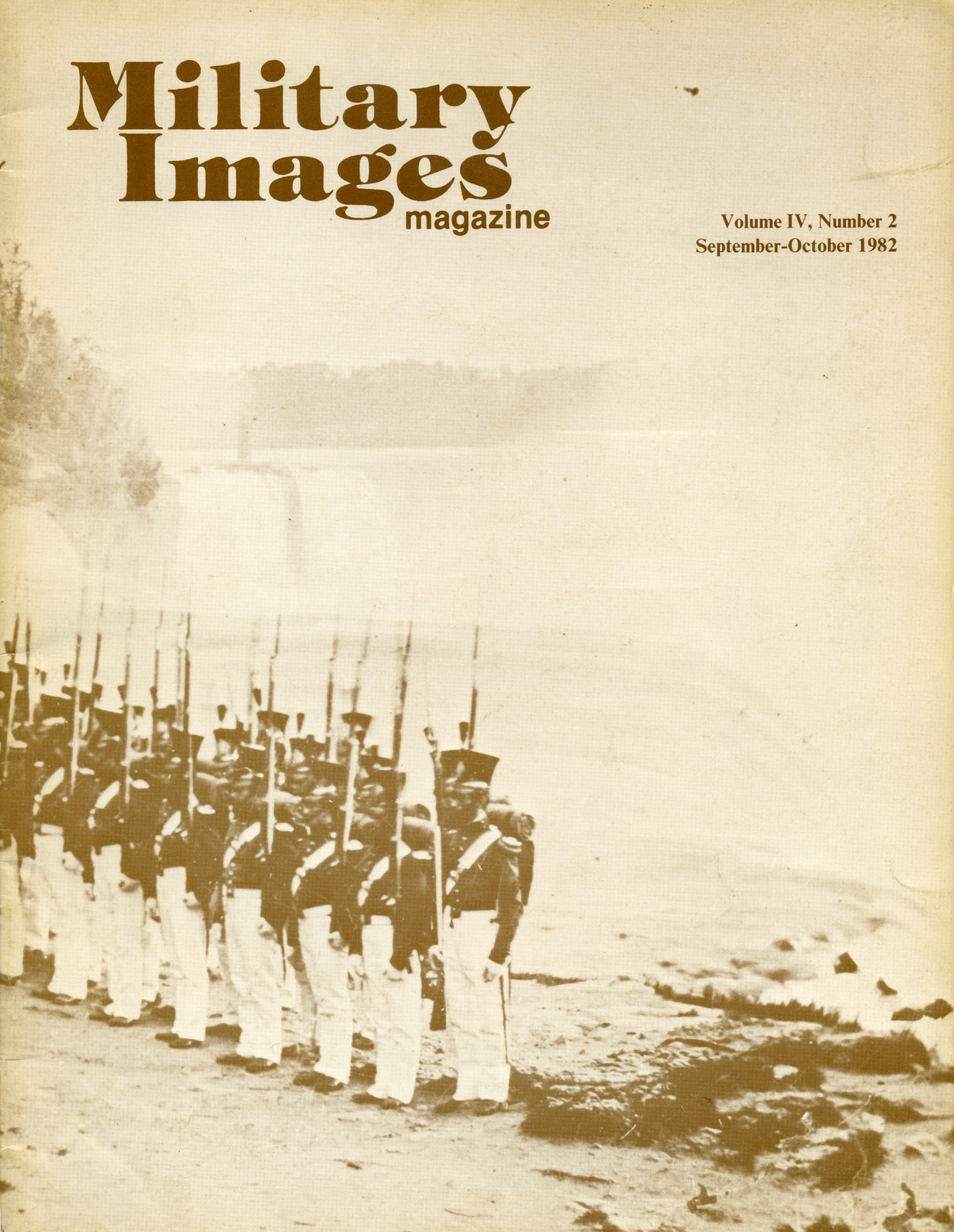
A full-plate ambrotype that wraps from front to back of the issue features a militia company with band at Niagara Falls. The image was taken at some point between 1854 and 1870.

Editor’s Corner (inside front cover)
The winner of the first issue is announced, and some insight into the results of the survey is given, with more results promised in the future.

Mail Call (pp. 2-3)
Several different types of responses are included in this edition of “Mail Call.” Several readers sent points of clarification on rifles, insignia, and identifications. Two different letters are examples of how family histories can sometimes detour from reality, with readers providing strong evidence that show what really happened to an individual, or who an individual in an image really was. Two letters also refer to the problem of reproducing old images, including one reader whose ambrotype was broken by a photographer in an attempt to copy it. A response to a reader also introduces the “Vignette” feature, which will provide a short biographic article focusing on an image of interest to readers.

Passing in Review (p. 4)
Five separate reviews are presented to the readership, beginning with Bringing up the Rear: A Memoir by S.L.A. Marshall. Edited by Cate Marshall, this work features reminiscences of “Slam” from the chase of Pancho Villa to Vietnam and the Arab-Israeli Wars of the 1970s, providing insight into the work of this soldier-historian-correspondent. Next is Civil War Corps Badges and Other Related Awards, Badges, and Medals of the Period by Stanley S. Phillips, which provides an excellent reference for collectors of these items. The book includes period images, current photographs, and advertisements for the commercially available insignia as well. Third in review is Custer Legends by Lawrence A. Frost, who puts to rest much of the “gossip, slander and innuendo” surrounding George A. Custer. Next is Hands Across the Wall by Stan B. Cohen, who provides readers a pictorial of the “Golden” and “Diamond” reunions at Gettysburg in 1913 and 1938. Finally, is General John Sedgwick: The Story of A Union Corps Commander by Richard Elliott Winslow III, providing a solid biography of a solid commander.

Vignette: The Rescue of Lieutenant Gilmore by John M. Carroll (p. 5)
A photograph of the rescued men led by Lt. J.C. Gilmore shows their condition upon reaching safety with an American flag they crafted while in captivity. Gilmore and a landing party of 14 were sent in April 1899 to find and rescue a group of Spanish soldiers who were under siege by the Filipino insurgents. Gilmore and his men were captured by Emilio Aguinaldo himself, and given good treatment until handed over to General Tinio. All of the Americans were rescued by Col. Luther Hare and his 33rd Texas Infantry, who received a promotion to brigadier for his action.

U.S. Army Uniforms of the Civil War, Part V: The Overcoat by Michael J. McAfee (pp. 6-11)
With the use of 16 different images, the author provides a discussion of history, regulation wear, and individual use of the Federal overcoat. Two different types of sky-blue kersey coats emerged for the enlisted man: single breasted with a shorter cape for infantry and double breasted with a longer cape for the cavalry. The officer variety was to be closed with frogs and loops as opposed to buttons, and was to be of a dark blue color. The major challenge facing Quartermaster Montgomery Meigs was the quick production of these coats before the start of cold weather; it was an impossibility and much leeway was given to the manufacture of these essential garments, although it was decided that the color gray would be avoided. The accompanying images show the wide variety of overcoats, sometimes showing that the cape, which was removable, could also be worn on its own, and there were many individual variations in how the coat was worn. For example, to make officers less conspicuous in the field, they were often permitted to wear the light blue overcoat.

Surgeon of the 20th by Seward R. Osborne (pp. 12-13)
Describing the career of Robert Loughran of the 20th New York State Militia, the author provides a glimpse into the career of a regimental physician. Starting off as a Surgeon’s mate in early 1861 and ending the Civil War as a Brevet Lieutenant Colonel, Loughran’s first experience with the 20th in the war was after Second Manassas, where casualties as high as 50% were experienced. As a Mason, Loughran was able to stay behind Confederate lines in safety for over a week as he tended to the wounded. He was also in charge of the hospital set up at the Lutheran Theological Seminary on the first day of fighting at Gettysburg, suffering himself only the loss of his horse and a flask of whiskey. Eventually, Loughran was assigned to set up the hospital at City Point, Virginia, which is not only described in the article, but accompanied by a drawing of the site that was done for Loughran at the time.

Guy Eisenhuth Sees the Elephant edited by Wayne Eisenhuth (pp. 14-15)
A humorous accounting of his grandfather’s service in World War One, the reader finds out that a boy of 16 could get into the Army by drawing the number “18” on his shoe and thereby truthfully swear that he was “over 18” when questioned by recruiting officials. Guy Eisenhuth became a driver during the war, and recounts several tales of driving the officers as well as driving an ambulance. At one point, he was designated the unit’s cook and created a dish made of beans cooked in French wine that knocked “the whole gang as stiff as goats” when served. The article does describe scenes with “Dutchmen” and some harrowing experience of “seeing the elephant” as related by Eisenhuth to his grandson.

Civil War Photo Maps by William Gladstone (pp. 16-19)
This article provides a great deal of insight into the Civil War developments that led to the application of photographic technology to the art of cartography. Maps are critical in the pursuit of war and the Civil War was no exception. Tracing the innovations by Michler, Margedant, and Campbell, illustrations are included that show the reader examples of the development of these new technical applications. The best example of how this culminated is the story of the map found on the body of Confederate General John R. Chambliss in August 1864, which showed the fortifications and important features surrounding Richmond. Using the photo copy method, reproductions of this map were distributed to all Union commanders within two days.

Corps Badges of the Spanish-American War by Robert Borrell, Sr. (pp. 20-22)
This photo gallery features 11 different men who served in the Spanish-American War, both in Cuba and the Philippines. Accompanied by a silhouette chart of all 20 corps devices and a close-up of a rare artillery badge, the article shows how the badge developed from its Civil War origins. While the badge shape itself changed, the use of red-white-blue to show division within a corps was still used. Some soldiers chose to wear gold or yellow metal versions instead of the felt variety.

Fighting Yankees: A Statistical Analysis of Late-War Uniforms in the Eastern Theater by Philip Katcher (pp. 24-27)
Similar to a previous article in Military Images, the author takes a look at the typical Union soldier from the Army of the Potomac between 1863 and 1865 to assess what really was typical for the enlisted soldier. The methodology is discussed and the study reveals what was common wear for vests, hats, cap insignia, coats, trousers, accoutrements, and miscellaneous items such as footwear or knapsacks. An unanticipated finding was that more men wore gaiters than was expected, and none of the images showed a man with his trousers tucked into his socks, despite paintings and literature of the time describing otherwise. One of the photographs included with the article (but outside of the scope of the survey) is an 1862 photograph of a soldier at Manassas Junction, the only known image of a soldier with trousers in socks known.

Stragglers (pp. 28-30)
Seven different stragglers are included in this edition’s feature. One collector requests additional information about an unusual Massachusetts militiaman’s uniform, while another alerts readers to a theft of a ninth-plate ambrotype of Luther H. Clapp of the 37th Virginia Infantry. A carte de visite image of Dr. Mary Walker is shared, complete with a mat made up of postage stamps of the Medal of Honor recipient. A quiz regarding an image purported to be a post-battle image at Devil’s Den asks readers to identify two major inconsistencies in the image. The final image appears to show a number of men at “Pine Camp” perched on what look much more like cooking appliances than the actual latrines that they are.

Finding Aid: July/Aug. 1982

1982-v4-01-iv-cover

The complete issue

Vol. 4, No. 1
(32 pages)

Print edition: Visit our store to check availability
Digital edition: Visit JSTOR.org to purchase
Subscribe to MI
Explore the MI Archives: Browse | Advanced search | Tutorial

Inside

Cover Image
The magazine cover shows an extremely rare 1898 image of three Spanish infantrymen in Cuba, with Mausers from 1893.

Editor’s Corner (inside front cover)
The editor explains the reason for featuring non-American military on the cover of the current issue. Due to its rarity and the fact that they were adversaries to American soldiers in the Spanish-American War, the editor felt it was a significant image and should grace the cover. The editor also announces a special drawing for another rare item: the premier issue of Military Images. Readers can submit the survey form on page 31 to enter a raffle to win a copy of the out-of-print issue, or an extension of their subscription by one year.

Mail Call (p. 2)
The readership provides clarification on the identification of a Tennessee Confederate officer, further information about the Lincoln family of Virginia, complaints (too many Yanks, not enough trans-Mississippi Yanks), and a reader who finds out that he most likely did see General Charles King when he was a child at a parade in Milwaukee in 1931. A request for information about the uniform worn by the 23rd Illinois (“Mulligan’s Chicago Irish Brigade”) was also made.

Passing in Review (p. 3, 5)
Three different publications are reviewed in this issue, beginning with Quartered in Hell: The Story of the American North Russian Expeditionary Force, 1918-1919 by Dennis Gordon. Told in the words of the men who were part of this campaign against the Bolsheviks after the end of World War One, the book provides insight into a little-known part of American military history. Next is The Guns of ’62, volume II of The Images of War: 1861-1865, edited by William C. Davis. With three errors noted in the review, the book was found to be a worthy text with some rare photographs included. Finally, a lengthy review of Attack and Die: Civil War Military Tactics and the Southern Heritage by Grady McWhiney and Perry D. Jamieson. The thesis of the work is that the South lost in the Civil War due to their tactics, which favored the offensive and was a reflection of the Scots-Irish heritage and culture that predominated in the South. While the reviewer disagreed with this assessment (and provided rationale for this disagreement), the book was still thought to be a very worthwhile and thought-provoking read.

Babes in Arms: A Photo Survey of Children in Patriotic Attire by Carol Villa (pp. 6-11)
Collected from reader submissions, the article is a pictorial featuring 23 different images of children wearing attire ranging from an antebellum sheriff with his four siblings to would-be Zouaves to a doctor and nurse wearing appropriate World War One outfits. One image may be of a member of a Baltimore Zouave unit made up of boys from age 9 to 14, while others are patriotic Yankee toddlers or little loyal Southern belles. Spanish-American War uniforms include a few soldiers and a sailor, while the siblings (boy and girl) wearing Indian garb and both holding different types of BB guns in a cabinet photo showed how they were interpreted at the start of the 20th century. The makes of the different air rifles and BB guns are also indicated, providing additional interest.

“Lee broke today…” by Alan J. Sessarego (pp. 12-13)
The author describes a recent find of his in an antique store, where he came across a pocket diary belonging to an employee of Alexander Gardner. John L. Cameron’s diary was purchased on December 30, 1865 and the entries ended in April 1866. Although not much is known about Cameron, it is known that he worked as a printer and grader of glass in the Gardner studio… and that a negative of General Robert E. Lee broke while he was grading it on March 28.

Three Rebs and Three Yanks by Thomas P. Sweeney and Robert J. Willey (pp. 14-15)
Thomas Sweeney provides information on two images that show all three of the Duval sons of Missouri, all three which would be killed in action while serving the Confederacy in the Missouri State Guard and then the 3rd Missouri Infantry. Both Henderson and Thomas would be killed at Champion’s Hill in 1863, while Lt. William Duval was killed at Corinth in 1862. Robert Willey provide the same for three Indiana friends who had to go north into Michigan to find a unit that would enlist all three. Andrew Kingsley was the first of the three to leave Company C of the 4th Michigan Infantry, being discharged for disability in a few months before Frank Spelman was killed at White Oak Swamp in 1862; the letter informing his father of this death was included with the article. Only Eugene Vaughn survived of the three, mustering out with the end of his enlistment in June 1964.

Pennsylvanians in Gray: Early Civil War Uniforms in the Keystone State by Michael J. Winey (pp. 16-23)
Sixteen different images detail the discussion regarding the different Pennsylvania units that began the Civil War wearing gray rather than blue. Sometimes it was due to the militia uniform that the men wore and sometimes it was due to the sheer volume of recruits and the more expensive blue dye needed to produce blue uniforms, but many Pennsylvanians went to war wearing a hue that was associated with the Confederates they were fighting. The article discusses the existence of swatch books, which show the colors used in uniform production until a standard Federal uniform could be provided. One very interesting pair of photographs shows a soldier and his family at Camp Slocum in Virginia, with soldiers in the background also wearing the same lighter colored uniform. The article provides a great deal of detail, outlining the various reasons for Pennsylvanians in gray, making the case for collectors to look closely and research their images.

Gettysburg Mystery Photo: A Second Look by Lawrence G. Bixley (pp. 24-25)
In a follow-up article to one printed in the March-April 1982 issue of Military Images, the author is able to provide additional detail regarding each of the two main questions that remained from the investigation of the Gutekunst image. Firstly, the tent in the original article is established as the embalming tent of Dr. Thomas Holmes, as it was identified as such in a Mathew Brady image. The question that arose from this second image, which is assumed to be a later image, is why the tent was moved a short distance from where it was in the Gutekunst image. Secondly, the author of the current article provides a definitive image of Marie “French Mary” Tepe, which shows her wearing the Kearny Cross which she was awarded for bravery shown during the Battle of Fredericksburg. With the veracity of that part of the previous article answered, the question of the details surrounding her two marriages are addressed. Her first husband did not die in her arms at Gettysburg, but was taken prisoner on the first day, eventually spending six months in a Confederate prison. The question of her second husband is still not resolved.

Stragglers (pp. 26-29)
The submissions by the readers include two World War One machine gunners of the 322nd Machine Gun Battalion, 86th Division aiming at the camera in 1917, Marines relaxing under the shadow of a tent fly among the headstones of fallen comrades in Cuba in 1898, and a very rare 1861 tintype image of the Main Plaza in San Antonio, Texas in 1861 as Federal military gather to leave after their surrender by General David Twigg in February of that year.

Back Image
The back image is of a very small “Confederate” standing at attention in a sixth-plate tintype.

Finding Aid: May/June 1982

1982-v3-06-iii-cover

The complete issue

Vol. 3, No. 6
(32 pages)

Print edition: Visit our store to check availability
Digital edition: Visit JSTOR.org to purchase
Subscribe to MI
Explore the MI Archives: Browse | Advanced search | Tutorial

Inside

Cover Image
This issue features an enlargement of a carte de visite image of what appears to be the formation of an infantry company during the Civil War.

Editor’s “Corner” (inside front cover)
Due to an increase in the amount of advertising in the current issue, the editor is limited to just a small space, where he announces a change to a higher gloss paper, the increase of subscribers, and that there are subscribers in all states and ten foreign countries.

Mail Call (p. 2)
Readers provide clarification on two issues: the identification of a Coast Artillery Reserve badge in use between 1910 and 1917 and the manufacture of Pennsylvania battle flags during the Civil War.

Company D, 4th Texas Cavalry: A look at the “Ellis County Bengal Tigers” by Danny Sessums (p. 3)
The photograph presented by the author was made in either late 1863 or early 1864, and shows the recruitment effort for a trans-Mississippi company of the Arizona Brigade, 4th Texas Cavalry. The article describes the uniforms, weaponry, and accoutrements used by the men in the image. The value of this rare image, as stated by the author, is that it challenges the belief that trans-Mississippi units were not well-armed.

Battle at Bacalod: Action in the Philippine Islands, 1903 by George M. Cress (pp. 4-7)
Six pictures taken by the unit chaplain illustrate the challenges facing Captain John J. “Black Jack” Pershing and his 15th Cavalry soldiers during their fighting at the fortress outside Bacalod on the island of Mindanao. Complete with moats, parapets, and walls as thick as they were tall, the Americans were fighting Moro guerillas who were challenging U.S. occupation. The article also includes images of Hospital Steward Charles Lincoln Leonard, his military awards and insignia, and a portrait of him in a St. Louis Fire Department uniform when he returned from his service in 1905.

Samuel Dana Greene, U.S.N.: Executive Officer of the Monitor by Charles S. Schwartz (pp. 8-9)
With a lineage of military and public service behind him, including Nathaniel Greene of the American Revolution, Samuel Dana Greene was the second in command of the Monitor during her famed battle against C.S.S. Virginia in the Civil War. He directed each shot fired by the Monitor and when the machinery failed during the fighting, he personally directed the positioning of the turret by hand when the mechanism broke. Taking command of the vessel when the commander was injured, the erroneous perception, outlined in the article, that Greene retreated from the fight dogged him for years. One may assume that this unrelenting criticism led to his suicide at the age of 44 in 1884.

U.S. Army Uniforms of the Civil War, Part IV: The Jacket by Michael J. McAfee (pp. 10-15)
This pictorial article provides the background of the military jacket as worn by Federal enlisted soldiers. Originally beginning with the shell jacket, which was to end at the natural waistline of the soldier, the jacket was adapted to the “uniform” jacket, which extended a few inches lower, generally below the beltline. Often discussed interchangeably, there are distinctions, and as the 16 images provided in the article show, there were also many variations. Some were for specific reasons, such as to accommodate the wearing of a saber belt, but others were personalized and still others were very unusual.

Johnny Came Marching Home: Recollections of Company E. 3rd Army Composite Regiment by Merwin Silverthorn and John A. Stacey (pp. 16-19)
Based on interviews with Lt.Gen. Silverthorn, U.S.M.C., Ret. along with his personal papers and photographs, the author describes the experience of the unit, which was designed to serve as a ceremonial unit and honor guard for General John J. Pershing, Commander of the American Expeditionary Forces, at the end of World War One. The article describes the process and training of the company, of which 1Lt. Silverthorn was deputy officer. The photographs include a panoramic image of the company with an enlargement of the commanders, images from a few of the celebratory parades in which the regiment took part, and some of the enlisted men of Company E.

Passing in Review (p. 20)
The first of three reviews in this issue of Military Images is entitled Regimental Strengths at Gettysburg by John W. Busey and Dr. David Martin. This limited edition of 1000 copies attempts to fine-tune the strengths of both the Federal and Confederate armies that met at Gettysburg. The second publication is E.M. Collar Insignia, 1907-1926 by L. Albert Scipio II, which provides the history, specifications, and other information regarding the collar disks worn by Army personnel in a highly organized format. The final review is of If the South Won Gettysburg by Mark Nesbit. While the first part of the book recounts the facts up to July 2, the second half looks at “what if” Robert E. Lee had followed James Longstreet’s suggestion.

Memoirs of a Rebel, Part II: Chancellorsville and Gettysburg by John Calvin Gorman (pp. 21-25)
Edited by a descendant, the memoirs of Captain John Calvin Gorman of Company B, 2nd North Carolina Regiment follow him through the Battle of Chancellorsville as well as the three days at Gettysburg. The first story is a humorous tale about how two Southern women across a river gave Gorman a clue that the Yankees were going to be crossing soon, which they did the next day. Becoming more serious, the reader gets a sense of what it was like to be part of Jackson’s flanking maneuver that Chancellorsville is known for. Gorman recounts Jackson’s wounding and then is present to receive the congratulations from Jeb Stuart, who took command the next day. The next part of the memoir recounts moving up towards Pennsylvania and how the Confederates were greeted by liberated Southerners and by Union supporters when they got to Martinsburg. Very telling is Gorman’s reflections on the situation at the end of the first day at Gettysburg, which he says would not have ended as it did had “Old Jack” still been with them. He and his men heard the sounds of preparation during the night, and awoke to face the gathered Union Army that had previously been in retreat. He describes the second and third day, and preparations for a moonlight attack which never took place.

Portrait of a General: John Newton by James F. Neel (p. 27)
A cabinet photograph copy of the original carte de visite image taken after his promotion to brigadier at the end of March, 1863, the previously unpublished portrait of John Newton accompanies this biographic article. Newton was known for having accompanied his brigade commander John Cochrane and gone to both Secretary of War Seward and President Abraham Lincoln to remove Ambrose Burnside from command after the disaster at Fredericksburg. After the first day at Gettysburg, Newton was selected to replace fallen General John Reynolds as the commander of I Corps until 1864 and his corps was reorganized out of existence. After the Civil War, Newton returned to his original role as an Army engineer, eventually becoming the commander of the Corps of Engineers. Upon retirement, he was elected the president of the Panama Railroad Company.

Stragglers (pp. 28-31)
This edition of stragglers features several individual images of soldiers with unusual insignia that require identification, and hopes that the readership can provide enlightenment. Also included is a carte de visite outdoor image of Yankees crowded outside of a photographer’s studio, with samples of his work hanging on the walls outside. A large image of a Pawnee chief taken in Mathew Brady’s studio about 1885 completes the reader submissions.

Finding Aid: January/February 1997

The complete issue

Vol. XVIII, No. 4
(40 pages)

Print edition: Visit our store to check availability
Digital edition: Visit JSTOR.org to purchase
Subscribe to MI
Explore the MI Archives: Browse | Advanced search | Tutorial

Inside

Cover image
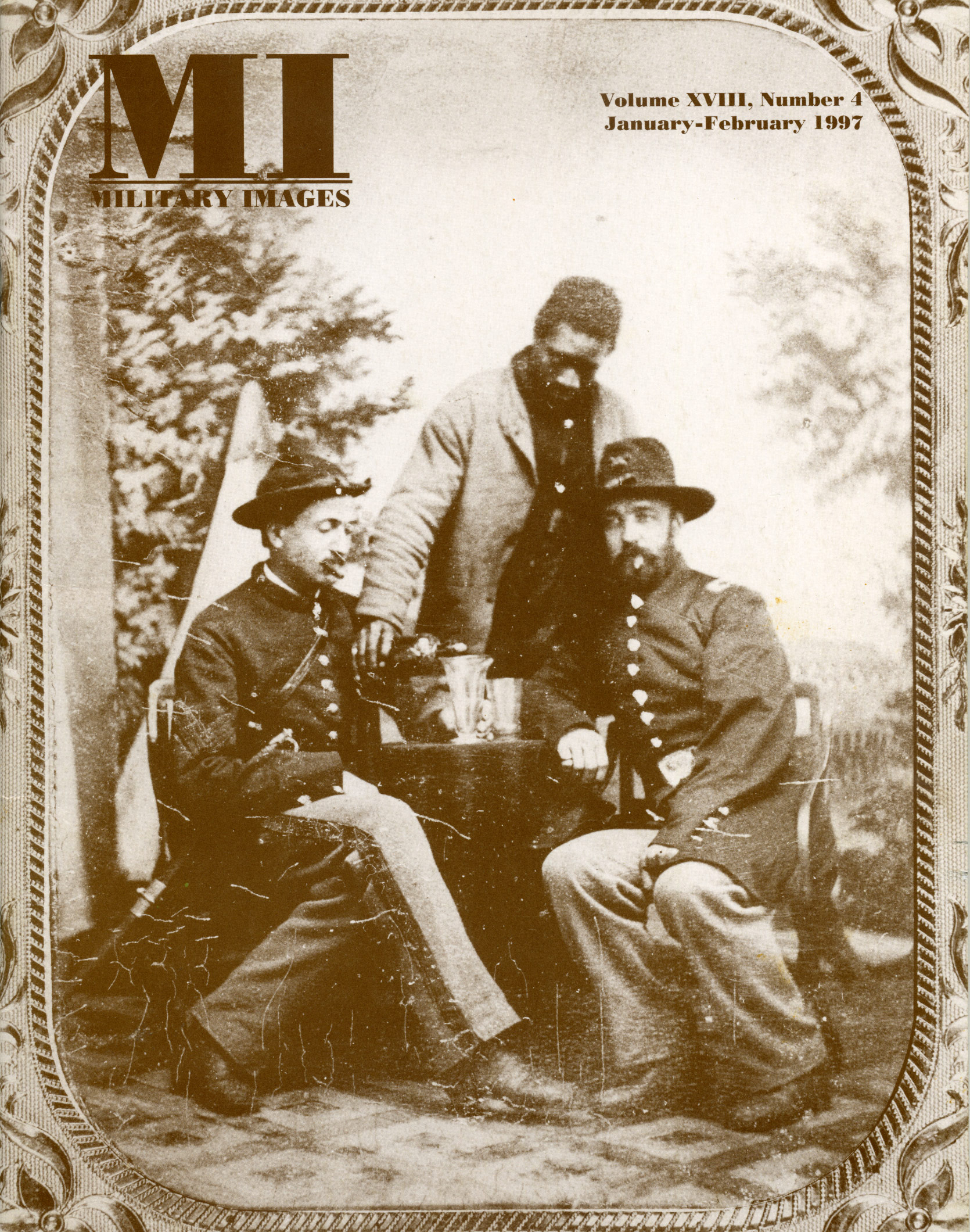
A sixth-plate tintype from the Coby Mack Collection pictures three Yank tipplers at the officers’ mess enjoying a break from endless rounds of drill.

Editor’s Desk (p. 3)
The editor notes work on the Irish Brigade monument at Antietam, Ron Tunison’s medallion bust of Gen. Meagher and new mailing software.

Mail Call (p. 5)
Letters include feedback about hospitals, glass plate negatives, postal issues and “Uncommon Cavalrymen.”

Passing in Review (pp. 6-7)
Five publications are mentioned, including American Civil War Confederate Army (Brassey’s Inc.) by Ron Field, Bentonville: The Final Battle of Sherman and Johnston (University of North Carolina Press) by Nathaniel Cheairs Hughes, Jr., The Alabama and the Kearsarge: The Sailor’s Civil War (University of North Carolina Press) by William Marvel, Photographer Under Fire: The Story of George S. Cook (Historical Resources Press) by Jack C. Ramsay, Jr. and Civil War Firearms (Combined Books) by Joseph G. Bilby.

The Philadelphia National Guards: Antebellum company of uniformed militia by James Durkin (pp. 8-9)
A brief history of the militia company that became a regiment that mustered into federal service during the Civil War as the 19th Pennsylvania Infantry is illustrated with portraits of John T. Durang before and during the war. He was seriously wounded at Gettysburg.

A Search Through Time: Charles Mitchell, Kentucky Confederate soldier by Richard Staley (pp. 10-11)
The author relates his experience on the research trail, hunting for information about a soldier identified in a portrait photograph as Charles B. Mitchell.

“Shell Fever” & Other Zouaves: An album of U.S. troops in baggy trousers by Brian Pohanka, et al (pp.12-17)
A survey of 20 portraits from the collections of our readers highlights the wide variety of Zouave-inspired fashions worn by soldiers as late as 1910.

Uniforms & History by Michael J. McAfee (pp. 18, 35)
In “8th Regiment, Massachusetts Volunteer Militia,” McAfee explores the history and uniforms of this hybrid Zouave regiment. The text is illustrated with a portrait of an enlisted man from the regiment.

George Henry Stevens, Orderly Sergeant, Company B, Milwaukee Light Guard: Winner of Milwaukee’s antebellum drill competition by Alan D. Gaff (p. 19)
A description of how Stevens won the competition is also a lesson in drills of the antebellum period. Stevens went on to fight in the Civil War with the 2nd Wisconsin Infantry and suffered a mortal wound in the fighting at McPherson’s Woods at Gettysburg.

Harpers Ferry to Peking: Journeys of a 19th century soldier, Augustus Corliss by Chris Nelson (pp. 20-30)
The story of “Augie” Corliss spans from 1861 to 1904 and includes numerous anecdotes and life details. The text is illustrated with ten photographs and artworks of Corliss, and images of his cap, coat, revolver and a post-Civil War badge.

The Frozen Prairie: Winter tragedies in Minnesota by Roger Norland (pp. 31-32)
A well-known portrait of Benjamin Franklin of the 2nd Minnesota Cavalry illustrates a story of how he came to lose his legs to frostbite. Also included is an image of Franklin before he lost his legs.

Light & Shadow by Sam Tucibat and Scott Cross (p. 33)
In “The Wet Plate Process Enters the Computer Age,” the authors explain how photos can be retouched using a powerful application by Adobe called “Photoshop.”

The Auction Block (p. 34)
Latest auction news.

Captain Bob’s Caveat Emptorium (p.35)
The Captain tries to pull a fast one over readers with an almost genuine Zouave image.

Stragglers (pp. 36-37)
Solo photos of the odd and unusual from the collections of our readers includes nine Confederate portraits.

Sutler’s Row (pp. 38-40)

Back cover
A sixth-plate tintype from the Michael Albanese Collection pictures a soldier posing with a mug, an apple on a tin plate, and an unknown morsel on the end of his fork.

Finding Aid: March/April 1982

1982-v3-05-iii-cover

The complete issue

Vol. 3, No. 5
(32 pages)

Print edition: Visit our store to check availability
Digital edition: Visit JSTOR.org to purchase
Subscribe to MI
Explore the MI Archives: Browse | Advanced search | Tutorial

Inside

Cover Image
The cover features a “dandy” sixth-plate tintype of a fully armed George Maddox, chief scout for Quantrill’s raiders.

Editor’s Page (inside front cover)
The editor introduces a new feature – “The Bulletin Board” – where events that relate to the study of American military history of any era can be listed. The current issue has a number of Confederate articles, the result of a call for more articles of this type. The editor also highlights upcoming issues that readers can look forward to.

Mail Call (pp. 2-3)
A few corrections are made, suggestions for future articles are put forward, and a cautionary tale about knowing one’s memorabilia is offered. The passing of George E. Gorman III is also noted.

Passing in Review (p. 3, 27)
Uniforms of the Continental Army by Philip Katcher is the first review in this issue of Military Images, and is hailed as the new authority on the uniforms worn by the American army and navy of the Revolutionary War era. The next review is of Bushwhackers of the Border: the Civil War Period in Western Missouri by Patrick Brophy, which provides insight into the complex nature of this area and its history. Lastly, Infantry Regiments of the U.S. Army by James Sawicki is reviewed. While it is considered to be a very comprehensive and detailed work, Civil War readers are cautioned that many volunteer regiments are not included unless they had links to units continuing into the 20th century.

Santa Cruz, 1885 by J. Phillip Langellier (pp. 4-8)
Complete with nine images that present insight into this festive encampment, the article describes the first all-state encampment of the California National Guard between August 15 and 23, 1885. Santa Cruz was chosen as a location that was pleasant and easy to reach from across the state, and each company was given funding for 35 attendees, although more could attend if they could manage the expense on their own. The article provides ample detail on uniforms, weaponry, and activities, as well as highlighting the objection of the inspecting regular Army officer to the late nights and the Chinese lanterns that (in his opinion) diminished the martial nature of the event. The images reveal that not very many of the guardsmen objected.

A Confederate Lincoln by Dale S. Snair (p. 9)
It is common knowledge that relatives of Abraham Lincoln’s wife, Mary Todd Lincoln, chose to fight with the South during the Civil War, but it is not as well-known that Abraham Lincoln himself had extended family that resided in Virginia. In a short biographical article accompanied by an image of Benjamin Franklin Lincoln, the reader learns about how a second cousin of the American President became a member of Company H, 10th Virginia Cavalry, riding under Jeb Stuart. Returning to his home at Lacey Spring at some point in 1864, Private Lincoln died of illness or wounds in November of that year.

Eye of the Collector by Kean Wilcox (pp. 10-15)
The author presents 19 images from his collection of photographic images. Wilcox explains that there was no real rhyme or reason behind his purchases, except that he liked them. Many are in cases and as he recently noticed, many are of military men. The current selections have some sort of unique aspect to them, like the quarter-plate ambrotype of an American militiaman wearing a large bearskin busby reminiscent of British, several images of very young Confederates, and one very sharp image of a Federal soldier in which one can see the reflection of the camera in his eyes. The final image is the author’s favorite: a full-plate ambrotype of an outdoor scene at a military academy. Three smaller details are included in close-up and show one tiny guidon bearer, women watching the review from the roof of the building, and one of the cadets or militiamen in the ranks. The image provides one small snapshot of life at the time with plenty of detail for readers of MI to enjoy.

Gettysburg Mystery Photo by William Gladstone (pp. 16-19)
The author shares his acquisition of a well-known Gettysburg image, positively identifying not only the place it was taken, but establishing the true identity of the photographer. Taken “Looking East from Cemetery Hill” by Frederick Gutekunst of Philadelphia, a more modern attempt to look at the details of the image by using current enlarging equipment available to him, the author finds two revealing things that provide some answers, but bring up even more questions. First, the tent in the image is an embalming tent of an unidentified “surgeon” using “Holmes’s Process.” Is this the tent of Thomas Holmes, who perfected the practice of chemical embalming, or the tent of another embalmer who used his process? Secondly, the person in the middle of the image who is leaning against a fence post, is not a conventional soldier, but a woman dressed in a Zouave uniform, a vivandiere who often accompanied and worked with a unit. The author found that this was not just any vivandiere either, but the well-known Marie “French Mary” Tepe who saw distinguished service with the 114th Pennsylvania Infantry. This led to many questions about Mary’s past and what she might have been doing at that location, where her supposed first husband served with the 27th Pennsylvania. The transcript of a newspaper article announcing her intended divorce from her second husband in 1897 accompanies the article “She Feared Not War” from the New York Sunday World, and provides some (questionable) insight into Mary’s military adventures.

Fighting Confederates: A statistical analysis of late-war uniforms by Philip Katcher (pp. 20-23)
By using nine group images of Confederate soldiers, some of which are included with the article, as well as a number of individual portraits selected from a wide variety of publications, the author conducted a statistical analysis of what the “typical” Confederate soldier would wear. After a discussion of the many sampling errors inherent in a study of this nature such a long time after the occurrence and attempts to correct or adjust for some of them, the author was able to determine a statistical average for hats, packs, coats, and belt plates, thereby allowing a much richer picture of what attire a Confederate soldier would have worn to emerge.

General Charles King by Paul L. Hedren (pp. 24-26)
Beginning with a brief biographical background about the “author-soldier” who served during five wars over a 70 year military career, the MI reader then learns about the literary contributions of Charles King. Beginning in 1880, King wrote fiction, histories, and articles set in the military contexts with which he was intimately familiar for reading audiences which appreciated his ability to bring distant scenes to life for them. The article provides photographs of King at the beginning and end of his military career, a group image with the 5th Cavalry in the Black Hills of Dakota Territory, and two illustrations. One depicts an event in his career while the other is a political cartoon critiquing his combining of pen with command during the Spanish-American War.

Stragglers (pp. 28-31)
Contributions from readers include a member of the Coast Guard with unusual uniform items such as cavalry boots, a rare image of a group image from 1898 that includes an NCO holding both the Heavy Artillery First Class Gunner’s Badge and a cat, a previously unpublished cabinet card of George A. Custer in dress uniform from about 1874, and also a few images that request further information from the readership.

Back Cover
This issue features a group image of Yankees settling down with a picnic basket in an imperial size image, probably taken of Butler’s Army of the James.

Finding Aid: Jan./Feb. 1982

1982-v3-04-iii-cover

The complete issue

Vol. 3, No. 4
(32 pages)

Print edition: Visit our store to check availability
Digital edition: Visit JSTOR.org to purchase
Subscribe to MI
Explore the MI Archives: Browse | Advanced search | Tutorial

Inside

Cover Image
An unidentified New York corporal holding hands with a lady who is probably his wife graces the cover of this issue.

Editor’s Page (inside front cover)
Responding to reader requests for images of the women of the Civil War, the editor explains that the regular “Stragglers” feature is replaced in this issue by a pictorial focusing on the women the soldiers left behind.

Mail Call (p. 2)
The editor responds to letters from readers, who submitted clarifications, corrections, suggestions for articles, and requests for information from the readership.

Passing in Review (p. 3)
The first publication reviewed is Military Uniforms in Canada, 1665-1970 by Jack L. Summers and Rene Chartrand. Consisting of quarto-sized plates to provide images of French, British, and Canadian uniforms, the review feels this would be a very helpful work in identification of uniforms often confused with American militia or Confederate soldiers. The second review is of Gallant Fourteenth: the Story of an Indiana Civil War Regiment by Nancy Niblack Baxter. The author drew from primary source documents such as diaries and letters to compose a regimental history with descriptions of the individuals and battles along with a collection of images. Finally, the book The Hardtack Regiment: an Illustrated History of the 154th Regiment, New York State Infantry Volunteers by Mark H. Dunkelman and Michael J. Winey is reviewed. The volume includes several images of members of the regiment, complete with biographies.

John Hartranft, Defender of the Union by Harry Roach (pp. 4-9)
A little known commander from Pennsylvania, Col. John Frederick Hartranft was often involved in some of the major campaigns of the Civil War. After his 90-day militia regiment left the day before the fighting at First Bull Run (their enlistment had expired), Nartranft remained and fought with valor, eventually receiving the Medal of Honor for his rallying of two Massachusetts regiments at the end of the action. He returned to Pennsylvania and raised the 51st Pennsylvania Infantry, which was often linked with the careers of Edward Ferrero and Ambrose Burnside. Despite being a teetotaler, Hartranft led his hard-drinking 51st at New Bern, during the last push at “Burnside’s Bridge” at Antietam, at Fredericksburg, Chattanooga, and several other campaigns, often without due recognition. He was hailed as the “Hero of Fort Stedman” at the end of the war, culminating his career as Brevet Major General.

Images of the 51st Pennsylvania Infantry (pp. 10-13)
A collection of 19 images of members of 51st Pennsylvania Infantry follows the biographical article of their colonel, John Hartranft.

The Havelock by Don Dillon (pp. 14-15)
The article and accompanying images features the seldom used uniform hat cover, which draped over the back of the neck in order to protect from sunburn and heatstroke. Popularized during the Sepoy Rebellion of 1857 and a staple of the French Foreign Legion, the havelock was only popular at the beginning of the Civil War as it did not provide the air circulation that soldiers preferred. One of the four images includes an alternative to the havelock in the form of a kepi with a brim as worn by the 5th New Hampshire Infantry.

Sunshine Soldiers: New Jersey’s Nine Months Regiments at the Battle of Fredericksburg by Joseph G. Bilby (pp. 16-23, 13)
The author uses many personal stories to describe how New Jersey developed a nine-month system of militia service in parallel with a regimental system requiring three year commitments. The article describes the chaos of training camp and the politics behind the election of officers, using the election of George Mindil as the “Boy Colonel” of the 17th New Jersey due to his recent service with General Phil Kearney, who had recently been killed at the Battle of Chantilly. Mindil got his regiment into disciplined order while training them in the shadow of the U.S. Capitol building, while other nine-month regiments were not as disciplined. As the nine-month regiments moved towards and then into Fredericksburg, the men had different experiences – from participating in looting to experiencing the horrors of the fighting–which augment the overall story of the Battle of Fredericksburg.

The Girl I Left Behind Me by Carol Villa (pp. 24-31)
Thirty-three different images, most of them cartes de visite, ambrotypes or tintypes, illustrate this pictorial of the men who fought in the Civil War with the women for whom they fought. The images provide a wider sense of the more common forms of dress of the era than do the periodicals of the time, which were often the more elaborate “fashion plates” that guided more understated lifestyles. A few of the images are taken outdoors: one was at Lookout Mountain and another is of a woman riding sidesaddle on a horse led by a soldier. However, most are studio images that include wives, sisters, children, and mothers.

Back Image
A touching image of Lt. Col. Judson Kilpatrick of the 2nd New York Cavalry and his wife, who is wearing a fur-trimmed winter mantle with muff.


Finding Aid: Nov./Dec. 1981

1981-v3-03-iii-cover

The complete issue

Vol. 3, No. 3
(32 pages)

Print edition: Visit our store to check availability
Digital edition: Visit JSTOR.org to purchase
Subscribe to MI
Explore the MI Archives: Browse | Advanced search | Tutorial

Inside

Cover Image
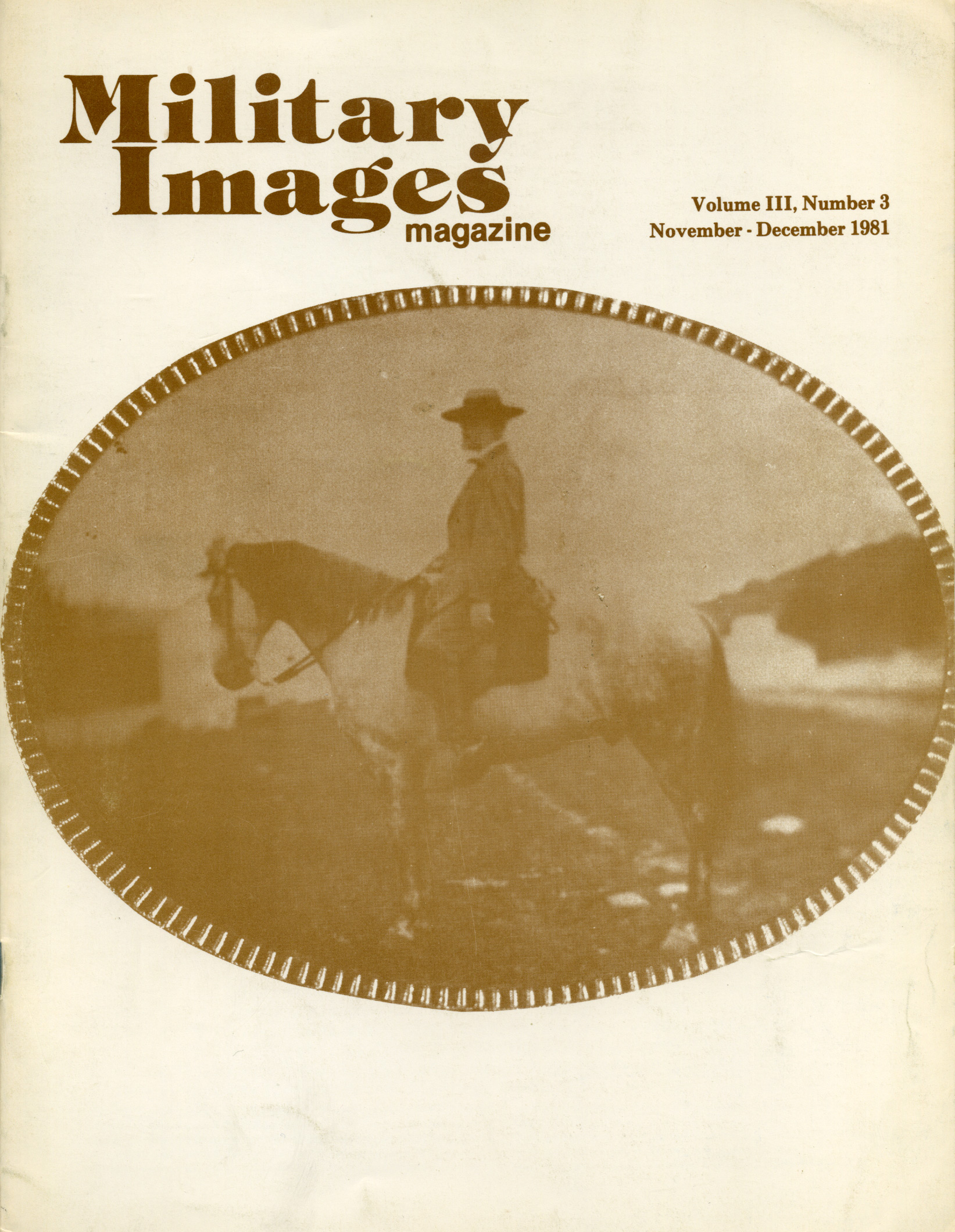
A previously unpublished quarter-plate melainotype taken in 1866 of General Robert E. Lee astride his horse Traveller.

Editor’s Page (inside front cover)
The editor announces not only a change in address, but his marriage to Military Image attorney.

Mail Call (p. 2)
Letters from subscribers provide their comments about past issues and suggestions for those in the future. Of interest was a recently discovered photograph of “Stonewall” Jackson. The editor described how the identification of the casual soldier in a private’s coat was made.

Passing in Review (p. 3)
The feature begins with a review of Autographs of the Confederacy by Michael Reese II, which is based on the collection of autographs compiled by John F. Mayer, who was a clerk in the Confederate War Department. The beautifully bound book contains the signatures of many notable individuals, including all of the Confederate general officers, some of which are extremely rare. The second review is of The Image of War, 1861-1865, Volume 1: The Shadows of the Storm edited by William C. Davis. Containing over 650 images with context provided by noted specialists, this first of a projected six volumes was given high marks.

Memoirs of a Rebel, Part I: South Mountain and Sharpsburg by John Calvin Gorman (pp. 4-6)
Edited by his grandson, George Gorman, North Carolina journalist John C. Gorman wrote out his memoirs of his time as a captain in Company B, 2nd North Carolina Regiment. This first installment for Military Images describes the action at South Mountain and the battle fought at Sharpsburg, including a stirring description of what it was like to fight in the “Bloody Lane” where so many of both sides fell.

The Hanging by William Christen (pp. 7-8)
The author takes the reader on a sleuthing mission to discover the truth behind two postcard photographs found in his grandfather’s collection of World War I photographs. Taken on board the Indiana in 1918, the details of the story behind the gleeful seamen, a lack of officers, and a hanging victim are revealed.

U.S. Army Uniforms of the Civil War, Part III: The Artillery by Robert Borrell, Sr. (pp. 9-15)
A collection of 19 images accompanies this article which describes the uniform requirements of the Federal artillery as worn in the Civil War by both enlisted and officer ranks, and by light and heavy artillery. One trio of images shows the wear of frock and sack coats as well as the shell jacket, while another trio shows the wear of Hardee, kepi, and plug hats. An interesting feature of the pictorial is the close-up images of a gold bullion artillery insignia worn on the kepi of 2d Lt. Eben Hall of the 4th Connecticut Infantry as well as two different commercially purchased badges engraved with a soldier’s name.

The Few, the Forgotten: The Confederate States Marines by David L. Sullivan (pp. 16-21)
Difficult to research as the official records of the Confederate States Marine Corps were burned in Richmond at the end of the Civil War, the article traces the development and history of this little known group. With service as diverse at guarding shipping in dock at New Orleans to participating in on the Virginia as it fought at Hampton Roads to fighting at Saylor’s Creek, the four companies of the Confederate Marines were involved in conflict with the Federals consistently throughout the war. The article includes several images of notable Confederate Marines along with short biographies.

Harvard Crimson to Horizon Blue: The Odyssey of Parker Ellis by Dale Biever (pp. 22-23)
Many young American men, several from Ivy League schools, decided to fight in World War One long before the United States entered the conflict in 1917. One of these was Parker Ellis, who left Harvard in early 1917. Photographs that accompany the article show his transition from an ambulance driver for the American Field Service in France and Italy to his training with the French Foreign Legion. Eventually serving as a lieutenant with the 260th Artillery, he was awarded the Croix de Guerre for bravery for his actions in the field in October 1918, shown in a portrait taken in 1919. He was not yet 22 years of age.

“U.S. Official:” A look at the Signal Corps photos of the First World War by Philip Katcher (pp. 24-26)
Five large format images, each marked with a “U.S. Official” stamp, from the collection of the author show very different aspects of the conflict. From soldiers of the Signal Corps wearing special gas masks that allowed them to communicate normally to camouflaged snipers returning from the trenches to a group of Americans with a captured German Howitzer, these images provide detail that many other images of the time were unable to obtain. The collection also includes a group photograph of a mobile “Dental Car” sent from New York, with dentists ready to apply their skills. The final image of the pictorial is a unique view of troops of different nations from both sides of the conflict – German and Austrian, American and British – apparently celebrating the Armistice that called an end to the fighting of World War One.

Private Benjamin Franklin: Company H, 2d Minnesota Cavalry by William Gladstone (p. 27)
The article presents a fund-raising carte de visite featuring Private Franklin, the only soldier of the era to undergo and survive partial amputation of all four limbs. Caught in a snowstorm after escorting a wagon train as part of his Indian fighting duty, and without shelter or food for a week, Franklin was the only survivor from the detail. He was rescued by friendly Indians and brought to Fort Ridgley for treatment. While provided with a small government pension, Private Franklin sold copies of his carte de visite for a quarter as a way to earn extra income, a “not uncommon practice after the Civil War.”

Stragglers (pp. 28-31)
From Company H, 31st Michigan Infantry celebrating the birthday of General Robert E. Lee in Savannah in 1899 on their way to Cuba to some unique personal additions to regulation uniforms, this edition of “Stragglers” includes some unusual images. A previously unpublished image of Col. Frederick G. D’Utassy of the 39th New York “Garibaldi Guard,” an unofficial “foreign legion” fighting with the Union, is presented. Readers are also given a quiz to test their knowledge: How many of the four images of soldiers in grey are Yanks?

Back Image
The elaborate image of a sergeant in the 2nd Regiment, Wisconsin National Guard, Oshkosh from between 1878 and 1886 is featured.