Finding Aid: May/June 1984

1984-v5-06-v-cover

The complete issue

Vol. V, No. 6
(32 pages)


Print edition: Visit our store to check availability
Digital edition: Visit JSTOR.org to purchase
Subscribe to MI
Explore the MI Archives: Browse | Advanced search | Tutorial

Inside

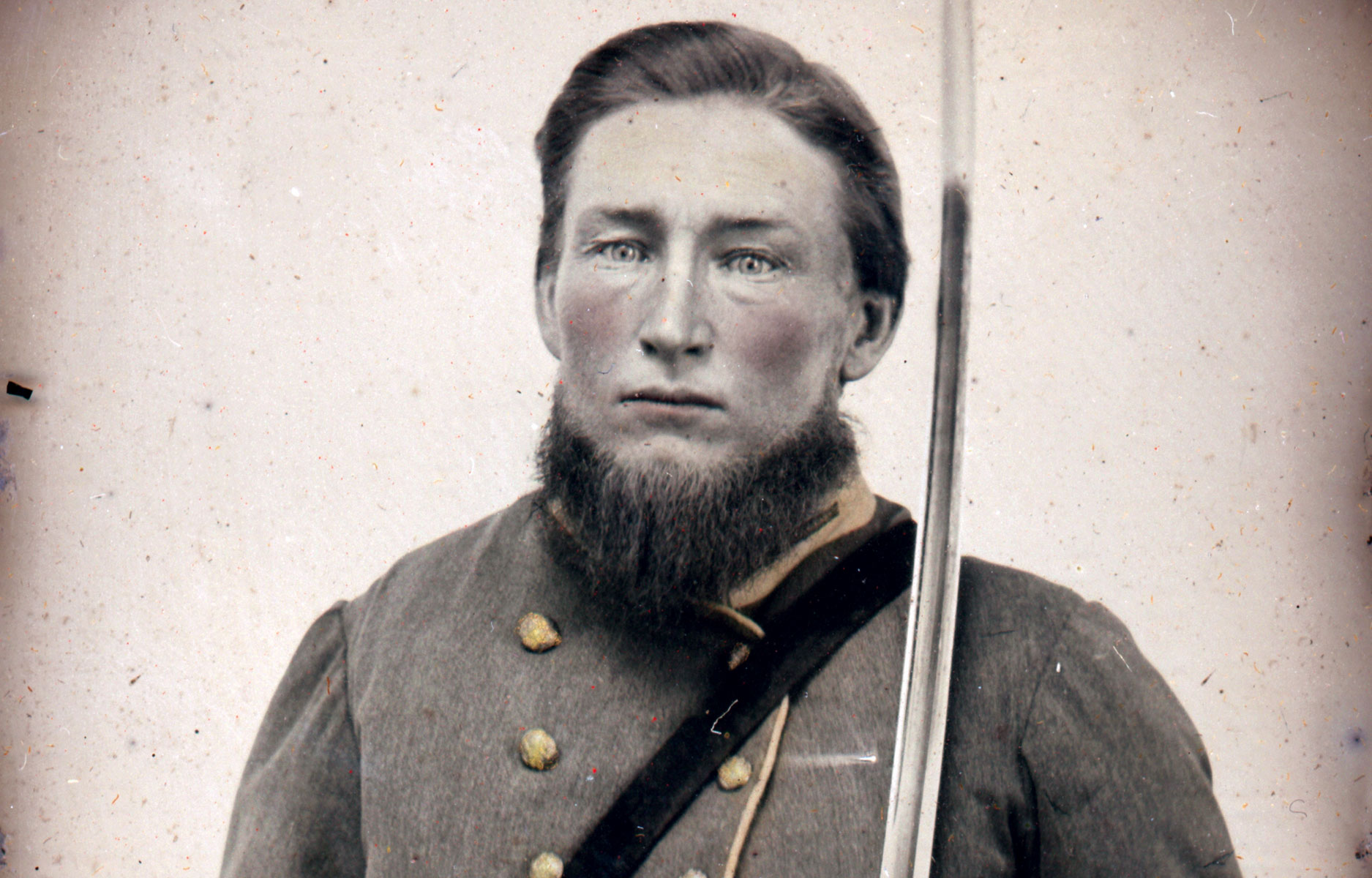
Cover image
The elaborate image of a tirailleur of the 146th New York Infantry, also known as “Girard’s Tigers,” features a Zouave style uniform known as a Turco. The unidentified soldier wears a light blue uniform with yellow trim.

Editor’s Desk (p. 1)
The editor asks the readership to participate in the goal of preserving 9000 acres around the Custer Battlefield National Monument. Only 760 of the newly released federal land will be preserved unless it is purchased and then donated to the National Park Service. The editor also notes that the article “The Famous Petersburg Photo” (January-February 1984) should have included Harris Andrews as co-author with Brian Pohanka.

Mail Call (p. 2)
The letters to the editor provide some further insight into the New Hampshire cap (which was featured in a past issue as well as the current issue of Military Images), the correct uniform of a Scot’s Guard officer, and a correction regarding the use of the word “Congressional” when referencing the Medal of Honor.

Passing in Review (p. 3)
There are four different publications reviewed for readers in this issue. First is The United States Cavalry: An Illustrated History by Gregory J.W. Urwin, a short history of the cavalry from the Revolutionary War to the single cavalry unit to see action in World War Two, including 32 color-plates and 100 black-and-white photographs. Next is The Civil War in Maryland by Daniel Carroll Toomey, who presents a detailed chronological accounting of over 280 different large and small conflicts between Federal and Confederate forces in this border state. A Battlefield Atlas of the Civil War by Craig L. Symonds, with cartography by William J. Clipson, provides readers with a way to view the flow of Civil War battles by using simple and uncluttered maps in an organized chronological format. Those who hope to use this book at a site may have trouble, as modern roads are not marked. Lastly, the recorded album Civil War Guitar: Campfire Memories by Kirk Browne is reviewed. Using an 1850 Martin guitar and with occasional accompaniment with fiddle, harmonica, and banjo, listeners get to hear a selection of songs popular with soldiers in the North and the South. Lyrics are included in liner notes, but no vocals are featured in the recording.

Vignette: 3rd Georgia Infantry, C.S.A. by Keith Bohannon (p. 5)
A reproduction of a well-known ambrotype that is often misidentified as three soldiers in Braxton Bragg’s Army of Tennessee is presented, this time with correct identification. From left to right, the author provides short biographical information about the three members of Company D, the “Madison Home Guards” from the 3rd Georgia Infantry that was part of the Army of Northern Virginia: Columbus C. Taylor who is wearing a neck scarf, James D. Jackson with a slouch hat with “3 G V” in brass letters, and James H. Porter wearing a light kepi. Both Taylor and Jackson died at Malvern Hill, while Porter’s military record ends with a muster roll notation that he was detailed to railroad service.

Ernest Hemingway in the First World War by Susan Beegel (pp. 6-8)
He was young and he was enthusiastic, and he had eyesight that would not have passed an Army physical. The article takes the reader from his first job at the Kansas City Star to his first work with the American Red Cross in Italy, and shows where his experiences with being wounded and falling in love with the nurse tending him at the A.R.C. hospital in Milan (Agnes von Kurowsky) intersects with his later writing, most specifically A Farewell to Arms. Hemingway was seriously wounded when an Austrian mortar hit the group of Italian soldiers he was conversing with. With over 200 pieces of shrapnel in his legs, Hemingway was trying to get one of the wounded to safety when he was then hit with machine gun bullets in his knee before he and the wounded man he carried were able to get to a command post. Hemingway was decorated with Italy’s Croce di Guerra and Medaglia di Valore for this act. After attempting to return to the front, Agnes was able to convince him to return stateside, which he did, finding that his story as the first American wounded in Italy had been followed back home. His legs still painful, unable to relate to people at home, unemployed, and depressed after Agnes broke their engagement, Hemingway had the material needed to begin writing some of his most memorable fiction, and led to his need to eventually return to war in Europe.

“Go East, Young Man…”: A history of the California Hundred and Battalion in the Civil War by Richard K. Tibbals (pp. 9-12)
A need for soldiers was still evident in late 1862, when Massachusetts came to an agreement with a group of men in California led by J. Sewall Reed who desired to fight for the Union in the Civil War. Because the War Department did not want to transfer men from the West to the East to fight, these 100 men agreed that their bounties from Massachusetts would be used for their transportation over Panama in December 1862; the troopers making up this unique cavalry unit known as the “California Hundred” (Company A of the 2nd Massachusetts Cavalry) would supply their own uniforms and equipment. The “California Battalion” was comprised of an additional 400 men from California who also wanted to join the fighting, and made a similar request which allowed them to follow in March 1863; they were designated as Companies E, F, L, and M. Initially, the California Hundred (soon followed by the rest of the 2nd Massachusetts) were sent to engage with the Rebels in “Mosby’s Confederacy” and in August were able to seriously wound Major John Mosby at Gooding’s Tavern. At a planned skirmish in February 1864, Mosby and his forces were able to ambush and kill five of the Californians, including Captain J.S. Reed, the organizer of the Hundred. Other actions of the California Hundred and Battalion included protecting Washington, D.C. from the assaults of Jubal Early, action in the Valley under the command of Phil Sheridan, the battle held at Saylor’s Creek, and the surrender at Appomattox Court House. Several images of command officers and unknown troopers accompany the article, along with a photograph of their encampment during the winter of 1863-4 in Vienna, Virginia.

Whipple’s Patent Military Cap by James Stametelos (pp. 13-15)
The Fall 1983 catalog for the Stametelos establishment “Sutler’s Wagon” included an example of what was called “that Crazy Cap” in the Volume V, No. 4 issue of Military Images. This article in this issue of MI provides patent drawings, several current photographs of the cap being worn, and a contemporary view of a “Yankee stalwart” wearing the cap. A drawing from Frank Leslie’s Illustrated Weekly from 1862, which shows how the common error of thinking the soldiers of the 4th New Hampshire Infantry wore pith helmets began, is also included in this detailed history of an unique piece of military gear.

More Zouaves and Chasseurs by Carol Villa (pp. 16-21)
The third pictorial of the uniforms inspired by French colonial troops in North Africa is presented, with 27 different images. Two vivandieres from Zouave units are included as well.

From Bull Run to San Juan Hill: Unit History of the 71st New York National Guard by Ronald Beifuss (pp. 22-28)
With the vast majority of the images from the Spanish-American War in 1898, the 25 images in this article illustrate the history described in the article, which begins with the origins of the militia regiment in the era of the “Know Nothings” and reaction to a great influx of immigration into the New York City of 1849. Reenlistments after the three-month initial enlistments expired shortly after Bull Run in 1861 led to the renaming of the organization as a National Guard unit, which was called into action on a number of occasions. After the Civil War, the regiment was used to quell riots, but did not see significant action again until the Spanish-American War when they were part of the 1st Brigade of the 1st Division. On July 1, 1898, the 71st prepared to engage the Spanish at San Juan Hill, which the article describes in some detail; many of the images were taken by Lt. Herbert True of Company L, commander of the pioneer company for the brigade.

U.S. Navy Machinist’s Mark, 1881 by John A. Stacey (p. 29)
With the gradual replacement of a sail navy by steam powered vessels, the insignia of this new navy needed to be updated. In 1881, the use of a screw propeller with an anchor began as the insignia of a U.S. Navy Machinist. In 1886, an eagle and chevrons were added to designate the wearer as a petty officer. An image taken between 1881-86 by one of the crew of the U.S.S. Ranger (identified on the hatband of one sailor) reveals the use of the insignia on the lower part of a coat sleeve. The insignia image was magnified for clarity.

Index to Articles, July 1979-May 1984: The First Five Years of MI (pp. 30-31)
Article titles and authors are indicated for each issue.

Back Image
Miss Katherine Andrews wears her Y.M.C.A. uniform along with an insignia of the 23rd Infantry Regiment, 2nd Division from World War One.

Finding Aid: March/April 1984

1984-v5-05-v-cover

The complete issue

Vol. V, No. 5
(32 pages)


Print edition: Visit our store to check availability
Digital edition: Visit JSTOR.org to purchase
Subscribe to MI
Explore the MI Archives: Browse | Advanced search | Tutorial

Inside

Cover image
A pause in the action in France on September 6, 1918 allowed a photograph of Lt. Col. William J. “Wild Bill” Donovan to be taken. After a distinguished military career before and during World War I, he was later the director of the O.S.S. during World War II, which later became the C.I.A.

Editor’s Desk (p. 1)
The editor notes that the article on the Irish “Fighting 69th” of New York in World War I is one of several units from New York profiled in the pages of Military Images. He asks the readers to contribute more articles from the South as well as from the trans-Mississippi in order to produce more balance in the issues.

Mail Call (p. 2)
Letters to the editor include praise for the unique content as well as some corrections. A few of the articles remark on questions raised by “Stragglers” from previous issues.

Passing in Review (p. 3)
A total of four publications are included in this issue of Military Images. First is The Iron Brigade by Alan T. Nolan, which is a third edition of the 1961 classic publication, including additional images. Second is Even More Confederate Faces by William A. Turner, which continues the work of William Albaugh (Confederate Faces and More Confederate Faces). With improved reproduction photographs of the images, it includes a wide variety of images from the Confederacy, many of them previously unpublished, which allow readers an excellent overview of uniforms, equipment, and period photography. The third publication is Crimea 1854-56: The War with Russia from Contemporary Photographs by Lawrence James. This book documents one of the first wars to be photographed, and provides 85 images, one to a page, each with comments by the author, contemporary commentary, and some with information provided by the photographer. Finally, there is Military Equipage 1851-1872, volume II: State Forces by Frederick P. Todd, the final part of a series begun before the author’s death. With added material by Michael McAfee, the volume provides information on each state and territory, including some of the more obscure units.

Army Uniforms of the Civil War, Part VII: U.S. Sharpshooters by Michael J. McAfee (pp. 5-9)
Eleven different images accompany the article on the two regiments of the U.S.S.S., the United States Sharp Shooters. Known for their green frock coats instead of the usual blue, the Federal sharpshooters had to prove their abilities by getting ten shots into a 10” circle from a distance of 200 feet. They were then accepted into Colonel Hiram Berdan’s two regiments, with the 1st being initially issued green trousers and the 2nd being issued sky blue. The weapons used by these units are also described and shown in the article, beginning with Colt revolving rifles in 1862 until they could be provided with Sharps rifles a few months later. Oftentimes, the units including officers would wear blue sack coats in action, but retained the green uniforms for dress use. The images illustrating the article show the variations in trim, including one that shows a soldier in uniform with gutta percha buttons, which were issued late in the Civil War.

“California Joe” Head by Stuart G. Vogt (pp. 10-13)
A member of Company C, 1st U.S. Sharpshooters, Truman Head enlisted in Berman’s sharpshooters in September 1861. He was 52 years old, originally from New York State, and after spending some years in Philadelphia, Head ended up in California during the Gold Rush. He became a wealthy man by hunting grizzly bears, and became an acquaintance of Edward D. Baker of the 71st Pennsylvania Infantry, known throughout the war as the “California Regiment.” During instruction in Washington, D.C., Joe purchased his own Sharps rifle, which was the rifle the men wanted to be issued. Col. Berman sent an appeal directly to Secretary of War Simon Cameron, sending the appeal with a man with a Sharps; Joe was the only on in either regiment to have one, so it was likely him who went. The U.S.S.S. regiments got their weapon of choice, likely due to Joe’s maturity and his skill with the rifle. Becoming known as “California Joe” about this time, he became known early on for his skills in the field, many of these memorable incidents recounted in the article. Mustered out in 1862 due to his failing health and eyesight, he was given his discharge papers personally by Abraham Lincoln. Returning to San Francisco, “California Joe” passed away in November 1875.

The Anderson Troop by Ronn Palm (pp. 14-15)
An independent unit originally formed as the headquarters guard for General Robert Anderson, commanding the Army of the Ohio, the Anderson Troop remained an independent unit until it was broken up in March 1863. Many of its original officers were reassigned to the 15th Pennsylvania (“Anderson”) Cavalry, and it eventually was known also as “Rosy’s Ponies” while under the command of General William S. Rosecrans. Five images of Anderson Troops soldiers accompany the article.

Fort Niobrara, Nebraska, 1880-1906 by Thomas R. Buecker (pp. 16-20)
Eight different images accompany this article on the history of Fort Niobrara, located in north-central Nebraska, including one of 2nd Lt. Roger Fitch and 1st Lt. J.D.L. Hartman with Mrs. Hartman, the only two officers on Fort Niobrara in 1899 when Company K of the 1st Cavalry was assigned there for 22 months. It was during this time that the images accompanying the article, likely with a box camera, providing an unique glimpse into life on these small Army posts following the Spanish-American War.

“The Fighting 69th”: Irish-American Troops in World War I by Jack McCormack (pp. 22-28)
The first image in this article illustrates the anecdote with which the article begins: the 69th New York National Guard had such a long and illustrious history that its color-staff was much longer than regulation as it had to accommodate the battle streamers that outlined the regiment’s history. Long before they became the 165th U.S. Infantry Regiment of the 42nd (“Rainbow”) Division, they held a storied past in the Civil War, which was a contributing factor in a brawl over an upturned ice cream truck with the 167th. The 167th had origins in the 4th Alabama (Confederate) Infantry, both having fought at Fredericksburg. The article provides insight into some of the individuals who made up the 69th in France, including Major James McKenna of the “Shamrock” Battalion and noted American poet Sgt. Joyce Kilmer, both of whom were killed at Ourcq River, Father Frances P. Duffy, the chaplain of the 69th, and William “Wild Bill” Donovan, featured on the cover of the issue.

Stragglers (pp. 30-31)
Readers are asked to “Find the Foreigners” in this edition of “Stragglers” from a collection of eight different images. The images are identified at the bottom of page 31.

Back Cover
Mounted cavalryman Corp. Ralph McCormick, Troop A, 11th U.S. Volunteer Cavalry is featured in this circa 1903 image taken in the Philippines.

Finding Aid: Jan./Feb. 1984

1984-v5-04-v-cover

The complete issue

Vol. V, No. 4
(32 pages)


Print edition: Visit our store to check availability
Digital edition: Visit JSTOR.org to purchase
Subscribe to MI
Explore the MI Archives: Browse | Advanced search | Tutorial

Inside

Cover image
Turn-of-the-century U.S. infantry are in this group photograph, likely taken in the Philippines.

Editor’s Desk (p. 1)
The editor writes about the last of Joseph Bilby’s last in his series of articles on the 15th New Jersey Infantry. He also outlines further contributions by Mr. Bilby, as well as anticipated articles ranging from a survey of sharpshooter uniforms to further unit histories to a pictorial of Civil War battleflags.

Mail Call (p. 2)
There are requests for information from a few readers as well as from Military Images. Two points of clarification are provided by readers. One is that the “table knives” in the belts of two soldiers identified in a previous issue are actually ornate silver-hilted Bowie knives. A badge is also identified as coming from cavalry saddles, initially used with the 1847 Grimsley dragoon saddle. In addition, the episode described between Dr. Gibbs and Stephen Crane was the inspiration for Crane’s story “The Upturned Face.”

Seeing the Elephant: 15th New Jersey at Salem Church by Joseph G. Bilby (pp. 3-4, 6-15)
The article begins by recounting the events that are now collectively known as the Battle of Chancellorsville in early May 1863. Taking place in and around the difficult “Wilderness” that predominated the area, the focus of the article is on the men of the 15th New Jersey, who held a position covering the Union left flank as it advanced on the Confederate-held Marye’s Heights. Known as Second Fredericksburg, the Confederates were thrown back and retreated towards their main army in action at Chancellorsville, with Federal units, including the 15th New Jersey, following behind. McLaws’ Division was sent by Lee to support Wilcox’s forces. They met up at Salem Church, and there on May 3, 1863, the fighting commenced. The author provides many individual stories, such as that of Private Abraham Baird of Company E, whose image is included in the article, as well as two sidebars discussing “Regimental Strengths in the Civil War” and a letter written by Col. William Penrose of the 15th regarding the failure of the Enfield muskets distributed to his troops. The article concludes with an “Epilogue” which tells the further stories of some of the individual soldiers included in the article.

The Famous “Petersburg” Photo by Brian Pohanka (p. 5)
Inset in the article by Joseph Bilby, the image which has been usually identified as being taken of troops during the Siege of Petersburg was actually taken just prior to the action at Salem Church, the topic of the article in which it has been inserted. The detailed history of this and two others taken by A.J. Russell at the time will be the topic of a future issue of MI.

That Crazy Cap by Monte Akers (pp. 16-19)
Probably one of the most unique examples of Civil War headgear, seven examples of New Hampshire’s 1st through 5th Volunteer Infantry are presented in this pictorial. These units are often misidentified as Confederates, as the state of New Hampshire also issued their infantry units with grey coats. But it is the dark wool hat with the leather brim on front and back to ward off the sun that identifies them as belonging to the initial New Hampshire infantry regiments.

Vignette: Lt. Stephen C. Mills by Michael J. Winey (pp. 20-21)
After graduating from West Point in 1877, Stephen Crosby Mills was eventually given a most unique assignment. He was sent to San Francisco as part of the 12th U.S. Infantry, but spent four years as commander of Company D, Indian Scouts. He led six-month enlisted companies of Apache, and appears to have been successful. The two photographs that accompany the article show that he did not wear regulations uniforms, as his personal gear was often lagging behind as he moved across New Mexico and Arizona territories, which led to an amusing anecdote between Lt. Mills and General William T. Sherman at a formal reception in Tuscon, Arizona in 1880.

5th Kansas Cavalry: a Photo Album by Gregory Hermon (pp. 22-24)
The photo album, which includes the image of Brig. Gen. Powell Clayton and twelve of the men of the 5th Kansas Cavalry, was a unit begun under the patronage of Senator James H. Lane, who held a commission as a general issued by the War Department. The men we not prepared to fight and spent a good deal of time raiding in Missouri, giving William C. Quantrill a reason to raid Lawrence, Kansas a few years later. Under the command of Gen. Clayton, the 5th Kansas became a well-trained and more disciplined unit, talking part in many smaller engagements rather than large-scale battles, with their worst defeat coming when a detachment of the 5th was taken as it defended a wagon train at Mark’s Mills in 1864.

Stragglers (pp. 26-29)
Recreation time for some soldiers during the Civil War is shown, with soldiers playing cards and others playing chess. A rare glimpse of the insignia of a Master Gunner in the Coast Artillery is found in a group photo postcard taken between 1904 and 1908. Two images ask for help in identification from the readership: a Yankee with a buckle with “VVB” on it from the Civil War is the first, while the second is a ninth-plate ambrotype of what could be “a Chicago fireman, a Georgia militiaman, or anything in between.” The saddlery seen in one image of a 7th Cavalry trooper identifies yet another image as being taken between 1892 and 1894. The last image in this set of “Stragglers” is of Israel W. Coombs, Company G, 1st Maine Cavalry, complete with a Smith carbine.

Passing in Review (p. 30)
Three publications are reviewed in this issue of Military Images; one is reviewed separately while two are reviewed together. The Banana Wars: an Inner History of American Empire, 1900-1934 by Lester Langley investigates the history of American military interventionism in the first half of the twentieth century; the reviewer found the parallels with contemporary current events remarkable, and thought that much could be learned from Langley’s volume. The books My Dear Parents by James Horrocks and Reminiscences of Confederate Service by Francis W. Dawson both recount the memoirs of two Englishmen who fought for the Union and the Confederacy respectively. While they had different motivations for enlisting, the volumes do show how the Civil War was perceived by outside participants.

Back Image
This 1861 image of a Scottish piper is a half-plate ambrotype image of Thomas F. Campbell, a veteran of Waterloo, and a Union soldier.

Finding Aid: Nov./Dec. 1983

1983-v5-03-v-cover

The complete issue

Vol. V, No. 3
(32 pages)


Print edition: Visit our store to check availability
Digital edition: Visit JSTOR.org to purchase
Subscribe to MI
Explore the MI Archives: Browse | Advanced search | Tutorial

Inside

Cover image
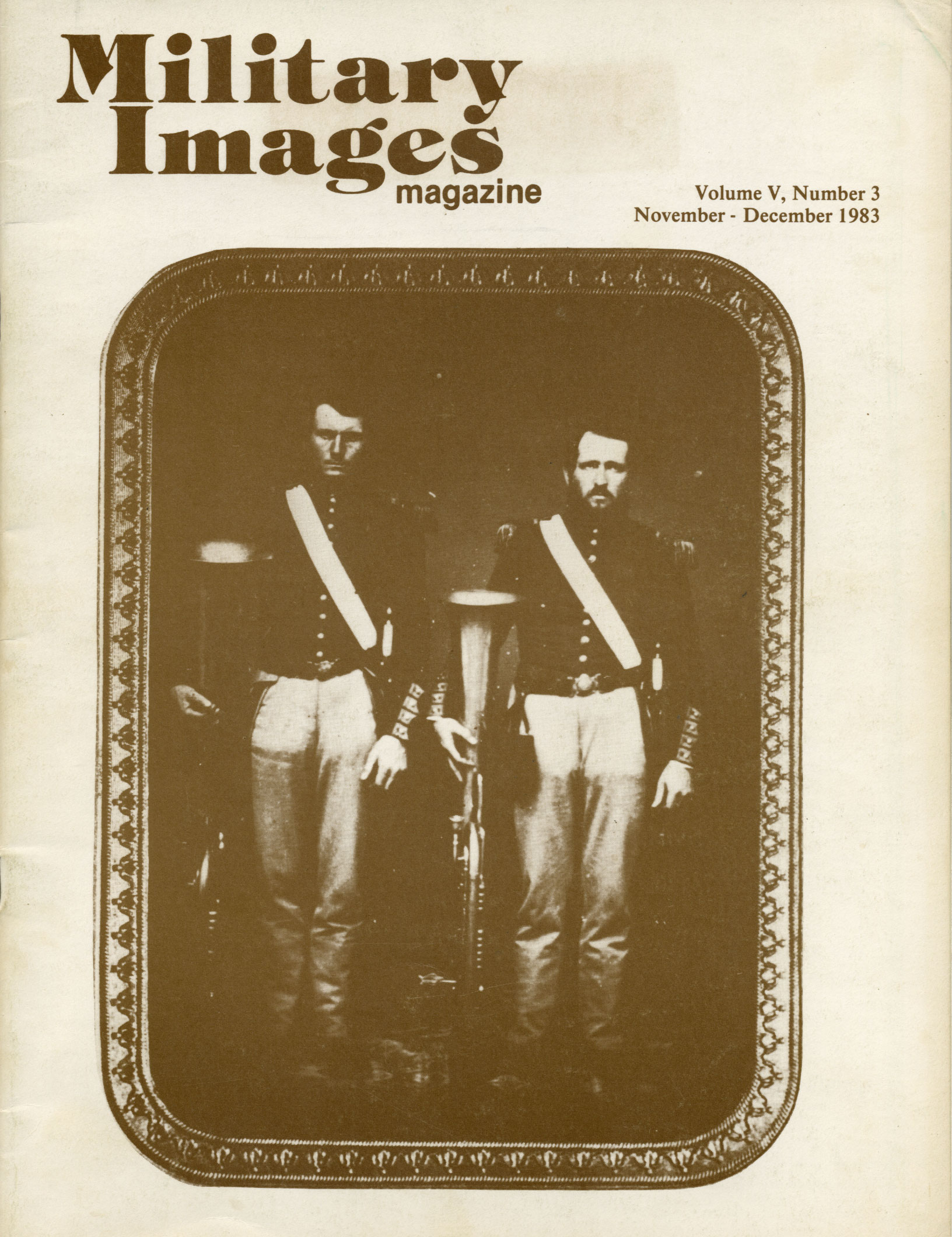
The quarter-plate ambrotype on the cover of Military Images features two members of the Manchester, New Hampshire Brass Band with five-valve E-flat bass over-the-shoulder saxhorns. The image was taken in about 1855 and the instruments featured are exceptionally rare.

Editor’s Desk (p. 1)
The editor recounts how he met fellow “Civil War nut” Mark Elrod, writer of the featured article on Civil War bands and musicians, during their service in Vietnam.

Passing in Review (p. 2)
The first of two reviews is of How the North Won: A Military History of the Civil War by Herman Hattaway and Archer Jones. Different than many books that provide a chronology of events, this work looks more closely at the leading personalities as well as the strategies and economic foundations of the war. The second work is Stephen W. Sears’ work Landscape Turned Red: The Battle of Antietam. The reviewer felt that the first five chapters were not new, but gave high praise to the remainder of the book, which looks at Antietam through the regimental and brigade levels, giving new insight into the events of that bloodiest of days.

Mail Call (p. 3)
Among the letters that praised past articles and requested information from other readers, the editor provided insight into the service of Bucktail soldier Private William Pitts. A letter also credits Military Images with bringing attention to the story of Mary Tepe and announces that the interest has led to the discovery of her grave and the decision to replace her headstone, as “the old one was worn nearly smooth.”

The Shrill of Fifes, the Beat of Drums compiled by Don Murphy (pp. 4-15)
A pictorial with 38 images provides readers of Military Images with individual and group images of military musicians and bands from the era of the Indian Wars through World War One. Three of the images are of Robert Hendershot, 8th Michigan Infantry, who was wounded during the Battle of Fredericksburg at age 13; two are Civil War era cartes de visite while the third is from later years in the National Guard. Other images of small boys who served with fife or drum or bugle are presented, along with some images of children who were far too young to serve, but dressed the part for patriotic images. Some of the notable images are of a young woman who appears to be a vivandiere with her drum, a 1908 example of how daily bugle calls were amplified, a small group of Spanish-American War musicians with their gear (one wonders how the tuba player managed his instrument with his bed roll), and a “jazz band” from World War One, complete with mandolins and guitar.

Military Bands and Bandsmen, 1861-1865 by Mark Elrod (pp. 16-29)
Beginning with a history of bands prior to the outbreak of the Civil War, the reader learns about the development of brass instruments, which were key elements to military bands of the mid-nineteenth century. Many units of the war were developed right out of small communities across the North and South, and local bands were a part of that. They would join local militia as bandsmen, and held non-combat roles which explains why so many young boys (some as young as age 10 or 11) were in uniform. These “regimental bands” were in existence between April 1861 and August 1862, and were comprised of 24 members led by a member with the “title” of colonel. In order to reduce the cost of maintaining regimental bands, the Union Army officially only supported bands at the brigade level or higher. Regiments could get around this by enlisting their band members as combatants and then having them play. The article also discusses instruments, such as the OTS (over the shoulder saxhorn) instruments. Their unique positioning of the instrument bells allowed the sound to project backwards towards the troops so they could hear the music. Although allowed as many as 24 musicians, many bands had fewer members and were almost exclusively comprised of brass and drum instruments. The eighteen images that follow show a variety of bands and band members, including two images of the valve construction common at the time. Two rare composite photographs, one of the Federal 1st Brigade Band, 3rd Division, 15th Army Corps (from Brodhead, Wisconsin) and one of the Confederate band of the 5th Virginia Infantry (from Staunton, Virginia), are also presented, showing each individual member. The article closes with a modern image of the author, wearing a Marine band uniform with an OTS E-flat bass saxhorn.

Back Image
Pvt. Daniel W. Elliott of Rhode Island poses for a carte de visite image with violin.

Finding Aid: Sept./Oct. 1983

1983-v5-02-v-cover

The complete issue

Vol. 5, No. 2
(32 pages)

Print edition: Visit our store to check availability
Digital edition: Visit JSTOR.org to purchase
Subscribe to MI
Explore the MI Archives: Browse | Advanced search | Tutorial

Inside

Cover and Back Image
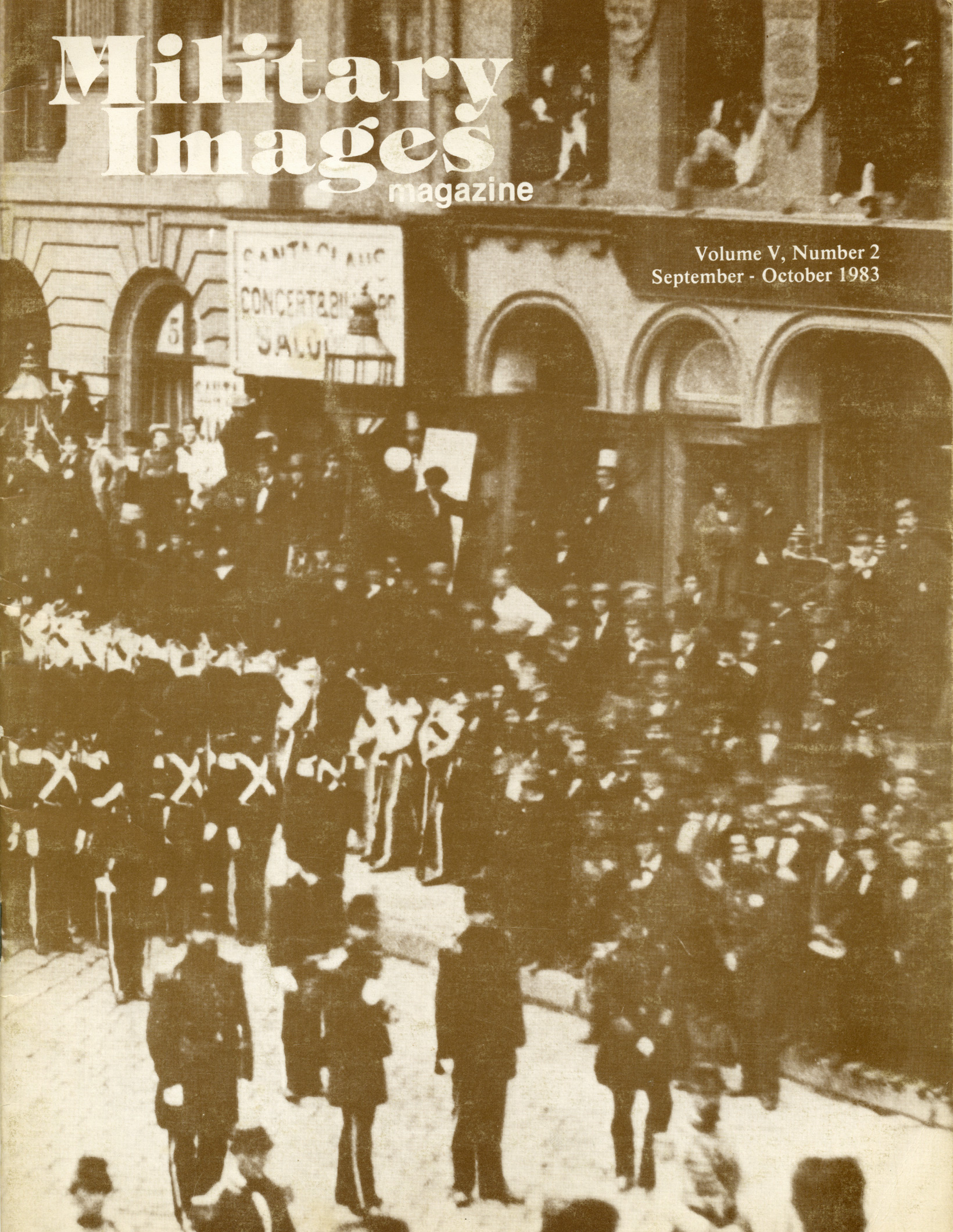
This wrap-around image that covers both front and back of the issue cover is from a New York City parade from about 1856. Two militia units are featured in the image: the Boston Light Infantry and the New York City Guard.

Editor’s Desk (p. 1)
The editor provides some amusing yet sad questions that are sometimes posed to guides at National Park Service battlefields. The editor encourages the support of programs that provide public education at parks, especially battlefield preservations.

Passing in Review (p. 2-3)
Four publications are reviewed in this issue of Military Images for the benefit of the readership. First Blood: Ft. Sumter to Bull Run is volume 2 of the Time-Life series on the Civil War, with many images provided by frequent contributors to MI. Next is Journey to Pleasant Hill: The Civil War Letters of Captain Elijah P. Petty, Walkers Texas Division, C.S.A. edited by Norman D. Brown and illustrated by John Groth. Falling in April 1864 after initially enlisting in May 1861, the letters provide insight into the experiences (mostly in camp) of an officer in the 17th Texas Infantry. Joe’s War: Memoirs of a Doughboy by Joseph N. Rizzi and edited by Richard A. Baumgartner was also reviewed, and recommended with several reservations. Finally, Grant and Lee: the Virginia Campaigns 1864-1865 by William Frassanito is given a short review, marking it as a last volume in a trilogy that is “a must for students of Civil War photography.”

Mail Call (p. 3)
A variety of letters are included in this issue, such as one letter asking for help with the identification of an item found in a late grandfather’s coin collection. Another reader was glad to see an article on a Wisconsin unit, and another subscriber muses on the reason for why more “unusual” belt plates have not been located. The editor reported that there wasn’t sufficient interest in magazine binders to merit offering them, and subscribers that live overseas or at APO/FPO addresses may get first class mail service for an additional fee.

Vignette: Peter W. Ott, Veteran of Two Wars by David M. Sullivan (p. 5)
The image accompanying the article is of Peter Walter Ott before he left to fight in the Mexican War. A member of the Mounted Battalion of Louisiana Volunteers, this image is the only known published image of a member of this unit. He saw action in Mexico, arriving at Vera Cruz in August 1847, but was discharged from service due to severe dysentery in January 1848. When the Civil War came around, Ott enlisted again, enlisting in the Confederate Marine Corps in September 1863. He was aboard the C.S.S. Tennessee when it was surrendered in Mobile Bay and remained a prisoner until the end of the war, when he returned home to Biloxi, Mississippi.

Antebellum Photography, Part V: Portraits of the U.S. military before the Civil War by Michael J. Winey (pp. 6-12)
Beginning with a collection of portraits of unidentified soldiers wearing a wide variety of regular and militia uniforms, the pictorial collection of images provides a number of images of antebellum soldiers who also served with distinction in the Civil War. The author makes a point of mentioning that the images often used for Confederate generals John H. Winder and Lewis A. Armistead are actually the only known images of these men, taken during Federal service in the 1840s. Also included are “before” and “after” images of Fitzhugh Lee as a 2nd Lt. in 1856-1858 at Carlisle, Pennsylvania. After his service as a cavalry general in the Confederate Army of Northern Virginia under his uncle, Robert E. Lee, “Fitz” Lee was again in the service of the United States Army as a Major General of Volunteers during the Spanish-American War in 1898. Federal notable officers in their antebellum uniforms include John G. Barnard, General George Cadwalader in 1851 uniform, Edwin V. “Bull” Sumner, among others.

The Custer Cyclorama: A Last-Stand-in-the-Round by Brian Pohanka (pp. 14-19)
Painted in 1888-89 and displayed by the Boston Cyclorama Company, the article describes the history behind the painting along with a recent discovery of an oil on canvas painting used as a guide to the project’s artists. Instructions for connecting the images in the magazine to produce a small version are provided, as well as close-up images of some of the sections with descriptions. The article also includes two previously unpublished carte de visite images of George Armstrong Custer from during the Civil War.

Dr. Gibbs, Stephen Crane, and J.E. Hill: Life and death in the Spanish-American War by Jerry Harlowe (pp. 20-21)
A “Straggler” image from a previous issue of Military Images inspired this article, as the author had a different view of one of the three graves by which men rested in the shade of a fly during the Spanish-American War. Intrigued by these images, the author researched the background of Acting Asst. Surgeon John B. Gibbs. What he found was that Gibbs was from a military family, and had a prestigious and prosperous career as a surgeon and teacher. He was able to get his post as a navy ensign by petitioning his personal friend, Asst. Secretary of the Navy, Theodore Roosevelt, and while the Americans set up their base at Guantanamo Bay, Gibbs befriended the journalist Stephen Crane. Often under the fire of Spanish snipers, one evening the camp came under attack, and Crane described his terror and how he heard the life and death struggle of a man with in yards of where he had taken cover. It was his friend, Dr. John Gibbs.

103rd Ohio Infantry: A Photo Album by William Stark (pp. 22-24)
Twelve different images comprise this pictorial of the 103rd Ohio Volunteers. The unit began service in September 1862 and was discharged in June 1865 after taking part in several major campaigns as part of the Army of the Ohio. Colonel John S. Casement, who is remembered for his work on the construction of the Union Pacific Railroad is also included. Some of the images of the soldiers are from earlier in the war, when uniforms were not as standardized as they became later on. One image shows two brothers, Thomas and Robert Allen, seated together; one wears a striped vest and cavalry boots and both appear to be carrying table knives in their belts. Corporal Ezra Brewster is shown wearing a shell jacket instead of the standard four-button sack coat worn by the others in later images.

Vignette: William Bancroft, Connecticut’s double deserter? by William Gladstone (p. 25)
This vignette on its own is interesting, but the story behind the man in the image is just at intriguing. The image is a double tintype—a tintype of a tintype—that allows the unique stenciling of the soldier’s name on his rifle sling to be read properly rather than in mirror image. It clearly says “Bancroft” and is of Connecticut soldier William C. Bancroft who mustered in with the Company G, 28th Connecticut on November 15, 1862 after having enlisted with the New Haven unit a month earlier. It was not unusual to allow new enlistees to return home for a time before reporting for muster, which might explain why a William C. Bancroft enlisted with, collected his bounty from, and then deserted Company I of the 25th Regiment in West Hartford between October 31 and November 12, 1862! Bancroft also deserted the 28th, making his service and his image quite unique: that of a bounty-jumper.

Diary of Sgt. John Fleming, 165th New York: the 2nd Duryee Zouaves in 1863 edited by Ronald Beifuss (pp. 26-27)
The unit in which Sgt. John Fleming served was formed after representatives of the Duryee Zouaves returned to New York City to bolster their losses at Second Manassas with recruits. So many showed up that the 2nd Duryee Zouaves were formed. Fleming’s short but interesting entries comprise a glimpse into the life of this soldier during 1863, who served in Louisiana as sergeant of Company A. Fleming’s image, as well as that of his friend, Sgt. George Cogswell of Company B, who died of illness in April, is included, illustrating the uniforms worn by these Zouaves.

Stragglers (pp. 29-31)
Many truly unusual images are shared in this issue of MI. A carte de visite of Lt. G. Gerrard of the 1st New York (U.S.) Marine Artillery is presented; photographs of this unit are extremely rare. A unique image of a reclining John Flehr, Company K of Reading, Pennsylvania comes with a request for more information about the soldier from the owner of the quarter-plate tintype. Another image is possibly a carte de visite of a Confederate Marine, given the hat and upturned chevrons; that the soldier is wearing a lighter colored shell jacket has given some of the MI staff pause, and requests reader input. Other rare images include a ninth-plate leathertype image of a Confederate, a post war cabinet card image of the only known Chinese Confederate (William Henry Kwan, Co. B, 12th Virginia Battalion Artillery), and a carte de visite of Chaplain William H. Hunter, 4th U.S. Colored Troops, who was only one of a dozen chaplains who served with black regiments.

Finding Aid: July/August 1983

1983-v5-01-v-cover

The complete issue

Vol. 5, No. 1
(32 pages)

Print edition: Visit our store to check availability
Digital edition: Visit JSTOR.org to purchase
Subscribe to MI
Explore the MI Archives: Browse | Advanced search | Tutorial

Inside

Cover Image
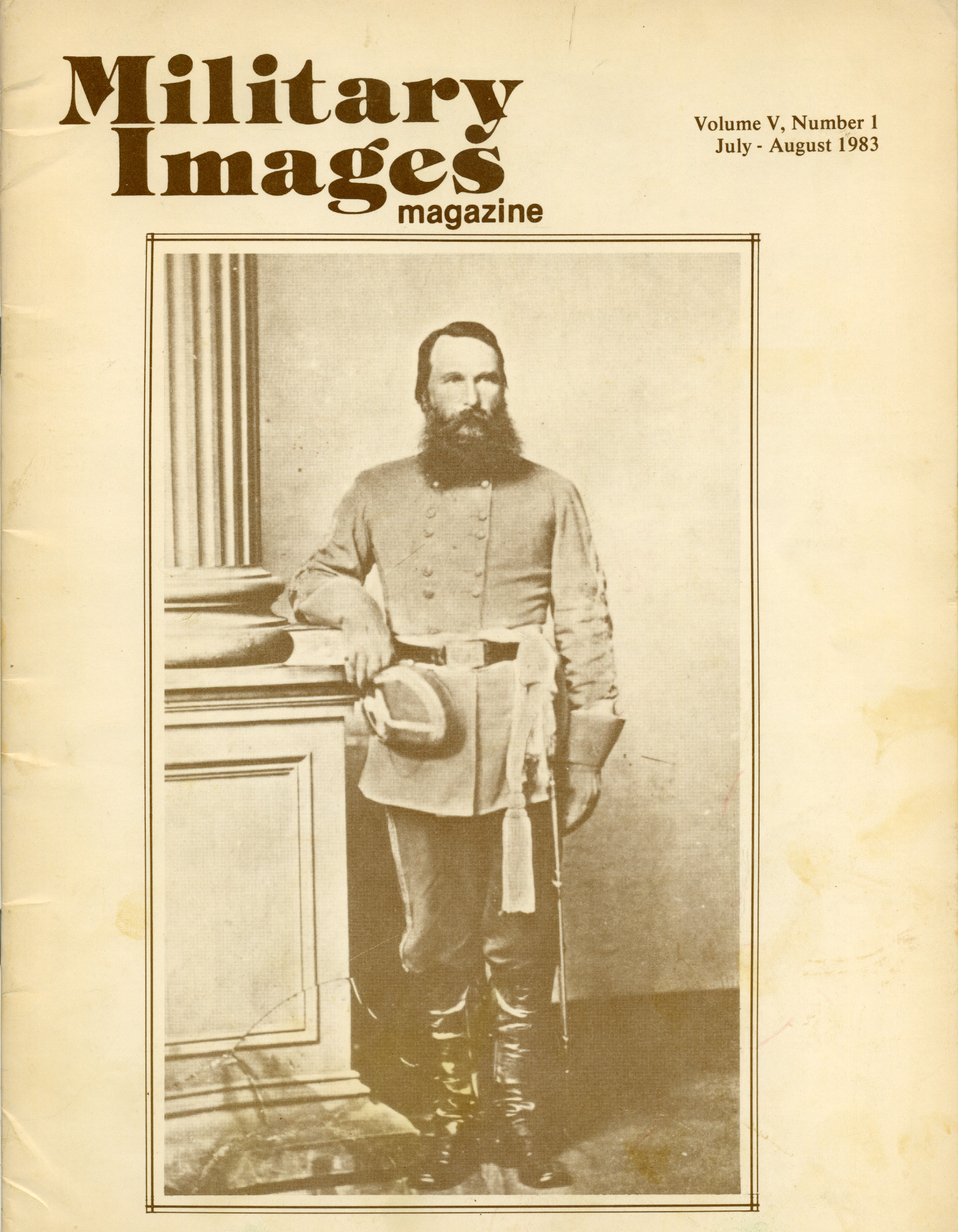
The cover image is a previously unpublished carte de visite image, taken from an ambrotype original, features Brigadier General James Longstreet from probably late 1861.

Editor’s Desk (inside front cover)
The editor introduces some of the important events of the Civil War that occurred in July and two articles that deal with them: Gettysburg and Vicksburg. He also gives some insight into future articles, and asks readers to submit images of Union and Confederate shelter halves, or “dog tents,” in use in the field.

Mail Call (p. 2)
This issue’s letters contain suggestions about content balance, some corrections, an announcement regarding a new monument being installed for the Michigan soldiers who fought at Perryville, and an alert regarding the theft of the sword and scabbard belonging to VMI founder Colonel J.T.L. Preston from the VMI Museum collection.

Passing in Review (p. 4)
Three reviews are included in this issue of Military Images. The first is of When War Passed This Way by W.P. Conrad and Ted Alexander, which provides readers with a case study of the occasionally humorous and sometimes frightening experiences of the Civil War in Greencastle, Pennsylvania. The second publication is Photography: The Early Years by George Gilbert, which not only provides information about dating certain types of images, but also how to make 19th century-type images. The feature concludes with Brother Against Brother: The War Begins, which is volume I of the Time-Life Series on the Civil War. Some contributors to Military Images also have contributed to this publication, which will include between 24 and 26 different volumes. The one under review looks at the 1850s with focus on several important factors that contributed to the conflict.

The Fight for Devil’s Den by Robert A. Braun (pp. 5-12)
The author recounts the story of the 124th Regiment of New York State Volunteer Infantry from Orange County during their fighting on the second day of the Gettysburg fighting. After reorganizing due to losses at Chambersburg, the unit led by Col. Augustus Van Horne Ellis, who had called out his men in that fight with “Hie! Hie! My Orange Blossoms!” the men began to wear orange ribbons on their uniforms and were proud of their nickname as they moved north into Pennsylvania. Complete with a map showing the placement and eventual movement of the units fighting on both sides around Devil’s Den, the author describes the conflict as the 124th walked through a perfect field of wheat to take their place in battle line. The 124th lost all of their field officers, and four company grade officers, with one in three of the men either wounded or killed. A sidebar describes the life story of Col. Ellis, and an epilogue describes how he and another officer were returned to their families as well as a commentary on the lack of historical investigation on the fight at Devil’s Den and its true impact on the outcome of Gettysburg.

The Death of “French Mary” by Marie Varrelman Melchiori (pp. 14-15)
Past issues of Military Images have featured the story of “French Mary” Tepe, and brought up several questions about the life of this vivandiere from the 114th Pennsylvania Volunteer Regiment. The author of the current article has provided answers to some of these, including wartime information regarding her two husbands and the fact that she was in the company of her second husband at the time of her death. The author has included an article from a 1901 Pennsylvania newspaper recounting some of these stories as it announced her death by suicide and a photograph of Mrs. Mary Leonard at a regimental reunion in 1893.

The Hanging of William Johnson by William Frassanito (pp. 16-18)
In an excerpt from his upcoming volume Grant and Lee: the Virginia Campaigns, 1864-1865, the author describes the June 20, 1864 hanging of a black Union soldier for the rape of a white woman; the hanging was done in full view of the Confederates, who shelled the location beforehand. The photographs in the article are interesting in that they were made by rival photographic teams (Gardner and Brady), there was some research confusion about the identity of the hanged man, and the background of the images provides good evidence as to where the actual hanging took place.

Quentin Roosevelt’s Last Flight: A Vignette from the First World War by Charles Worman (pp. 20-22)
The brief military career of one of Theodore Roosevelt’s sons is outlined in this article. Serving as a pursuit pilot 95th Aero Squadron at Orly from June 17, 1918, Quentin Roosevelt had one verified victory over a German aircraft before being shot down on July 14, 1918. The Germans were able to verify his identity at the site, and produced postcards with Roosevelt’s body in view for propaganda value. They did, however, provide the son of the former president with a burial with full military honors, a hand-made wooden cross to mark his burial spot, and a three-man guard of honor that remained in place until the Americans retook the site in early August. The article then recounts the history of various crosses and memorials to mark Quentin Roosevelt’s burial site until his reburial next to his brother Theodore, Jr., who died in France shortly after the Normandy Invasion in 1944. The original German cross was eventually given to the U.S. Air Force Museum in Dayton, Ohio, for exhibition.

Uniforms: M1872 Foot Artillery Shako by Robert Borrell, Sr. (p. 23)
This short pictorial article features two images with the rarely photographed 1872 full-dress artillery shako. One is a family portrait with two regular soldiers, and presumably their mother, with both of the soldiers wearing their shako for the image. The other is an unknown militiaman holding the shako and a cavalry saber, suggesting that both might be photographer props. However, a close-up of the shako from this image gives a clear view of the shako.

The Siege of Vicksburg by John W. Paul, 23rd Wisconsin (pp. 24-25)
Edited by Dorothy Murphy, this excerpt of Paul’s unpublished memoirs describes his recollections from the burial of the dead after Champion’s Hill and marching to the forts at Vicksburg on May 20, 1863, to watching General Grant ride into Vicksburg with a cigar in his mouth on July 4, 1863. The account gives the reader a glimpse into what it was like to be involved in this campaign by describing not being allowed fires to cook on one occasion and what Paul did when his rifle took a bullet during battle. There are several personal stories included that can only be recounted by someone who was there.

Weapons: Billinghurst-Requa Gun at Fort Wagner, South Carolina by Ken Baumann (p. 26)
Based on an accompanying photograph showing the men of the 39th Illinois Infantry with the earliest known image of a machine gun, the article explains how the Billinghurst-Requa gun was developed and how it worked. The image includes a view of the 25-cartridge clip used by the gun being taken out of a limber chest in preparation for firing the gun. The Requa gun was given positive comments by Major T. B. Brooks writing during the siege of Charleston and also by the eventual regimental history of the 39th which described its use and battlefield impact.

Stragglers (pp. 27-30)
Some rare insignia are shown in this issue, with Frederick J. Kenyon in a photograph wearing the first U.S. enlisted air service insignia for enlisted men worn during World War One. Another image is of a bawdy and rare shoulder belt plate found at the location of a Confederate camp in Georgia. Other images include some American forces “somewhere in France” during World War One playing dice, a quarter-plate tintype of Company I, 18th New York Infantry informally posing during the Civil War, and a quarter-plate daguerreotype of an unidentified corporal from Company C, 71st New York State Militia taken before 1857.

Back Image
An unpublished carte de visite of General John Bell Hood with a pair of crutches takes its place on the back cover of the issue.

Finding Aid: May/June 1983

1983-v4-06-iv-cover

The complete issue

Vol. 4, No. 6
(32 pages)

Print edition: Visit our store to check availability
Digital edition: Visit JSTOR.org to purchase
Subscribe to MI
Explore the MI Archives: Browse | Advanced search | Tutorial

Inside

Cover Image
A sailor from the Civil War era poses for the camera, holding the hand of a little girl who is probably his daughter.

Editor’s Desk (inside front cover)
The editor advises that if readers are interested in purchasing a binder for their back issues of Military Images, they should let him know and if enough interest is shown, these can be made available. Additionally, extra issues of the lampoon issue remain available. The editor also adds that a cyclorama of Custer’s Last Stand that was made in 1888 will be featured in a future issue.

Mail Call (p. 2)
Readers provide additional insight to prior issues and images from previous issues.

Passing in Review (pp. 3-4)
Two books are reviewed in this issue of Military Images. First is Custer Victorious: The Civil War Battles of George Armstrong Custer by Gregory J.W. Urwin recounts the successes of Custer between his achievements at Gettysburg through the end of the war at Appomattox. Accompanied by images and primary source materials, the text is reviewed as sometimes unbalanced in Custer’s favor rather than remaining balanced throughout. Next under review is John Bell Hood and the War for Southern Independence, written by Richard McMurry. In a lengthy review, the details of Hood are grooming as a military officer, his career in Texas in the 2nd U.S. Cavalry, and his Civil War career are outlined. The author compares Hood’s military life with his equally tragic personal life, giving this book a rather unique insight into one of the South’s interesting personalities.

Foreign Naval Officers During the American Civil War by Philip Katcher (pp. 5-7)
Subtitled as “a mis-identification guide for image collectors,” this collection of nine images of British, Russian, Prussian, Spanish, French, and Dutch naval officers of varying rank. Each image has a detailed caption that discusses the unique identifying features of each uniform and how each could be confused with a Confederate or Federal naval officers.

Clergy in Uniform: Uniforms of Volunteer Chaplains in the Union Army, 1861-1865 by Michael J. Winey (pp. 8-12)
They were not assigned rank and were expected to be non-combatants, but the chaplains of the Union Army saw themselves as being within the officer corps, having the pay of a captain of cavalry. Many wore weapons and sabers, as did officers, and were often attached to regimental staff. Chaplains were to wear black coats, trousers, shoes, and hats, but as the pictorial article shows in 14 images, chaplains often personalized their wartime wear. The uniforms shown range from a few images that are almost completely regulation to one that is almost completely military. A pair of images show different chaplains from wearing uniform variants designed by Colonel Ambrose E. Burnside, with the chaplain wearing the officer version of the smock-like coat and the assistant chaplain wearing the enlisted pullover smock blouse worn by the Rhode Island enlisted men. One image is of Father Thomas Scully of the 9th Massachusetts Infantry wearing his Catholic vestments; his unit was heavily Irish in composition.

Vignette: John T. Hull, Company E, 2nd Virginia Infantry, Stonewall Brigade by Larry Allen (p. 15)
Two images accompany this vignette. The first is a sixth-plate ambrotype that shows Lt. John Hull after recovering from his wound at Chancellorsville, while the second is his post-war wedding photograph with his wife, Mary Ann, in October 1881. Enlisting in Raleigh Colston’s “Hedgesville Blues” two days after Virginia left the Union, John and his brothers George and Dallas saw action at the battles with the rest of the “Stonewall Brigade” from Manassas onward, with John’s wound in the neck sending him to hospitals until his discharge in January 1865.

Salty Dogs by Howard Hoffman (pp. 16-18)
Ten different images from the author’s collection show the men of the navy in various studio poses. Many are unidentified, however the identity of their ships can be seen in reverse in the images. One pair of images is of Acting Paymaster A.A. Harrison wearing his winter uniform in one image (taken in Little Rock, Arkansas in December 1863) and his summer uniform in the other (taken in Pine Bluff, Arkansas in August 1864). An image of a sailor with an unique arm insignia is also presented, with the apparent pioneer insignia showing him as a carpenter’s mate.

Vignette: George H.T. Macrae, Company F, 6th Virginia Cavalry by Wendell W. Lang, Jr. (p. 19)
Wearing a polka dot shirt under his Federal frock coat, George Macrae first joined up in Captain Edward B. Powell’s “Fairfax Cavalry” at Alexandria, Virginia. Eventually serving under Turner Ashby in the Shenandoah and then under General William E. “Grumble” Jones, Macrae (demoted to private) was wounded and left behind during raids on the Baltimore & Ohio in West Virginia. He was treated by Federal hospitals and then transferred to Point Lookout, Maryland as a P.O.W. before being exchanged on Christmas Day 1863. Macrae spent the rest of the war in Richmond working at General Hospital No. 9, indicating that his wounds did not allow him to return to cavalry duty.

Antebellum Photography, Part IV: Analysis of Pre-War Naval Uniforms by John A. Stacey (pp. 20-21)
Five portraits allow the reader to get a glimpse of the uniform devices used to determine naval rank. The size of buttons, number and width of gold lace braid, the number of oak leaf sprigs on a collar, and the placement of buttons on a sleeve all helped the author determine the approximate dates that the portraits were taken based on the uniform regulations in place at the time.

The Eagle Bearers: Company C, 8th Wisconsin Volunteer Infantry by Richard H. Zeitlin (pp. 22-25)
Several images accompany this article, but none rival the image of “Old Abe” who became the mascot of Company C right before the “Eau Claire Badgers” left to report to training camp in September 1861. Known thenceforth as the Eagle Regiment, the unit fought in several battles, as indicated on the photograph of their battle flag. Their original organizer, Captain John E. Perkins was killed at Farmington, Mississippi, and was succeeded by Lieutenant Victor Wolf, who had previous experience in the U.S. Army. “Old Abe” survived the war, and lived in the Wisconsin State Capitol Building until his death in 1881. Images of several veterans of the Eagle Regiment, taken as they mustered out of service, are included.

U.S.S. Pennsylvania Landing Party by Ronald Beifuss (pp. 26-29)
An unusual series of ten images of an amphibious landing and other exercises taken in approximately 1908 are featured. The photographer and the context of the collection is unknown, but seems to suggest exercises in the Philippines or another semi-tropical region.

Stragglers (pp. 30-31)
This issue of Military Images challenges readers to “Find the Civilian(s)” in this selection of five images of men in sailor-type dress.

Back Image
The image on the back of the magazine could be a sutler’s wagon being raided, or supplies being loaded, or something completely different.

Finding Aid: April 1, 1983 Lampoon

  • 1983-04-01-Lampoon-coverCover image: Possibly the world’s first practical joke to be captured by photography. Quarter plate tintype in the Andrew Daneman collection.
  • Back image: America’s first aeronaut, Art Nemo, photographed just prior to launch on May 12, 1913. Nemo achieved an altitude of over half a mile before splashing down in San Francisco Bay. Unfortunately, sharks got to Nemo before the recovery crew, and all scientific knowledge gained on the flight was lost with him. Stephen D. Rohnde collection.
  • “316th Bomb Squadron: The Western Front was one hell of a mess,” by Walter Pigeon.
  • “The Short Cruise of U.S.S. Turkey: A look at an early naval album, edited by Phil Scratcher,” by C.P.O. “Bull” Kneck, U.S.N.
  • “U.S. Army Uniforms of the Civil War, Part XIII: Underwear,” by Mike McKhaki.
  • “The 1st Greenwich Village Grenadiers: History of a semi-famous Civil War regiment,” by Bill Thatcher.
  • “The Chronicles of Arnold Fleshpot: Autobiography of a hero of the New Jersey Zouaves,” edited by Joe Philby.

Finding Aid: March/April 1983

1983-v4-05-iv-cover

The complete issue

Vol. 4, No. 5
(32 pages)

Print edition: Visit our store to check availability
Digital edition: Visit JSTOR.org to purchase
Subscribe to MI
Explore the MI Archives: Browse | Advanced search | Tutorial

Inside

Cover Image
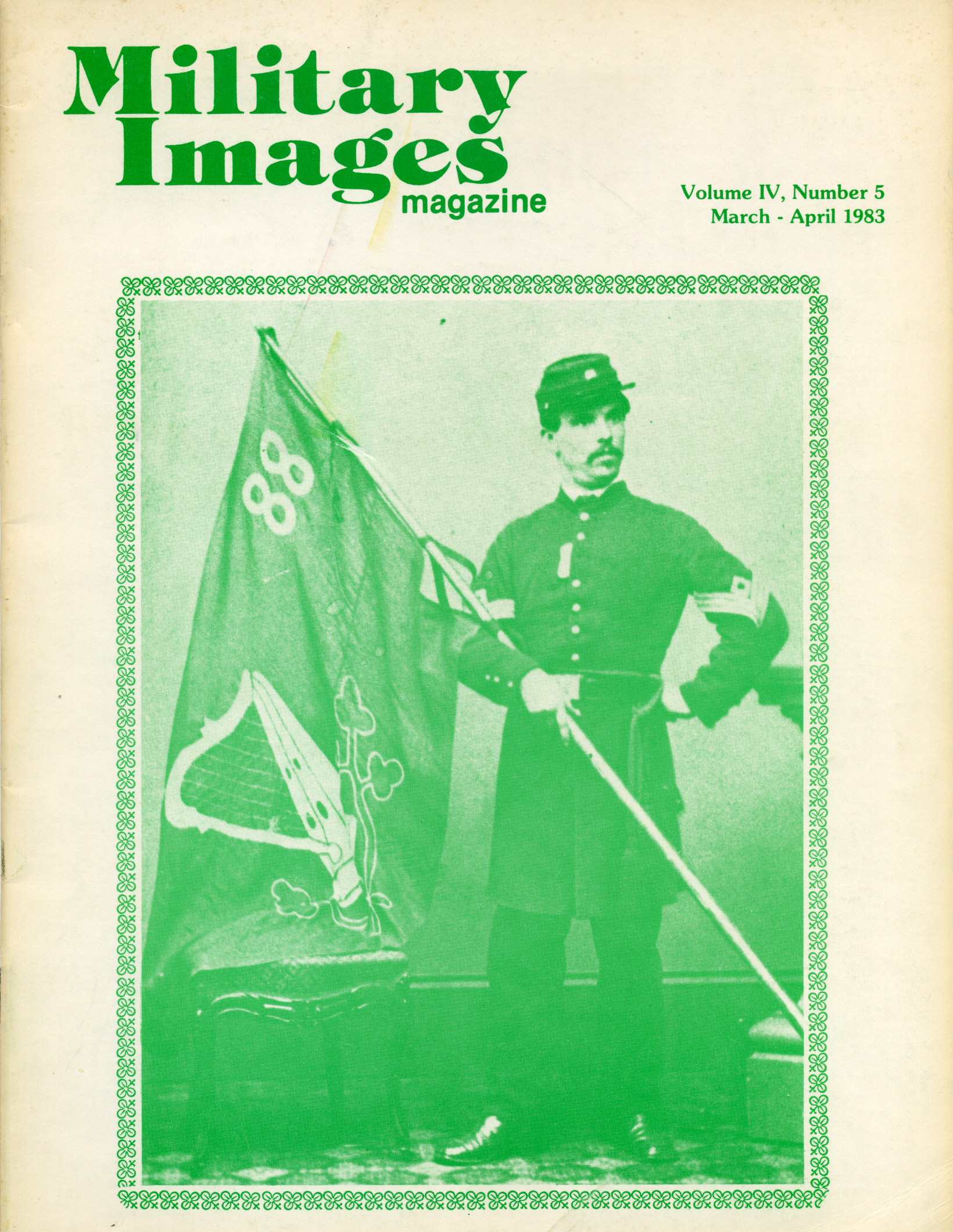
Tinted in green, the cover image features a soldier proudly holding the banner of the 88th New York Infantry – the Irish Brigade of the Army of the Potomac.

Editor’s Desk (inside front cover)
The editor introduces the featured article that ties to the front cover. The magazine takes on an Irish theme with an article by Joseph G. Bilby about the Irish Brigade in the Civil War.

Mail Call (pp. 2-3)
Letters from the readership include various corrections to a few articles, the identification of a “Straggler” item and a photograph from an article, a question regarding a uniform insignia from a member of the 27th Alabama Infantry, two warnings about “fake” cartes de visite and cabinet cards, and a clarification regarding copyright violations.

Company C, 3rd Cavalry by Douglas C. McChristian (pp. 4-6)
The two images presented in this article may appear to be two different units out in the Wild West somewhere, they are actually taken of the same unit on a hill on Fort Davis, Texas, most likely between March 1886 and October 1887. Close-up investigation identifies the men as belonging to Company C of the 3rd U.S. Cavalry. The remainder of the article assesses the equipment used by the men and their horses based on the images: carbine slings, cartridge belts, saber belts, belt plates, holsters, clothing, weapons, horse equipment, etc. The article concludes that the men did not necessarily follow the uniform regulations of General Orders No. 73 as one might have imagined.

Vignette: John H. Carter, 2nd Kentucky Cavalry, C.S.A. by John Ertzgaard (p. 8)
John H. Carter had an adventurous military career, taking part in John Hunt Morgan’s raid on Ohio, as well as being captured (and escaping) three times. The article provides detail on some of his adventures, culminating with Carter riding as an escort during Jefferson Davis’ escape, eventually surrendering at Washington, Georgia in May 1865.

Vignette: Henry Kirby, 15th Iowa Infantry, U.S.A. by Sharon L. Ball (p. 9)
Enlisting as a substitute for a wealthy man from Osceola, Iowa in March 1864, Kirby went with the 15th Iowa soon went south, being part of the push towards Atlanta. His unit was caught in the fighting that led to the death of McPherson, which the article describes in detail. Eventually captured, Henry Kirby was sent to Andersonville, where he contracted typhus, dying after he was exchanged.

Schmaltz: Sentimental Photography at the Turn of the Century by Carol Villa (pp. 10-14)
The article begins with a discussion of how sentimental images became popular at the end of the 19th century, and included military images with the advent of the Spanish-American War. Ending about the time of World War One, the pictorial shows a sampling of the “cute” and the “patriotic” images typical of the time. Postcards showing a small tyke in grown-up uniform captioned with “If McKinley Wants Me, I’ll Serve” or “The Regimental Mascot” are two examples, along with stereo views that told a story of soldiers falling in love, being heroic in battle, and then returning to claim the lady he loves.

Remember Fontenoy!: The 69th New York and the Irish Brigade in the American Civil War by Joseph G. Bilby (pp. 16-24)
Recounting the history of this storied unit, the author takes the reader from the development of the court martial of Colonel Michael Corcoran, who refused to march the 69th New York State Militia Regiment before the Prince of Wales before the outbreak of the Civil War through losses at Bull Run, Antietam, and the wearing of the evergreen at Fredericksburg. The author includes two sidebar articles, with the first providing a brief biography of General Thomas F. Meagher, who led the Irish Brigade until mid-1863. The second provides an outline of the Irish history of participating as exiles in both the French and Spanish armies, in order to fight against the British. The article ends with an accounting of the Irish Brigade at Gettysburg and during the draft riots in New York shortly thereafter. The unit was reconstituted during the winter of 1863-64, but lost its completely Irish composition, serving until the end of the war.

Passing in Review (p. 25)
Two items are offered for review in this issue, one film production and one book publication. The film is Antietam Revisited by the National Park Service. With realistic reenactment of the three major confrontations during the bloodiest day of battle, the film also focuses on Lincoln’s post-battle visit to McClellan and the decision for emancipation. The book is The Embattled Confederacy, Vol. III by William C. Davis in his Images of War series. Generally given a good review, there are a few errors in identification that the readers should be aware of.

Teddy Takes a Ride by Leon Comstock (pp. 26-27)
Edited by Orton Begner, the author describes the time he returned Lt. Colonel Theodore Roosevelt Jr. to his command in Germany after World War One. He was returning after the funeral of his father and Private Leon Comstock was assigned to drive him. With only an Indian motorcycle and a sidecar, Comstock and Roosevelt made their way from village to village, with the popular regimental commander receiving cheers from the units they met along the way. Despite a near crash down a frozen hill into the village of Unterhausen, Private Comstock was able to complete this memorable assignment.

The Ninth’s New Colonel: A humorous tale of Old New York by Robert E. Mulligan Jr. (p. 29)
The tale of how the 9th Regiment of Infantry, National Guard, State of New York avoided disbandment in 1870 involves individuals of power and position, and with connections to Tammany Hall. “Jubilee Jim” Fisk was well-known to New Yorkers and despite his total lack of military ability, he was elected as the colonel of the unit. He was able to use his deep pockets to ensure the continuation of the 9th. The article recounts the events of July 12, 1871: the anniversary of the Battle of the Boyne, which set the Irish and their rival Orangemen against one another. As the Orangemen marched, a number of regiments were ordered to provide them protection, including the 9th. Colonel Jim ended up injured and disguised to escape as gunfire between the marchers, regiments, and the crowd rang out, while four guardsmen, 41 citizens, and no Orangemen lay dead.

Stragglers (pp. 30-31)
This issue of Military Images asks readers to “Find the Fake(s)” within a collection of seven different images, some of which were previously unpublished.

Back Cover
A wedding portrait dating from the 1870s is the subject of the cabinet card featured on the back cover.

Finding Aid: Jan./Feb. 1983

1983-v4-04-iv-cover

The complete issue

Vol. 4, No. 4
(32 pages)

Print edition: Visit our store to check availability
Digital edition: Visit JSTOR.org to purchase
Subscribe to MI
Explore the MI Archives: Browse | Advanced search | Tutorial

Inside

Cover Image
This issue’s cover features a rare image of 2nd Lieutenant John F. Reynolds taken between 1841 and 1846 as a member of the 3rd U.S. Artillery.

Editor’s Desk (inside front cover)
The editor presents the cycloramas made by the Bennett Studios in Wisconsin and resurrected for the readers of Military Images for the first time in the 20th century. They are photographs of post-Civil War paintings instead of the usual content, with the details of the paintings were often directed by veterans of the battles, making these particularly instructive images. Instructions for creating the cycloramas are located on page 15.

Mail Call (p. 2)
A few letters from readers disagree with some assertions made in the magazine. One reader thinks that the “Babes in Arms” pictorial that was panned by readers in the recent survey was a delightful article, while another reader disagrees with the assertion that few soldiers tucked their trouser hems into their socks based on the lack of images showing that practice, as few images could be taken in battle at that time due to technology. The author of the article showing images of George A. Custer disagreed with commentary added by the writing staff, which the editor continued to support.

Passing in Review (p. 3)
Three publications are considered in this issue of Military Images. First is Long Endure: The Civil War Period, 1852-1867which is Volume III of Military Uniforms in America edited by John R. Elting and Michael J. McAfee. The volume consists of 64 color plates that have been reprinted with detail descriptions of the antebellum, Civil War (both North and South), and the Mexican conflict against the French Empire. Second is U.S. Navy Rating Badges, Specialty Marks, and Distinguishing Marks, 1885-1982 by John A. Stacey. The publication outlines the changes in the kinds of jobs performed by navy personnel over time, reflecting changes in technology. Finally is a review of Flashman and the Redskins by George MacDonald Fraser, a work of historical fiction that effectively combines a humorous fictional story with real history. The seventh in the series, the reviewer found the work that places the main character at the Little Bighorn, taking part in Custer’s Last Stand.

Company K, 1st Pennsylvania Reserves: The Hometown Boys of Gettysburg by Richard Tibbals (pp. 4-7)
Preferring to be known as the 1st Reserves rather than the 30th Pennsylvania Volunteer Reserve Corps, these boys from Adams County, Pennsylvania, saw their first fighting during the Seven Days campaign. After removing to defend Washington at Fairfax Court House, Virginia (where the well-known but misidentified photograph of musicians retitled “Talley’s Fifers and Drummers, as described in a sidebar article on page 6, was taken), they ended up following Lee’s forces as they moved up towards Pennsylvania in late June 1863. Finding themselves at home, the article follows the unit who shouted “Revenge for Reynolds” as they moved from the Round Tops and across the Wheat Field on the second day of fighting at Gettysburg. They were present to hear the blasts of the artillery barrage on the third day, and could hear Pickett’s Charge against the center of their lines. They took part in the last charge of the Gettysburg fighting when asked to take out Confederate artillery on the far side of the Wheat Field, eventually coming across a burial party on the other side of Rose Farm, whose victims were photographed by Alexander Gardner a few days later, still lined up as the Confederates left them. The article then tells some of the individual stories of the soldiers from Gettysburg as they quietly left their ranks to make sure all was well at home.

Catbalogan, P.I.: The letters of Sgt. Ray Hoover, 43rd Infantry by Sgt, Ray Hoover (pp. 8-11)
Edited by Ron Beifuss, the series of letters presented in this article, along with four images, were written by Sgt. Hoover during his four years of duty in the Philippine Islands from 1899 to 1904. He describes various actions while on Samar and Leyte Islands, including one in which he was recommended for the Medal of Honor. He was eventually promoted to 1st Lieutenant in the Philippine Scouts, a position that he held until his unit was returned to the U.S. to serve at the St. Louis World’s Fair and the Presidential inauguration in 1905. His career ended when court martialed in absentia in March 1905 for intoxication and desertion.

The Lost Cycloramas: Shiloh and Missionary Ridge by Dr. Michael Cunningham (pp. 12-19)
This feature provides the reader with images taken by Henry H. Bennett (Company E, 12th Wisconsin Volunteer Infantry), who photographed the cycloramas of Shiloh and Missionary Ridge. Unable to return to his prior occupation as a carpenter due to a hand injury at Paducah, Kentucky, Bennett purchased a photography studio in 1865. He was known for his stereo views of the nearby Wisconsin Dells, outdoor scenes, and Indian portraits. It is believed that the took the photographs of the “Battle of Shiloh” cyclorama during a visit to Chicago in 1887 and the “Battle of Missionary Ridge” during its viewing in Kansas City in late 1883. The reader can follow the instructions and construct a version of the cycloramas by following the cutting and pasting instructions on page 15.

Antebellum Photography by Michael J. Winey (pp. 20-28)
The third article in a series covers both regular army and militia soldiers, many of them not published previously. The 18 different images highlight the uniforms and weaponry carried by the military of the pre-Civil War era ranging from Brevet Brigadier General Thomas Lawson, who began his career in 1809, to Brevet 2nd lieutenants and topographical engineers Orlando M. Poe and William P. Smith, both of whom became chief engineers on opposite sides in the Civil War. The article illustrates the variations in the antebellum uniforms of the state militia soldier as well, with the captions providing as much information about the uniform and individual as possible.

Stragglers (pp. 29-31)
The reader contributions for this issue consists of an image of one of the Navy’s first Chief Petty Officers, a rating first introduced in February 1893. The cabinet card was made in Shanghai, China of an unidentified CPO and is accompanied by close up views of a CPO sleeve badge and a button.

Back Image
A half-plate daguerreotype of three militia members from the 1840s is shown on the back of the issue.