Finding Aid: July/August 2011

2011-v31-01-xxxi

The complete issue

Vol. XXXI, No. 1
(40 pages)


Print edition: Visit our store to check availability
Digital edition: Visit JSTOR.org to purchase
Subscribe to MI
Explore the MI Archives: Browse | Advanced search | Tutorial

Inside

Cover image
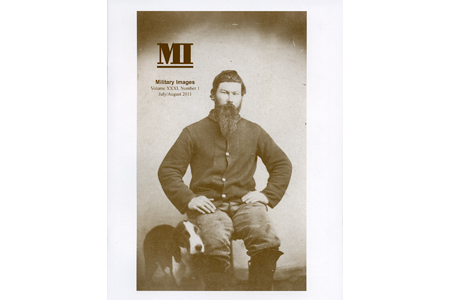
A carte de visite of a Union soldier and his canine companion from the Steve Karnes collection.

Inside Cover Image
A sailor with a Krag rifle, posed in front of a painted backdrop, from the Jules Martino collection.

Table of Contents (p. 1)

Editor’s Desk (p. 2)
The editor introduces two new departments, Vignette from the Naval War, 1861-65, by historian Ron Field, and a selection of unidentified images titled What’s My Name?

Front and Back cover details (p. 3)
Additional information is provided about the images pictured on the front and back covers.

What’s My Name? Unidentified Images From The David W. Vaughan Collection (pp. 4-11)
A total of 8 images, a combination of hard plates and cartes de visite, pictures Union and Confederate soldiers whose names have become separated from their likenesses. Included in the grouping are five Confederate officers, two images of Union officers and a portrait of a Native American dressed in a double-breasted federal frock coat.

Colonel Frank Wolford, 1st Kentucky Cavalry USA by John Sickles (pp. 12-12)
Wolford, who organized the 1st in the summer of 1861, was among a contingent of Union officers who accepted the surrender of John Hunt Morgan on July 26, 1863. Upon his surrender, Morgan gave his silver spurs to Wolford. Less than a year later, Wolford was dismissed from the army after publicly criticizing President Abraham Lincoln. Two portraits of Wolford illustrate the profile, both from the author’s collection.

Morgan’s Commissary Officer by John Sickles (pp. 14-15)
A carte de visite of Kentuckian Theodore B. Boyd (1834-1909) is accompanied by a summary of his military service. A staff officer to generals John Breckenridge and Braxton Bragg, Boyd eventually joined the staff of John Hunt Morgan. He was captured with Morgan in July 1863 and spent the rest of the war in the Confederate officer’s prison at Fort Delaware, Del.

The Many Faces of Captain Henry Blake Hays, 6th United States Cavalry by David M. Neville (pp. 16-17)
Four images of Hays, who served as ordnance officer on the staff of Maj. Gen. Alfred Pleasonton, are pictured. Each image is accompanied by a brief caption.

William N. Brady: Master of the Yard by Ron Field (pp. 18-20)
Brady (1809-1887), a career navy officer, served two stints as the master of the Brooklyn Navy Yard: From 1843-1853, and again from 1858-1865. Newspaper reports described him as “a cool head to attend to and direct anything,” and a man of “precision and energy.” He is perhaps best known for his 1841 book for early-career American naval officers, The Kedge Anchor, or Young Sailors’ Assistant. Two portraits illustrate his story.

Midshipman Nathaniel Prickett of the Brazil Squadron (p. 21)
In 1850, two years after midshipman Prickett sat for the daguerreotype shown here, he died in Rio de Janeiro while on duty with the Brazil Squadron. Image from the David W. Vaughan collection.

Disaster @ Fort Monroe (pp. 22-23)
An image of a 12-inch coastal gun and its crew at Fort Monroe was taken prior to 1910. On July 21 of that year, an accidental gun explosion at the fortress killed an undetermined number of men.

William C. Armor, Aide-De-Camp, 2nd Division, 20th Army Corps by David M. Neville (pp. 24-25)
William Crawford Armor (1842-1911) served on the staff of Maj. Gen. John White Geary. Armor survived wounds below the knee at Antietam and in the right hand at Chancellorsville. He went on to participate in the campaigns of Chattanooga, Atlanta, Savannah and the Carolinas. He ended the war as a captain with a brevet, or honorary rank, of major. The profile is illustrated with portraits of Armor and Geary.

Passed From His Sight: An Incident in The Military Career of Captain Augustus Michaelis by Scott Valentine (pp. 26-27)
Michaelis, the captain and commander of Company I of the 45th New York Infantry, was eyewitness to an unusual event in his Virginia camp during the early evening of May 2, 1863. A huge stag emerged from a wooded area, soon followed by a menagerie of wild animals. This surreal scene was followed by gray soldiers and the rebel yell—and thus began Michaelis’s Chancellorsville experience. A carte de visite of Capt. Michaelis is part of the author’s collection.

Uniforms & History by Michael J. McAfee (pp. 28-29)
In “Just Before the Battle…,” McAfee examines the uniforms of the 8th New York State Militia at Bull Run. A portrait of an unidentified sergeant from the regiment and a Mathew Brady image of men from the 8th titled, “Arlington Heights July 16th 1861” is included.

Stragglers (pp. 30-36)
A grouping of seven images submitted by readers is included in this installment of the popular department, including a bugler from the 1st Delaware Cavalry, a soldier in the 10th Ohio Independent Company Sharpshooters, a federal sergeant major and two young Confederate soldiers.

Sutler’s Row (p. 39)

The Last Shot (p. 40)
A tintype from the Jules Martino collection features two injured men—one is missing an arm and the other has a gauze-like wrapping of brace around his neck.

Inside Back Cover
A carte de visite of a Civil War band with a fort in the background by itinerant photographer C.G. Blatt of Bernville, Pa., is part of the Donald Bates Sr. collection.

Back Cover
A woman holds an image of a soldier housed in a composition frame. The soldier is probably her husband. This tintype is part of the Liljenquist Family Collection at the Library of Congress.

Finding Aid: November/December 2011

2011-v31-03-xxxi

The complete issue

Vol. XXXI, No. 3
(40 pages)


Print edition: Visit our store to check availability
Digital edition: Visit JSTOR.org to purchase
Subscribe to MI
Explore the MI Archives: Browse | Advanced search | Tutorial

Inside

Cover Image
Uniformed in a coatee with light colored facings, this useful militiaman’s portrait was made in the late 1850s. Tom Gaard collection.

Table of Contents (p. 1)

Editor’s Desk (p. 2)
The editor introduces one of the feature articles, “Peach-Fuzz” and “Gray-Beards” by Mike Fitzpatrick. On a somber note, the editor reports that passing of former contributing editor Michael J. Winey, 70, who was the Chief Photo and Map Archivist and Chief Curator of Artifacts of the United States Military History Institute in Carlisle Barracks, Pa.

Front and Back Cover Details (p. 3)
Additional information is provided about the images pictured on the front, inside back and back covers.

A Fallen Marine at Belleau Wood Finds a Final Resting Place by Michael Kraus (pp. 4-7)
Corp. David B. Foster of the 5th Marines was killed in action on June 12, 1918, only six days after he survived the intense fighting in France at Bellau Wood. Thus began an odyssey of sorts to bring his body home. Despite numerous obstacles and bureaucracy, Foster’s parents and others finally brought his remains home to Dravosburg, Pa., in 1921.

Our First Airmen by John Sickles (pp. 8-11)
Selected images and captions of pilots who flew during World War I include Hamilton Coolidge, a great-great-great grandson of Thomas Jefferson killed in 1918, Kenneth Russell Unger, a New Jersey native who joined the Royal Flying Corps after being rejected for U.S. service, and Chester Ellis Wright, a Massachusetts native who dropped out of Harvard to join the service.

Peach-Fuzz and Gray-Beards by Mike Fitzpatrick (pp. 12-19)
A dozen images from the author’s collection illustrate the young boys and old men who came out to join the Union army. Included in the group is 16-year-old Henry Campbell of the 18th Indiana Light Artillery, 62-year-old Joseph Wild of the 15th Ohio Battery and 12-year-old Johnny Clem, who was credited with shooting a Confederate colonel during the Battle of Chickamauga.

Captain William M. Campbell, 19th Indiana Volunteer Infantry by Steven Karnes (p. 20)
A peacetime sheriff born in Hamilton County, Ohio, Campbell enlisted in the 19th Indiana on July 4, 1861. He started as a second lieutenant and soon advanced to captain of Company I. He participated in the Second Battle of Bull Run, Antietam and other actions until he resigned in October 1862 due to poor health. He died in 1885.

At Harpers Ferry with the 22nd New York State Militia by Michael Kraus (p. 21)
An image of a corporal posed outdoors in front of a cannon is one of a series of images of soldiers of the 22nd New York State Militia. Though the image has been published many times, this is the first time it has been identified. The corporal is Joseph H.P. Inslee, who served for a few months in 1862.

A Dutchman in the Union Navy by Ron Field (p. 22)
Holland native Harry Kiekins served in the Union navy from 1862 to 1867. His service took him from the coast of Alabama to the European Squadron. Perhaps his most memorable moment during the war was his participation in the capture of Fort Fisher, N.C., from Jan. 13-15, 1865.

The Hills Twins: Company H, 7th New Hampshire Infantry by Ron Field (pp. 23-25)
The author shares his story of two hard plate images he purchased of what appeared to be the same Union infantryman identified only by the regimental number 7 and company letter H on his Hardee hat. Upon closer examination however, he suspected that the images were twins rather than the same soldier. Further research led to a tentative identification of the images as Albert and Alfred Hills, who served in Company H of the 7th New Hampshire Infantry.

J.E.B. Stuart II by Sean Heuvel (pp. 26-29)
The son of the legendary Confederate cavalryman, born in 1860, was originally named Phillip St. George Cooke Stuart in honor of his maternal grandfather. But after the Civil War began and the grandfather remained loyal to the Union, Stuart renamed his son J.E.B. Stuart II. Though fascinated by all things military, young Stuart became a banker. He did serve a stint as captain in the volunteer army during the Spanish American War. He died in 1930. The story is illustrated with six images of Stuart.

Uniforms & History by Michael J. McAfee (pp. 30-35)
In “The Veteran Reserve Corps,” McAfee begins by relating an anecdote about the 18th VRC in the summer of 1864. Ordered to march 25 miles to change their base, the colonel commanding replied to the general who issued the order, “Tell the general that my men are cripples, and that they can’t run away.” What follows is an accounting of the organization and distinctive uniforms of the Corps, illustrated with 14 cartes de visite.

Erratum? (p. 36)
The editor revisits a portrait in the last issue identified at Pvt. John Leisure of the 15th Ohio Volunteers. The original caption speculated that Leisure wore a sate-issued Ohio jacket. But Ohio collector and historian Larry Strayer suggested that perhaps Leisure wore an untrimmed VRC jacket. The variations, notes the editor, “Reinforces my statement that the whole issue of Union army jackets is an uncertain field.”

The Confederate Soldier (p. 37)
In this quarter-plate ambrotype from the Liljenquist Family Collection at the Library of Congress, two Confederate soldiers ready to do battle, wear identical uniforms, with cuffs and braiding tinted red.

Sutler’s Row (p. 38)

Coming Up in MI (p. 39)

The Last Shot (p. 40)
A handsome Union second lieutenant strikes a pose before an artistically painted backdrop. The image is housed in a black thermoplastic frame. Ken Bertholf collection.

Inside Back Cover
A tintype of Thomas Eubanks of the 7th Wisconsin Infantry, posed with his wife and daughter, is notable for their expressions and the affectionate way they hold hands. Brian Boeve collection.

Back Cover
A stuffed rooster dominates this portrait of an unidentified Veteran Reserve Corps soldier. The Uniforms & History department has more on the VRC. Michael J. McAfee collection.

Finding Aid: Winter 2014

2014-v32-01-xxxii

The complete issue

Vol. XXXII, No. 1
(44 pages)

Print edition: Visit our store to check availability
Digital edition: Visit JSTOR.org to purchase
Subscribe to MI
Explore the MI Archives: Browse | Advanced search | Tutorial

Inside

Cover image
The hand-tinted image is a half plate ambrotype of Capt. James A. Holeman, Company A, 24th North Carolina Infantry, who was wounded at the Battle of Drewry’s Bluff and captured at the Battle of Five Forks.

Table of Contents (p. 1)

Editor’s Desk (p. 2)
This “Change in Command” issue features a farewell from David Neville, who introduces Ronald S. Coddington as the new editor and publisher of Military Images and thanks the “collectors and historians who contribute the wonderful photographs that grace the pages of each issue.” The incoming editor, Ronald S. Coddington, follows with a pledge to continue in the established tradition of MI and thanks subscribers for their participation in the recent survey and their valuable input, which have provided guidance for future publication changes.

Tar Heels! A Survey of North Carolinians in the Confederate Army by Greg Mast (pp. 3-12)
This Military Images feature article is an exclusive preview of Greg Mast’s recently discovered photographs of identified North Carolina citizen soldiers in advance of his second published volume of Tar Heel images. The article includes seven images detailed with individual biographies, unit histories, and descriptions of uniforms and weaponry. One very intriguing image is a possible self-portrait of “photographic artist” Capt. Abner David Peace of the “Granville Targeteers” 23rd Regiment North Carolina Troops, who saw service in a wide variety of battles. Another subject of the article is Pvt. Josephus S. Morris of “Tecumseh’s Scouts” 67th Regiment North Carolina Troops who saw duty only within North Carolina. The article’s seven subjects provide insight into the wide range of duty, background, and experiences that represent the soldiers known as Tar Heels.

Passing in Review by Ronald S. Coddington (p. 13)
The review is of Confederate Faces in Color by Shannon Prichard and Shane Kisner, a new volume that features over 300 color images of Southern soldiers, including the image of Capt. James A. Holeman, featured on the cover of this issue of Military Images.

“God Bless Gallant Old North Carolina” (pp. 14-15)
The quotation by Gen. Robert E. Lee referencing the arrival of North Carolina troops during the fighting at Appomattox, this article features five images of four North Carolina soldiers from the Liljenquist Family collection at the Library of Congress. One image has now been identified as a result of conversation on the MI Facebook page.

An Album of the Faces of the 25th USCT by Shayne Davidson (pp. 16-18)
Eighteen different gem sized tintypes of African American infantrymen serving in Company G of the 25th U.S. Colored Troops are the focus of this fascinating article. The images were originally owed by the Capt. William A. Prickett, who was nursed back to health by some of his soldiers. Capt. Prickett’s image is also included with the article. The author of the article created life-sized drawings of the men and entitled her noted 2013exhibit “Civil War Soldiers.”

Uniforms & History by Michael J. McAfee (pp. 19-23)
Fourteen images and two illustrations accompany “The Uniform Coat, Part 2: Enlisted Men” and its extensive discussion of the evolution of the 1858 frock coat for enlisted soldiers. The article discusses different variations used by state militia as well as variations in trimmings and buttons, including two features that are often not included in current reproductions of the frock.

Showdown With the Sioux by Scott Valentine (pp. 24-25)
The career of Irish immigrant, Capt. Ferdinand Edwin DeCourcy is described. DeCourcy arrived in the United States in 1857, and joined the army. He became a second lieutenant in May, 1861, with the 13th Infantry and saw action at Vicksburg. The article moves next to DeCourcy’s post-Civil War career, and begins by describing the extremes of the natural environment found on the Plains. However the focus of the article is on the defense led by DeCourcy and his soldiers against a stirring attack by Sioux Indians on Fort Cooke, Montana Territory, in 1868.

A Portrait of Lee We Were Not Supposed to See by Donald A. Hopkins (pp. 26-29)
The author challenges the generally accepted fact that two formerly known post-war images of Gen. Robert E. Lee attributed to the studio of John C. Boude and Michael Miley in Lexington, VA. Hopkins discusses the history behind a very rare image of Lee taken by C.R. Rees of Richmond. Lee had requested that Rees destroy the negative as he thought it “makes me look more like a prosperous Southern gentleman than a defeated warrior.” Rees ignored the request and the result is a fascinating single portrait with a rich history taken between November 25 and December 6, 1867. Hopkins’ discussion of the portraits’ verso documentation provides evidence that all three images were taken during the same sitting in Richmond in late 1867.

Four Decades on the High Seas: Boatswain William Long, An Englishman in the U.S. Navy by Ron Field (pp. 30-31)
The author provides an extensive history of the subject of a carte de visite of Boatswain William Long, probably taken in 1864. Long had many adventures at sea, including service as boatswain aboard the San Jacinto, which was noted for its many captures of Confederate blockade runners.

Stragglers (pp. 32-42)
Includes a wide variety of citizen soldiers through 22 different images from both the Civil War and Spanish-American War eras. A few of the unique images include a ninth-plate ambrotype of a Stonewall Brigade soldier in a case with a later newspaper clipping describing some of his service, a sixth-plate ambrotype of a Native American sharpshooter from Michigan, and a carte de visite of a Union soldier and four ladies, some of whom are dressed in military inspired clothing from the 1864 Army Relief Fair in Albany, NY.

The Last Shot (p. 44)
The ninth-plate ambrotype is of a very intense15-year-old Tar Heel, Pvt. James T. Rogers. He is shown armed with two different pistols. He enlisted with Company H of the 13th North Carolina Infantry in May of 1861 and served until discharged due to his age in August 1962. His unit was present during the Seven Days Battles.


Finding Aid: May/June 2007

2007-v28-06-xxviii

The complete issue

Vol. XXVIII, No. 6
(40 pages)


Print edition: Visit our store to check availability
Digital edition: Visit JSTOR.org to purchase
Subscribe to MI
Explore the MI Archives: Browse | Advanced search | Tutorial

Inside

Cover image
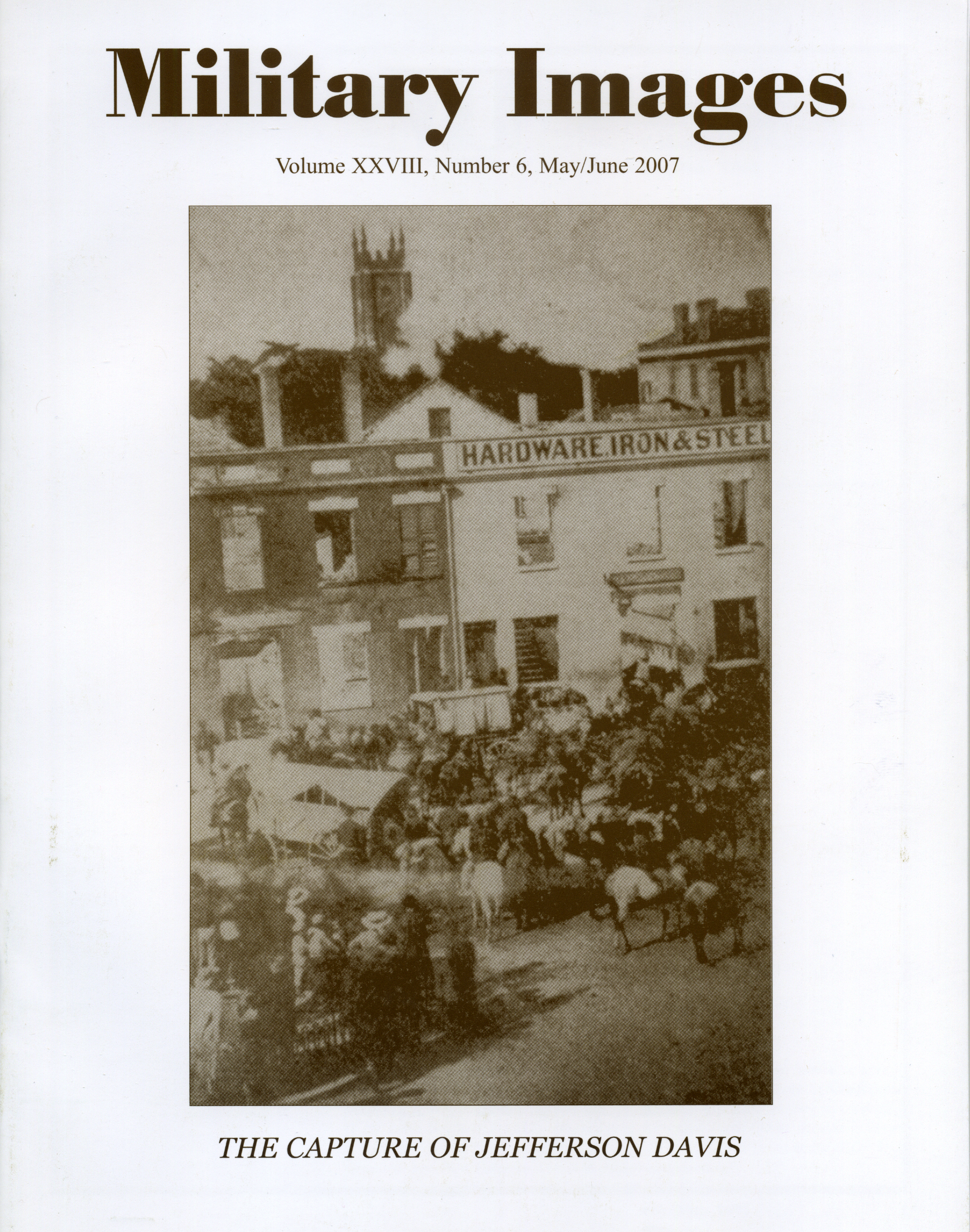
carte de visite from the David Parks collection is inscribed, “Ambulance and wagon occupied by Mr. Davis and family in front of Gen. Wilson’s Headquarters Macon, GA, May 12, 1865.”

Table of Contents (p. 1)

Editor’s Desk and Mail Call (p. 2)
The editor explains why readers received a second copy of this issue. Turns out the first issue had printing irregularities that prompted a reprint and resend. He goes on to promote the upcoming medical issue, and describes the interest as “red hot.”

Passing in Review (p. 3)
The Officer Corps of Custer’s Seventh Cavalry 1866-1876 (Schiffer Military History) by James B. Klokner is well received. “Mr. Klokner’s volume contributes useful biographical data to our already vast knowledge of the 7th U.S. Cavalry.”

The Capture of Jefferson Davis by John Sickles (pp. 4-19)
The author tells the dramatic story of how the Confederate president fell into enemy hands, and it is illustrated with a number of identified portraits of troopers who served in the 4th Michigan Cavalry, the regiment credited with the capture. They include Benjamin Archer, Herbert A. Backus, William L. Bailey, Lester P. Bates, Lucius Bates, Charles Blackall, Henry S. Boutell, Martin L. Brown, Joseph Colenso, Julian G. Dickinson, William Dill, John H. Douglas, John N. Gilbert, Augustus Grawn, George Hall, Martin V. Heckathorn, George F. Hodge, Charles T. Hudson, Joseph W. Huston, George Kauffman, Gurdin N. Kenyon, George W. Lawton, William McCune, Angus McDonald, John C. McLain, Emery A. Miller, Robert Horatio George Minty, Frank Mix, Elias F. Pierce, Henry A. Potter, Benjamin D. Pritchard, Alfred B. Purinton, Elias Scales, Isaac Skinner, George Smith, Luke M. Thayer, Benjamin Thompson, George B. Walker, Horace B. Warner, Augustus Wegal, Charles Wegal, Daniel P. Welton (possibly) and Fred Woohans.

Conant Family in the Civil War by J. Dale West (pp. 20-23)
The story is subtitled, “From Missouri, the Conant brothers were early volunteers in ‘Mr. Lincoln’s Army.’” The author profiles Maj. Horace A. Conant, aide de camp to Brig. Gen. Nathaniel Lyon and paymaster, 1st and 2nd Regiments, 1st Brigade Missouri Volunteers and Capt. John H. Conant, 1st Missouri Light Artillery. Also pictures are Capt. and Provost Marshal Abraham D. Daugherty and Abbie Maria Conant Daugherty, wife of Capt. Abraham Daugherty and sister of Horace and John.

Texans in Search of a Fight by Derek Manov (pp. 24-27)
Two photographs of Confederate soldiers are the subject of this investigation into the uniforms and equipment of the 4th Texas Infantry, which was part of Gen. John B. Hood’s Texas Brigade in the Army of Northern Virginia. One image, a quarter-plate ambrotype, pictures two unidentified members of Company B, also known as the ‘Tom Green Rifles.” The second image, a sixth-plate ambrotype, is a portrait of an unidentified member of the regiment.

Rhode Island Uniforms in the Civil War by Robert Grandchamp (pp. 28-32)
Though comparatively smaller in size and population to the other states of the Union, Rhode Island had its share of uniform style. The author details the variations, illustrated with several images that include privates William S. Perrin and William H. Jordan of the 1st Light Artillery, Capt. Theodore Winn, Pvt. Horace D. Healey, Pvt. Henry Wilson, Pvt. John P. Jones, Sgt. Franklin Gonsolve and Lt. Darius Cole of the 7th Infantry, Capt. George Newman Bliss of the 1st Cavalry, Pvt. George Henry Maxfield of the 2nd Infantry.

Uniforms & History by Michael J. McAfee (pp. 33-34)
In “The Ninety-Seventh Regiment, New York Volunteer Infantry,” McAfee examines the service record of the regiment, which lost heavily during the first day of the Battle of Gettysburg, and the uniforms and equipment that they were issued. Images that accompany the text include Luther E. Bullock, Louis Dallarmi, George F. Dempster and William A Wright.

The Confederate Soldier (p. 35)
A hard-plate photograph of A.J. Johnson of the 18th Alabama Infantry in civilian clothes may be the only surviving portrait of the soldier, who died during the April 1865 siege on Spanish Fort in Mobile Bay, Ala.

Stragglers (pp. 36-38)
A total of 11 images are featured in this issue. None of the soldiers are identified.

Sutler’s Row (p. 39)

The Last Shot (p. 40)
A carte de visite copy of a tintype of two soldiers with smokes and cards from the collection of Chris Nelson is simply titled, “Pards At Cards.”

Back Cover
A carte de visite from the David W. Vaughan collection pictures Benjamin Staats of the 14th Rhode Island Heavy Artillery.

Finding Aid: March/April 2007

2007-v28-05-xxviii

The complete issue

Vol. XXVIII, No. 5
(40 pages)


Print edition: Visit our store to check availability
Digital edition: Visit JSTOR.org to purchase
Subscribe to MI
Explore the MI Archives: Browse | Advanced search | Tutorial

Inside

Cover image
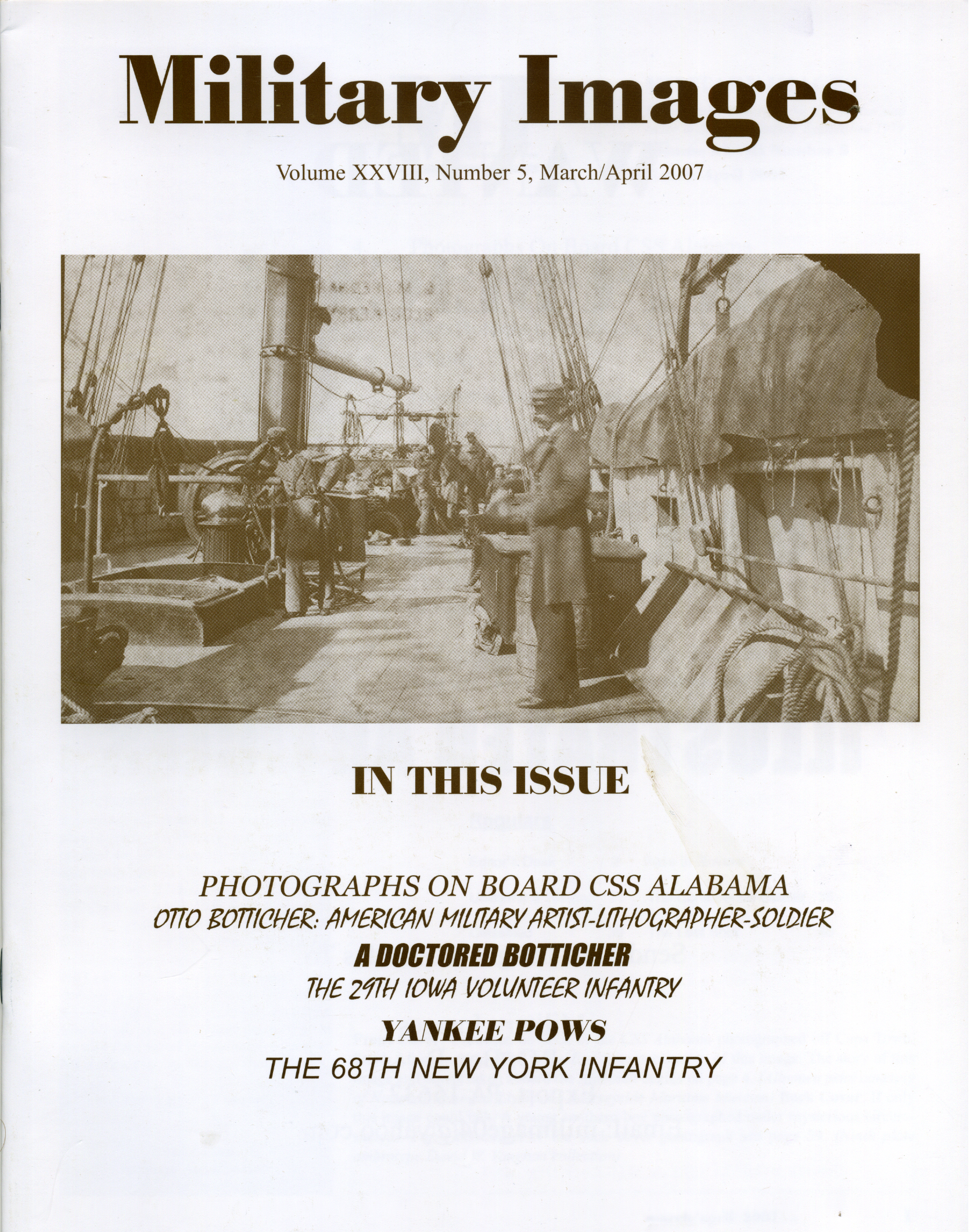
An albumen print from the National Museums Liverpool-Merseyside Maritime Museum pictures crewmen on deck of the Confederate cruiser Alabama off Cape Town, South Africa, in 1863. This is the first time this image has been published.

Table of Contents (p. 1)

Editor’s Desk and Mail Call (p. 2)
The editor previews the contents of this issue with emphasis on the Alabama and a profile of artist-lithographer-soldier Otto Botticher.

Passing in Review (p. 3)
Four books are recommended: Rough Riding Scout, The Story of John W. Mobberly Loudon’s Own Civil War Guerrilla Hero (Elden Editions) by Richard E. Crouch; The Civil War Collector’s Price Guide 11th Edition (Publisher’s Press, Inc.) by North South Trader’s Civil War; The Darkest Days of the War, The Battles of Iuka and Corinth (The University of North Carolina Press) by Peter Cozzens and The Wilderness Campaign (The University of North Carolina Press), edited by Gary Gallagher.

Photographers On Board CSS Alabama by Andrew Bowcock (pp. 4-7)
Subtitled “The first time publication of a photograph taken aboard the Confederacy’s most famous raider,” the author details three albumen prints that appeared in a catalog issued by a London book dealer. Two of the images, of Capt. Raphael Semmes and 1st Lt. John McIntosh Kell on the deck of the vessel, are fairly well known. The third, reproduced on the cover of MI, is previously unknown. This image is explored in depth with several enlargements to highlight salient details.

Otto Botticher: American Military Artist-Lithographer-Soldier by Seward R. Osborne (pp. 8-16)
Subtitled, “We’ve all seen his military prints, but who was Otto Botticher?” Historian Seward Osborne went in search of the answer and presented his findings in this profile of the German-born artist. He served as an officer in the 68th New York Infantry during the Civil War and was captured by Confederates near Manassas on March 29, 1862. He eventually returned to his regiment and fought through the rest of the war, suffering a wound in the Battle of Gettysburg. Numerous examples of his military art survive, which cleverly melded photography and art into lithography. Botticher died in 1886.

 The Doctored Botticher by Mark H. Dunkelman (pp. 17-19)
Patrick Henry Jones, a Union brigadier who was once colonel of the 154th New York Infantry, is at the center of this story of a Botticher print titled “Sherman at Savannah, Ga.” An admirer of Gen. Jones commissioned an artist to replace the likeness of Maj. Gen. Henry A. Barnum with Jones. The story is illustrated with details of the image and photographs of Jones and Barnum.

Rhode Island Uniforms in the Civil War by Robert Grandchamp (pp. 28-32)
Though comparatively smaller in size and population to the other states of the Union, Rhode Island had its share of uniform style. The author details the variations, illustrated with several images that include privates William S. Perrin and William H. Jordan of the 1st Light Artillery, Capt. Theodore Winn, Pvt. Horace D. Healey, Pvt. Henry Wilson, Pvt. John P. Jones, Sgt. Franklin Gonsolve and Lt. Darius Cole of the 7th Infantry, Capt. George Newman Bliss of the 1st Cavalry, Pvt. George Henry Maxfield of the 2nd Infantry.

Yankee POWs: Vignettes from the Collection of Michael Fitzpatrick (pp. 20-26)
The author profiles six soldiers who fell into enemy hands during the war: Richard Thomas of the 99th New York Infantry and 6th U.S. Infantry, captured on March 8, 1862, at Hampton Roads, Va.; Edward Hayes Swisher of the 7th Pennsylvania Reserves, captured first during the Peninsula Campaign and again in The Wilderness; Joseph S. Stigler of the 2nd Pennsylvania Heavy Artillery, captured at Chaffin’s Farm; Abraham Loane of the 2nd Massachusetts Cavalry, captured near Aldie, Va., in 1864, Samuel T. Moles of the 47th Illinois Infantry, captured at Holly Springs, Miss., in 1862, and Frederick B. Nesbett of the 5th Main Infantry, captured at Salem Church, Va., in 1863.

A Regimental History of the 29th Iowa Volunteer Infantry by Brian K. Robertson (pp. 27-32)
Subtitled, “Exposed to sickness and rebel bullets, service in Arkansas & Mississippi took its toll on this regiment from the Midwest,” the author provides a sketch of the 29th that is illustrated with photographs from the collection of the Butler Center for Arkansas Studies. They include Orlando H. Bagley, Thomas H. Benton Jr., Isaac C. Catlett, William M. Carlile, Octavius B. Gaddy, Bird Hagans, Frederick D. Hahnonkratt, Francis M. Haskins, Lemen D. Helm, William M. Hindman, John S. Miller, James L. Mitchell, Heslip W. Rodgers, Wesley M. Rodgers, Robert Salen, John B. Thomson and William H.W. Wax.

Uniforms & History by Michael J. McAfee (pp. 33-35)
In “The 68th Regiment, New York Volunteer Infantry,” McAfee examines the service record of the regiment and the uniforms and equipment that they were issued. Images that accompany the text include Robert J. Betge, Johann H. Kleefish and Heinrich W. Reissberger. One additional image that the author believes may be Otto Botticher is also included.

The Confederate Soldier (p. 36)
A sixth-plate ambrotype from the Brian Boeve collection is a portrait of Pvt. James Robert Gwin of the 17th Battalion Virginia Infantry and the 11th Virginia Cavalry. Gwin survived a wound in the Wilderness and the Civil War. He lived until 1923.

Back Cover Story (p. 38)

Sutler’s Row (p. 39)

The Last Shot (p. 40)
A carte de visite from the Don Ryberg collection pictures Cpl. Joseph H. De Castro of the 19th Massachusetts Infantry. He received the Medal of Honor for his capture of the colors of the 19th Virginia Infantry during Pickett’s Charge at the Battle of Gettysburg. He survived the war and died in 1892.

Back Cover
A ninth-plate ambrotype from the David W. Vaughan collection pictures a young boy posed with flowers. The image shows all indications of being a post mortem with the exception of his eyes, which are wide open.

Finding Aid: July/August 2006

2006-v28-01-xxviii

The complete issue

Vol. XXVIII, No. 1
(48 pages)


Print edition: Visit our store to check availability
Digital edition: Visit JSTOR.org to purchase
Subscribe to MI
Explore the MI Archives: Browse | Advanced search | Tutorial

Inside

Cover image
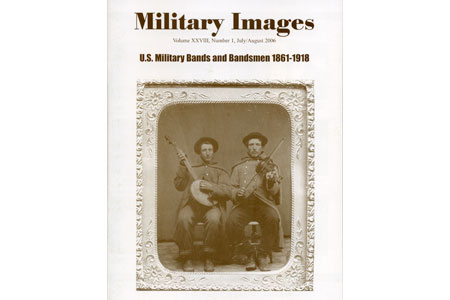
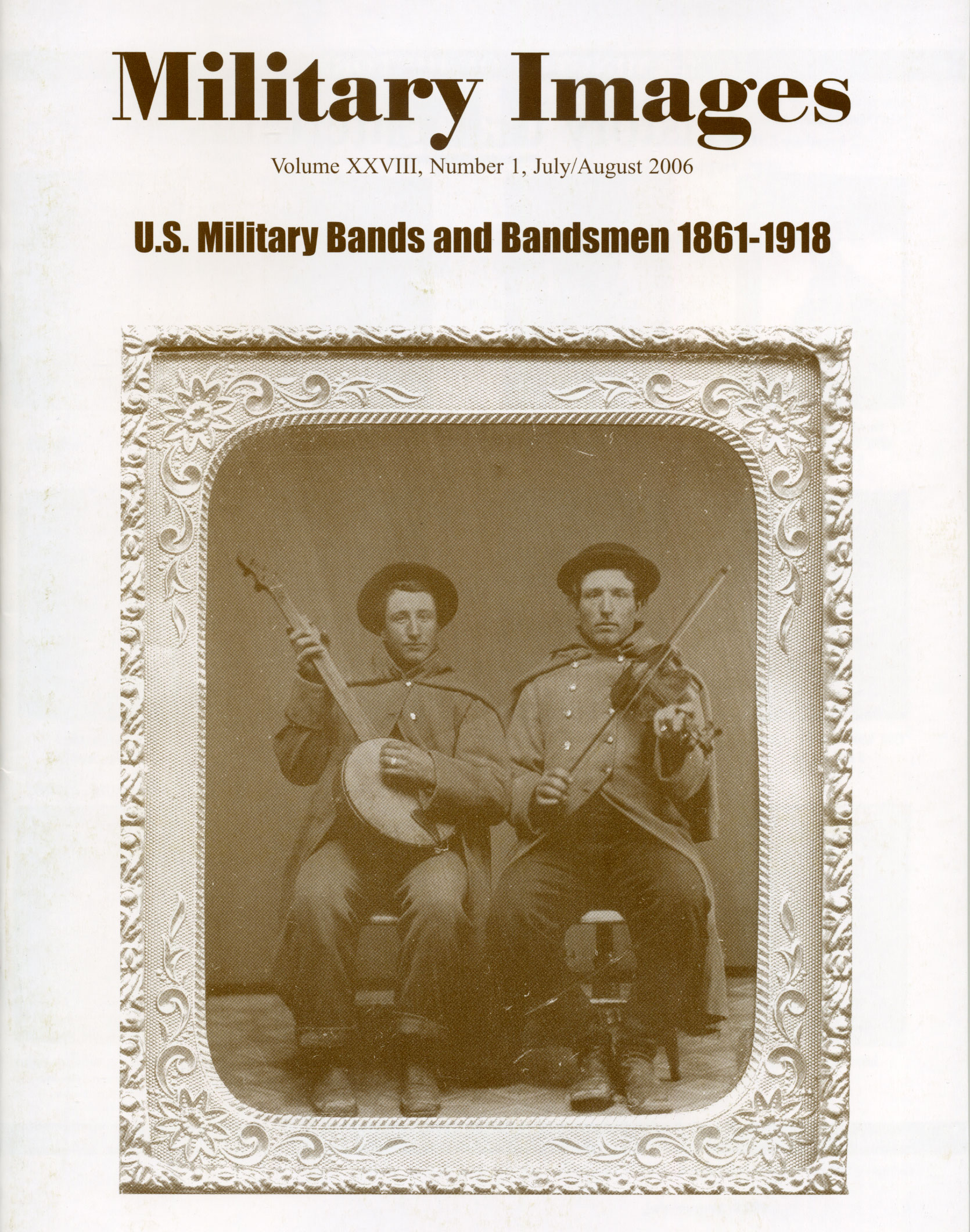
A sixth-plate tintype from the Donald Bates Sr. collection pictures two Union soldiers, one with a banjo and the other with a fiddle.

Table of Contents (p. 1)

Editor’s Desk and Mail Call (p. 2)
The editor welcomes readers to this special issue dedicated to U.S. military bands and bandsman, 1861-1918. Also mentioned is the passing of Dr. Francis Lord, 94, who authored pioneer books about Civil War relics, including his landmark 1963 reference volume the Civil War Collector’s Encyclopedia. Mail Call features a single letter about experiences in Multigraph photography.

Passing in Review (pp. 3-4)
One book is recommended: The Shenandoah Valley Campaign of 1864 (University of North Carolina Press) by Gary W. Gallagher.

U.S. Military Bands and Bandsmen 1861-1918 by Chris Nelson (pp. 4-7)
The introduction to this multipage cover story examines the integral role played by musicians in every U.S. war since the Revolution. The author notes, “Fortunately for students of U.S. military history, the documentation, and surviving examples of instruments, uniforms, and sheet music, allows us to virtually recreate the entire experience. The increasingly successful efforts of Civil War re-enactors to replicate accurate band and field music are now a staple of most events. This article is a quick look at the original bands and bandsmen from 1861 through WWI.” The photo survey that follows is divided into sub-sections that include profiles.

Drummers and Fifers (pp. 8-19)
A total of 31 images of all formats includes the following identified individuals: Connecticut drum maker C.B. Hendrick, the Rebagg Brothers of Rochester, N.Y., Christian Heckler of the 62nd Illinois Infantry, the Smith brothers of Illinois regiments (John of the 89th, Joseph of the 36th and William of the 26th), John Miller of the 100th Indiana Infantry, Robert Henry Hendershot of the 8th Michigan Infantry, Archibald Godley of the 14th New York Heavy Artillery, John S. Kountz of the 37th Ohio Infantry and John G. Webb of the 78th Pennsylvania Infantry.

Brass Instrumentalists (pp. 20-23, 25)
A total of 18 images of all formats includes the following identified individuals: James Porter of Gen. Grenville Dodge’s band, George Lowman of the 36th Illinois Infantry, Jeremiah Potter of the 2nd Rhode Island Infantry, Robert J. Hancock and David L. Thomas of the 3rd Rhode Island Cavalry and Edwin Ordway of the 1st Vermont Heavy Artillery.

Calixa Lavallee: Civil War Musician & Composer of the Canadian National Anthem (p. 24)
A sketch of the life and military service of the song O’Canada is illustrated with a quarter-plate ambrotype of Lavallee and his brother George during their service with the 4th Rhode Island Infantry.

Buglers & Trumpeters (pp. 26-33)
A total of 24 images of all formats includes the following identified individuals: John H. Buckner of an unidentified post-war regiment, Joseph Gibble of the 12th Ohio Cavalry and Emil Smith of the 39th Ohio Infantry.

Military Bands (pp. 34-36)
A total of 6 images includes the following identified organizations: the U.S. Military Academy Band in 1864, the band of the 12th U.S. Infantry at Chickamauga, Ga., in 1898 and Watson’s Band, 1st Minnesota Infantry, Minnesota national Guard, in 1898.

The Boys Who Broke the Hindenburg Line: 370th Old 8th Regiment, Chicago, Illinois (p. 37)
Three images of the band of the 370th U.S. Infantry, an African American World War I unit, which served alongside the famous 369th U.S. Infantry (Harlem Hell Fighters) in the French army.

Sergeant John von Staden: Drum Major, 1st California U.S. Volunteers 1898-1899 (p. 38)
An image of the band of the 1st California photographed in the Philippines in 1899 pictures von Staden holding his baton. A sketch of the regiment and his service is included.

Uniforms & History by Michael J. McAfee (pp. 39-42)
In “The Military Band,” McAfee provides a short history of Union Civil War bands. A dozen cartes de visite illustrate the text, including Charles Grimmer of the 17th U.S. Infantry.

Stragglers (pp. 43-45)
A total of 11 portraits of bandsmen include 1st lt. George Andrews of the 25th U.S. Infantry astride his horse “Bob,” Dunallen M. Woodburn of the 58th Ohio Infantry and the band of the 329th U.S Infantry of the 83rd Infantry Division.

 Sutler’s Row (p. 46)

The Last Shot (p. 48)
“Band Gone Wild” is the headline that accompanies this image of the band of the 1st Minnesota Infantry, Minnesota National Guard. The members are attired in a bizarre assortment of costumes for a mock parade.

Finding Aid: January/February 2007

2007-v28-04-xxviii

The complete issue

Vol. XXVIII, No. 4
(40 pages)


Print edition: Visit our store to check availability
Digital edition: Visit JSTOR.org to purchase
Subscribe to MI
Explore the MI Archives: Browse | Advanced search | Tutorial

Inside

Cover image
A half-plate daguerreotype from the Thom Cole collection is a circa 1850 portrait of a militia dragoon non-commissioned officer in full dress uniform.

Table of Contents (p. 1)

Editor’s Desk and Mail Call (p. 2)
The editor notes that it has been a long while since so many military daguerreotypes have been published in the magazine. He also references upcoming projects.

Passing in Review (p. 3)
Three books are recommended: Confederate Heroines, 120 Southern Women Convicted by Union Military Justice (Louisiana State University Press) by Thomas P. Lowry; War’s Relentless Hand, Twelve Tales of Civil War Soldiers (Louisiana State University Press) by Mark Dunkelman and The Daguerreian Annual 2005 (The Daguerreian Society), edited by Mark S. Johnson and Dawn Patton.

American Military Daguerreotypes From the Collection of Dr. William T. Schultz (pp. 4-23)
A Q&A with Dr. Schultz by James Ronan II (reprinted with permission by the Company of Military Historians) covers the basics of military daguerreotypes and explores various aspects of the collection. A survey of 22 follows, including identified images of Lt. George H. Gordon, U.S. Mounted Rifles; Henry Ledyard, U.S. Charge d’ Affair in Paris; Asst. Surg. Robert Little Brodie, U.S. Army; Midshipman John Gardner Mitchell, U.S. Navy; Lt. Col. Joseph R. Smith, U.S. Army; 1st Lt. William Root, 5th U.S. Infantry; 2nd Lt. William Thompson Mechling, 3rd U.S. Infantry; 1st Lt. William H. Gray, 11th U.S. Infantry and 1st lt. Robert S. Hayward, 13th U.S. Infantry.

“Respetad a la Humanidad!” by Kirk D. Lyons, JD (pp. 24-29)
Subtitled, “The curious history of a Mexican War daguerreotype,” the author, a self-described “keen student of Mexican War photography since my college days,” traces the history of a medical image from the War with Mexico. The photograph pictures Pedro Vander Linden, Chief Surgeon of the Mexican Medical Corps. Captured at the Battle of Cerro Gordo in 1847 when his field hospital was overrun by Americans, Vander Linden, “turned, faced the soldiers with his upraised bloody hands shouting: ‘Respedad a la humanidad, o un hospital de sangre; somos cirujuanos!’ (Respect humanity of this hospital if blood! We are surgeons!)”

Babe Hudspeth: Missouri Guerrilla by John Sickles (pp. 30-33)
Guerrilla fighter William Napoleon “Babe” Hudspeth participated in some of the bloodiest raids of the Civil War. He rode with the likes of William Quantrill, Bloody Bill Anderson and Jesse James and survived his war experience. He died in 1907. The story is illustrated with two cartes de visite from the author’s collection. One is Hudspeth dressed in a Mexican Bolero jacket, and the other pictures him with Oscar Thompson, who also rode with Quantrill.

Uniforms & History by Michael J. McAfee (pp. 33-35)
In “The Military Daguerreotype,” McAfee shares his memory of the first military daguerreotype he purchased, how he came to sell it to well-known collector Herb Peck Jr., and memories of other similar images that passed through his hands. Four images illustrate the column.

The Confederate Soldier (p. 36)
A ninth-plate ruby ambrotype from the Steven Karnes collection is a portrait of an unidentified South Carolina private who served with the Holcombe Legion.

Back Cover Story (p. 38)
The background of the image includes a circa 1846 daguerreotype of the same man dressed in civilian clothes.

Sutler’s Row (p. 39)

The Last Shot (p. 40)
A half-plate ambrotype from the David W. Vaughan collection pictures an unidentified Confederate officer with cavalry-style saber.

Back Cover
A daguerreotype from the Fred Sherfy collection is identified as “Uncle Issac Hull in Civil War.” Though not a Civil War era image, Hull may have served in a militia company.

Finding Aid: March/April 2006

2006-v27-05-xxvii

The complete issue

Vol. XXVII, No. 5
(40 pages)


Print edition: Visit our store to check availability
Digital edition: Visit JSTOR.org to purchase
Subscribe to MI
Explore the MI Archives: Browse | Advanced search | Tutorial

Inside

Cover image
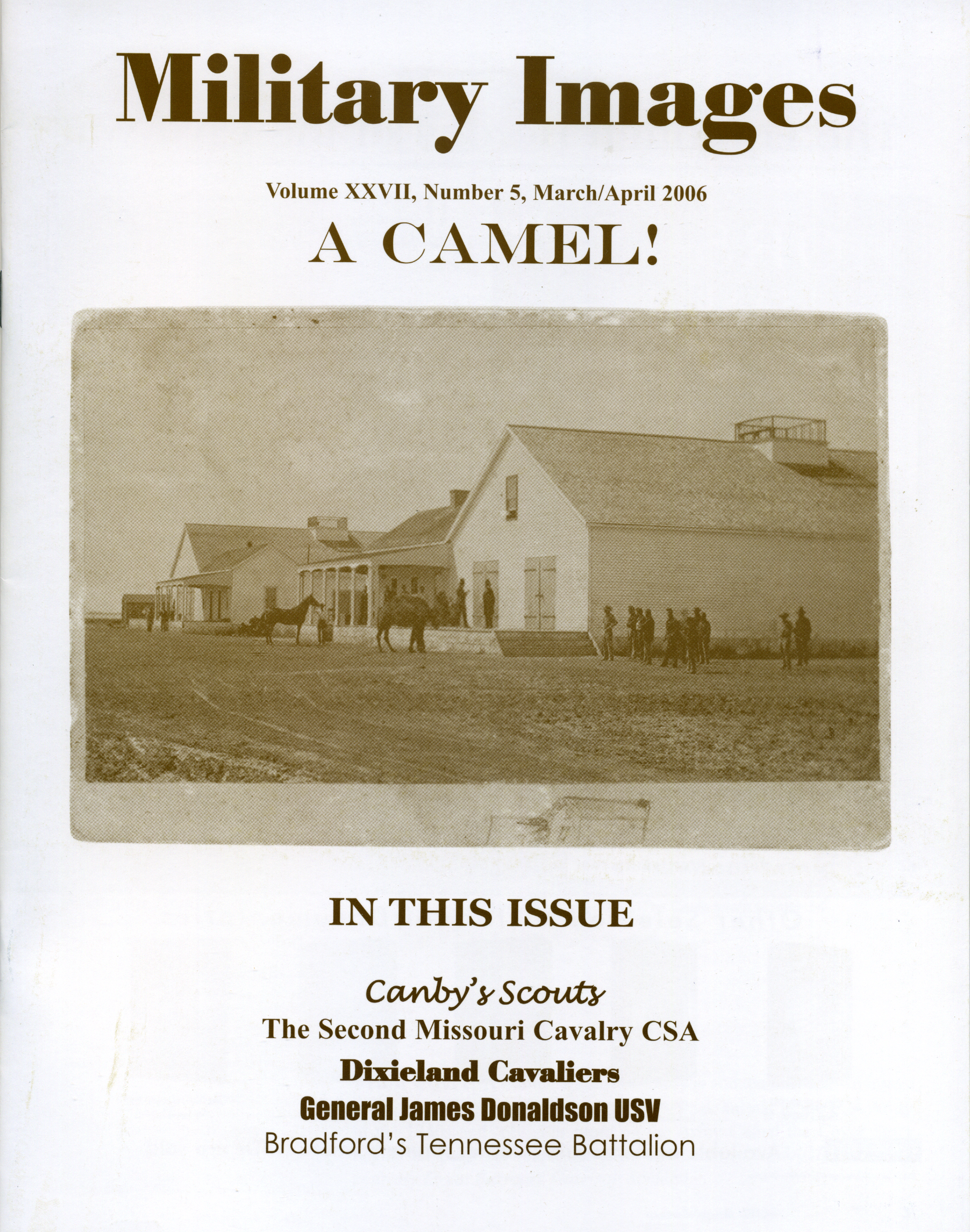
carte de visite courtesy of the Drum Barracks Garrison Society pictures a camel, the only known image of the pack animal in the U.S. army during the 1850s and 1860s.

Table of Contents (p. 1)

Editor’s Desk and Mail Call (p. 2)
The editor describes how he found the cover carte de visite on eBay in 2005 and was pleased to find that the winning bidder was MI contributor Mile Sorenson. He goes on to note the top-notch images in this issue and praise senior editors Mike McAfee and John Sickles. A single letter to the editor adds details about the flag of Horse Battery M, 2nd U.S. Artillery. The unit was featured in the last Uniforms and History column.

Passing in Review (pp. 3-4)
Three books are recommended: For Dixie Land I’ll Take My Stand! Somebody’s Darling: Images of Mississippi (Chickasaw Bayou Press) by H. Grady Howell Jr.; Antietam: Then & Now (Thomas Publications) by Garry Adelman and Where Custer Fell: Photographs of the Little Bighorn Battlefield Then and Now (University of Oklahoma Press) by Brian C. Pohanka and Sandy Barnard.

Stoneman’s Raid to Macon by John Sickles (pp. 5-15)
The author notes that Stoneman had hoped to destroy railroads and free prisoners of war, but in the end many found themselves in prison camps. A history of the raid follows, illustrated by identified images of Nicholas Barkes, Peter Reising, William R. Sanford and Newton Smith of the 14th Illinois Cavalry, George S. Amrick, Will Angel, Thomas Butler, Edward N. Elliott, Benjamin Farley, Russell P. Finney, Tillman H. Fisher, Erastus Holmes, William Jefferis, David W. Patty, Charles Rugg, J. Albert Smith, Melville H. Soper and George Whitenack of the 5th Indiana Cavalry and James Biddle and Nathaniel Craigmile of the 6th Indiana Cavalry. Also included is a post-war image of Joseph Clouse of the 5th Indiana Cavalry.

A Most Curious Corps by Michael K. Sorenson (pp. 16-17)
The brief but unique history of the U.S. Camel Corps in the American West is detailed, and it is illustrated by a detail of the cover image and a bell purportedly used on camels in the army service during the 1850s and 1860s.

The Second Missouri Cavalry C.S.A. by John Sickles (pp. 18-20)
The author provides a brief history of the Confederate regiment, which is illustrated by portraits of Col. Robert “Black Bob” McCulloch, Lt. Col. Robert A. “Red Bob” McCulloch, David C. Boggs and two unidentified members of the regiment.

Dixieland Cavaliers by John Sickles (pp. 21-23)
Images and details are provided about the life and service of the following Confederate soldiers: 2nd Lt. B.A. Powell of the 3rd Tennessee Cavalry, Pvt. W.B. Middleton of the 3rd Kentucky Mounted Infantry, Pvt. John Pierson of the 7th Alabama Cavalry and Pvt. M. Bolen of the 64th North Carolina Infantry.

Canby’s Special Scouts by Michael J. Martin (pp. 24-27)
The author explains the background of these mounted citizen scouts authorized by Maj. Gen. E.R.S. Canby. Pictured is the officer who organized the scouts, 1st Lt. Isaac N. Earl of the 4th Wisconsin Cavalry. Two wartime images of scouts Nelson Porter and Warren Knowles, and a postwar photograph believed to be Charles Baker, are also incuded.

Brevet major General James Lowry Donaldson, “The Forgotten Quartermaster” by Henry A. Pomerantz (pp. 28-31)
Described as one of the many “invisible person” who toiled behind the lines as quartermasters, Donaldson (1814-1885) became something of a right-hand man to Quartermaster Gen. Montgomery C. Meigs. Nine portraits of Donaldson taken at various times during the war illustrate the story.

Uniforms & History by Michael J. McAfee (pp. 32-33)
In the “Bradford’s Battalion, Tennessee (Union) Cavalry,” McAfee provides a short history and statistics about this regiment, which faced Gen. Nathan Bedford Forrest’s cavalry at Fort Pillow on April 12, 1864. It is illustrated with a carte de visite of Lt. Mack J. Leaming, who survived the fighting, which included the murder of numerous African American soldiers.

The Confederate Soldier (p. 34)
A sixth-plate ambrotype of a well-armed first lieutenant wearing the number 7 on his lapel is part of the Brian Boeve collection. The image is inscribed “Elzi Benson 3 August 1861.”

Stragglers (pp. 35-38)
A total of 12 portraits include Lt. John J. Fray and Pvt. William A. Brawner of the 43rd Partisan Battalion, Mosby’s Cavalry. The men were photographed in civilian clothing about 1861. Also included is Cpl. Charles Rude of the 100th Indiana Infantry and Maj. James E. Doran of the 24th New York Cavalry and his son.

Sutler’s Row (p. 39)

The Last Shot (p. 40)
A sixth-plate tintype from the Roy Mantle collection is an unidentified federal first sergeant fully equipped for the war.

Finding Aid: November/December 2005

2005-v27-03-xxvii

The complete issue

Vol. XXVII, No. 3
(48 pages)


Print edition: Visit our store to check availability
Digital edition: Visit JSTOR.org to purchase
Subscribe to MI
Explore the MI Archives: Browse | Advanced search | Tutorial

Inside

Cover image
carte de visite of Brevet Brig. Gen. Frederick A. Starring, designer of the Grand Army of the Republic badge, and an inset image of GAR badge No. 1.

Table of Contents (p. 1)

Editor’s Desk (p. 2)
The editor introduces the cover story, which features Illinois brothers Frederick and William Starring. Also mentioned are the other features and departments in the issue, and this parting note: “I would like to thank all those who have generously supported the magazine in the past year, for without your continued interest and input there would be no MI.

Passing in Review (p. 3)
Two books are mentioned: Pioneer Photographers From the Mississippi to the Continental Divide, A Biographical Dictionary (Stanford University Press) by Peter E. Palmquist and Thomas R. Kailbourn and “We Are Coming Father Abra’am” the History of the 9th Vermont Volunteer Infantry 1862-1865 (Schroeder Publications) by Don Wickman.

Duty, Honor, Country: The Life and Times of Frederick A. & William S. Starring by David M. Neville with Lucinda Page Knox (pp. 4-17)
The authors provide accounts of the Starring brothers based on “a significant cache of primary source material, once the property of General Starring” and not available to previous researchers and writers. The narrative is illustrated with numerous images, including military, postwar and family images of the brothers, badges that belonged to Gen. Starring and relics once owned by Lt. William Starring.

Alabama Troops in the Civil War 1861-1865 (pp. 18-33)
A total of 48 Alabama images are showcased in this extensive survey. Identified soldiers include J.W. “Jimmie” Franks of the 4th Cavalry, George A. Wright of the 6th Cavalry, Julian W. Whiting of the 1st Battalion of Artillery, Julius A. and Flavius F. Kimbrough of the 6th Infantry, Reuben Davis Phillips of the 6th Infantry, John P. Alldredge of the 48th Infantry, David W. Ramsey of the 1st Infantry, James M. Steadham of the 25th Infantry, Charles Patrick Walker of the 3rd Infantry, Charles and Joseph A. Hendrix of the 4th Infantry, Henry Wesley Grubbs of the 5th Infantry Battalion, W.A. Pate of the 8th Infantry, Macon Abernathy of the 10th Infantry, Washington Bennett Vardaman, Caleb Woodruff Brewton and Bailey George McClellan of the 10th Infantry, Jesse Owen of the 13th Infantry, William Jasper Bunn of the 14th Infantry, David D. Wheeler of the 16th Infantry, Dennis Lindsey of the 18th Infantry, Irvin Owen of the 22nd Infantry, William G. Norton of the 22nd Infantry, Edwin C. Turner of the 25th Infantry, John Clark Francis of the 10th and 30th infantries, Robert Wheeler of the 37th Infantry, Wesley W. Probst of the 41st Infantry, Joseph W. Griffith of the 44th Infantry, Joseph Parker of the 57th Infantry, Samuel Durham McClellan of the 57th Infantry, Silas Mattison Bunn of the 62nd Infantry, Ellsberry Jackson Andrews of the 2nd Cavalry, James Ainsley Stevenson of the 72nd Militia, Francis Young Gaines of the 3rd Cavalry, Calvin W. Sharp of the 51st Cavalry, David Jennings of the 51st Cavalry, Charles V. Phillips of the 56th Cavalry (Partisan Rangers), Nathaniel H. Clanton of Clanton’s Battery Light Artillery, “Dogwood,” the home of author Thom Cole, David Francis Weaver of the 2nd Infantry, Whatley McGee Hall of the 29th Infantry and J.A. Teney of the 45th Infantry.

The Forney Brothers Civil War by Thom Cole (pp. 34-36)
Subtitled “The life and times of four of Alabama’s most distinguished soldiers—John, George, William and Daniel Forney,” the author profiles the men and their early service with the Calhoun Guards from Jacksonville, Ala., and later service in several organizations. Images of all three of the four men are included. A likeness of Daniel is missing.

“Yankee Cavalry:” The 1st Alabama Volunteer Cavalry USA with images from the collections of Don Scoggins & J. Dale West (pp. 37-39)
A short history of the regiment is illustrated by no less than ten cartes de visite, of which all but one are identified. They are Erasmus D. Chandler, Edward D. Coe, Alonson W. Edwards, Micajah F. Fairfield, William T. Gray, George W. Kellogg, Philip Sternberg, James C. Swift and Francis W. Tupper.

In Camp At Brandy Station, Virginia, February, 1864 by John Sickles (pp. 40-41)
The author identifies a group of individuals pictured in a carte de visite at their winter quarters. They include Asst. Surg. Cecil Rogers of the 6th U.S. Cavalry, Lt. George T. Ingraham of the 4th and 11th New Jersey infantries, 1st Lt. Alexander C.M. Pennington of the 3rd New Jersey Cavalry, his wife Clara Pennington, 1st Lt. Carle Augustus Woodruff of the 2nd U.S. Artillery and 1st Lt. William Scott Worth of the 8th U.S. Infantry.

Uniforms & History by Michael J. McAfee (pp. 42-44)
In “The Fifth Regiment, New York Volunteer Infantry (Revisited),” McAfee cites the untimely passing of his colleague, Brian Pohanka, as the primary reason to take another look at the uniform of this regiment. (Pohanka was a noted student of this regiment.) Several well-known and often reproduced images illustrate the text, and one lesser-known image of Capt. (later colonel) Cleveland Winslow, who was mortally wounded at the Battle of Cold Harbor in 1864, and his father, Chaplain Gordon Winslow.

The Confederate Soldier (p. 45)
A sixth-plate ambrotype from the Ron Field collection pictures an unidentified South Carolina soldier photographed during the antebellum of early war period.

More Images From the Starring Collection (p. 46)
Miscellaneous wartime and post-war images.

Sutler’s Row (p. 47)

The Last Shot (p. 48)
A carte de visite from the Seward Osborne collection is titled “An Old Yank.”

Finding Aid: September/October 2005

2005-v27-02-xxvii

The complete issue

Vol. XXVII, No. 2
(40 pages)


Print edition: Visit our store to check availability
Digital edition: Visit JSTOR.org to purchase
Subscribe to MI
Explore the MI Archives: Browse | Advanced search | Tutorial

Inside

Cover image
A unique ninth-plate ambrotype from the David W. Vaughan collection is a Confederate kepi embellished with a small First National pattern flag, ribbon and dogwood flower. The image was likely to have been made in April 1861.

Table of Contents (p. 1)

Editor’s Desk (p. 2)
The editor provides a moving tribute to Brian Pohanka, “A man of boundless energy and courage who dedicated his all-to-shirt life to the preservation of Civil War battlefields and in the discipline of historical scholarship. Indeed, Brian was one of the finest military historians of our time, a man whose body of work included the authorship of many books, countless magazine article and extensive film work. But his influence on the historical community was even greater than the sum of his work, for he was a true inspiration and mentor to countless men and women, whose passion, like his, was history.” The editor also singles out a story in the current issue about an image of the 17th Michigan Infantry. He points out that Military Images does not agree with the author Charles Joyce’s Aug. 3, 1865, dating of the image, but agreed to publish it on the basis of “its historical merits alone.”

Passing in Review (pp. 3-4)
Two books are mentioned: Generals In Bronze: Interviewing the Commanders of the Civil War (Belle Grove Publishing Company) by William B. Styple and Collecting the Confederacy: Artifacts and Antiques from the War Between the States (Savas Beatie) by Shannon Pritchard.

Last Muster for the “Stonewall Regiment;” The Seventeenth Michigan Infantry Returns To The Wolverine State, Summer 1865 by Charles T. Joyce (pp. 5-14)
The author introduces a newly discovered image of the Michiganders in camp as “singularly deceptive. To even the expert eye, it reveals a war-hardened fragment of a Union infantry regiment drawn up in a weedy field by company in ‘column of divisions.’” What follows is a detailed analysis of the regiment and its key personnel that support the theory that the image was produced on Aug. 3, 1865, on the shores of Grass Lake, Mich. Supporting images include a view of the officers of the 17th in camp in 1865 from the State Archives of Michigan and portraits of Col. William H. Withington, Lt. Col. Frederick W. Swift, Maj. Thomas Mathews, Capt. Christian Rath, Capt. Joseph A. Sudborough, Capt. George Goodsell, Lt. and Adjutant Samuel Sizer, Lt. John S. Maltman, Lt. William Leanhouts, QM. Sgt. John M. Lawrence, Corp. Frank Wright and photographer Corydon Randall.

A Tribute to Brian Pohanka (pp. 15-21)
Brian Caldwell Pohanka (1955-2005) is remembered by numerous colleagues and friends associated with him over the course of his eventful life.

The Custer Cyclorama, Revisited by Charles G. Markantes (pp. 22-31)
Subtitled “The subject of a 1983 article in Military Images, the story of the long-lost Custer Cyclorama is explored again,” the author begins by noting that cyclorama paintings were 19th century versions of virtual reality. He continues on to share the history of the Custer Cyclorama, including surviving images of the painting with original 1983 captions by the late Brian Pohanka.

Uniforms & History by Michael J. McAfee (pp. 32-33)
In “The Third Regiment, Michigan Volunteer Infantry, 1864-1865,” McAfee notes that personal accounts by veterans of the Civil War can be extremely valuable to the student of history, but Four Years Campaigning in the Army of the Potomac by color sergeant D.G. Crotty of the 3rd is unfortunately not a useful reference. McAfee details why the volume raises more questions than it answers, and illustrates his text with a tintype of the color guard of the 3rd and a carte de visite of Anna Etheridge, a nurse who found a home with the boys of the regiment.

The Confederate Soldier (p. 34)
A sixth-plate tintype from the David W. Vaughan collection pictures Pvt. Charles Holtzclaw, who served in Company H of the 6th Virginia Cavalry.

Henley Fugate 63rd Tennessee Infantry C.S.A. by John Sickles (p. 35)
Fugate suffered the loss of an arm at Chickamauga after he was struck by a Union cannon shot. A carte de visite of Fugate and his second wife, likely taken in the 1870s or 1880s, accompanies the narrative.

A Palmetto Artillerist and the Columbia Flying Artillery by John Mills Bigham (pp. 36-37)
John W. Self served as second lieutenant of Waties’ Battery B, Palmetto Battalion of Light Artillery, which was first known as the Columbia Artillery and Columbia Flying Artillery. Details of his military service and a brief history of this artillery organization are included.

Stragglers (p. 38)
Three images include a Union soldier with a Sharps rifle, a young Yank with a Bowie knife and a Colt pocket revolver and an unidentified Confederate soldier wearing color shoulder straps.

Sutler’s Row (p. 39)

The Last Shot (p. 40)
A carte de visite from the Chris Nelson collection pictures two Kentucky National Guardsmen portraying Confederates.