Finding Aid: July/August 2011

2011-v31-01-xxxi

The complete issue

Vol. XXXI, No. 1
(40 pages)


Print edition: Visit our store to check availability
Digital edition: Visit JSTOR.org to purchase
Subscribe to MI
Explore the MI Archives: Browse | Advanced search | Tutorial

Inside

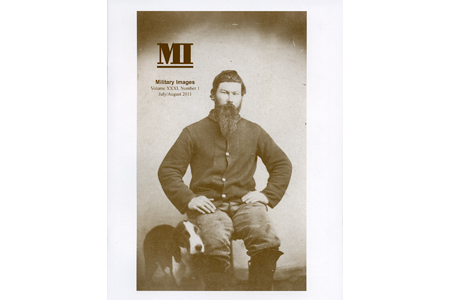
Cover image
A carte de visite of a Union soldier and his canine companion from the Steve Karnes collection.

Inside Cover Image
A sailor with a Krag rifle, posed in front of a painted backdrop, from the Jules Martino collection.

Table of Contents (p. 1)

Editor’s Desk (p. 2)
The editor introduces two new departments, Vignette from the Naval War, 1861-65, by historian Ron Field, and a selection of unidentified images titled What’s My Name?

Front and Back cover details (p. 3)
Additional information is provided about the images pictured on the front and back covers.

What’s My Name? Unidentified Images From The David W. Vaughan Collection (pp. 4-11)
A total of 8 images, a combination of hard plates and cartes de visite, pictures Union and Confederate soldiers whose names have become separated from their likenesses. Included in the grouping are five Confederate officers, two images of Union officers and a portrait of a Native American dressed in a double-breasted federal frock coat.

Colonel Frank Wolford, 1st Kentucky Cavalry USA by John Sickles (pp. 12-12)
Wolford, who organized the 1st in the summer of 1861, was among a contingent of Union officers who accepted the surrender of John Hunt Morgan on July 26, 1863. Upon his surrender, Morgan gave his silver spurs to Wolford. Less than a year later, Wolford was dismissed from the army after publicly criticizing President Abraham Lincoln. Two portraits of Wolford illustrate the profile, both from the author’s collection.

Morgan’s Commissary Officer by John Sickles (pp. 14-15)
A carte de visite of Kentuckian Theodore B. Boyd (1834-1909) is accompanied by a summary of his military service. A staff officer to generals John Breckenridge and Braxton Bragg, Boyd eventually joined the staff of John Hunt Morgan. He was captured with Morgan in July 1863 and spent the rest of the war in the Confederate officer’s prison at Fort Delaware, Del.

The Many Faces of Captain Henry Blake Hays, 6th United States Cavalry by David M. Neville (pp. 16-17)
Four images of Hays, who served as ordnance officer on the staff of Maj. Gen. Alfred Pleasonton, are pictured. Each image is accompanied by a brief caption.

William N. Brady: Master of the Yard by Ron Field (pp. 18-20)
Brady (1809-1887), a career navy officer, served two stints as the master of the Brooklyn Navy Yard: From 1843-1853, and again from 1858-1865. Newspaper reports described him as “a cool head to attend to and direct anything,” and a man of “precision and energy.” He is perhaps best known for his 1841 book for early-career American naval officers, The Kedge Anchor, or Young Sailors’ Assistant. Two portraits illustrate his story.

Midshipman Nathaniel Prickett of the Brazil Squadron (p. 21)
In 1850, two years after midshipman Prickett sat for the daguerreotype shown here, he died in Rio de Janeiro while on duty with the Brazil Squadron. Image from the David W. Vaughan collection.

Disaster @ Fort Monroe (pp. 22-23)
An image of a 12-inch coastal gun and its crew at Fort Monroe was taken prior to 1910. On July 21 of that year, an accidental gun explosion at the fortress killed an undetermined number of men.

William C. Armor, Aide-De-Camp, 2nd Division, 20th Army Corps by David M. Neville (pp. 24-25)
William Crawford Armor (1842-1911) served on the staff of Maj. Gen. John White Geary. Armor survived wounds below the knee at Antietam and in the right hand at Chancellorsville. He went on to participate in the campaigns of Chattanooga, Atlanta, Savannah and the Carolinas. He ended the war as a captain with a brevet, or honorary rank, of major. The profile is illustrated with portraits of Armor and Geary.

Passed From His Sight: An Incident in The Military Career of Captain Augustus Michaelis by Scott Valentine (pp. 26-27)
Michaelis, the captain and commander of Company I of the 45th New York Infantry, was eyewitness to an unusual event in his Virginia camp during the early evening of May 2, 1863. A huge stag emerged from a wooded area, soon followed by a menagerie of wild animals. This surreal scene was followed by gray soldiers and the rebel yell—and thus began Michaelis’s Chancellorsville experience. A carte de visite of Capt. Michaelis is part of the author’s collection.

Uniforms & History by Michael J. McAfee (pp. 28-29)
In “Just Before the Battle…,” McAfee examines the uniforms of the 8th New York State Militia at Bull Run. A portrait of an unidentified sergeant from the regiment and a Mathew Brady image of men from the 8th titled, “Arlington Heights July 16th 1861” is included.

Stragglers (pp. 30-36)
A grouping of seven images submitted by readers is included in this installment of the popular department, including a bugler from the 1st Delaware Cavalry, a soldier in the 10th Ohio Independent Company Sharpshooters, a federal sergeant major and two young Confederate soldiers.

Sutler’s Row (p. 39)

The Last Shot (p. 40)
A tintype from the Jules Martino collection features two injured men—one is missing an arm and the other has a gauze-like wrapping of brace around his neck.

Inside Back Cover
A carte de visite of a Civil War band with a fort in the background by itinerant photographer C.G. Blatt of Bernville, Pa., is part of the Donald Bates Sr. collection.

Back Cover
A woman holds an image of a soldier housed in a composition frame. The soldier is probably her husband. This tintype is part of the Liljenquist Family Collection at the Library of Congress.

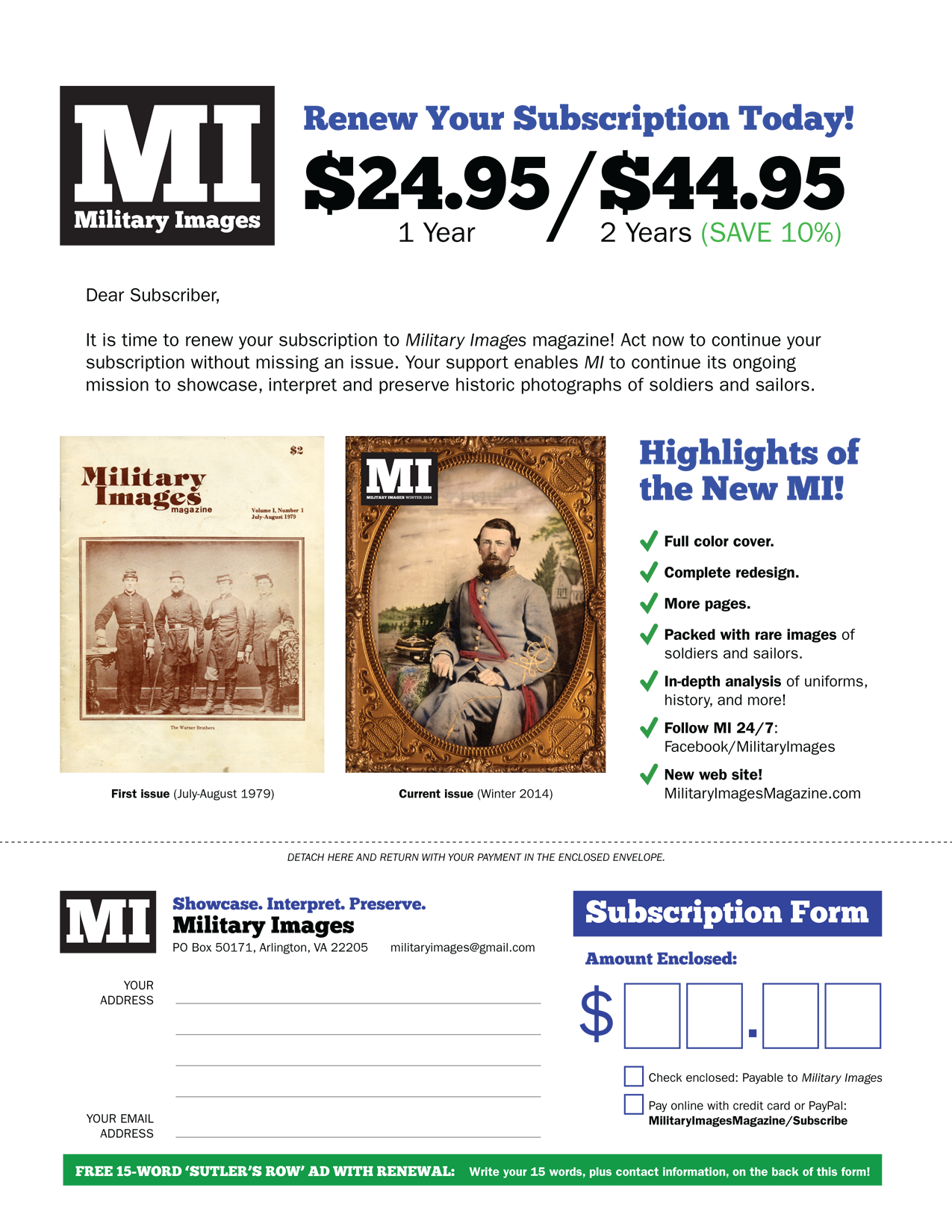
MI’s New Look Extends to Renewal Form

renewalThe redesign that debuted with the current issue of the magazine has impacted all other materials associated with the publication. This includes the renewal form, which is being mailed today to those who have expired subscriptions.

The renewal form is a challenge from a design perspective. There are a number of details to communicate, and clarity is essential. Before beginning the task, I prepared by collecting renewal forms and invitations to subscribe forms from other publications.

Armed with samples, I set about creating the new form shown here. The final version is divided into two sections. The upper two-thirds states the price and describes highlights of the new MI, which includes the redesigned magazine and web site. The bottom third is a detachable return slip which is returned with payment in a self-addressed stamped envelope included with the form.

The biggest change, aside from the new look, is the placement of the free (and optional) classified ad, a long-time tradition for renewing subscribers. The free ad is still available, but the large space on the front of the return slip to enter the ten words and contact information has been reduced to a green box at the very bottom of the form. Text in the green box instructs subscribers to use the back of the return slip to enter this information. They can also email militaryimages@gmail.com.

Finding Aid: November/December 2011

2011-v31-03-xxxi

The complete issue

Vol. XXXI, No. 3
(40 pages)


Print edition: Visit our store to check availability
Digital edition: Visit JSTOR.org to purchase
Subscribe to MI
Explore the MI Archives: Browse | Advanced search | Tutorial

Inside

Cover Image
Uniformed in a coatee with light colored facings, this useful militiaman’s portrait was made in the late 1850s. Tom Gaard collection.

Table of Contents (p. 1)

Editor’s Desk (p. 2)
The editor introduces one of the feature articles, “Peach-Fuzz” and “Gray-Beards” by Mike Fitzpatrick. On a somber note, the editor reports that passing of former contributing editor Michael J. Winey, 70, who was the Chief Photo and Map Archivist and Chief Curator of Artifacts of the United States Military History Institute in Carlisle Barracks, Pa.

Front and Back Cover Details (p. 3)
Additional information is provided about the images pictured on the front, inside back and back covers.

A Fallen Marine at Belleau Wood Finds a Final Resting Place by Michael Kraus (pp. 4-7)
Corp. David B. Foster of the 5th Marines was killed in action on June 12, 1918, only six days after he survived the intense fighting in France at Bellau Wood. Thus began an odyssey of sorts to bring his body home. Despite numerous obstacles and bureaucracy, Foster’s parents and others finally brought his remains home to Dravosburg, Pa., in 1921.

Our First Airmen by John Sickles (pp. 8-11)
Selected images and captions of pilots who flew during World War I include Hamilton Coolidge, a great-great-great grandson of Thomas Jefferson killed in 1918, Kenneth Russell Unger, a New Jersey native who joined the Royal Flying Corps after being rejected for U.S. service, and Chester Ellis Wright, a Massachusetts native who dropped out of Harvard to join the service.

Peach-Fuzz and Gray-Beards by Mike Fitzpatrick (pp. 12-19)
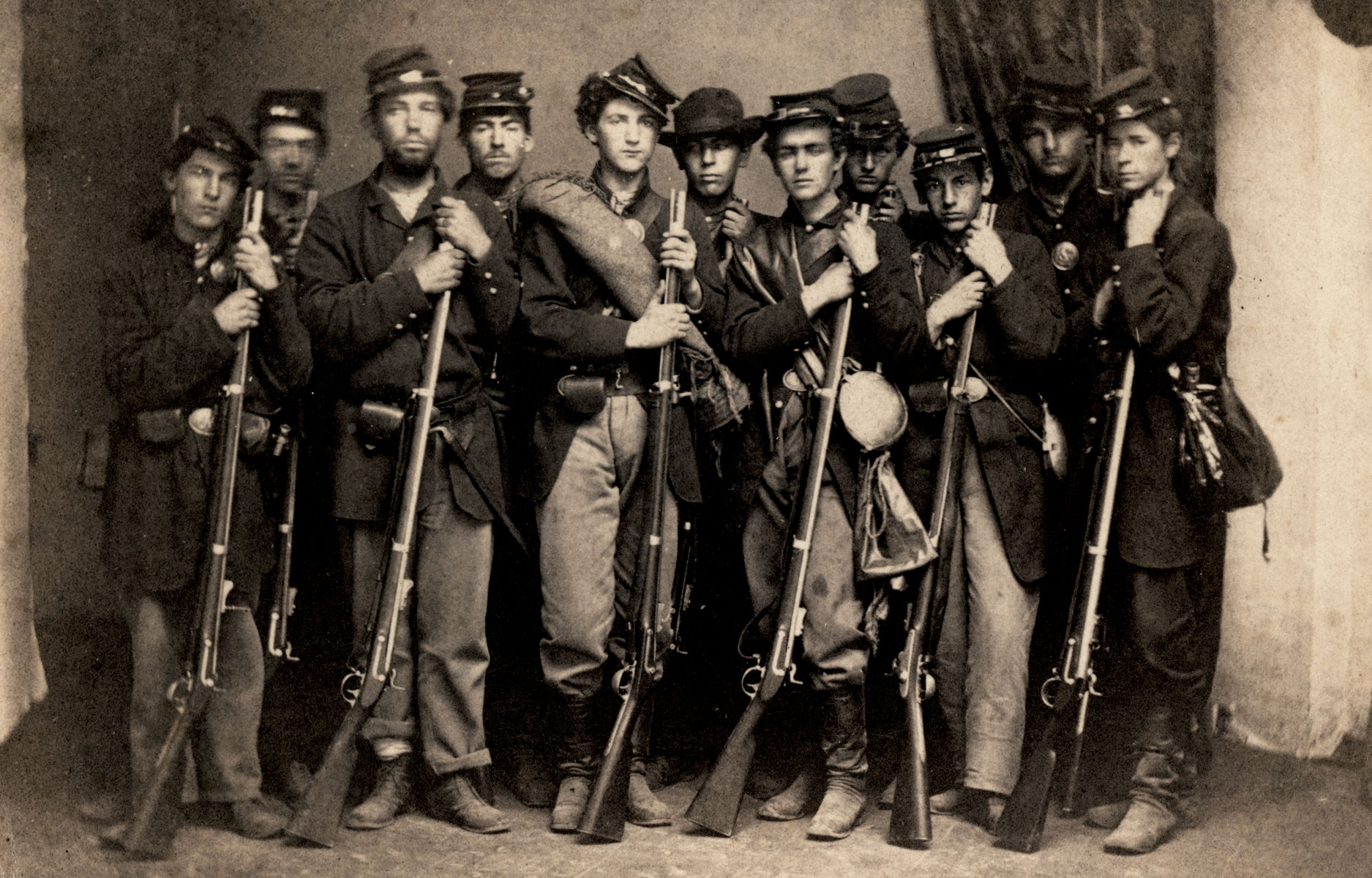
A dozen images from the author’s collection illustrate the young boys and old men who came out to join the Union army. Included in the group is 16-year-old Henry Campbell of the 18th Indiana Light Artillery, 62-year-old Joseph Wild of the 15th Ohio Battery and 12-year-old Johnny Clem, who was credited with shooting a Confederate colonel during the Battle of Chickamauga.

Captain William M. Campbell, 19th Indiana Volunteer Infantry by Steven Karnes (p. 20)
A peacetime sheriff born in Hamilton County, Ohio, Campbell enlisted in the 19th Indiana on July 4, 1861. He started as a second lieutenant and soon advanced to captain of Company I. He participated in the Second Battle of Bull Run, Antietam and other actions until he resigned in October 1862 due to poor health. He died in 1885.

At Harpers Ferry with the 22nd New York State Militia by Michael Kraus (p. 21)
An image of a corporal posed outdoors in front of a cannon is one of a series of images of soldiers of the 22nd New York State Militia. Though the image has been published many times, this is the first time it has been identified. The corporal is Joseph H.P. Inslee, who served for a few months in 1862.

A Dutchman in the Union Navy by Ron Field (p. 22)
Holland native Harry Kiekins served in the Union navy from 1862 to 1867. His service took him from the coast of Alabama to the European Squadron. Perhaps his most memorable moment during the war was his participation in the capture of Fort Fisher, N.C., from Jan. 13-15, 1865.

The Hills Twins: Company H, 7th New Hampshire Infantry by Ron Field (pp. 23-25)
The author shares his story of two hard plate images he purchased of what appeared to be the same Union infantryman identified only by the regimental number 7 and company letter H on his Hardee hat. Upon closer examination however, he suspected that the images were twins rather than the same soldier. Further research led to a tentative identification of the images as Albert and Alfred Hills, who served in Company H of the 7th New Hampshire Infantry.

J.E.B. Stuart II by Sean Heuvel (pp. 26-29)
The son of the legendary Confederate cavalryman, born in 1860, was originally named Phillip St. George Cooke Stuart in honor of his maternal grandfather. But after the Civil War began and the grandfather remained loyal to the Union, Stuart renamed his son J.E.B. Stuart II. Though fascinated by all things military, young Stuart became a banker. He did serve a stint as captain in the volunteer army during the Spanish American War. He died in 1930. The story is illustrated with six images of Stuart.

Uniforms & History by Michael J. McAfee (pp. 30-35)
In “The Veteran Reserve Corps,” McAfee begins by relating an anecdote about the 18th VRC in the summer of 1864. Ordered to march 25 miles to change their base, the colonel commanding replied to the general who issued the order, “Tell the general that my men are cripples, and that they can’t run away.” What follows is an accounting of the organization and distinctive uniforms of the Corps, illustrated with 14 cartes de visite.

Erratum? (p. 36)
The editor revisits a portrait in the last issue identified at Pvt. John Leisure of the 15th Ohio Volunteers. The original caption speculated that Leisure wore a sate-issued Ohio jacket. But Ohio collector and historian Larry Strayer suggested that perhaps Leisure wore an untrimmed VRC jacket. The variations, notes the editor, “Reinforces my statement that the whole issue of Union army jackets is an uncertain field.”

The Confederate Soldier (p. 37)
In this quarter-plate ambrotype from the Liljenquist Family Collection at the Library of Congress, two Confederate soldiers ready to do battle, wear identical uniforms, with cuffs and braiding tinted red.

Sutler’s Row (p. 38)

Coming Up in MI (p. 39)

The Last Shot (p. 40)
A handsome Union second lieutenant strikes a pose before an artistically painted backdrop. The image is housed in a black thermoplastic frame. Ken Bertholf collection.

Inside Back Cover
A tintype of Thomas Eubanks of the 7th Wisconsin Infantry, posed with his wife and daughter, is notable for their expressions and the affectionate way they hold hands. Brian Boeve collection.

Back Cover
A stuffed rooster dominates this portrait of an unidentified Veteran Reserve Corps soldier. The Uniforms & History department has more on the VRC. Michael J. McAfee collection.

Live From Charleston!

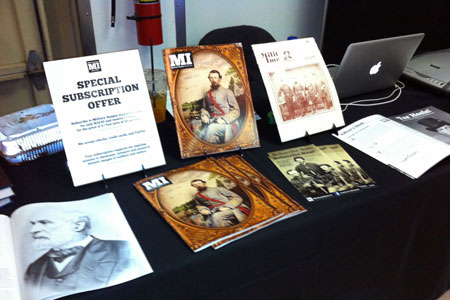
02One of the most-repeated responses from last summer’s subscriber survey was to have Military Images represented at Civil War shows. This request came from long-time subscribers who remember the days when founding editor Harry Roach set up a table, gave away copies of the magazine, and photographed images from dealers and attendees.

Now, Military Images is back! This weekend, Anne and I attended the Low Country Civil War Show in Charleston, S.C. Following Harry’s lead, we gave away complimentary copies of the latest issue, and set up a scanner to make high-resolution scans of selected images.

We had a wonderful time. The show provided us an opportunity to meet up and thank current subscribers, to welcome returning and new subscribers, and to let everyone know that MI’s mission to showcase, interpret and preserve historic photographs of soldiers and sailors is as important as ever.

01The support we received throughout was wonderful! Cliff Krainik and George Whiteley shared their thoughts and ideas abut the editorial direction of the magazine. Steve Sylvia of North South Trader’s Civil War magazine was super supportive and generously offered his help. Had productive chats with Cary Delery, Richard Ferry and a large group of others.

A heartfelt hanks to each and everyone I met for your enthusiasm and generosity. It fueled my desire to breathe new life into Military Images. The biggest thanks are reserved for Anne, who spent the majority of the show strolling up and down the aisles meeting and greeting folks on both sides of the table. She was absolutely fantastic, and MI is much better for her presence.

Look for Military Images at the DC Photo Show on March 16.

Finding Aid: Winter 2014

2014-v32-01-xxxii

The complete issue

Vol. XXXII, No. 1
(44 pages)

Print edition: Visit our store to check availability
Digital edition: Visit JSTOR.org to purchase
Subscribe to MI
Explore the MI Archives: Browse | Advanced search | Tutorial

Inside

Cover image
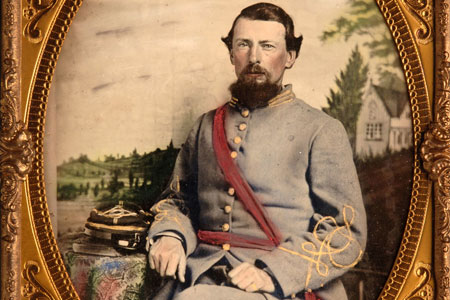
The hand-tinted image is a half plate ambrotype of Capt. James A. Holeman, Company A, 24th North Carolina Infantry, who was wounded at the Battle of Drewry’s Bluff and captured at the Battle of Five Forks.

Table of Contents (p. 1)

Editor’s Desk (p. 2)
This “Change in Command” issue features a farewell from David Neville, who introduces Ronald S. Coddington as the new editor and publisher of Military Images and thanks the “collectors and historians who contribute the wonderful photographs that grace the pages of each issue.” The incoming editor, Ronald S. Coddington, follows with a pledge to continue in the established tradition of MI and thanks subscribers for their participation in the recent survey and their valuable input, which have provided guidance for future publication changes.

Tar Heels! A Survey of North Carolinians in the Confederate Army by Greg Mast (pp. 3-12)
This Military Images feature article is an exclusive preview of Greg Mast’s recently discovered photographs of identified North Carolina citizen soldiers in advance of his second published volume of Tar Heel images. The article includes seven images detailed with individual biographies, unit histories, and descriptions of uniforms and weaponry. One very intriguing image is a possible self-portrait of “photographic artist” Capt. Abner David Peace of the “Granville Targeteers” 23rd Regiment North Carolina Troops, who saw service in a wide variety of battles. Another subject of the article is Pvt. Josephus S. Morris of “Tecumseh’s Scouts” 67th Regiment North Carolina Troops who saw duty only within North Carolina. The article’s seven subjects provide insight into the wide range of duty, background, and experiences that represent the soldiers known as Tar Heels.

Passing in Review by Ronald S. Coddington (p. 13)
The review is of Confederate Faces in Color by Shannon Prichard and Shane Kisner, a new volume that features over 300 color images of Southern soldiers, including the image of Capt. James A. Holeman, featured on the cover of this issue of Military Images.

“God Bless Gallant Old North Carolina” (pp. 14-15)
The quotation by Gen. Robert E. Lee referencing the arrival of North Carolina troops during the fighting at Appomattox, this article features five images of four North Carolina soldiers from the Liljenquist Family collection at the Library of Congress. One image has now been identified as a result of conversation on the MI Facebook page.

An Album of the Faces of the 25th USCT by Shayne Davidson (pp. 16-18)
Eighteen different gem sized tintypes of African American infantrymen serving in Company G of the 25th U.S. Colored Troops are the focus of this fascinating article. The images were originally owed by the Capt. William A. Prickett, who was nursed back to health by some of his soldiers. Capt. Prickett’s image is also included with the article. The author of the article created life-sized drawings of the men and entitled her noted 2013exhibit “Civil War Soldiers.”

Uniforms & History by Michael J. McAfee (pp. 19-23)
Fourteen images and two illustrations accompany “The Uniform Coat, Part 2: Enlisted Men” and its extensive discussion of the evolution of the 1858 frock coat for enlisted soldiers. The article discusses different variations used by state militia as well as variations in trimmings and buttons, including two features that are often not included in current reproductions of the frock.

Showdown With the Sioux by Scott Valentine (pp. 24-25)
The career of Irish immigrant, Capt. Ferdinand Edwin DeCourcy is described. DeCourcy arrived in the United States in 1857, and joined the army. He became a second lieutenant in May, 1861, with the 13th Infantry and saw action at Vicksburg. The article moves next to DeCourcy’s post-Civil War career, and begins by describing the extremes of the natural environment found on the Plains. However the focus of the article is on the defense led by DeCourcy and his soldiers against a stirring attack by Sioux Indians on Fort Cooke, Montana Territory, in 1868.

A Portrait of Lee We Were Not Supposed to See by Donald A. Hopkins (pp. 26-29)
The author challenges the generally accepted fact that two formerly known post-war images of Gen. Robert E. Lee attributed to the studio of John C. Boude and Michael Miley in Lexington, VA. Hopkins discusses the history behind a very rare image of Lee taken by C.R. Rees of Richmond. Lee had requested that Rees destroy the negative as he thought it “makes me look more like a prosperous Southern gentleman than a defeated warrior.” Rees ignored the request and the result is a fascinating single portrait with a rich history taken between November 25 and December 6, 1867. Hopkins’ discussion of the portraits’ verso documentation provides evidence that all three images were taken during the same sitting in Richmond in late 1867.

Four Decades on the High Seas: Boatswain William Long, An Englishman in the U.S. Navy by Ron Field (pp. 30-31)
The author provides an extensive history of the subject of a carte de visite of Boatswain William Long, probably taken in 1864. Long had many adventures at sea, including service as boatswain aboard the San Jacinto, which was noted for its many captures of Confederate blockade runners.

Stragglers (pp. 32-42)
Includes a wide variety of citizen soldiers through 22 different images from both the Civil War and Spanish-American War eras. A few of the unique images include a ninth-plate ambrotype of a Stonewall Brigade soldier in a case with a later newspaper clipping describing some of his service, a sixth-plate ambrotype of a Native American sharpshooter from Michigan, and a carte de visite of a Union soldier and four ladies, some of whom are dressed in military inspired clothing from the 1864 Army Relief Fair in Albany, NY.

The Last Shot (p. 44)
The ninth-plate ambrotype is of a very intense15-year-old Tar Heel, Pvt. James T. Rogers. He is shown armed with two different pistols. He enlisted with Company H of the 13th North Carolina Infantry in May of 1861 and served until discharged due to his age in August 1962. His unit was present during the Seven Days Battles.


The First Issue of MI Has Arrived!

coddington-miI was outside my home raking in the back yard when I saw the FedEx truck pull up. The delivery man stacked up several boxes, and I instantly knew they were the right size to contain the extra issues of MI that I had ordered. A few minutes later I was thumbing through the Winter 2014 issue, my first as editor and publisher. I am thrilled with the outcome, and excited about getting to work on the next issue. The best early Christmas gift!

New MI Policy Addresses Digital Scans

submission-featureI recently received a submission of a scanned historic photograph. I learned that various nicks, chips and other blemishes had been carefully removed in Photoshop. The result was a nearly pristine restored image. During an email exchange about the Photoshop work, the contributor provided the original, unmodified scan. I compared the two, and determined that Military Images should have a formal policy that addresses Photoshop use.

Since the advent of the digital era, photojournalists and other professional documentary photographers have crafted policies to preserve the authenticity of images. Curators and other museum professionals, notably at the Library of Congress, have established technical guidelines and best practices to insure the accuracy of historic photographs.

After careful consideration and after consultation with contributing editors and others connected to Military Images, I am pleased to announce the following statement summarizing MI’s position on the subject:

Military Images does not accept scans of photographs that have been digitally enhanced, and does not condone the practice of digital enhancement of historic images. Scratches, chips, nicks, cracks and other blemishes, while they may interfere with the content of an image, are also part of its history and should be preserved. Military Images will accept digitally corrected scans that have been adjusted for brightness, contrast and color.

This policy is consistent with MI’s mission to showcase, interpret and preserve historic military photographs. It seeks to provide the MI audience with the most historically accurate and reliable images consistent with current standards and best practices.

The “Submission Guidelines and Deadlines” section of our site has been updated to include this statement.

Coming Up in the Winter 2014 Issue of MI

mi-cover-winter-2014Pleased to present the Table of Contents for the Winter 2014 issue of Military Images. Inside you’ll find rare and unpublished portraits of North Carolina Confederates, enlisted men from Company G of the 25th U.S. Colored Infantry, and more! Here’s a list of features and columns (pictured here is the cover from the David W. Vaughan collection):

“Tar Heels: A Survey of North Carolinians in the Confederate Army,” by Greg Mast. An MI exclusive preview of images from Greg’s forthcoming book, a long awaited follow-up to his first volume on North Carolina soldiers published two decades ago.

“Gallery: ‘God Bless Gallant Old North Carolina,’ is a collection of identified images from the Liljenquist Family collection at the Library of Congress.

“An Album of Faces of the 25th USCT,” by Shayne Davidson, features 18 never-before-published photographs of African Americans who served in Company G of the regiment, and their white captain.

“An Irish-American Civil War Veteran Engages in a Showdown with the Sioux,” by longtime MI Contributing Editor Scott Valentine traces the military career of Ferdinand Edwin DeCourcy of Ballylongford, County Kerry, Ireland, from Civil War officer to frontier fighter.

“A Portrait of Lee We Were Not Supposed to See,” by Don Hopkins, sheds light on a series of post-war portraits of the General.

“Four Decades on the High Seas: Boastwain William Long, and Englishman in the U.S. Navy,” by Ron Field, MI Contributing Editor and author of Bluejackets, chronicles the career of a sailor who served on the fames “San Jacinto” and a number of other vessels during his time in uniform.

“Passing in Review,” MI’s book review, examines  by Shannon Pritchard and Shane Kisner.

Mike McAfee’s “Uniforms & History” column traces the origins of the Union enlisted man’s frock coat, and examines how Civil War soldiers adopted it to suit their style.

“Stragglers,” a collection of images submitted by the MI audience, includes images from the Civil War and the Spanish-American War.

“The Last Shot,” the images that traditionally appears on the last page of the issue, is a previously unpublished ambrotype of a 15-year-old Confederate from North Carolina.

The Winter 2014 Issue Is Ready to Go to Press!

One of the editorial highlights of any publication is the moment you decide it is ready to go to press. The moment comes after weeks and months of planning, and a final few frenetic days of proofing pages, editing text and tweaking the design.

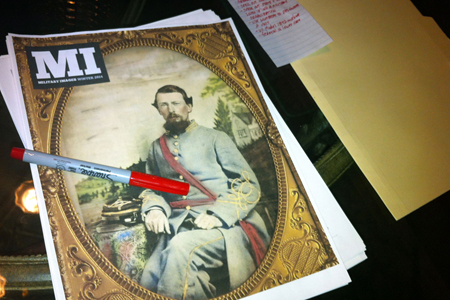
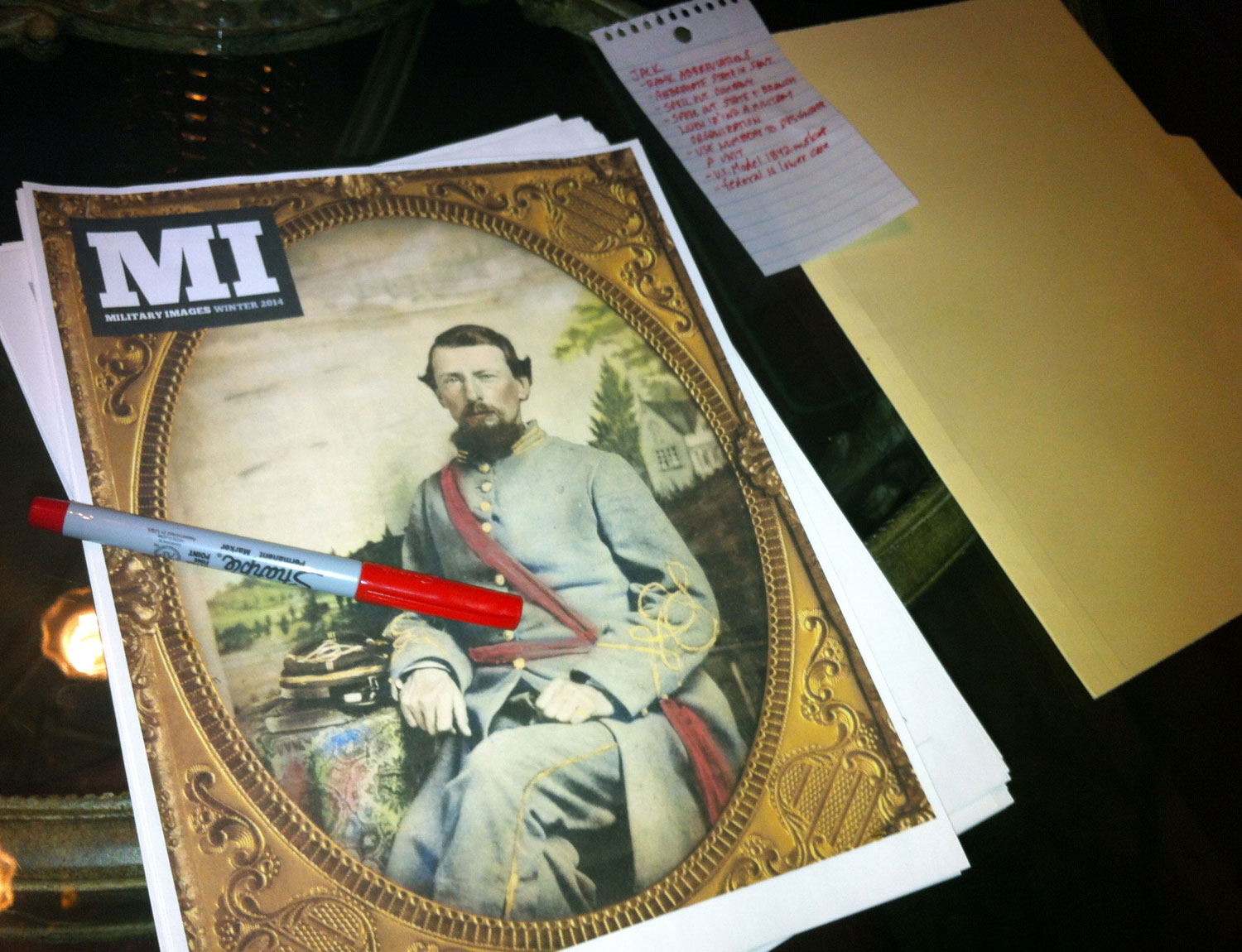
mi-editsThe ‘Moment’ for Military Images arrived last night when I put my red pen down, confident that the Winter 2014 issue (my first as editor and publisher) was completed.

And while my description may make it seem a solitary journey, it was anything but a lonesome adventure. My wife Anne has been great in every way, and her honest feedback along the way truly appreciated. Copy Editor Jack Hurov has been terrific. His work has sharpened the text and put MI on the path of a solid style guide that will be very useful for future issues. I am indebted to Senior Editor Mike McAfee for his great column, “Uniforms & History,” and for the number of times over the last few months that I’ve emailed him images with a request for his authoritative opinion, which he always gave quickly and decisively.

So many other friends of MI have rallied to support our efforts, and I’ve been overwhelmed with their generosity. Contributing Editors Ron Field, Steve Karnes, Scott Valentine and David W. Vaughan contacted me early on and shared their contributions and observations. They were not alone! Other contributors in this issue include Rick Carlile, David Cress, Shayne Davidson, Francis Guber, Janet & Bedford Hayes, Don Hopkins, Mike Hunt, Rich Jahn, Tom Liljenquist, Greg Mast, John Robella, Gary and Bill Stier, Bryan Watson and Buck Zaidel.

In the end, it is your passion, enthusiasm and energy that keeps MI alive. This thought is foremost in my mind this morning.

The work of course is not complete! Today, I’ll make pdfs of the pages and shipped them via DropBox to the printer. And planning is already underway for the Spring 2014 issue and beyond!

What Does Military Images Magazine Mean to You?

what-mi-means-to-meMI celebrates its 35th anniversary of MI in 2014. To mark the occasion,  I invite all magazine subscribers to share your thoughts about what Military Images has meant to you through the years.

Please leave your comments here, in 100 words or less. Or, send them to militaryimages@gmail.com. Selected comments will be published in the next issue, which goes to the printer Dec. 1. The comments will be featured in “Mail Call,” MIs letters to the editor section.

Please take a few minutes to share your thoughts—and thanks for your support of MI!