Assassination in Jackson County

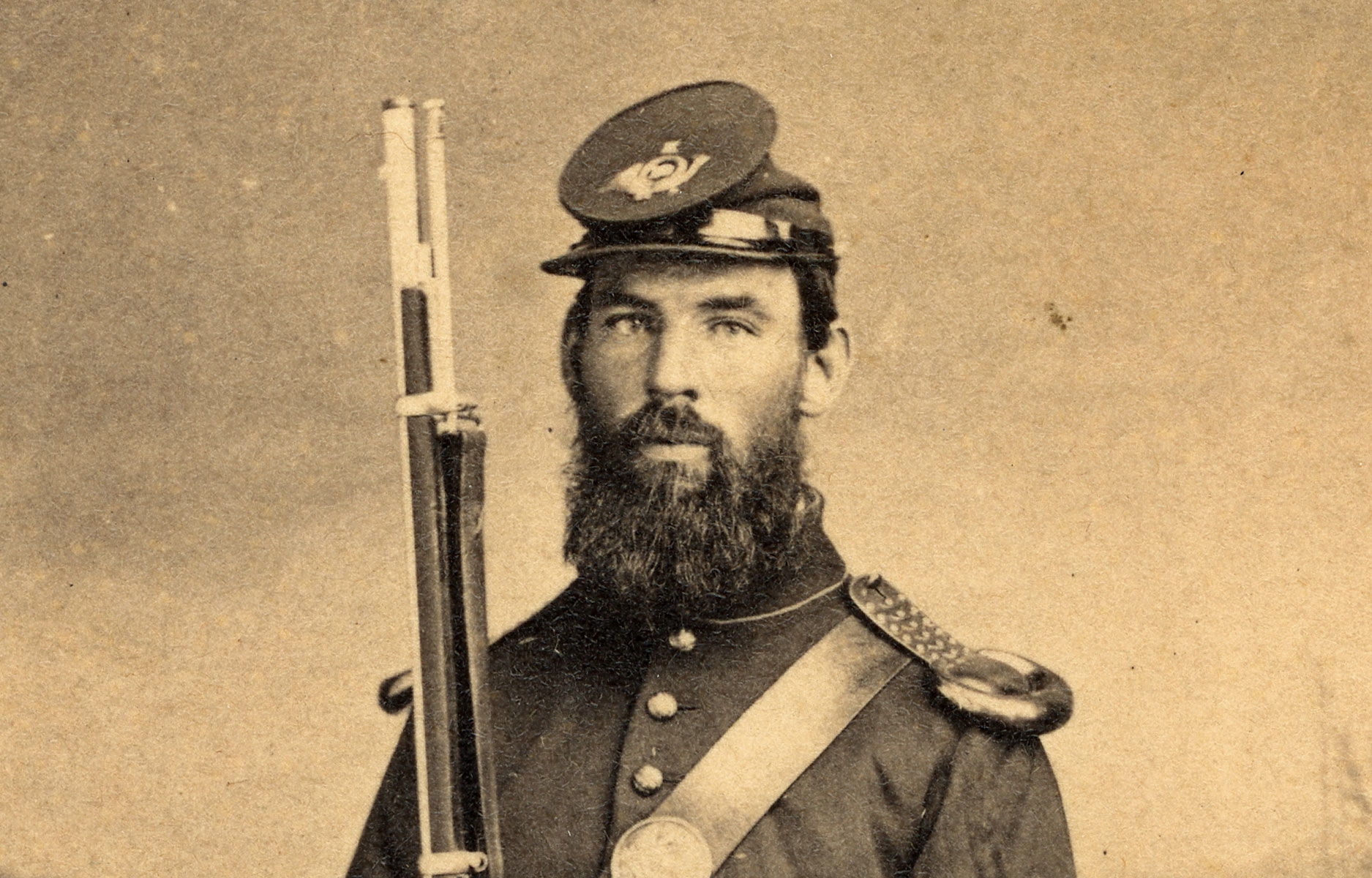
By 1865, the bullets had stopped flying and many of the soldiers in blue and gray marched home. But the residual effects of the war would continue for many years. Although Union veteran John Quincy Dickinson had escaped death on the battlefield, he faced new threats in his assignment to the Freedman’s Bureau in Jackson County, Fla., where he found himself in the crosshairs of the politically charged violence of the reconstruction effort.

The full story appears in the Winter 2016 issue of Military Images magazine.

Go to the finding aid for this issue.
Subscribe to the print and/or digital edition.

Riding the Rail, Revisited

25 years after a unique photo of a soldier holding an impossible large wood sword and seated astride an oversize “horse” made of timber made the rounds in books and film, Robert L. Kotchian discovered its origins and connections to Old World punishments.

The full story appears in the Winter 2016 issue of Military Images magazine.

Go to the finding aid for this issue.
Subscribe to the print and/or digital edition.

Thoughts on Private Booth

“When we attempt to understand history, we often find that empirical truths unfold alongside significant symbolic moments,” writes historian J. Matthew Gallman in this reflection on a portrait of Pvt. Booth of the 5th Massachusetts Cavalry. Gallman adds, “And, to make things even more complicated, it is not at all unusual that our collective memory of events (both real and symbolic) differs from how participants understood what they were living through.” The image of this black trooper speaks to emerging themes of democracy, equality and the individualism of the American soldier.

Gallman’s thoughts appear in the Winter 2016 issue of Military Images magazine.

Go to the finding aid for this issue.
Subscribe to the print and/or digital edition.

Finding Aid: Jan./Feb. 1986

The complete issue

Vol. VII, No. 4
(32 pages)


Print edition: Visit our store to check availability
Digital edition: Visit JSTOR.org to purchase
Subscribe to MI
Explore the MI Archives: Browse | Advanced search | Tutorial

Inside

Cover image
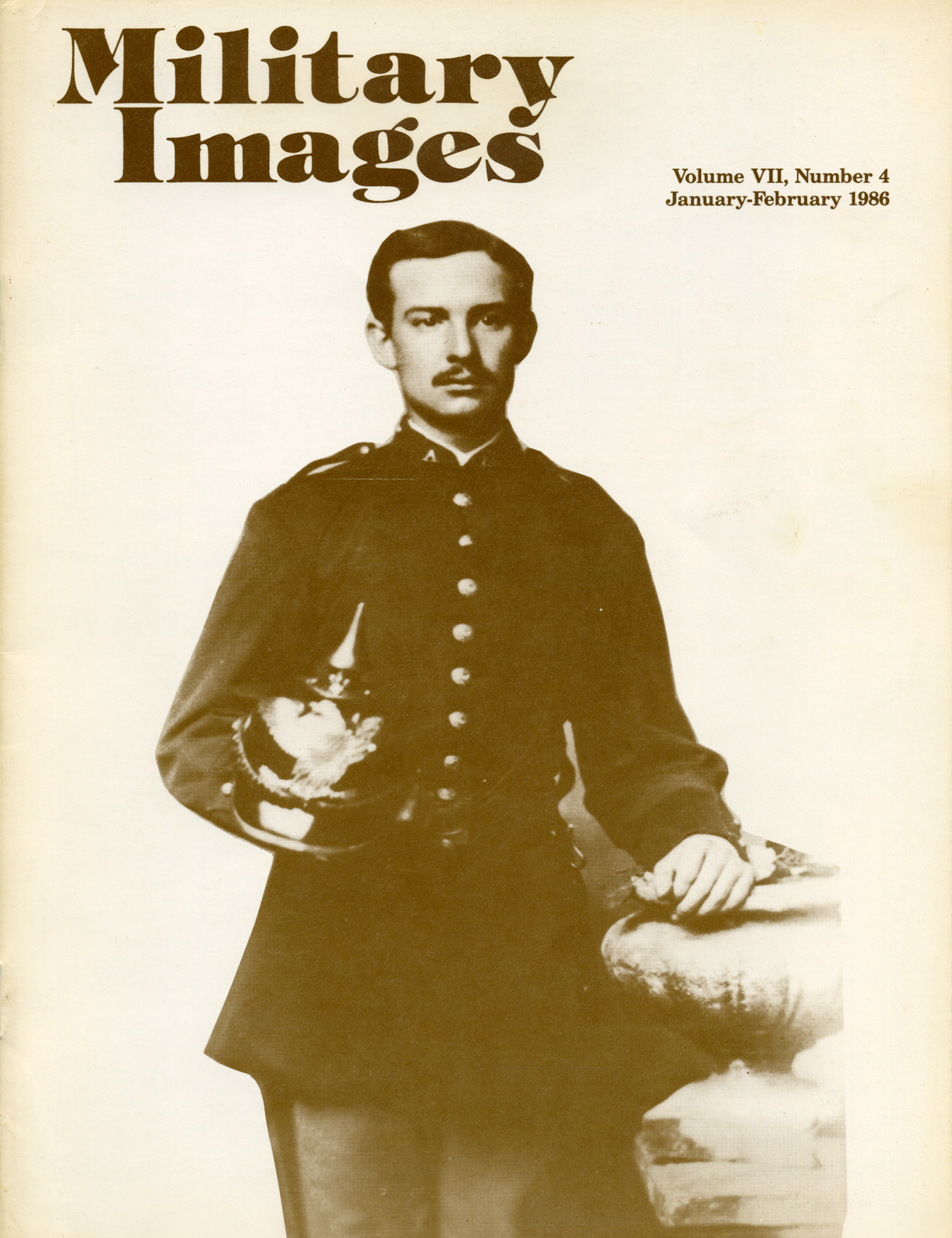
He may look like a Prussian soldier fresh from a victory in the Franco-Prussian War, but the soldier on the cover with the Pickelhaube helmet is Joseph Vance, a member of Company A, Light Artillery, Rhode Island State Militia, taken 1885-1886.

Editor’s Desk (p. 1)
The editor presents two new features with this issue. “The Darkroom” answers reader questions about the technology of imaging, while “Exhibits” lists museum and traveling exhibitions of interest to the readership. He also describes the types of articles that will be forthcoming, and welcomes suggestions as well as images. The editor also reprinted a clearer version of the wounded soldier in his hospital gown from the previous issue’s “Stragglers” feature.

Mail Call (pp. 2-3)
Letters to the editor included a request for help in identifying a shoulder strap uniform device, additional information on images from past issues, and additional responses to the editorial regarding U.S. policy in Nicaragua.

Darkroom (pp. 4-5)
George Hart’s first feature responds to the question regarding the sizes of different types of images. While a standard table is presented in the response, the great variation in sizes such as quarter-plate or ninth-plate images is due to the fact that many photographers cut their own plates. Tintypes are particularly known for this.

Six Sons for the Confederacy: The letters of Robert H. Jones, 22nd Georgia Infantry edited by Keith Bohannon (pp. 6-8)
The eldest of the six Jones brothers from Floyd County, Georgia, Robert H. Jones had organized the “Fireside Defenders” in August 1861. Once organized into the 22nd Georgia Volunteers, the 33 year old Jones was made colonel, two brothers made captain, one chaplain, and two remained privates. All six appear in an image taken in 1861, and although the six fought together at the start of the war, none were still with the 22nd Georgia at war’s end. The letters from Colonel Jones to his wife Lucinthia provide a glimpse into camp life during several different points of the war, from the humorous response of his troops (and body servant) to hearing cannon fire that was not warfare, but a salute to George Washington on his birthday to a more serious account of his unit during the Seven Days. Writing from Leesburg, Virginia, he tells her that “all the Brothers are well” just days prior to Antietam, where his brother Captain Wesley Jones was wounded; taken prisoner, he died from his wounds in October 1862.

“It is with a heavy harte…”: A letter to Private Clark’s sister edited by Richard K. Tibbals (p. 9)
Both men were 24 years old, and both enlisted in Company H, 22nd Indiana Infantry, Post’s Brigade from their homes in Lexington, Indiana. Privates John Clark and John Snodgrass had been friends at home, and remained close in their military lives as well. However, at Stone’s River on December 31, 1862, the fighting between the Union forces and their Confederate attackers split the two. In a letter sent to Private Clark’s sister Margaret, Private John Snodgrass wrote about the fighting that day, how he stayed with his friend as long as he could, and that he had been properly buried in a walnut coffin.

Farewell to Fancy Epaulettes: Philadelphia militia uniforms, 1866-1917 by Philip Katcher (pp. 10-13)
Eight different images accompany this article that describes the many changes seen by the militia of Philadelphia. Focusing on the last three to wear independent volunteer uniforms, the author briefly discusses the histories of the First Troop, Philadelphia Cavalry, the State Fencibles of Philadelphia, and the First Regiment Infantry of Philadelphia and their glorious dress uniforms.

Vignette: A Late Paycheck for Gilbert Montgomery, 4th U.S. Cavalry by William Gladstone (pp. 14-15)
A bit of sleuthing partially answers the questions about the man in the image and the two documents that belonged to him that are the focus of this article. A cook, not a soldier, Gilbert Montgomery was subject to the same procedures as enlisted soldiers. But there was a problem when Gilbert Montgomery was discharged from his five year service in 1869: he was underpaid. He was sent a check to make up the difference, and that check was not cashed. The question remains of why he never took the check to recover the $21.17 he was owed for his service.

Victorian Warriors: A photo survey of uniforms of the National Guard, 1870-1890 by Anthony Gero (pp. 16-24)
Sixteen images accompany the short article that outlines the history of the National Guard in the post-Civil War era. The increased cost of these units combined with a decrease in recruitment during this era led to many states standardizing their National Guard uniforms along federal lines. By the time of the Spanish-American War in 1898, only a few places retained the marvelous Victorian uniforms shown in this article. Featured are bearskins, several M1881 helmets with Prussian-style Pickelhaube, shakos, kepis with plumes, tailed coats, and epaulettes.

Vignette: A Down East Heavy: Rodolphus Tufts, 1st Maine Heavy Artillery by Wendell W. Lang (p. 25)
Enlisting in Company D, 18th Maine Infantry, Rodolphus Tufts was sent with his unit to be part of the permanent defense of Washington in August 1862. In the following January, the unit was reorganized into the 1st Maine Heavy Artillery, and expected to remain in their defensive post. In May 1864, following the fighting in the Wilderness, General Grant ordered the “heavies” to reinforce his Army of the Potomac. On June 18, the 1st Maine Heavy Artillery underwent the heaviest loss of a single unit in a single battle: 242 killed, 372 wounded, and 1 missing out of 900 men total. Tufts and the other surviving members of the unit eventually became involved in the more quiet game of siege warfare in the trenches around Petersburg. He was killed in a small skirmish on October 2, 1864 on Squirrel Level Road and buried as an Unknown in Poplar Grove National Cemetery.

Vignette: A Tarheel for the Union: Hugh Hamilton, 2nd North Carolina Mounted Infantry by John Sickles (p. 27)
The confident soldier in the image walked from him home in Buncombe County, North Carolina through the Cumberland Gap shortly after it was captured by De Courcy’s Union forces in September 1863. Hugh Hamilton was a Unionist and enlisted in Company B of the 2nd North Carolina Mounted Infantry. Other Tarheel Unionists and “Galvanized Yankees” (Confederates who had been captured, taken the oath of allegiance to the United States, and enlisted to fight) made up the unit. On February 22, 1864, at Wireman’s Mill, Virginia, Hugh Hamilton was captured, although he was initially listed as a deserter for reasons that remain unclear. He was sent to prison camp at Belle Isle in Richmond, where he became ill with bronchitis and hepatitis; he was exchanged and sent to a Union hospital in Annapolis. Eventually recovering most of his health, he was transferred to the Veteran Reserve Corps in Baltimore. He married there, and eventually returned to North Carolina after the war.

Passing in Review (pp. 28-29)
Six different publications are presented for review in this issues of Military Images. First is The Congressional Medal of Honor: the Names, the Deeds tells the story of the Medal and those who have been awarded it. September Blood: the Battle of Carnifex Ferry by Terry Lowry, who provides a regional history of the fight for Western Virginia at the start of the Civil War. Uniforms of the American Civil War by Philip Haythornthwaite was deemed to be a disappointment by the reviewer. While some errors were seen as small, the implication that the battleflag of the Army of Northern Virginia was used by all Confederate armies was a major flaw. Battle at Balls Bluff by Kim Bernard Holein was reviewed as a comprehensive work that describes the battle, the participants, its significance, relics and period items, and a case study of how preservationists, collectors, and others can work to preserve a historic site. Twenty Million Yankees by Donald Jackson and the editors of Time-Life Books is a volume in the Civil War series of books, and looks at the impact that the Civil War had on everyday life in the North and how those changes led to lasting impact on the Northern economy. Lastly, Great Civil War Heroes and Their Battles was edited by Walton Rawls, and provides an excellent look at the nostalgic publications found in cigarette cards and other sources published in the latter part of the 19th century.

Stragglers (pp. 30-31)
Two different sets of images are presented as “Stragglers” in this issue. The first is of Sergeant Herman L. Small of Company C, 6th Vermont Infantry. Two are portraits of the soldier, who enlisted as a private in October 1861 and left the service as a second lieutenant. His kepi is of particular interest and merited a close-up shot, as it has many non-regulation features attached to it. The other set of images consists of six cartes de visite that provide humorous views of Federal generals and one admiral such as “Little Mac” and “Uncle Sam’s Admirable Porter” in caricature form.

Back Image
A stirring portrait of a Union infantry soldier wearing his full pack (and white gloves). He strikes the pose he would take when preparing for a cavalry advance.

Finding Aid: Winter 2016

The complete issue

Vol. XXXIV, No. 1
(60 pages)

Print edition: Visit our store to check availability
Digital edition: Visit JSTOR.org to purchase
Subscribe to MI
Explore the MI Archives: Browse | Advanced search | Tutorial

Inside

Cover image
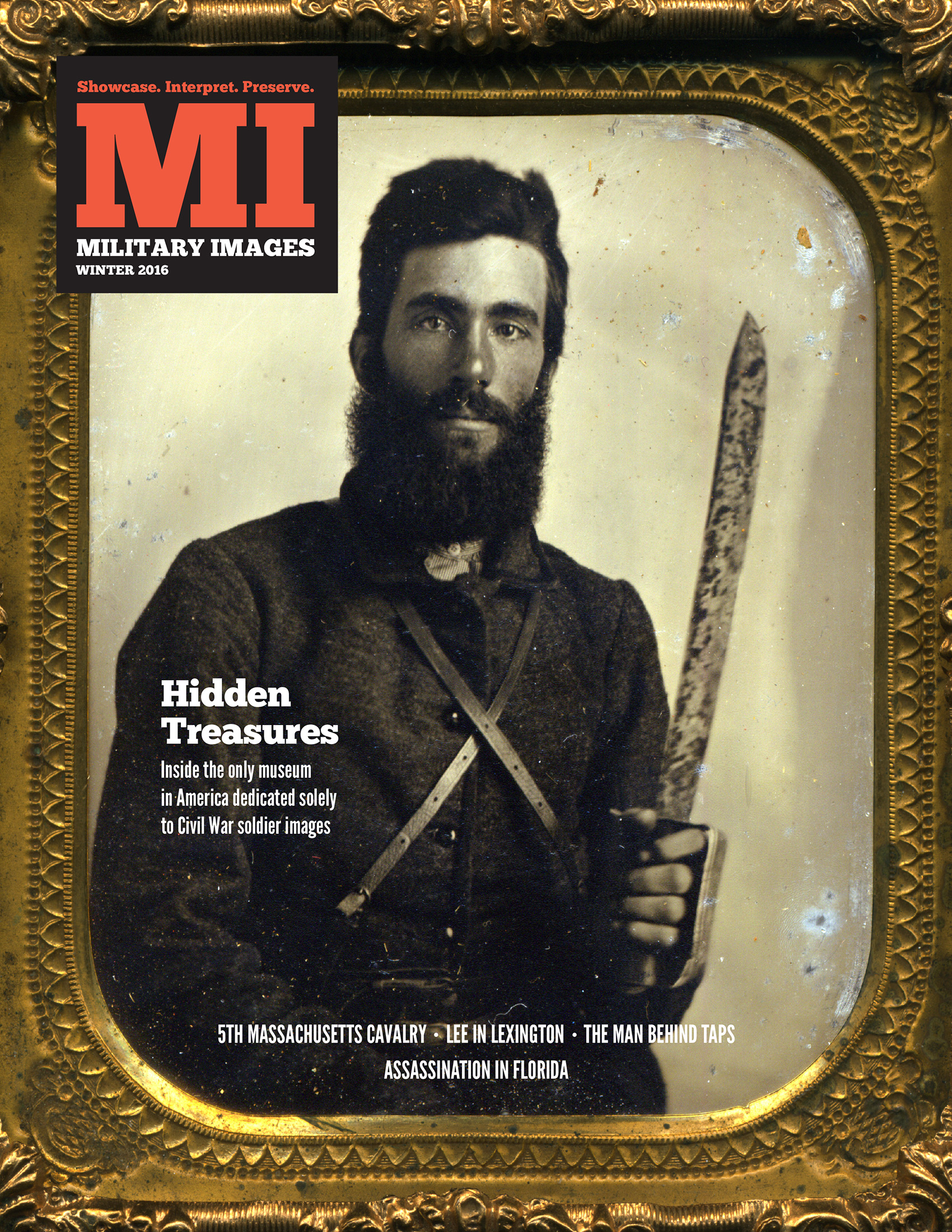
A sixth-plate ruby tintype of John William Rhea of the 6th Texas Cavalry, who brandishes his D-Guard Bowie knife. Rick Brown collection.
Download (free)

Table of Contents (p. 1)
Download (free)

Editor’s Desk (p. 2)
The editor reflects on historian John O’Brien’s study of an iconic photograph of Gen. Robert E’ Lee and Traveller. Specifically, how the power of observation can profoundly impact historical accuracy. He notes, “History is improved by keen observation and scholarship. Take a close look at all the images published in this and other issues of MI. You just might change history.”
Download (free)

Mail Call (p. 3)
Feedback includes a compliment to contributors for sharing their images, a new identification of a musket held by a South Carolinian in the Palmetto Faces gallery, and a suggestion to produce an article that examines the possible use of bugles as props.
Download (free)

Passing in Review (p. 4)
From its early days as a hotbed of colonial rebellion to its role during the Civil War as a prolific supplier of men and materials, the six states of New England have served as a powerhouse for American ideals and revolutionary action. When it came to conformity of Civil War uniforms however, New England was no different than any other region of the country, North or South. In Rally Round the Flag—Uniforms of the Union Volunteers of 1861: The New England States, author and MI Senior Editor Ron Field examines the dizzying array of early war uniforms. A modified excerpt provides background on the short-lived Edmands hat.
Download (free)

Lexington, Not Petersburg by John O’Brien (pp. 6-7)
An iconic image of Gen. Robert E. Lee astride his trusted horse Traveller has long thought to have been taken in Petersburg, Va., during the final months of the Civil War—a reasonable conclusion considering the content of the photograph. Author John O’Brien takes a fresh look at the image, and suggests a new location and date for the image, and identifies the photographers who made it.

Antebellum Warriors (p. 8)
Massachusetts militiaman Hosea Ballot Ellis sits in his full-dress uniform, which includes a pompon-topped dress cap adorned with the brass letter “H” surrounded by a laurel wreath. The letter may signify Ellis’s membership in the Hancock Light Guards, a militia company formed in Quincy in 1855.

The Honored Few (p. 9)
Brave. Aggressive. Fearless. Uncompromising. A writer once used these words to describe Milton Holland – leadership qualities that came into play when he and his regiment, the 5th U.S. Colored Infantry, went into action in Virginia along the front lines of Richmond and Petersburg in the autumn of 1864.

Men of Nerve: The 5th Massachusetts Cavalry in the Civil War by James Paradis (pp. 10-15)
Capt. Andrew F. Chapman filled a photo album with cartes de visite of his comrades in the 5th Massachusetts Cavalry, one of only seven African-American cavalry regiments in the entire Union army during the Civil War. Selected images from the album, published here for the first time, and from the Rick Carlile collection, illustrate the esprit de corps of its cadre of white officers. A profile of the regiment explores the role of the 5th during the final year of the Civil War.

Thoughts on Private Booth by J. Matthew Gallman (p. 16)
“When we attempt to understand history, we often find that empirical truths unfold alongside significant symbolic moments,” writes noted historian Gallman in this reflection on a portrait of Pvt. Booth of the 5th Massachusetts Cavalry. He adds, “And, to make things even more complicated, it is not at all unusual that our collective memory of events (both real and symbolic) differs from how participants understood what they were living through.” The image of this black trooper speaks to emerging themes of democracy, equality and the individualism of the American soldier.

Hidden Treasures: Inside the only museum dedicated solely to Civil War soldier images (pp. 17-27)
The first time Ronn Palm visited the red brick row house on 229 Baltimore Street in Gettysburg, Pa., the prominent archway in the entrance captured his attention. “Holy hell,” he though to himself, as the graceful shape of the building reminded him of a page in a carte de visite album. “That’s how my mind works, you know,” Palm said as he discussed the origins of the museum that bears his name. The building became home to Ronn Palm’s Museum of Civil War Images, and it is the only museum in America dedicated solely to soldier photographs. Representative examples from Palm’s extensive collections are highlighted here.

Photo Sleuth by Kurt Luther (pp. 29-30)
In “How Fellow Collectors, Field Photos and Muttonchops Identified an Unknown Officer,” Luther explains how two less commonly used, but equally valuable resources, namely fellow collectors and field photography, helped him identify 1st Lt.and brevet captain William Ball of the 93rd New York Infantry.

Assassination in Jackson County: A defender of Freedmen is murdered in Reconstruction Florida by William Mason-Palmer (pp. 32-34)
By 1865, the bullets had stopped flying and many of the soldiers in blue and gray marched home. But the residual effects of the war would continue for many years. Although Union veteran John Quincy Dickinson had escaped death on the battlefield, he faced new threats in his assignment to the Freedman’s Bureau in Jackson County, Fla., where he found himself in the crosshairs of the politically charged violence of the reconstruction effort.

Soldier, Author, Bugler: The extraordinary life and lasting military legacy of Oliver Wilcox Norton by Theodore J. Karle (pp. 35-37)
Modest and self-effacing Pennsylvania schoolteacher Oliver Wilcox Norton left behind one of America’s lasting military legacies. His Civil War service included the perils of combat, the joy of perfecting a classic bugle call and leading men of color into battle. Norton’s post-war writings contributed greatly to our understanding of the struggle for Little Round Top at the Battle of Gettysburg in July 1863. Moreover, he helped compose “Taps,” the timeless bugle call honoring fallen soldiers. Lastly, the free thinking Norton served as an officer for two years in the 8th U.S. Colored Infantry.

Uniforms & History by Michael J. McAfee (pp. 38-39)
McAfee explores the Hungarian connection to the Union Army’s Model 1858 uniform hat. It was known by various nicknames, including the “Kossuth hat” in honor of Louis Kossuth (1802-1894) of Hungary, a freedom fighter celebrated across the antebellum U.S. but hardly remembered today.

“Conquer We Must, For Our Cause Is Just” by Kathleen Heyworth (pp. 40-41)
White attitudes towards African Americans varied greatly throughout the Union army during the Civil War, even within regiments. Such was the case in the 7th Illinois Infantry. The respected commander of the unit’s Company G, Capt. Henry Willard Allen, publicly supported the Emancipation Proclamation—an endorsement that cost him his life at the hand of one of his own men.

Riding the Rail, Revisited by Robert L. Kotchian (pp. 42-44)
25 years after a unique photo of a soldier holding an impossible large wood sword and seated astride an oversize “horse” made of timber made the rounds in books and film, Kotchian discovered its origins and connections to Old World punishments.

Stragglers (pp. 45-49)
This issue’s selection of distinctive and unique images from MI contributors is focused on Confederates. Included is Hiram Rathbone of the 62nd North Carolina Infantry, a soldier with a small Confederate national flag protruding from the upturned brim of his hat, a private who may hail from the Virginia Piedmont, John William Rhea of the 6th Texas Cavalry, Edmond R. Brown of the 11th Virginia Infantry, Zachariah Angel Blanton of the 18th Virginia Infantry, and a soldier wearing fur gauntlets and muffler.

The Backdrops of Benton Barracks by Mike Medhurst and Brian Boeve (pp. 50-52)
The bustling Union army’s training facility on the outskirts of St. Louis, Benton Barracks was capable of housing up to 30,000 soldiers at one time. Recruits from Missouri and elsewhere poured into the sprawling complex, where they learned the military arts. Many of these green troops were eager to send home photographs dressed in newly issued uniforms and equipment. And, they did not have to go far. Enterprising photographers used painted canvas backdrops to lure in the soldiers. This survey examines a half dozen examples used by these photographers to bring soldiers into their studios.

Dark Memories After Antietam by Scott Valentine (pp. 53-55)
“Soldier’s Heart” was one term used in the 19th century to describe a mental health condition known today as Post-Traumatic Stress Disorder, or PTSD. Other terms were used by physicians, families and comrades as well, to define the changes that occurred to a man as a result of his Civil War experience, including “Melancholia,” “Nostalgia” and “Homesickness.” One man afflicted was Bernard F. Blakeslee of the 16th Connecticut Infantry. The horrors of Antietam and other wartime experiences left numerous physical injuries that healed over time, and a psychological injury from which he never recovered.

At Stones River, A Sword Lost and Found by Ronald S. Coddington (pp. 56-58)
In the maelstrom of fighting at Stones River, Tenn., on the last day of 1862, dense clouds of gun smoke hung like a pall over the bloody battlefield. At times, the smoke would drift apart to reveal a brief glimpse of the desperate struggle between blue and gray. At one such moment, a federal soldier observed a Union captain drop his sword, grab cartridges and a musket from a fallen comrade, and blast away at the enemy. The event would be recorded in an after-action report as a remarkable act of bravery. The captain, 54-year-old Richard M. Waterman of the 31st Indiana Infantry, was old enough to be the father of many in his command. The story of his participation in the battle and what happened to him afterwards is revealed.

The Last Shot (p. 60)
Collector Dan Binder shares an ambrotype of a bearded Union infantryman with a furrowed brow uses the bayonet of his Prussian Model 1809 Potsdam musket as a convenient hat stand. Three letters attached to the flat part of his cap reveal a C flanked by a pair of Gs. The letters appear reversed here, a limitation of the photographic processes of the time.