Finding Aid: March/April 2004

The complete issue

Vol. XXV, No. 5
(40 pages)


Print edition: Visit our store to check availability
Digital edition: Visit JSTOR.org to purchase
Subscribe to MI
Explore the MI Archives: Browse | Advanced search | Tutorial

Inside

Cover image
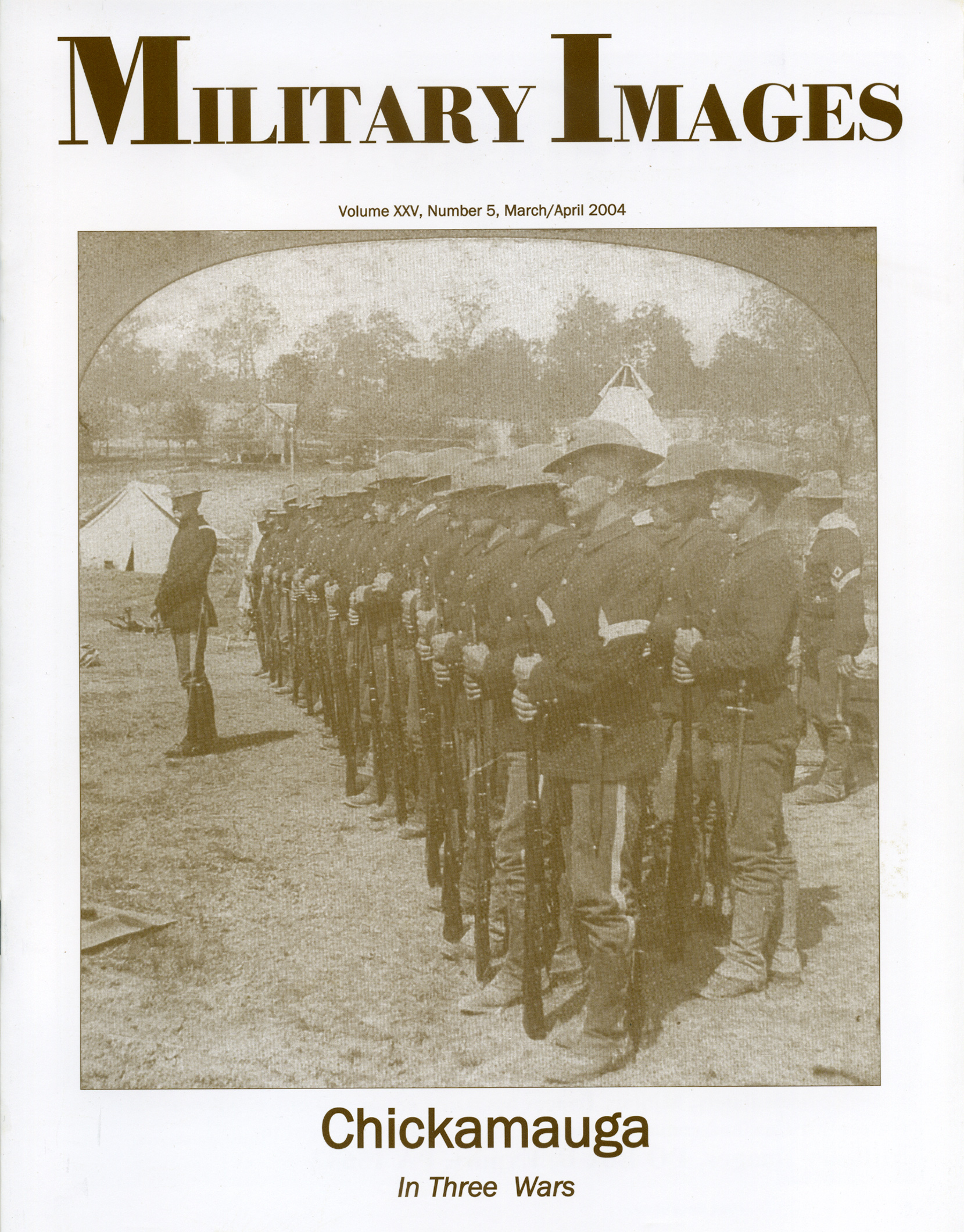
A company of U.S. soldiers in camp at Chickamauga, Ga., stand with their commander in an albumen print about the time of the Spanish-American War.

Table of Contents (p. 1)

Editor’s Desk and Mail Call (p. 2)
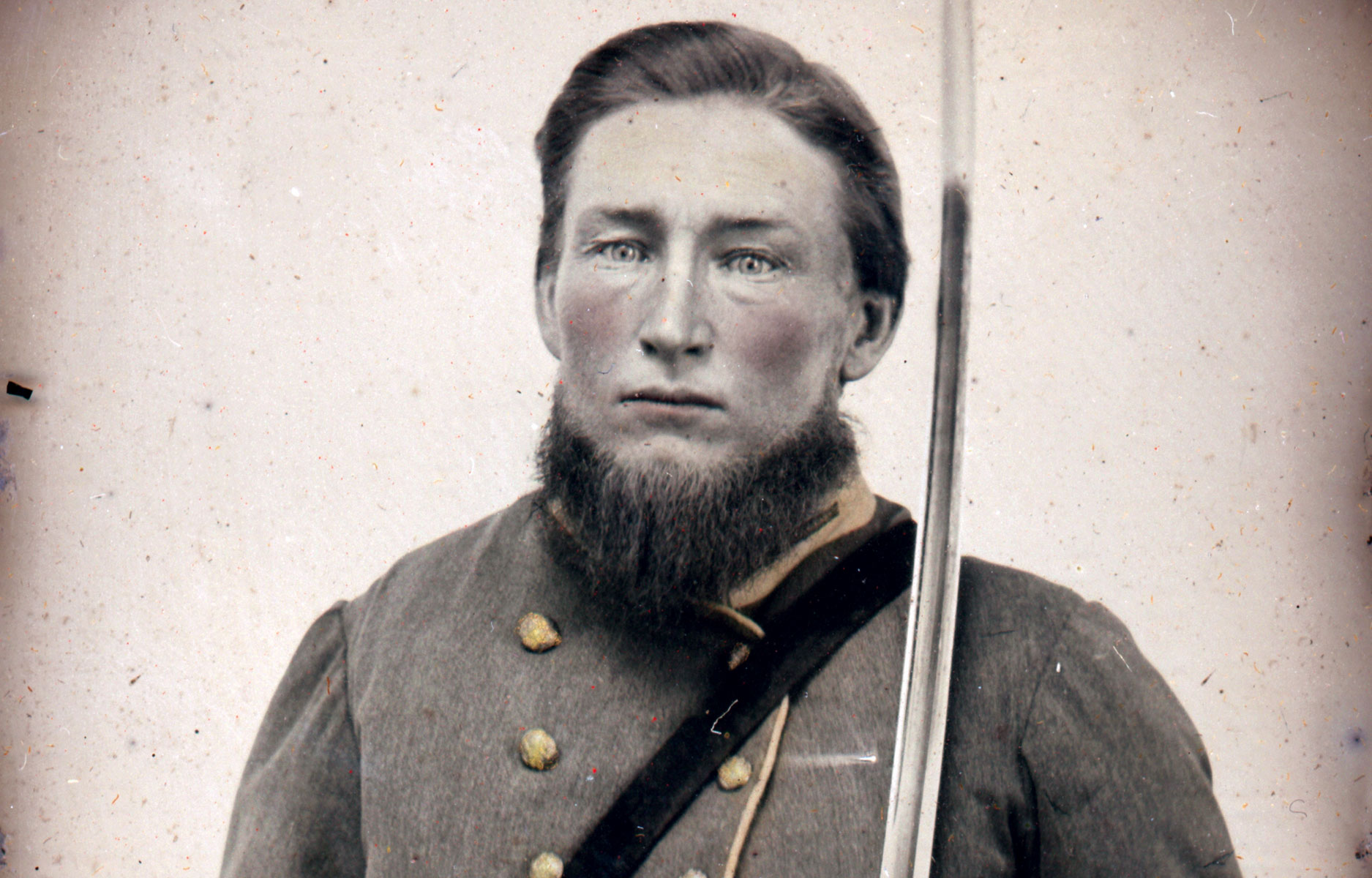
New editor David Neville thanks outgoing editor Philip Katcher for the opportunity to lead the magazine into its next chapter. “MI has always been more than a ‘picture magazine,’ publishing the best in both military photography and historic scholarship. And so MI will continue.”

Passing in Review (pp. 4-5)
Capsule summaries of seven volumes include Masters of the Shoals by Jim McNeil, Sacrifice at Vicksburg: Letters from the Front by Susan T. Puck, Blue & Gray at Sea edited by Brian M. Thomsen, The Defense of Vicksburg: A Louisiana Chronicle by Allan C. Richards Jr. and Mary Margaret Higginbotham Richard, Rebel Reefers: The Organization and Midshipmen of the Confederate States Naval Academy by James Lee Conrad, “For Fatigue Purposes…” The Army Sack Coat of 1857-1872 by Patrick Brown and These Honored Dead: How the Story of Gettysburg Shaped American Memory by Thomas A. Desjardin.

Warriors of 1863 (pp. 6-7)
A brief summary of the Battle of Chickamauga is illustrated by nine images, including Brig. Gen. John H. King and two other officers mounted on their horses, Capt. William W. Helm of the Confederate 3rd Kentucky Cavalry, Pvt. James Thomas of the 57th Indiana Infantry, an unidentified private from the 15th Pennsylvania Cavalry, Corp. Melvin A. Hurd of the 74th Indiana Infantry, 1st Sgt. Henry Fritz of the Confederate 2nd Kentucky Cavalry, Col. Newell Gleason of the 87th Indiana Infantry and a portrait of an unidentified soldier taken by photographers Schwing & Rudd, Army of the Cumberland.

Bluecoats Return to Chickamauga by David A. Norris (pp. 8-9)
A profile of Camp Thomas in Chickamauga, Ga., which was established in 1898 as a training facility for troops during the Spanish American War. About 69,161 volunteers and over 7,283 regulars were eventually housed there. Two stereoview images illustrate the text.

Chickamauga in World War One by David A. Norris (p. 10)
Fort Oglethorpe, establish in 1904, brought a flood of troops to Chickamauga, which was National Military Park land. The camp operated until 1947. Images of camp buildings are featured, all photographed by army Surg. Philip A. Sheaff, who is also pictured.

The New York State Jacket by Philip Katcher (pp. 11-15)
The author notes that, “The stylish, distinctive and comfortable New York State issue jacket was popular with the troops. It was even worn by troops from at least one other state.” A total of 10 images are featured, and one is identified—Pvt. George Aker of the 44th New York Infantry.

3 Members of the 4th Tennessee Cavalry by John Sickles (p. 16)
Mini-biographies of Maj. Baxter Smith, Campbell Craig and Pvt. E.M. Brown are presented along with portrait photos of each soldier.

More Boys of the 48th Pennsylvania Volunteer Infantry by James Jezorski (pp. 17-18)
Eight unidentified portraits of men who served in Company G of the regiment are featured. According to the author, the “old collector” from whom he purchased the images said that the individual from whom he bought them personally took them off the wall of a Grand Army of the Republic Hall in Hershey, Pa.

A Night of Terror by Thomas P. Lowry (pp. 19-20)
The author documents brutal crimes committed by members of the 14th Rhode Island Heavy Artillery (Colored). The story is illustrated with portraits of two of the regiment’s officers, Maj. Joseph J. Comstock Jr. and Capt. Joshua M. Addeman.

The Mystery Photographer by Michael K. Sorenson (pp. 21-22)
Five portraits of men who served in the famed “California Hundred” of the 2nd Massachusetts Infantry pose with a elaborately patterned drape. A sixth man from the 44th Massachusetts Infantry also poses with the drape. The name of the photographer is a mystery. Four of the men from the 2nd are identified: Capt. Charles S. Eigenbrodt, 1st Sgt. Robert H. Williams, Pvt. Jacob Walther and Pct. Joseph H. Burke. The soldier who served in the 44th is Pvt. Isaac Carry.

U.S. Cavalry, 1898, Stereos (pp. 23-26)
Mounted Cavalry did not play a major role in the campaigns of the Spanish-American War, but stereo photographers found images of them great sellers to the public. A survey of 8 stereoviews is included from the collections of Ron Da Silva and Philip Katcher.

The Passing of A.J. Krohn by Jerry Harlowe (pp. 27-29)
August John Krohn, a sailor who served on the Wilmington, died of typhoid fever in 1901. His remains were buried in the English Cemetery. Despite photographic evidence of his grave, the site has disappeared and its whereabouts remain a mystery.

More of Bell’s Boys by Richard F. Carlile (p. 30)
Four privates in the 21st Pennsylvania Cavalry, George Schriver, George W. Scott, Jonathan H. Bosserman and D.C. Brinkerhoff, are pictured here. The regiment is known for exchanging gunfire with Confederates outside Gettysburg, Pa., on June 26, 1863, and for serving as the bodyguard for President Abraham Lincoln when he visited Gettysburg to participate in dedication ceremonies for the national cemetery.

Bull Run Discovered by Keith Knoke and James Burgess (pp. 31- 33)
The authors, following the pioneer work of William Frassanito at Gettysburg, have uncovered the spot where several 1862 images were taken of the battlefield. The study is illustrated by period and contemporary images of the Henry Hill area, where heavy fighting occurred during the First Battle of Bull Run.

Thornton or Thornberry by James Burgess (pp. 34-35)
Burgess, a museum specialist at Manassas National Battlefield Park, asserts that the well-known George Barnard photograph of the William N. Thornton house is in fact the home of John Thornberry.

Uniforms & History by Michael J. McAfee (pp. 36-37)
In “The Orange Blossoms,” McAfee examines the uniforms of the 124th New York Infantry. Better known as “The Orange Blossoms,” the regiment received this name from its commanding colonel, the colorful Augustus Van Horne Ellis. Portraits of Bugler Moses Ross and Sgt. Woodward T. Ogden are featured.

Stragglers (p. 38)
Two images are featured: A little girl holding a portrait of a soldier that is very likely her father, and Pvt. Thomas J. Presson of the 1st North Carolina Cavalry.

Sutler’s Row (p. 39)

The Last Shot (p. 40)
A soldier dressed in the uniform of an officer is identified as Pvt. William Jefferson Billings, who served in Companies E, G and H of the 25th Georgia Infantry. The confusion of the uniform rank and actual rank is not explained.

Finding Aid: July/August 2000

The complete issue

Vol. XXII, No. 1
(40 pages)


Print edition: Visit our store to check availability
Digital edition: Visit JSTOR.org to purchase
Subscribe to MI
Explore the MI Archives: Browse | Advanced search | Tutorial

Inside

Cover image
A carte de visite from the Michael J. McAfee collection pictures Corp. Joseph Pierce of the 14th Connecticut Infantry, an Asian-American who served in the Union army.

Table of Contents (p. 1)

Editor’s Desk (p. 3)
Founder Harry Roach steps away from the editor’s chair. “I want to extend my heartfelt gratitude to all of you who have contributed so much to MI and to me over the years. I value you more than you can imagine. Your friendship is beyond price. I never thought of MI as mine. It has always been yours, and so it will remain.” Incoming editor Philip Katcher responds to Roach’s years as editor. “It won’t be an easy act to follow. Harry virtually created this magazine’s unique niche. Never before had a magazine just been aimed at saving and sharing the visual history of the American military.”

Mail Call (pp. 4-5)
Topics include congratulations on the recent vivandières story and the documentation of an eBay fake, which is cause for concern among collectors.

Uniforms & History by Michael J. McAfee (pp. 6-7)
In “The Recruit: ‘Any free white male person…,’” McAfee explores Article XL, Section 944, of the Revised Regulations for the Army of the United States, 1861. It describes clothing and equipment issued to recruits. Two images illustrate the Section, including a carte de visite of Albert A. Boynton of the 2nd New York Cavalry. Another illustration is an 1858 paper from the U.S. Office of Army Clothing & Equipage that lists items available for issue to new soldiers at a recruit rendezvous.

Armed and Dangerous: A study of real photo postcards and not-so-real armaments by Richard K. Tibbals (pp. 8-13)
A survey of 16 World War I era soldier and sailor portraits describes the uniforms worn and weapons held by the men, and offers analysis on whether the items are genuine or props. One of the images is identified, two sailors named Myron Hopper and Clarence Duane.

A Thermoplastic Quintet: Five Patriotic Cases in the Collection of Herm Engelhardt (pp. 14-15)
The survey includes a tent and cannon scene, a shield, an eagle, a shield and flags, and the Monitor at sea. The text references the second edition of Paul Berg’s Nineteenth Century Photographic Cases and Wall Frames.

Salt Water Buckeye: Lt. Cmdr. John J. Cornwell, U.S.N. by Timothy Brookes (pp. 16-17)
Cornwell, a native of New Lisbon, Ohio, graduated from the U.S. Naval Academy in 1853 and went on to serve as commander of the monitor Nahant during the Civil War. He barely outlived the war, dying in early 1867 in France. At the time he was executive officer of the double-turreted monitor Miantonomoh. The profile is illustrated with a wartime portrait of Cornwell and his wife, Hettie.

A Nation of Nations by Michael J. McAfee (pp. 18-19)
Reflecting on Ella Lonn’s classic Foreigners in the Union Army, the author surveys seven images of soldiers who hailed from other countries. They include Joseph Pierce of the 14th Connecticut Infantry (pictured on the cover), German-born Christian Dickel of the 4th New York Cavalry, Thomas Francis Meagher of the famed Irish Brigade, Poland’s Wladimir Kryzanowski of the 58th New York Infantry, Hungarian-born Frederick D’Utassy of the 39th New York Infantry (Garibaldi Guard) and Scotsman John McKenzie of the 79th New York Infantry (Highlanders).

Belle Plain and “The Punch Bowl” in 1864 by Noel G. Harrison (pp. 20-29)
Described as “A Research Report from Virginia,” the author recognizes the work of D.P. Newton, a fisherman and relic hunter who came to know the Belle Plain area as few others might. His collected observations build on the pioneer work of William Frassanito. Included are several period and modern images of Belle Plain keyed to a map that indicates the views.

Earnest Eddy Haskell Earns a Commission by Col. George S. Pappas, U.S. Army. Ret. (pp. 30-36)
The author tells the story of Ernest Eddie Haskell, a young West Point cadet who happened to serve with Teddy Roosevelt and his Rough Riders in 1898. Shot in the hip and intestines on July 1, 1898, Haskell may be the only cadet to have seen combat and been wounded in action while a cadet. He managed to survive his wound and went on to serve in the regular army. He eventually rose to the rank of colonel and died on active duty in 1932.

Captain Bob’s Caveat Emptorium (p. 37)
An occasional feature, the tongue-in-cheek photo dealer Cap’n Bob (Harry Roach) offers up what he believes is a Confederate soldier photo for $500—cash only! The recipient of the offer, Bill (also Harry Roach), politely declines the offer and goes on to describe that in fact this is not a Confederate or an old photo, but a modern image made by William Dunniway in 1999.

Sutler’s Row (pp. 38-39)

Back Cover
A carte de visite from the Harry Roach collection is a portrait of Willing F. Lewis of the 32nd Pennsylvania Emergency Infantry and three young ladies identified as Miss B.M. Lewis, who is perhaps the soldier’s sister, and the “Misses Pennington.”

Finding Aid: November/December 1987

The complete issue

Vol. IX, No. 3
(32 pages)


Print edition: Visit our store to check availability
Digital edition: Visit JSTOR.org to purchase
Subscribe to MI
Explore the MI Archives: Browse | Advanced search | Tutorial

Inside

Cover image
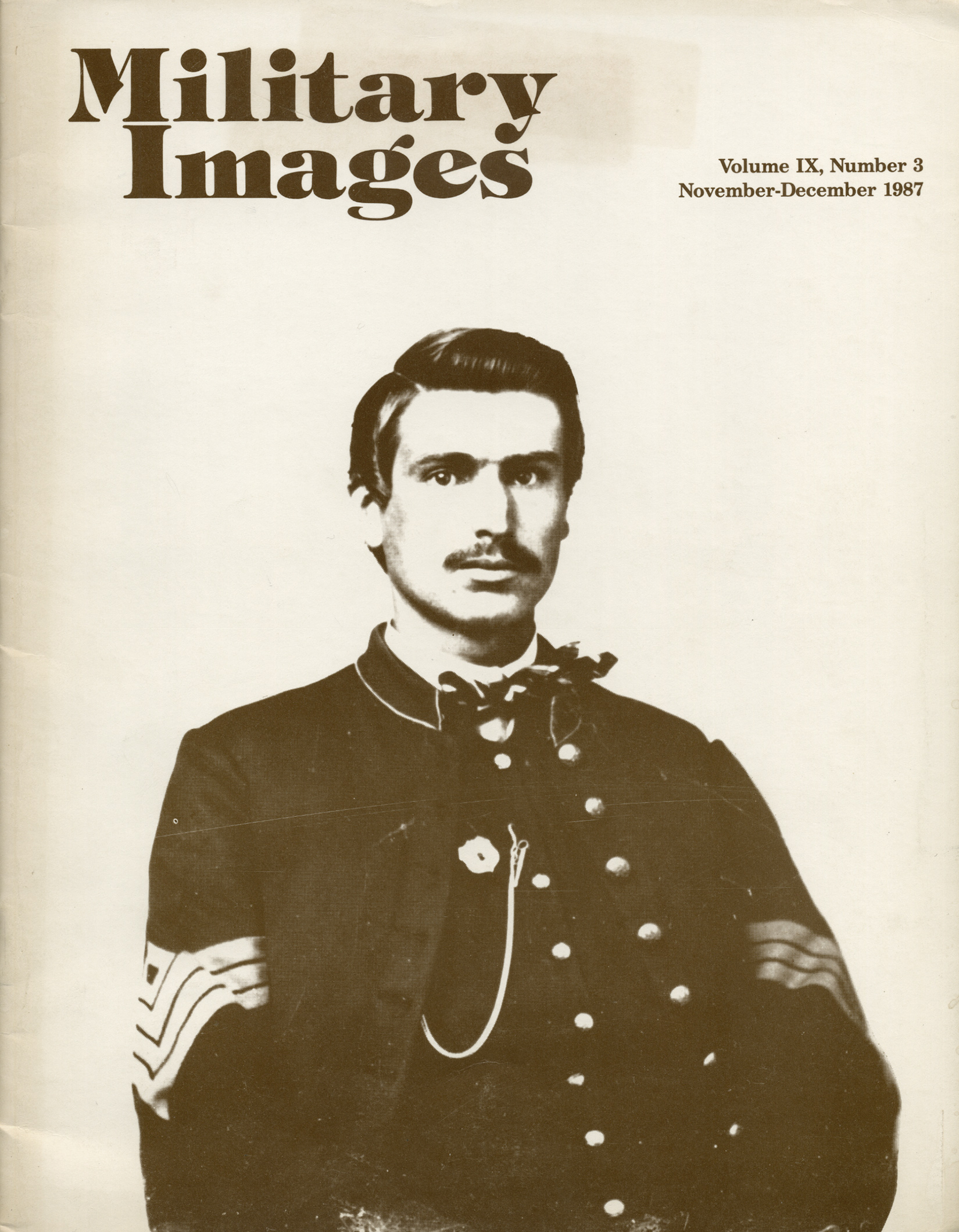
A sixth-plate ambrotype shows a First-Sergeant from Massachusetts wearing a battle pin which features the photograph of his commanding general.

Editor’s Desk (p. 1)
The editor turned his column over to the Executive Director of the Gettysburg Battlefield Preservation Association, Dr. Walter L. Powell, who is concerned about the possibility of land adjacent to remaining battlefield areas being taken over by development. He encourages readers to contact their legislators in support of H.R. 797 (“The Taney Farm Bill”) to preserve that land and force a geological survey to determine final boundaries for preservation at Gettysburg.

Mail Call (p. 3)
One of several letters to the editor requests readers to help provide more information about one of his images, which appears to show a soldier with an embroidered 8th Corps insignia on his kepi. Another reader complains about an anti-gun control ad, requesting that political issue ads be avoided in the future; the editor suggests that the ad be ignored if it disturbs. A reader suggests an article on WW1 balloons, and is told that Military Images stopped publishing First World War articles about a year previously as there was not enough support for them by the readership.

Passing in Review (pp. 4-5)
Three publications are set for review in this issue of MI. First is General A.P. Hill: The Story of a Confederate Warrior by James I. Robertson. The reviewer considers this to be a valuable biography of one of Lee’s important corps commanders, and feels that Robertson pointed out Hill’s weaknesses as a commander fairly. One point, however, that the reviewer makes is that an image purportedly of Hill in the 1850s shows a man in a naval, not army, uniform. Next is Henry Hopkins Sibley: Confederate General of the West by Jerry Thompson, which outlines the career of the man who is most remembered as the inventor of the Sibley tent. His story is much more than that. Hoping to gain quick advancement in the Confederate army, Sibley used his connections to Jefferson Davis to formulate a plan to raise an army in Texas and capture New Mexico and the precious metal fields of Colorado. The biography describes how and why this plan did not succeed. Finally, there is a lengthy review of Nothing But Glory: Pickett’s Division at Gettysburg by Kathleen R. Georg and John W. Busey. It is an interesting look not at Pickett’s Charge, but at his Confederate troops and their actions in and reactions to the charge. Using a number of previously untapped primary sources, Georg follows the men into the conflict, and like many of them, wonders where General Pickett actually was. Busey’s contribution lies in statistical evidence, along with rosters that outline each name and what the result was for each. The volume is highly recommended.

Civil War Badges, Part IV: Miscellaneous Badges by Wendell W. Lang, Jr. (pp. 6-15)
Eighteen different images illustrate the last type of badge discussed in this series of articles: the identification badge, a probable precursor to the “dog tag” worn in later conflicts. Generally made from stamped brass and often coming in three separate parts, soldiers could order these badges in order to identify themselves in the event of their death in battle. Some of the unique badges, similar to the one on the front cover of this issue of Military Images could include a small photograph of a famous politician (one thinks of the election of 1864), a commanding general, or even the soldier’s sweetheart back home. Some of the images show these identification badges in combination with Federal Corps badges. Some of them are in their complete three piece form while others are missing pieces and the soldier had to improvise how to attach them to their uniform. A few of the images show soldiers wearing badges on their outer coats and on their vests, perhaps to insure their identification should they be wounded or killed.

The Iredell Blues: An Independent Company of North Carolina Militia circa 1860 by Robert Fulmer (pp. 16-17)
The daguerreotype shows a large brick building with a full complement of soldiers, officers, and band members wearing elaborate uniforms that included white trousers and white plumes in their hats. They stand at present arms before a line of trees. The image, not published previously, was found in the estate of Mrs. Estelle Brady of Statesville, Iredell County, North Carolina and that is where researchers began to try and identify the group. The article describes the various hints that the daguerreotype provides and gives the readers a very rare look at an identified antebellum Southern militia.

The Kearny Medal by William Styple (pp. 18-19)
Major General Philip Kearny had a long and storied career in the Federal Army. He lost an arm fighting in the Mexican War, and with the French Army fighting in Italy, he was awarded the Legion of Honor medal in 1859. Killed at the Battle of Chantilly, Virginia in September 1862, Kearny rode straight into a Confederate line of battle that he had not been able to see clearly during the heavy rainstorm. He was called to surrender, but Kearny chose to turn and attempt to escape. His subordinates wanted to design and award a fitting remembrance for General Kearny, and devised what became known as the Kearny Medal, which was awarded to only 320 officers, five of whom are shown in images wearing the Medal. Kearny’s successor, General David Birney ordered the creation of the “Kearny Cross” which was different in design and presented to 463 noncommissioned officers, privates, and two vivandieres.

…And A Few Marines: U.S.M.C. Photos, 1898-1939 compiled by John A. Stacey (pp. 20-24)
Marines shown in this pictorial article served all over the world, from Guantanamo Bay to the Philippines to Samoa with their Fita Fita Guard. Their uniforms changed with linen summer dress shirts to the more common olive drab or khaki colors that we associate with Marines today. The collection of photographs includes individual portraits along with units posing for the camera as groups.

Bringing Up the Rear (pp. 25-29, 31)
This “holiday potpourri” of the regular “Stragglers” includes a large carte de visite taken by Mathew Brady of members of companies C and D of the 21st New York Infantry in Virginia in 1861, with identification of the individuals in the image. Another image shows surviving members of the 8th Illinois Cavalry; one of their number fired a shot at a Confederate officer, setting off what became the Battle of Gettysburg. Two post-war cartes de visite show young boys in uniform, one with a surplus Maynard carbine while the other shows a young soldier in kepi driving a dog pulling an “Express” wagon. Other images include an ambrotype of a mounted militiaman wearing a tricorn hat and a cabinet card of soldier wearing an unidentified badge. A total of fourteen images are included.

Back Image
A sixth-plate ambrotype shows a Confederate wearing his battle shirt, dating from the early years of the Civil War.

Finding Aid: September/October 1987

The complete issue

Vol. IX, No. 2
(32 pages)


Print edition: Visit our store to check availability
Digital edition: Visit JSTOR.org to purchase
Subscribe to MI
Explore the MI Archives: Browse | Advanced search | Tutorial

Inside

Cover image
Sgt.Maj. Alexander Bird of the 154th New York Infantry, the subject of one of the articles in this issue of Military Images, is shown with his wife, Melissa, in an albumen photograph.

Editor’s Desk (p. 1)
The editor suggests that readers in favor of preserving Civil War battlefields subscribe to The CWRT Digest, so that other battlefields do not fall to the same fate as Chantilly in Virginia.

Mail Call (p. 3)
The letters to the editor begins with a lengthy letter about the “off-beat” images found in the previous issue’s “Stragglers.” The author explains how carte de visite images can be manipulated with the original image switched with another in order to preserve a good backing. He suggests looking at other images from the same photographer to see if there is similarity with backdrops or even wall moldings or other features to authenticate a questionable image. Another letter provides additional information on the fate of Corporal Warren Alger (also in the previous issue); the author of this letter has access to a diary of another soldier who mentioned his sudden death. Other letters include the answer to Pop Quiz #320, which was an Italian Rifle Guards unit from Manhattan’Little Italy in the 1920s.

Passing in Review (pp. 4-5)
Six different publications are offered for review, beginning with the reprinting of the Recollections of a Naval Officer by Captain William H. Parker, which tells his story from joining the U.S. Navy at the age of 15, to his anguished decision to join the Confederacy, to several important naval battles, to his accompanying the refugee Confederate leadership from Richmond at the end of the war. Next is Confederate Shipbuilding by William N. Still, Jr. This book describes the failed attempt of the Confederacy to build a navy. The editor notes that readers interested in Still’s book should look also at “Phantom Fleet: The Confederacy’s Unclaimed European Warships” by David Sullivan in Warship International (vol. XXIV, no. 1). Third in review is Historic Dress of the Old West by Ernest Lisle Reedstrom, which is divided into different chapters devoted to different aspects of Western life. The review notes that there are numerous errors in the book that limits its value, however readers of MI might be interested in the nicely written overview of the life of frontier soldiers. Next is the review of Embattled Courage: The Experience of Combat in the American Civil War by Gerald F. Linderman. This volume describes the transition of the concept of “courage” between civilians and soldiers; the civilians maintained their definition without change, while the soldier, who was living the reality of war, changed his definition. Linderman posits that the divergence in definition remained until several years after the war, when the memories of the soldiers who survived softened over time and returned to an accord with the civilian definition. World Bayonets 1800 to the Present: An Illustrated Reference Guide For Collectors by Anthony Carter is next, and though the title is a bit misleading (only British bayonets are covered with American and other nations’ bayonets starting in 1873), it may be of use as there are very few books like this that focus on bayonets. Last in review is Uniforms of the French Foreign Legion by Martin Windrow which not only presents the uniforms of the French Foreign Legion over time, but also tells the stories of many Legion groups, including the one which fought to maintain Maximillian of Austria on the Mexican throne in the early 1860s.

Warrant Officers: Naval Uniforms of the Civil War, Part VI by Philip Katcher (pp. 6-7)
The U.S. Navy warrant officer is a rank dating back to 1794, unlike the warrant officer in the U.S. Army, which is a creation of the twentieth century. The men who held these ranks had various titles, such as passed midshipmen, sailmakers, and many others. The article describes the uniform details for the rank of warrant officer, often indicated by the number of buttons or the cap badges, and provides six different images as illustration.

A Tailor-made Image by Richard K. Tibbals (pp. 8-9)
A sixth-plate tintype shows six men appearing to be at work at tailors, or are they? Various items used in tailoring are prominently displayed, but with two soldiers in the image and a feel of relaxation among the men makes it a curious image indeed. The author requests any further information from the readership that might give the image more context and meaning.

New Recruits: Images of Children in Uniform by Robert Kotchian, Michael Scharfman, and William Schultz (pp. 10-13)
The three collectors who submitted these images provide a glimpse into childhood. The first two pages are from the collections of William Schultz and Michael Scharfman, offering eight images of children in patriotic garb, including miniature uniforms of varying types. The eight images on the second pair of pages are from the collection of Robert Kotchian; they are gem-sized tintype images found in an album which dates from the time of the Civil War. Each of the boys wears a kepi with the initials “N.A.C.” on them, presumably identifying them as Newark Academy Cadets. The images range from the serious boy saluting the camera to the mischievous lad who is thumbing his nose! Additional information regarding these images is encouraged as well.

Vignette: Colonel Van Manning, 3rd Arkansas Infantry by Keith Bohannon (pp. 14-15)
The sixth-plate ambrotype of Col. Van Manning and his wife Mary Zilephro Wallace Manning does not tell the story of the commander of the only Arkansas unit to fight with the Army of Northern Virginia. One would hardly note that the young lawyer who had gathered the men known as the “Arkansas Travellers” temporarily led a Texas brigade through the terrible fighting at Sharpsburg and was seriously wounded. Joined as part of the Texas Brigade, Manning fought on Houck’s Ridge during the second day of fighting at Gettysburg and led his Arkansans on a desperate charge, which left him wounded once more as a shell exploded right into his face. He led men at Chickamauga, Longstreet’s Knoxville campaign, and then returned to Virginia to fight in the Wilderness. Here he was wounded once more, and captured. He was hospitalized and then in August 1864, he led other men in the capture of the ship transferring him and 600 other prisoners – “The Immortal 600” – but the effort failed, and Col. Manning was imprisoned under close quarters. Again he annoyed his Federal captors by encouraging his fellow captives to refuse to sign the Oath of Allegiance, even after Lee surrendered; Manning would cut off the buttons from the uniforms of the “traitors” who did sign. Finally released in July 1865, Manning did have a successful post-war career as a lawyer and U.S. Congressman.

Every Picture Tells a Story: Outdoor views from the collection of Kean Wilcox (pp. 16-23)
Thirteen different outdoor images are featured in this article, which gives the reader some unique glimpses into the life of a Civil War soldier, from the quarter-plate tintype of soldiers in the process of breaking down their camp, to another quarter-plate tintype of what appears to be a new unit at training camp, to a sixth-plate tintype of Yankee troops with their camp set up in a town. Some of the images are portraits taken in outdoor settings, while one of the collection includes no images of humans at all – just the view of a camp with campfires burning and horses tied out in the woods. One intriguing image is of several Federal artillerymen relaxing with two small black boys in kepis in the front of the group and an unknown house on a hill in the background.

The 14th Brooklyn: A look at a unique uniform by Martin Schoenfeld (pp. 24-25)
The uniform worn by the 14th Brooklyn is truly a different one than those normally worn by Federal soldiers during the Civil War. It is distinguished by its chasseur leggings, red trousers, and a blue jacket with inversed red chevrons at the bottom of the sleeves and Russian knots on the shoulders. The jacket is unique also in that it had “false vest panels” down the front; the jacket was button closed at what looked like a vest, while the two false panels with as many bright brass buttons appeared to be the open jacket. The waist belt finished the look.

Vignette: Alexander Bird, 154th New York by Mark Dunkelman and Michael Winey (pp. 26-27)
The authors trace the service of Alexander “Alec” Bird after his enlistment as corporal in Company G of the 154th New York Volunteers in the summer of 1962. He was a blacksmith and farmer, and had recently married Melissa Ada Hyde, with whom he is featured on the cover of this MI issue. His diaries indicate that there were six images taken of himself during the course of the war, however the authors of the article have only located three at the time of this publication. The article includes one taken as a lieutenant in Savannah, Georgia on December 31, 1864 and a carte de visite taken at the time of his mustering out in June 1965 in Elmira, New York. He was in the fighting at Chancellorsville, where he also contracted the typhoid fever that kept him from joining his unit during the first day’s fighting at Gettysburg. Alec also took part in Sherman’s “March to the Sea” as well as doing duty in New York encouraging enlistments.

Stragglers (pp. 28-31)
This issue’s “Stragglers” include an unpublished carte de visite image of General Philip Kearney along with a quarter-plate tintype of an unidentified soldier with the knees of the next to be photographed in the margins of the image. There are three different sketches made of the charge of the 6th Michigan cavalry at Falling Water on July 14, 1863; two are by Edwin Forbes for Harper’s Weekly and one is by famed combat illustrator Alfred R. Waud. One fortunate collector found two images of the same soldier, one in dress and undress uniforms, at two different places. Lastly, Pop Quiz #322 shows former Confederate Brigadier General Alexander Welch Reynolds in 1869, wearing his uniform of colonel in the Egyptian Army.

Back Image
A quarter-plate tintype features three cavalrymen, complete with Gallagher carbines.

Finding Aid: July/August 1987

The complete issue

Vol. IX, No. 1
(32 pages)


Print edition: Visit our store to check availability
Digital edition: Visit JSTOR.org to purchase
Subscribe to MI
Explore the MI Archives: Browse | Advanced search | Tutorial

Inside

Cover image
The cover of this issues of Military Images features a carte de visite image of two compatriots working for the Veteran Reserve Corps. They wear the XXII corps badge that indicates their service in the defense of Washington, D.C.

Editor’s Desk (p. 1)
The editor discusses the loss of the Chantilly Battlefield site to development, and supports the protection of the Antietam site from the same fate.

Mail Call (p. 3)
Clarifications regarding identifications of images are provided by readers. Additional information about sharpshooters in Michigan brigades is also included. Subscribers are reminded to send in updated address information as soon as possible so their magazines do not go “absent without leave.”

Passing in Review (pp. 4-5)
There are seven publications offered for review in this issue of MI beginning with Illustrated Catalog of Civil War Military Goods by Schuyler, Hartley & Graham, an unabridged reprint of the 1864 catalog by the aforementioned New York firm. Next under review is Carl Bornemann’s Regiment, the 41st New York Infantry (DeKalb Regt.) in the Civil War by Dr. David G. Martin, which outlines the history of one of the regiments of “cowardly Dutchmen” which shows they were anything but. Some diary entries, photographic images, and sketches as well as some short biographies of regimental officers are also included. Civil War Generals: Categorical Listings and a Biographical Directory is compiled by James Spencer and shows the kind of database listing that could be compiled with the use of a computer at the date of publication of this issue. The Official Records of the Union and Confederate Armies is offered in 128 volumes and The Confederate Veteran in 40 volumes are made available by the Broadfoot Publishing Company, providing the essence of basic research information on the Civil War. These volumes are of considerable value to those doing extensive research on the course of the Civil War. Civil War Books: A Priced Checklist is compiled by Tom Broadfoot, Marianne Pair, and Roger Hunt, providing the collector of books a means to find a book’s comparative value. The checklist includes over 7000 titles in 10,000 volumes. Next in review is British Military Longarms, 1715-1865 by D.W. Bailey, providing an excellent overview of this very popular Confederate and second popular Federal firearm, as well as information from the Revolutionary and antebellum eras as well. Finally, the publication Why the South Lost the Civil War by Richard E. Berlinger, Herman Hattaway, Archer Jones, and William N. Still, Jr. is reviewed. The authors state that the South did not need to end the war as they did at Appomattox, but for three factors: absence of a sense of Southern nationalism, a religious belief that led to a sense of defeat/guilt, and a change in the nature of the government in Richmond. The reviewer sees the book as more of an “academic” work as opposed to a historical work.

The Faces of War: A series of vignettes (pp. 6-13)
Eleven different Military Issues vignettes are provided here, with an image and a short biography of each soldier:

  • “James T. McElvaney, 35th Georgia” by John and Robert Bailey
  • “Warren Alger, 15th Massachusetts” by Randy Beck
  • “Harvey Seeley, 6th Michigan Cavalry” by John Braden
  • “Abashe Cowen, 62nd Pennsylvania” by Timothy Brookes
  • “Velorous Bruce, 17th Michigan” by Bill Christen
  • “William Masten, 1st Btn., North Carolina Sharpshooters” by Robert Fulmer
  • “Lowell Mason, 42nd Massachusetts” by Norman Delaney
  • “Oren C. Hull, 30th Wisconsin” by Douglas Hennig
  • “George Lang, 3rd New Hampshire” by Wendell Lang
  • “David Holmes, 6th Mississippi” by Barry Mickey
  • “Charles Baldwin, U.S. Navy” by John Sickles

A Modest Hero: Sgt. Philip Decker at Cedar Creek by Seward R. Osborne (pp. 14-15)
Having entered the military in September 1862 at age 37, leaving his only daughter behind, Philip Decker enlisted as a sergeant in the “Mountain Legion,” Company E of the 156th New York Volunteer Infantry. By the time they left the Western part of the war and moved into the Eastern Theater in Virginia in the summer of 1864, their battle flag had been torn and tattered, in some cases pieces were pinned together. The “Mountain Legion” was just starting to get into line of battle before dawn at Cedar Creek when a number of other VIII Corps soldiers burst through their lines, followed by the Confederates of Kershaw’s 53rd Georgians. The color bearer went down as firing came at them from front and flank; Decker reached for the colors and made his stand at two Georgians with their own colors tried to wrest the banner from Sgt. Decker. He pulled the silken fabric from the standard, leaving the Georgian with the staff. Decker was downed by a shot in the elbow, giving up the colors to his captain, Alfred Cooley, who passed the tattered silk to Brig. Gen. Alfred Neafie, who carried the colors on his saddle for the remainder of the fighting at Cedar Ridge. Neafie sent the remnants home to his wife; the flag was eventually sent back to Cooley who kept it until it was dedicated at a reunion and dedication of the 156th monument at Highland, NY in 1908, with Sgt. Decker taking part in the ceremonies.

Rally Round the Flag: Images of Old Glory on her birthday compiled by Irena Zagoff (pp. 16-25)
A total of 31 different American flags from the Civil War era (with one exception) are presented in this pictorial article. The flags range from the human flag made by St. Paul, Minnesota school children wearing red, white, or blue hats taken in 1896 to an image of the famous American Eagle from the 8th Wisconsin, Old Abe, in front of Old Glory, to the typical tintype or carte de visite images of soldiers that have a flag in the background or wearing pins or badges. There are many examples of battle flags, torn and worn from their service on the Civil War battlefield, such as that of the 18th Connecticut, which had all of their major battles and dates inscribed on the red and white stripes or that of the 103rd Ohio, held by the “daughter of the regiment.”

A Flag for the Iron Brigade by William Gladstone (p. 26)
The “Iron Brigade” was made up of soldiers from Wisconsin, Indiana, and Michigan and citizens from those states commissioned Tiffany & Co. of New York to create a flag for the regiment. The article describes the details of the flag, from its rich dark blue silk to flags designating major battles through Gettysburg. The story of the flag’s presentation is told as well, with the ceremony being delayed a few days from its original anniversary of Antietam as the unit was called away to fight in Culpeper, Virginia. It is currently held in the War Museum of the Wisconsin State Capitol in Madison.

Stragglers (pp. 29)
The feature begins with a pair of pairs – one pair of militia or early Civil War musicians in a sixth-plate ambrotype sharing the page with a pair of images of Sergeant and Mrs. Abraham Cole of the 61st New York. “Pop Quiz #321” asks readers to identify an outdoor image, which would be easy for anyone from the Baltimore area. And three stragglers are presented as not quite what they seem to be; all are purported to be images of a hussar, Civil War wounded, and a pair of Confederates. They are probably images of actors, rather than the reality they purport to show.

Back Image
A war-weary image of a soldier in a sixth-plate tintype.

Finding Aid: May/June 1987

The complete issue

Vol. VIII, No. 6
(32 pages)


Print edition: Visit our store to check availability
Digital edition: Visit JSTOR.org to purchase
Subscribe to MI
Explore the MI Archives: Browse | Advanced search | Tutorial

Inside

Cover image
This issue’s cover features a Pennsylvania Bucktail holding his Enfield rifle in a sixth-plate tintype.

Editor’s Desk (p. 1)
The editor tells the story of a family treasure that got lost – someone in the family left a photo album of Uncle Isaac who served in the Civil War from 1862 to the end of the war in a train somewhere about 1957. He makes the point that while the images have significant family value, they are not remarkable. Remarkable images are those that provide new insight into the conflict, and the editor estimates that Military Images publishes on average one remarkable image per year. He believes one of these images to be the subject of the article beginning on page 6.

Mail Call (p. 3)
Many readers wrote to congratulate MI on the previous issue, which featured images from the collection of Ronn Palm. One reader provided some additional identifications for some of the images. Additional information regarding John C. Black and his brother William was also provided in a note from Brian Pohanka. One reader complained about the use of the term “kepi” with reference to “forage caps.”

Passing in Review (pp. 4-5)
A trio of reviews are presented in this issue, beginning with Checklist of Western Photographers: A Reference Workbook by Carl Mautz. This booklet intends to list all of the major photographers whose work focused west of the Mississippi in the 19th century. Space is left for new finds, which readers are encouraged to submit to the authors. The reviewer finds a lack of information on the eastern Western states. Next is The Photograph Collector’s Pocket Handbook by Doug Wahlberg, which does not receive high marks from the reviewer. It provides the names and basic biographies of major photographers, but only a range of value for the photographer’s individual work. In the case of Mathew Brady, this was from $50 to $10,000, which does not provide much guidance for collectors. Third in the group is Marylanders in the Confederacy by Daniel D. Hartzler, whose work attempts to list all of the men from Maryland who served in the Confederacy. While the estimate is about 25,000, the author lists 12,000 names with unit, highest rank, Maryland residence, and source of information. Other information that might be of interest (details of service such as wounding or death, battles, etc.) are not included.

A Scene in the Woods…: Analysis of a Rare Gettysburg Photograph by Harry Roach (pp. 6-9)
Published for the first time ever is one of the missing images from Alexander Gardner’s catalog of 1863 Civil War images. Shown along with images 245, 246, and 274 that have been clearly placed on the Rose Farm ground by the previous work of William Frasanito, this article presents Gardner’s stereoview image number 240 from the collection of Jeff Kowalis, as well as two magnified images. One image from the Alexander collection is still missing, however this particular image has been clearly identified as also having been taken from the same area as the previously identified images. The article also includes a map of the area, showing where the bodies of the dead were laid out for burial and where the cameras were likely placed. The article also makes the assertion that the dead were Union soldiers from the brigade led by Colonel John R. Brooks made up of a composite of the 2nd Delaware, 64th New York, 53rd Pennsylvania, part of the 145th Pennsylvania, and part of the 27th Connecticut.

A Soldier of Semmes’s Brigade: Robert N. Richardson, 53rd Georgia Volunteers by Keith Bohannon (p. 10)
This vignette tells the story of a “soldier of Semmes’s Brigade” who was a fatal casualty of the fighting at Rose Woods. Robert N. Richardson was a 38 year old farmer who had enlisted in the Quitman Guards in May 1862. Although ill for some time once he had been in the military, he rejoined his unit and eventually took part in this fighting at Gettysburg on July 2, 1863. He was shot in the thigh and eventually removed from the field, only to die in a Union hospital on August 11, 1863.

A Death in the Rose Woods by Orton Begner (p. 11)
A second vignette featuring a fatality from the fighting on the Rose Farm is about Captain Lieutenant Henry V. Fuller of Company F, 64th New York Infantry. The image shows him after his first promotion to the officer ranks in December 1861. Shot during the fighting and carried to the back as far as possible by one of his men, Fuller died on the field, his body being recovered on July 4th. He was buried at home in Little Valley, New York, and was brevetted full colonel in 1865. Members of his unit who survived the war erected a monument in his memory on the Gettysburg battlefield in 1894, only one of four company grade officers so honored.

The Fight for the Rose Woods: A Battle Narrative by Stephen Rogers (pp. 12-13)
This article is an excerpt from a forthcoming book by the author on the 64th New York, which took part in the fighting at Rose Woods as part of Brooke’s brigade, and provides a comprehensive narrative of what fighting took place at the Rose Woods after the Federal troops pushed the Confederates back across the Wheat Field. They were hit hard by the Rebels and began to retreat, only to turn into confusion along their lines. The article includes many recounted stories from survivors, including those left wounded overnight.

“Dear Brother Isaac…”: Letters from George Edgcomb, 15th New York Engineers edited by Edmund Raus (pp. 14-15)
In four letters, accompanied by a number of photographic images, the reader is given a glimpse into the time when the pontoon bridges were constructed across the James River by Union troops, including George Edgcomb, in June 1864. His letters provide comment on the activity in his camp as well as on the upcoming political elections and the possibility of his brother being called up in the next draft call.

The Jackson Guards: Company C, 149th Pennsylvania Infantry at Gettysburg by Richard Matthews (pp. 16-25)
A unit history of the Bucktail unit caught up in a controversy as a result of the fighting on the first day at Gettysburg. Calling themselves the “Jackson Guards,” Company C was made up of young men from the Myerstown Academy, with their principal, John Basseler serving as their captain. The article documents the group through training to become a Bucktail rifle brigade through the days leading up to July 1, 1863. The controversy dealt with the loss of the regimental flags during the fighting at the McPherson Farm. Basseler was able to bring the controversy to a conclusion with his collection of various statements from soldiers who were present. The article features 20 images of soldiers who took part in the fighting at the McPherson Farm, and provides a map that shows the positioning of the units on the field, including where the incident with the colors took place.

Bucktail Images by Ronn Palm (pp. 27-29)
Sixteen different images of Bucktail unit soldiers are featured in this pictorial article, with most of the subjects identified.. Ronn Palm provides a brief overview of the history of the Bucktail regiments and the so-called “Bogus Bucktails” who fought at the McPherson Farm as well.

Stragglers (pp. 30-31)
The submissions included in this edition of “Stragglers” includes an oval quarter-plate tintype of a young bugler set in front of a painted camp scene background. Another submission includes four soldiers in their winter coats in what appears to be an impromptu quarter-plate tintype image with many unique details. The last two images are part of “Pop Quiz No. 320.” The two full-body carte de visite images show two members of what is probably a New York militia company from probably the 1880s, complete with fancy feathered hats, intricate outdoor backdrops, and identification by the same photographer.

Back Image
A pair of images grace the back of the issue. One is a sixth-plate daguerreotype of an American dragoon with saber and horse pistols from about 1845-50. The second is an oval tintype image of Sewell Lawrence Fremont, found in the Asheville, NC area; the owners are requesting information about Fremont.