Finding Aid: July/August 1986

The complete issue

Vol. VIII, No. 1
(32 pages)


Print edition: Visit our store to check availability
Digital edition: Visit JSTOR.org to purchase
Subscribe to MI
Explore the MI Archives: Browse | Advanced search | Tutorial

Inside

Cover image
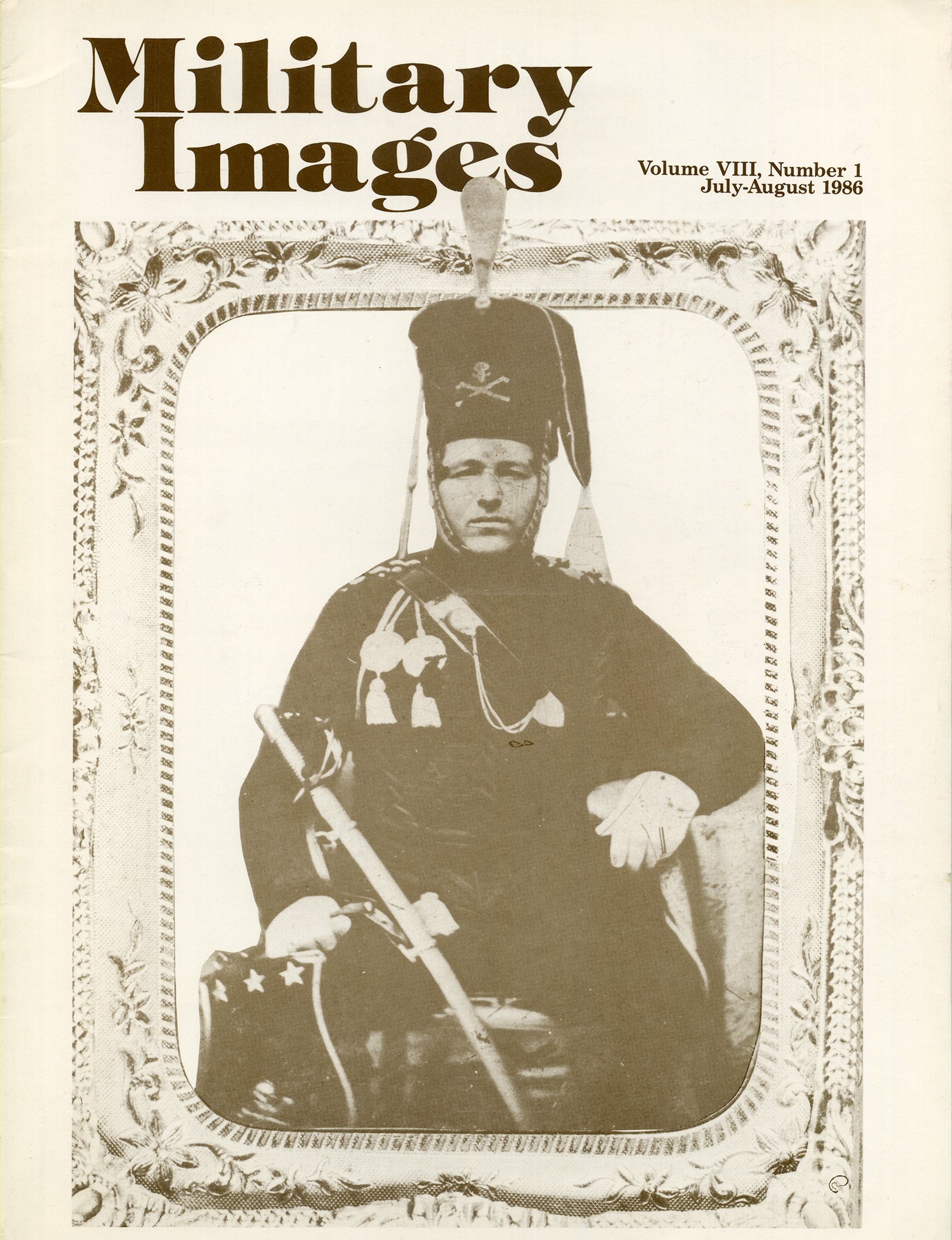
The cover of the current issue is an American hussar from about 1860, complete with the fur headgear with the death’s head insignia.

Editor’s Desk (p. 1)
The editor discusses the problem that the publication team had with saving and using back issues of Military Images. He writes with high praise for the work of Frank Jasek, who bound each volume into a hardcover set. The editor also discussed some of the upcoming features planned for future issues.

Mail Call (pp. 2-3)
A lengthy letter from a reader questions the identification of an individual in as Lt. David Raney, Confederate States Marines, providing a great deal of information to put the positive identification back into question. Another article disputes the assertion that the Colt revolving rifle saw limited and unpopular use during the war, using the history of the Michigan Cavalry Brigade as evidence.

Passing in Review (pp. 3-4)
Four volumes are presented for review in this issue of Military Images. First is Recollections of a Naval Officer by Captain William H. Parker, which is a quality reprint of the memoirs of a Confederate naval officer who had many memorable experiences; it is reprinted as part of the Classics in Naval Literature series. Next is Soldiers: A History of Men in Battle by John Keegan and Richard Holmes. The volume is a companion book to a British television series and devotes considerable space to discussions of the American Civil War and the lessons that were “too often ignored by professional soldiers in Europe.” Third is History of the First Delaware Volunteers by William P. Seville, another reprint of the original and only history of the unit written in 1884. Last is a review of an audiotape, Battlefields and Campfires, by the 97th Regimental String Band. Created by reenactors. The tape includes many of the songs of the era, played as they would have likely been played by soldiers of the Civil War.

The Darkroom (p. 5)
George Hart answers a question from a reader regarding the best way to repair damaged daguerreotype cases and how collectors store or clean their images. He responds with a list of products and suggested reading, and also explains that the means used by museums to control the environments of their collections are beyond the means of collectors. He describes how a pistol case can be used to protect images that are within cases and also cautions collectors to use “acid free” products that might come into contact with albumen images in particular.

Izzat a Chaplain or what?: Masonic Uniforms of the Civil War Period by Jacques Noel Jacobsen, Jr. (pp. 6-7)
A part of American history that goes back to before the Revolution, the fact that there were organized military lodges of Masons among both Union and Confederate soldiers should come as no surprise. The story is frequently told of captured or wounded Masons giving the sign of distress to their captors in order to receive protection while captured during the Civil War. What is more unusual is to see some of the Masonic badges and symbols from this era. The article includes six different images which describe the insignia, from the simple Masonic square and compass to the more elaborate insignia worn by Knights Templar and even a Master Mason. Two images from the post-Civil War era are also included.

Corps Badges of the Civil War, Part II: VI through X Corps by Wendell Lang (pp. 8-15)
The second of the series on the Corps badges worn by Federal soldiers begins with a short description of how the felt insignia were supposed to be worn, which was on the front or top of the cap, or the side of wide-brimmed hat. As seen by the images included in the article, the men had other ways of wearing their corps badges. Often purchasing more elaborate pins or even cockades, the men would also wear their badges with pride on their chest. One image shows a private of the 10th Vermont Infantry wearing the badges of both III and VI Corps, along with another shield-shaped badge, showing the movement of units between corps. The article shows thirteen soldiers wearing the VI Corps badge, a vertical Greek or Swiss cross, in a number of forms. There was no badge adopted for VII Corps (the Department of Arkansas) during the war, but a five-pointed star riding on a crescent was approved after the war was over and before the corps was disbanded; no photographic image is included. VIII Corps also had no official corps badge, but the men adopted the six-pointed star, as shown in the image included with the article. The badge for IX Corps was a badge shape with cannon and anchor imposed on it, reflecting the “amphibious operations” of this corps in North Carolina at the start of the war. The last badge presented in the article is for X Corps, a “square with an extended point at each corner” which represents the overhead view of a typical fort “with four bastions.”

The Militia of ’61: U.S. Army Uniforms of the Civil War, Part VIII by Michael J. McAfee (pp. 16-24)
Providing an overview of the history of militia in the United States, the author intends to show that there was no one “militia” in existence at the time of the Civil War. Tracing back to the “common” militia under which the different states could design their own militia system, the reader finds out that this system was in great decline by 1861. However, the “volunteer” militia, which were basically private clubs that were attached to the “common” militia. By the decade prior to the Civil War, states such as Massachusetts and New York tried to instill a regimental spirit by imposing uniforms, but this was largely unsuccessful, as the competitive nature of these groups prevailed. To make things more complicated for the collector, there were also units that had a military air to them, but were not actual militia units. They were more of a social club, many of which would perform as drill or marching societies. Militia uniforms could take three forms: “modern” units would wear variations of the 1851 U.S. Regular Army uniform; “traditional” units would wear the older type of uniform with high collars, tight sleeves, and tailed coats; “specialized” units would have more elaborate uniforms and could include hussars, Highlanders, and Zouaves. The twenty images that accompany the article, including one of Brig. Gen. Benjamin Butler of the Massachusetts Volunteer Militia in 1861, provide an excellent visual overview of the discussion.

“Up, Alabamians!”: The 4th Alabama Infantry at Manassas by Gregory Starbuck (pp. 25-29)
Eleven images of the men of the 4th Alabama illustrate the account of the first engagement that this unit underwent. Under the command of General Bernard Bee on Henry House Hill , the unit lost 40 killed and 170 wounded. The article recounts the stories of those who survived, such as Private Joe Angell who was knocked unconscious by a cannonball that hit his knapsack, and those who did not, like Colonel Egbert Jones who had undergone the embarrassment of a petition by his men because they had not seen enough action and wanted to redeem himself in battle. It also includes the story of two men who were not supposed to be there. Dr. Samuel Vaughn had been visiting relatives in the 4th when the unit moved out to Manassas from Winchester; he and his servant, James Jefferson (one of the few documented cases of a slave fighting for the Confederacy), accompanied the unit and fought with the regiment in this first frightening step into the Civil War.

Stragglers (p. 30)
Two images—a “before” and “after” pair—show the crew of a ship identified only by a banner in the second image with “O.Y.C.” The first image shows the crew cleaning up for their photograph, wearing undershirts and getting shaved, brushing hair and teeth, and generally in a relaxed mood. The second image shows the same crew with their banner and American flag, posing for their photograph in uniform and looking “shipshape.”

Back Image
1st Lt. James Young of Company K, 4th Alabama who was involved in the fighting of the 4th Alabama at First Manassas.
Finding Aid: May/June 1986

The complete issue

Vol. VII, No. 6
(32 pages)


Print edition: Visit our store to check availability
Digital edition: Visit JSTOR.org to purchase
Subscribe to MI
Explore the MI Archives: Browse | Advanced search | Tutorial

Inside

Cover image
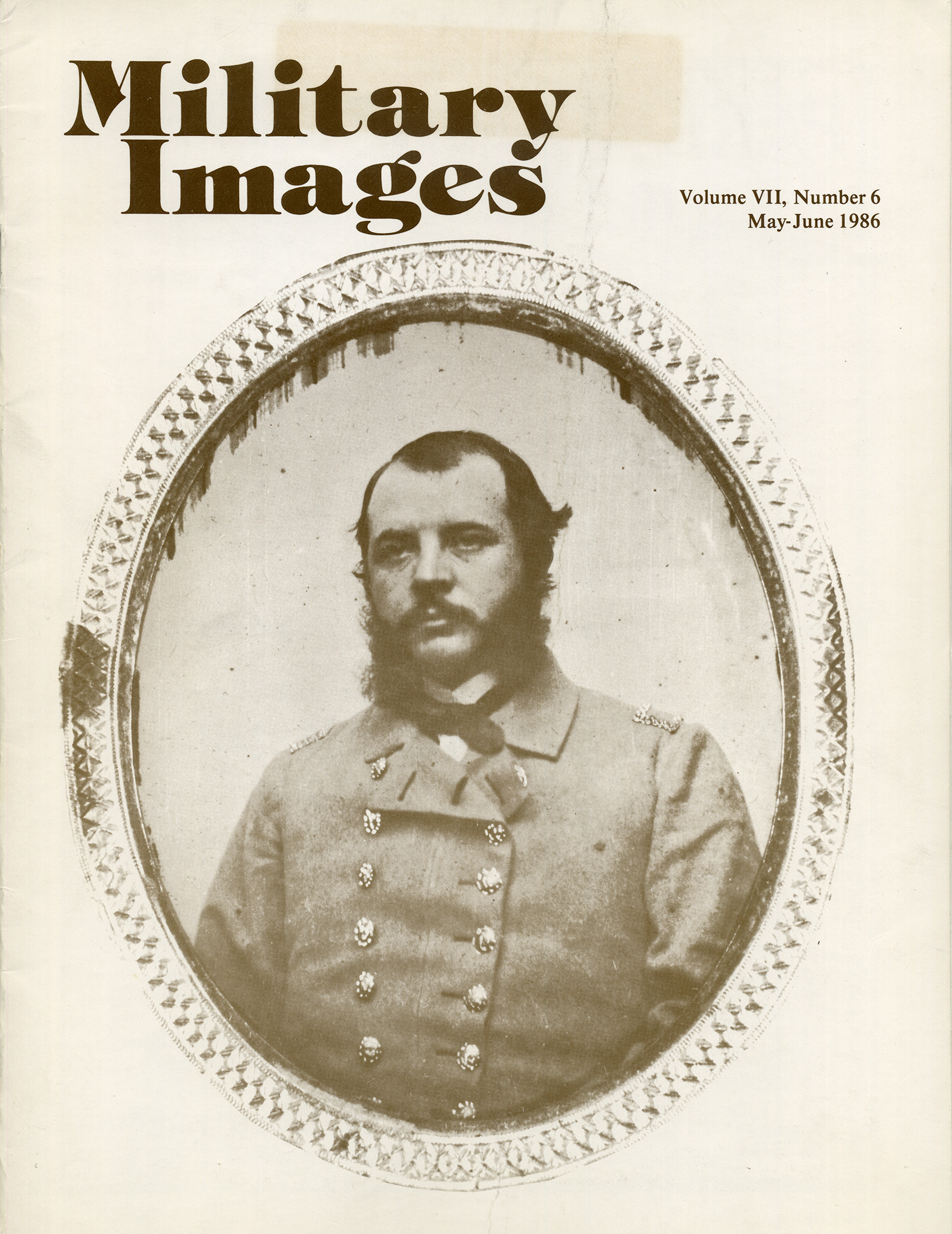
The oval image on the front cover is an unidentified Confederate who might be James D. Bulloch, who was in charge of the European shipbuilding program during the Civil War.

Editor’s Desk (p. 1)
The editor notes that an article in the current issue is topical based on continuing news from South Africa and Ireland. The upcoming 125th anniversary of the Battle of Bull Run will also be followed by Military Images; the editor provides a short overview of what readers can expect.

Mail Call (p. 2)
Letters to the editor include an explanation of label codes found on Military Images address labels and a clarification of the different cavalry regiments assigned to the U.S. Colored Troops are included. The editor also included a letter from William C. Davis which objected to the “Passing in Review” (March-April 1986) claim that persons other than the author selected the images for his work; the editor extended his apologies for the assertion and thanked Mr. Davis for his courtesy.

Passing in Review (p. 3)
Two publications are reviewed for the benefit of the readership in the issue. First is All for the Union edited by Robert Hunt Rhodes. Although subtitled to suggest it to be a history of the 2nd Rhode Island Volunteer Infantry, it is more a collection of diary entries, letters, and images from the collection of Elisha Hunt Rhodes, who served from 1861-1865. Second is Dear Friends at Home: The Letters and Diary of Thomas James Owen, Fiftieth New York Volunteer Regiment, During the Civil War edited by Dale E. Floyd. This volume does not come across as favorably as the first. It focuses mainly on a short period of time in 1864 from City Point during the siege of Petersburg, and does not provide much insight into the activities of the unit, but more on the political views of the author.

The 18th Louisiana Infantry: Acadians in Gray by Michael D. Jones (pp. 5-7)
This unit was much like other Confederate volunteers, but in one aspect they were very different. The men of the 18th Louisiana were French-speaking descendants of exiles sent out of Nova Scotia in 1755 as they refused to swear allegiance to the British king. The regiment represented the elite of Louisiana in the person of Colonel Alfred Mouton, who was a 1850 graduate of West Point and the son of a former Louisiana governor. It also represented the typical resident of the state: farmers, laborers, workmen from mostly the southern part of the state. The 18th Louisiana fought bravely at Shiloh, losing many at the Hornet’s Nest. They were sent then to the Trans-Mississippi Department, where they eventually took part in the Lafourche campaign and the Battle of Bayou Teche. While their last major battle was at Sabine Cross Roads, they remained together to become one of the last Confederate units to surrender in June 1865.

Pards: Photos of Friends, Partners, and Pals by Richard Carlile (pp. 8-13)
Twenty different images are presented of soldiers in the field or in the photographer’s studio. They were all comrades frequently displaying their arms, and all marking their Civil War friendships for posterity.

Chicago’s Wild Geese: Irish Volunteers in the Boer War by Kevin Young (pp. 14-15)
Some hatred die hard, and this article focuses on the continuing enmity felt by the Irish toward the British, this time taking the form of Irish-Americans who left Chicago to take up arms against the British in the Boer War in 1900. They fought with the deeply religious Boers, Protestants who looked upon the hard drinking and swearing Irish-Catholics from Chicago with some distain. However, the Boers needed fighters, and once the “Chicago Ambulance Corps” landed at Pretoria, they were handed guns under the leadership of John Y.F. Blake, a West Point graduate (1880) who had been in the 6th Cavalry and served, as had many of the Chicagoans, in the Spanish-American War. The Red Cross took away their flag and the American ambassador to South Africa protested, but the Chicagoans fought hard and provided rear guard support during Boer retreats. A monument to the first two casualties from the unit was erected in Mount Carmel Cemetery in Chicago to commemorate this group of Irish who took the fight to the British in South Africa.

Corps Badges of the Civil War, Part I: I, II, III, IV, V Corps by Wendell Lang (pp. 16-25)
This first of three articles about the Union corps badge begins with the story of how General Philip Kearny wanted to be able to identify “any of his officers who shirked or straggled” in the retreat across Virginia in the summer of 1862. He took his own red wool blanket and had his officers wear a red square for identification. After his death at the Battle of Chantilly on September 1, 1862, the men of his corps began to wear the badge as a memorial, gradually changing the shape until it was more of a diamond rather than a square. Joseph Hooker standardized this practice in March 1863. Today, our military wears identification patches to show their unit affiliation in an extension of this tradition. Twenty-six different images illustrate the different ways that the circle of I Corps, the trefoil (shamrock) of II Corps, the diamond of III Corps, the triangle of IV Corps, and the Maltese cross of V Corps. The insignia were often felt and sewn to soldiers’ kepis or worn on their uniform coats. Others were manufactured with bullion edging or made out of brass and attached with pin backs. The article shows the wide variety of corps badges and the many ways in which they were worn.

Stragglers (p. 25)
A soldier from Company H, 7th Pennsylvania Emergency Militia, a unit called up for the Battle of Antietam is the only image featured.

Whitfield’s Cavalry: A Texas-Arkansas Battalion in the Western Confederacy by Barry Mickey (pp. 27-29)
After routing Federal forces at Wilson’s Creek in August of 1861, commanding General Ben McCollough was in a hard place. His troops were from Arkansas and had not enlisted in the Confederate army, but had enlisted to serve in Missouri as state troopers. Only 18 of the men who fought at Wilson’s Creek decided to enlist as CSA soldiers. One small unit, Murphy’s Company of Arkansas Cavalry, was mustered in October 1861 and eventually merged with John W. Whitfield’s “Whitfield Rifles” from Texas and two other Texas companies to become the 4th Battalion, Texas Cavalry with Major Whitfield commanding. They fought against Union-supporting Indians and fought at Pea Ridge, before being reorganized as Whitfield’s Legion with the addition of seven more companies from Texas and one from Arkansas. Under the command of General Van Dorn this dismounted unit was sent to assist in Western Tennessee after Shiloh when the unit was again reorganized. This time, the Arkansans were grouped together and detached as Company H of the 1st Battalion Arkansas Cavalry. Both the Texas and Arkansas units saw extensive service, with the Arkansas fighting in pivotal engagements such as Vicksburg and the Texans fighting in the Battle of Iuka and the raid at Holly Springs, both in Mississippi.

Back Image
A cavalry trooper astride his mount graces the back cover.

Finding Aid: March/April 1986

The complete issue

Vol. VII, No. 5
(32 pages)


Print edition: Visit our store to check availability
Digital edition: Visit JSTOR.org to purchase
Subscribe to MI
Explore the MI Archives: Browse | Advanced search | Tutorial

Inside

Cover image
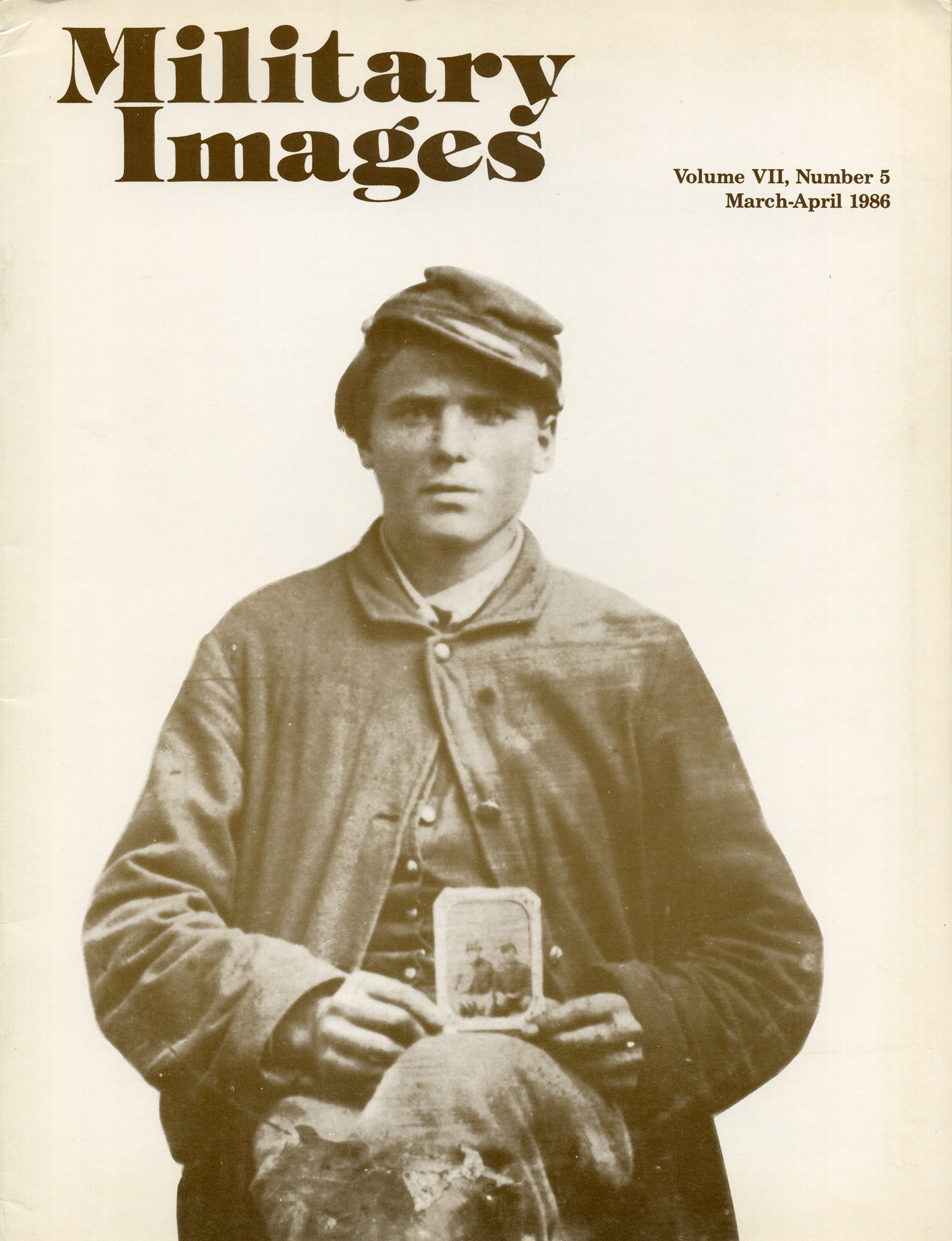
The front of this issue of Military Images features a soldier in kepi with a tintype image in his lap. He was 18 year old Freeman Mason of the 17th Vermont Infantry and the figure on the right in the tintype was his brother Michael. Both of the Mason brothers died in the service of their country.

Editor’s Desk (p. 1)
The editor notes a change in address for the magazine, and an increase in subscription prices due to rising costs of production and mailing. A preview of the upcoming issues was also outlined, based on popular issues of past issues.

Mail Call (p. 2)
The editor addresses a call for a rebuttal of a review of a publication in the September-October 1985 issue; the author and the reviewer have gone into litigation and the editor feels it best to refrain from comment. The author appears to have fraudulently gained access to the MI mailing list, and the editor requests that any communication be forwarded including the mailing label. A reader also questions the identity of the “oldest continuing military organization” in the U.S.

Passing in Review (pp. 3-4)
The current issue includes three reviews, beginning with The March to the Sea and Beyond by Joseph T. Glatthaar. The work looks at the Western Union soldier through the lens of Sherman’s Atlanta campaign. He looks at their views on the war, the South and slavery, and other issues on a more individual basis and discusses how these views changed during the campaign. The next review is of Touched by Fire: a Photographic Portrait of the Civil War, Volume I edited by William C. Davis. The reviewer does not give this volume very high marks. While nicely produced, it is not a recommended purchase. Cannoneers in Gray by Larry J. Daniel tells the story of the artillery branch of the Army of Tennessee and how these soldiers, at a disadvantage in many different ways, held up against their Northern opponents.

Vignette: Isaac Buswell, A patriot in the 20th N.Y.S.M. by Seward R. Osborne (p. 5)
“Ike” Buswell came from a family grounded in military service and he proved himself to be of the same patriotic cloth. He was taken prisoner in 1862 while taking a small expedition to find out what he could about Confederate secret mail service between Richmond and Fredericksburg, spending time in Libby Prison and Belle Isle. He was paroled, recuperated, promoted, and returned to the 20th only to be wounded on the first day of fighting at Gettysburg. His wounded leg became gangrenous, but he fought to keep his leg, returning once again to the 20th. The end of the war saw Ike Buswell with the rank of captain and part of the forces occupying Richmond at the end of the war.

Brady and Lee – 1866: The history of a photographic session by John O’Brien (pp. 6-8)
Complete with four different versions of on an iconic image, the author describes the history of the 1866 image of Robert E. Lee, the first postwar photograph that was often noted as being taken in Washington, D.C. in 1869. It was an image that Lee and the college he led (now known as Washington and Lee in Lexington, Virginia) wanted in order to show that he had moved on and was taking an active role in Reconstruction Virginia. It contrasts greatly with the 1865 image that Mathew Brady took of Lee on his porch in Richmond immediately after the surrender at Appomattox, also included with the article.

Vignette: Edwin Francis Johnson, a private in the 2nd Louisiana Infantry by Keith Bohannon (p. 9)
One of the most well-known images of the Civil War, the oval portrait of a very young Confederate soldier is often misidentified as belonging to a member of a Georgia regiment, although the kepi he wears bears the pelican insignia of Louisiana. The vignette describes his military career, ending with his death in July 1862 at Malvern Hill in Virginia.

Capt. Abraham Cottrell by Kean Wilcox (pp. 11-15)
He was both a photographer and a soldier, and a series of previously unpublished tintype images found in the effects of Capt. Cottrell have allowed the author to investigate both aspects of this soldier/photographer. Serving with the 8th Michigan Volunteer Infantry, Cottrell had been appointed as an aid-de-camp to General Isaac Stevens for his exceptional service in South Carolina in 1861. He was injured when his horse fell on him in early 1862, and eventually returned to serve as commander of Company E (“The Elder Zouaves”) of the 8th Michigan at Secessionville, South Carolina; his injuries in that battle, which initially saw him listed as killed in action, led to promotion and eventually a discharge for disability in March 1863. However, Cottrell returned to service later that same year as a lieutenant in the Invalid Corps, later renamed the Veterans Reserve Corps. His organizational abilities with the 16th Regiment of the VRC led to a promotion to captain, and a number of various independent command assignments. The article includes portraits of Cottrell, including some post-war cartes de visite and samples of backmarks he used with his work in Lansing, Michigan. The remaining images are of the four quarter plate tintypes found among Cottrell’s effects which feature a photographer working at some sort of ceremony.

Union Cavalry Carbines by Richard Carlile (pp. 16-26)
More than twenty images make up this informational pictorial article on the weapon that was favored by Union cavalry units. The carbine allowed the cavalry to fight mounted or dismounted, providing another weapon that could be effectively used by cavalry units. The problem was the vast number of different makes of carbine, each requiring a specific type of cartridge for its ammunition. The article discusses the main carbine brands used by the Union in the Civil War, and provides a chart that illustrates 16 different carbine types. The two most commonly used were the Sharps and the Burnside, with the seven-shot Spencer that appeared towards the end of the conflict. The images include many different types, including one of a Gallager; that particular make was popular, but not seen often in photographs.

To the Bitter End: Lt. David Raney, Confederate States Marines by David M. Sullivan (pp. 26-28)
A misidentification of an image led to the investigation of who the subject of the image was: Lt. David Raney, Jr., a native of Apalachicola, Florida, the first commissioned 2nd lieutenant in the Confederate States Marine Corps. Serving until the end of the war, he had a wide range of experiences from serving on the flagship of Commodore Tattnall during fighting at Port Royal to serving in the garrison at Drewry’s Point to commanding the Marines on the C.S.S. Tennessee and being captured at Mobile Bay. Raney escaped from prison in New Orleans and returned to Mobile to command Company D. Raney was with a group of his Marines when the C.S.S. Morgan surrendered on May 10, 1865, signing his parole papers for his men and for himself. Raney never did quite recover from the loss of the Confederacy, ending up a recluse in his family home in Apalachicola for the remainder of his life.

Stragglers (pp. 30-31)
Images submitted for inclusion in this issue of Military Images includes two views of the Inaugural Parade for President Taft in March 1909, including a mountain battery unit loaded on mules. An officer of the day from the Connecticut National Guard is also included, as is an 1888 image of the Lisbon, Ohio militia battery. The same gun is on display in the town’s village square.

Back Image
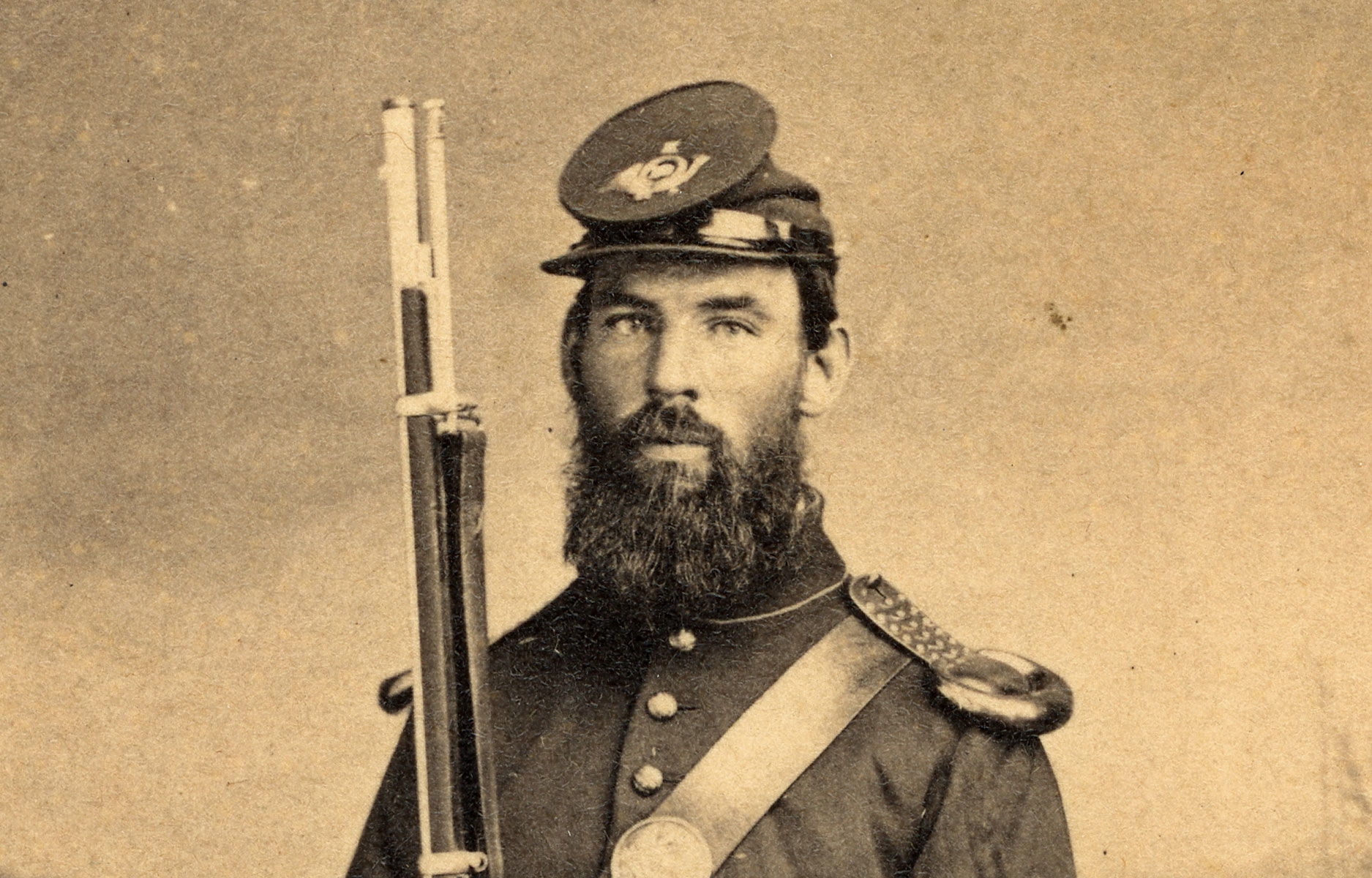
A fully armed Union soldier, including a Model-1859 Sharps carbine.