The Autumn 2025 Issue

A complete table of contents for the Autumn 2025 issue of Military Images magazine, and information about how to purchase single issues and subscriptions.

Vol. XLIII, No. 4
(80 pages)

Print edition: Visit our store to check availability
Digital edition: Visit JSTOR.org to purchase
Subscribe or renew your subscription

Explore the MI Archives:
Browse | Advanced search | Tutorial

Inside

Cover
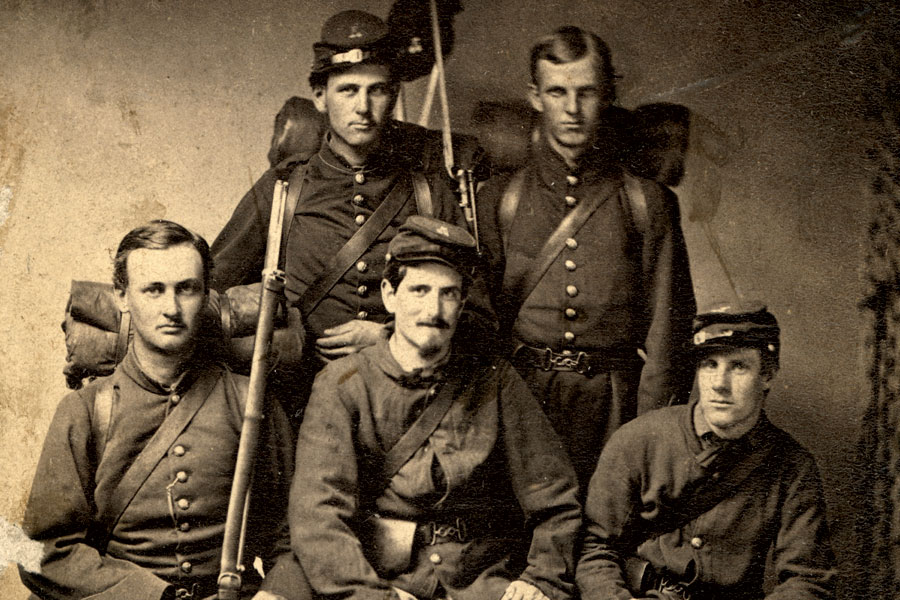
An albumen print the Rick Carlile Collection pictures five members of Company F, 44th Massachusetts Infantry, posed with weapons and gear.

Table of Contents (p. 1)

Editor’s Desk (p. 2)
A reflection on generative AI that animates and colorizes 19th-century military photographs, situating it within photography’s history and public engagement.

Mail Call (pp. 3-4)
Feedback includes the identification of two military images: U.S. Navy sailor Isaac H. Pierman and Sgt. John S. Koster of he 35th and 21st Massachusetts infantries.

Military Anthropologist (p. 4)
Newspapers.com data shows how “Contraband,” “Fugitive Slave,” “Colored Troops,” and “Freedmen” rose and fell in U.S. newspapers during the Civil War, 1861–1865.

Passing in Review (p. 6)
Review of Timothy Renner’s I Have Never Minded the Loneliness, profiling 37 hermits—including Gettysburg’s Hermit of Wolf Hill—with ties to Strange Familiars.

Photo Sleuth by Kurt Luther (pp. 8-11)
How to use generative AI in Civil War photo sleuthing: reverse image search, facial recognition, backdrop matching, better prompts, bias checks, and cautions.

Antebellum Warriors by Ron Field (p. 12)
A South Carolina militiaman with palmetto-plumed shako, triple-breasted coat, leather stock, civilian trousers, and an 1807-pattern stirrup-hilted sword.

Most Hallowed Ground (p. 14)
Franklin Y. Commagere served with the 14th Ohio Infantry, 67th New York Infantry, and the 6th U.S. Colored Cavalry; later in the 7th U.S. Cavalry. He is buried at Arlington.

The Honored Few by Evan Phifer (p. 16)
At Gettysburg, John B. Fassett led the 39th New York Infantry to retake Watson’s Battery guns near the Trostle farm on July 2, 1863, earning the Medal of Honor.

The Citizenry by Elizabeth A. Topping (p. 18)
Nine women identified as nurses at York U.S. Army Hospital, c.1864; with ties to the Ladies’ Aid Society ties and care after the Battle of Gettysburg.

Of Arms and Men by Phil Spaugy (pp. 20-23)
Company B, 9th Pennsylvania Cavalry on Lookout Mountain with Starr carbines in 1864, soon to ride under Kilpatrick during Sherman’s March to the Sea.

“Our Mess”: An 1862 image captures the camaraderie, campaigns, and distinctive equipment of five pards in Company F of the 44th Massachusetts Infantry by Michael R. Cunningham, Ph.D., featuring an image from the Rick Carlile Collection(pp. 24-27)
Exploring an image of five soldiers of Company F, 44th Massachusetts Infantry, posed with Enfield rifles and Short’s Patent knapsacks.

Marching Order! A glimpse of what federal soldiers looked like as they marched into battle— and into history by Michael R. Cunningham, Ph.D., featuring images from the Rick Carlile Collection (pp. 28-37)
Portraits show soldiers ready for campaigning with field gear—knapsacks, canteens, bayonets—plus other gear, from all sections of the Union.

The Bayard of the Volunteer Army: The life and death of Brig. Gen. William Haines Lytle, the poet-warrior by Ronald S. Coddington (pp. 38-43)
William Haines Lytle, 10th Ohio commander and poet, received a gold Maltese cross in August 1863 and fell at Chickamauga weeks later; his verse shaped his legacy. 

On Quinby’s Watch by Ronald S. Coddington (pp. 46-55)
Colorado Lt. Ira Quinby, a Signal Corps officer active at the 1864 Battle of Westport, helped guide moves that halted Price’s Raid—The Gettysburg of the West.

Mary’s Album: Cartes de visite and tintypes collected by a teenager put faces on two Loudoun Rangers of Virginia by Bob Iwig (pp. 58-60)
A Harpers Ferry teenager’s album includes photos of two Loudoun Rangers—Union cavalrymen active in an area with Mosby’s raiders and White’s Comanches.

Collecting Civil War Artifacts Before the Centennial by Norman Delaney(pp. 62-63)
Reflecting on how Civil War artifacts were found before the 1961–65 centennial, from family heirlooms to Bannerman catalogs, antique shops and early hunts.

Material Culture by Frederick C. Gaede and Paul D. Johnson (pp. 66-67)
Colonel William d’Alton Mann proposed shoulder-slung accouterments to move weight off the waist. Selected units tried the innovation, but never adopted it as standard.

Women of War by Melissa A. Wynn (pp. 68-69)
Louisa May Alcott served as a Civil War nurse in Washington, D.C., recorded her experiences in Hospital Sketches, and championed women’s rights.

Behind the Backdrop by Buck Zaidel (pp. 70-71)
A Hartford, Conn., studio’s camp-scene backdrop—attributed to Nelson A. Moore—shows up in similar form in Ohio and Philadelphia, tracing links among wartime studios.

Vignette by Scott Valentine (p. 72)
Samuel A. Duncan led the 4th and 6th USCT at New Market Heights in 1864 during the Richmond campaign; Sgt. Maj. Christian Fleetwood earned the Medal of Honor.

Stragglers (pp. 74-76)
Kentucky campaigners, a sailor of Asian heritage, a split-screen soldier on camp and on campaign, and a soldier at Point Lookout.

The Last Shot (p. 80)
Unidentified Confederate with Bowie knife, single-shot pistol, and tinware in a wool jacket—a ninth-plate ambrotype from the Paul Reeder Collection. 

The Summer 2025 Issue

A complete table of contents for the Summer 2025 issue of Military Images magazine, and information about how to purchase single issues and subscriptions.

Vol. XLIII, No. 3
(80 pages)

Print edition: Visit our store to check availability
Digital edition: Visit JSTOR.org to purchase
Subscribe or renew your subscription

Explore the MI Archives:
Browse | Advanced search | Tutorial

Inside

Cover
A carte de visite from the Karl Sundstrom Collection pictures Maj. Horace N. Attkisson of the 50th Indiana Infantry, “The Gallant Hero of Edgefield Junction.”

Table of Contents (p. 1)

Editor’s Desk (p. 2)
Civil War portraits of wounded, like battlefield photos in 1862, evoke powerful emotions—reminders of war’s cost and the courage of those who endured it.

Mail Call (pp. 3-4)
Feedback includes references to Confederate Gen. Evander Law, North Carolina photographer Esley Hunt, and American heritage and memories.

Military Anthropologist (p. 4)
A chart reveals how far Union regiments marched in the three weeks before Gettysburg. The range is from under 60 to more than 350 miles.

Passing in Review (p. 6)
Two new books spotlight overlooked forces in the Civil War—Catholic chaplains who served troops and the powerful role of weather in the Gettysburg Campaign.

Photo Sleuth by Kurt Luther (pp. 8-10)
A mystery Brady photo once thought to be Thomas Meagher or John Buford is correctly re-identified as Capt. Atlee W. Putnam of the 7th U.S. Infantry.

Antebellum Warriors by Joe Bauman (pp. 12-13)
Lt. Col. Joshua Howard fought in the War of 1812, the Mexican-American War, and the Civil War—one of a small group to serve in all three major conflicts.

Most Hallowed Ground (p. 14)
Captain Edward C. Townsend, a Union officer and War Department clerk, mourned Lincoln’s assassination and led U.S. Colored Troops at the Battle of the Crater.

The Honored Few (p. 16)
Christian Fleetwood, a free Black man from Baltimore, earned the Medal of Honor for heroism at New Market Heights and fought to preserve the legacy of Black soldiers.

The Citizenry (pp. 18-19)
In 1861, President-elect Abraham Lincoln met 94-year-old Joshua Dewey, a Revolutionary War veteran who had voted in every U.S. election since Washington.

Of Arms and Men by Phil Spaugy (pp. 20-22)
The story of John Burns, the civilian hero of Gettysburg, his iconic firearms, battlefield bravery, and how history and photography remembered him—and his weapons.

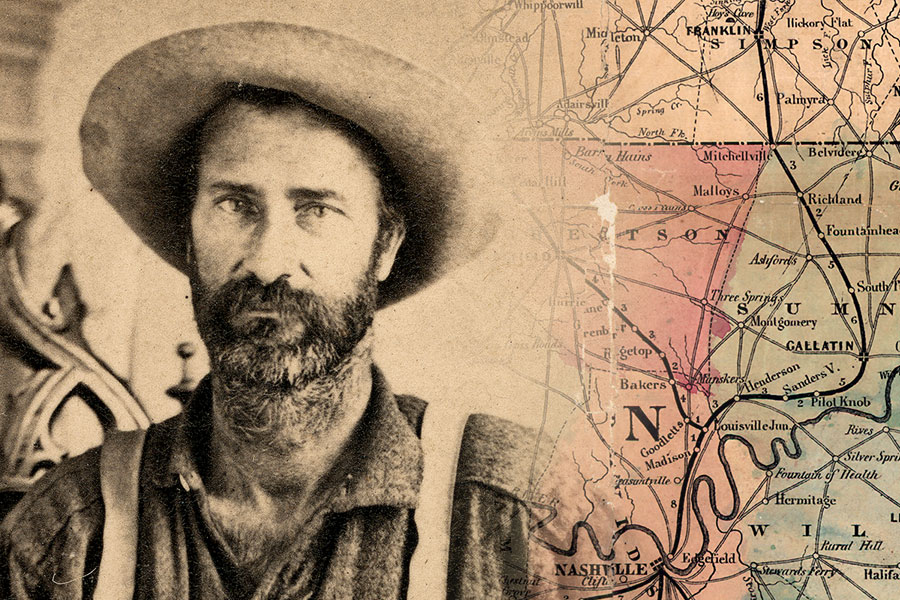
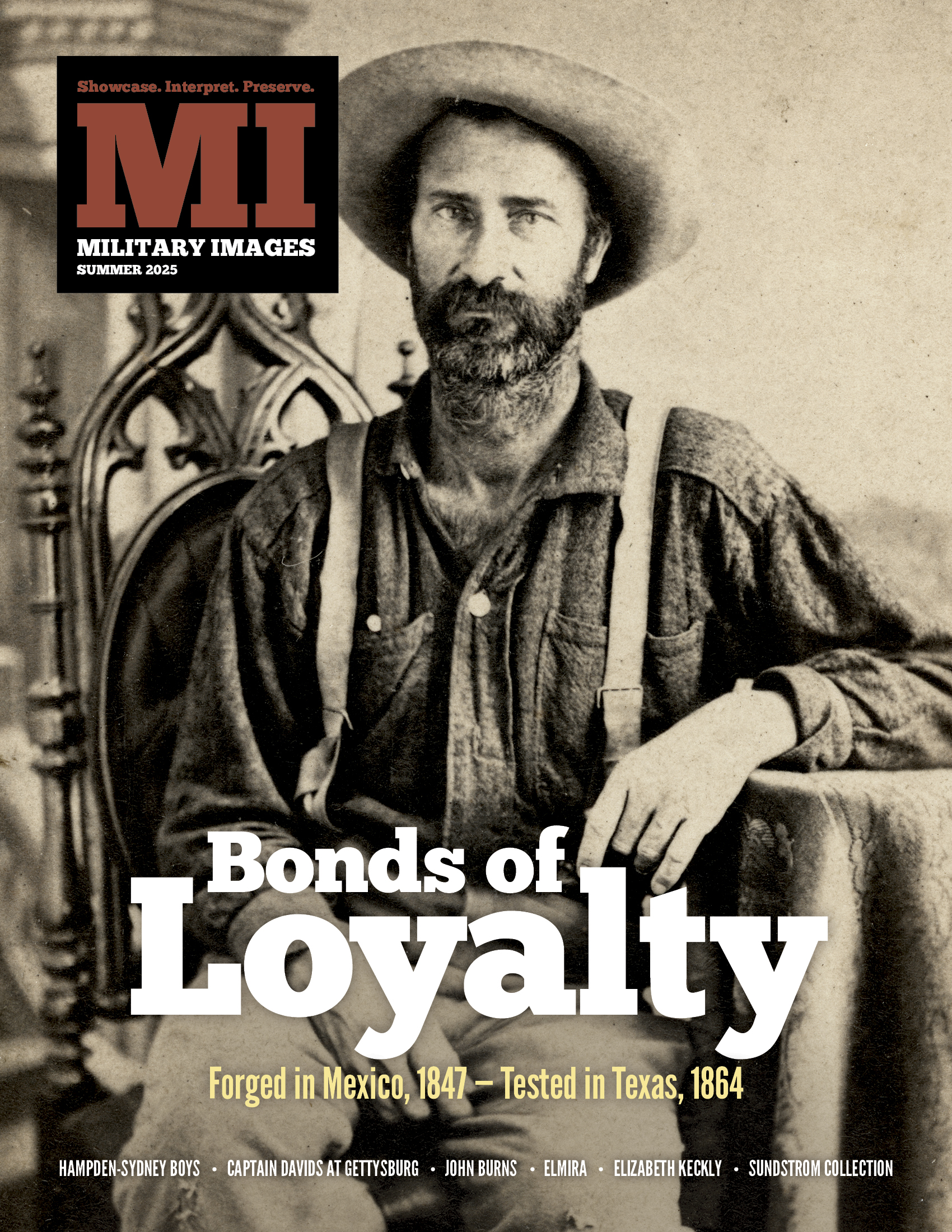
Bonds of Loyalty: Forged in Mexico, 1847 — Tested in Texas, 1864 by Ronald S. Coddington (pp. 24-32)
In Indiana during the Mexican War, two soldiers fought side by side. Fifteen years later during the Civil War they met again—this time on opposite sides.

Capturing Elmira: The photographers who documented a Northern prisoner of war camp by Richard Leisenring, Jr., adapted from his forthcoming book(pp. 34-38)
The story of Elmira’s Civil War prison camp—“Hellmira”—through photographs, historical details, and the harsh realities faced by Confederate prisoners.

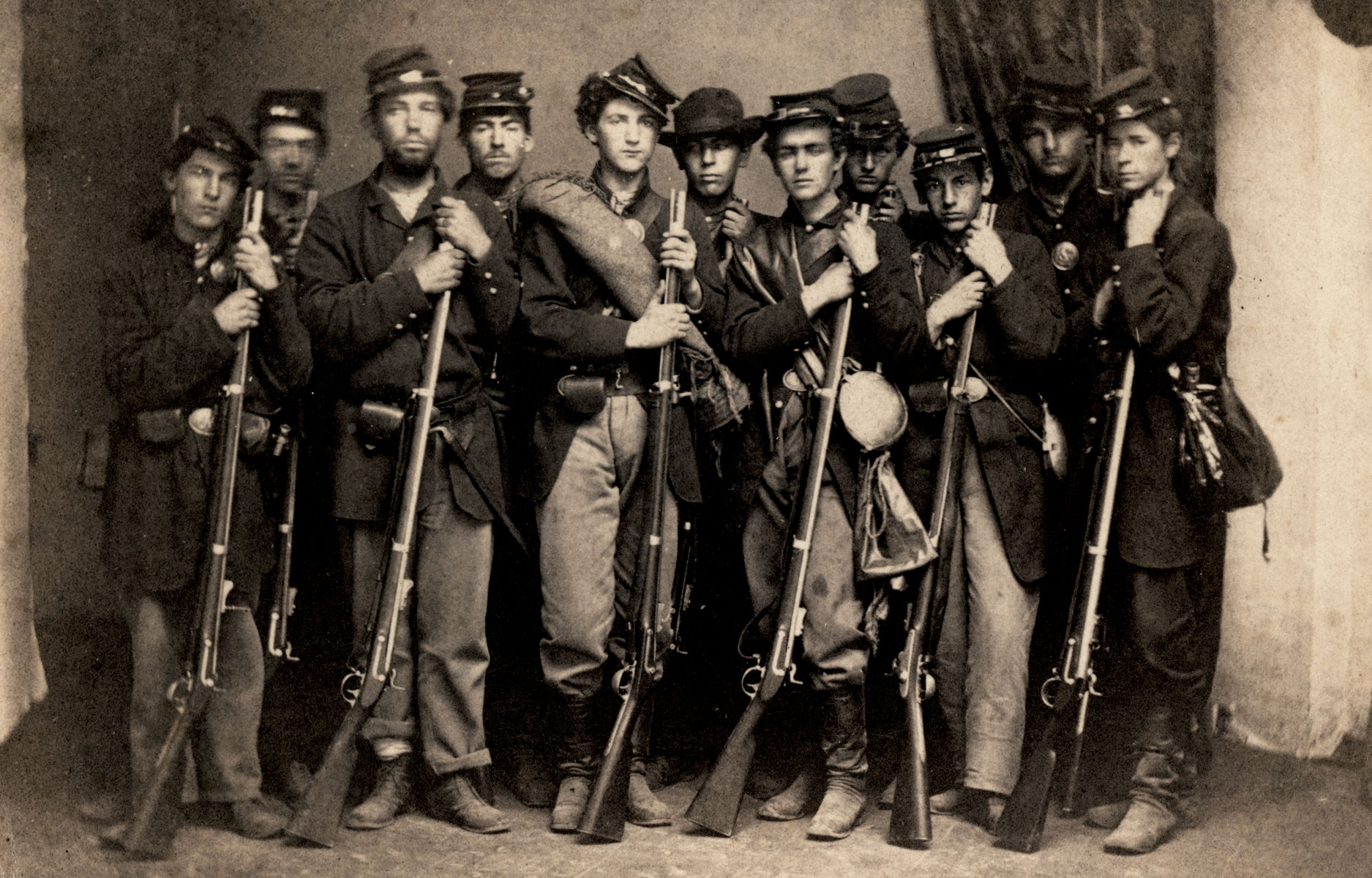
A Boy Company Goes to War: William Henry Harrison Ewing and His Hampden-Sydney College Classmates by Dave Batalo and Hunter Lesser (pp. 40-43)
Hampden-Sydney College students formed a militia in 1861, fought at Rich Mountain, were captured, and sent home with a lesson from Maj. Gen. George B. McClellan.

The Last Grand Army Vets and a Youthful Symbol of America’s Fighting Men by Ronald S. Coddington (pp. 44-47)
A 1952 Boston Globe cover honored the last Union veterans and a young Korean War soldier, bridging generations of service and capturing a poignant national moment.

The Last Confederate Veteran by Ronald S. Coddington (pp. 48-49)
Pleasant Riggs Crump, the last confirmed Confederate veteran, survived Hatcher’s Run, lived to 104, and became a symbol of memory in the postwar South.

“‘Died at Gettysburg!’ No Prouder Epitaph Need Any Man Covet.”: The Tragedy of Capt. Richard Wistar Davids of the 118th Pennsylvania Infantry by Charles T. Joyce (pp. 50-59)
The life and legacy of Davids, a Philadelphia aristocrat whose sacrifice at Gettysburg shaped his family’s story and historical memory.

Collector and Mentor: Seven decades after he began his Civil War journey, Karl Sundstrom continues to inspire by Austin Sundstrom(pp. 60-65)
Explore Civil War portrait photography through the unique lens of Karl Sundstrom’s collection, introduced by his nephew and fellow collector, Austin Sundstrom.

Material Culture by Ron Field (pp. 66-68)
Explore how to distinguish U.S. and British Navy sailors in Civil War-era photos by comparing subtle uniform differences in rare images from Ron Field’s collection.

Women of War by Melissa A. Wynn (pp. 70-71)
Elizabeth Keckly rose from slavery to become Mary Todd Lincoln’s dressmaker and confidante—then risked it all by publishing her bold and controversial memoir.

Behind the Backdrop by Buck Zaidel and Ronald S. Coddington (p. 72)
Philadelphia photographer Washington L. Germon’s Sea of Tents background is likely inspired by the many military camps in the city during the Civil War.

Vignette by Scott Valentine (p. 74)
Brigadier Gen. Joseph King Fenno Mansfield, a veteran engineer and Mexican War hero, was mortally wounded at Antietam just two days after taking corps command.

Stragglers (p. 74)
A Union soldier grips a War of 1812-era cavalry saber, dressed in early war uniform with 1851 eagle belt plate, and a collector’s first image.

The Last Shot (p. 80)
John “Laurenz” Rosenberger, a Confederate band member and postwar orchestra leader, played music through war and peace, from Richmond to Ford’s Theater.