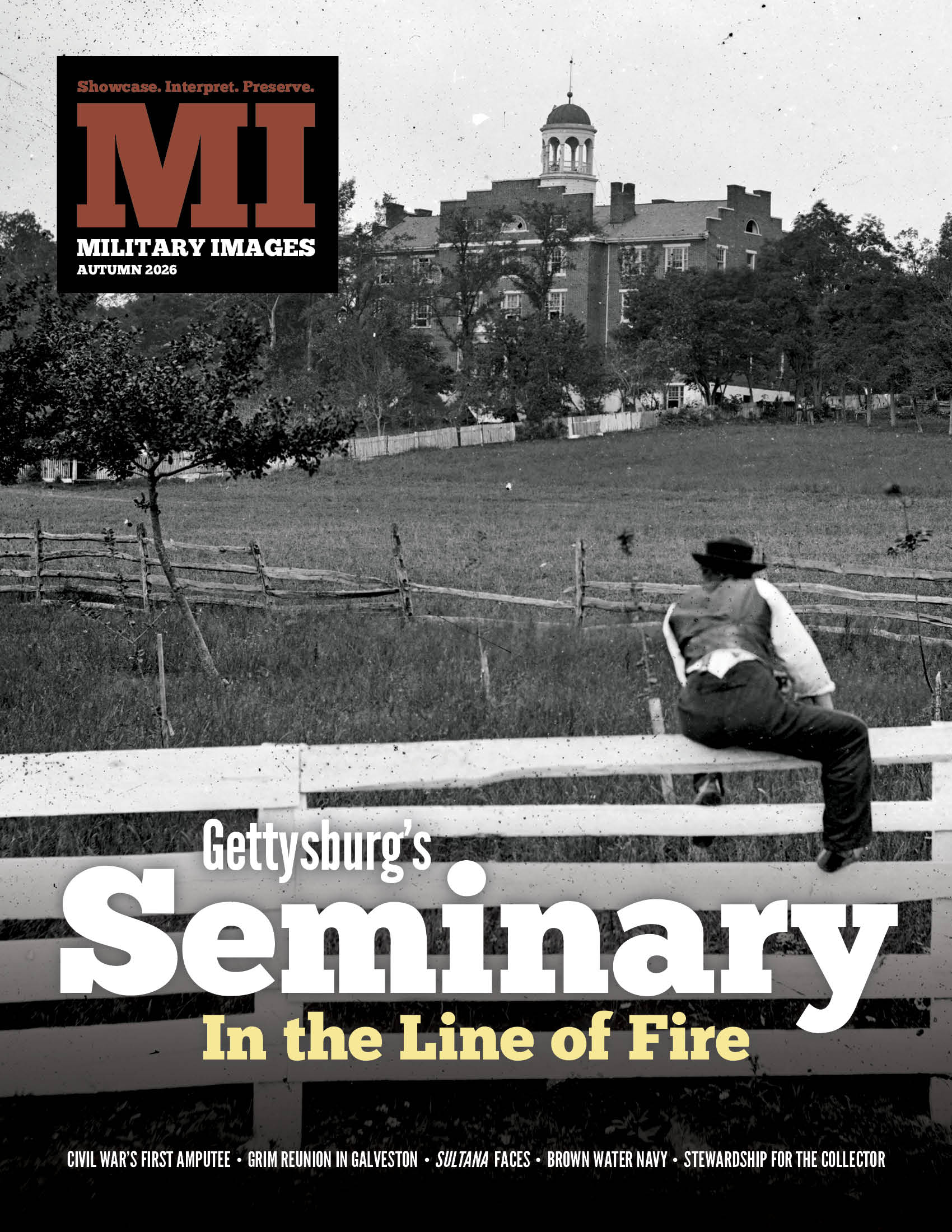

A complete table of contents for the Winter 2027 issue of Military Images magazine, and information about how to purchase single issues and subscriptions.

Vol. XLV, No. 1
(80 pages)
Print edition: Visit our store to check availability
Digital edition: Visit JSTOR.org to purchase
Subscribe or renew your subscription
Explore the MI Archives:
Browse | Advanced search | Tutorial
Inside
Cover
A man posed with a lens board is believed to be George W. Foster, contract photographer for Camp Nelson, Ky.
Table of Contents (p. 1)
Editor’s Desk (p. 2)
Can Civil War cartes de visite qualify as trading cards? A William T. Sherman engraving by Louis Prang raises questions about collecting, grading, and authentication.
Mail Call (pp. 3-4)
Feedback includes an obituary for contributor Norman Delaney, family connections to Col. Henry K. Burgwyn of the 26th North Carolina Infantry, and more.
Military Anthropologist (p. 4)
An 1897 War Department catalog reveals the 10 most photographed U.S. Quartermaster sites, led by Hilton Head, Chattanooga, and Nashville.
Passing in Review (p. 6)
Reviews of three Civil War books covering 432 eyewitness accounts, the second day at Gettysburg, and one Ohio soldier’s story through family research.
Photo Sleuth by Kurt Luther (pp. 8-10)
Explore thousands of Civil War photographers on the Photographer Atlas, a new free interactive tool that maps historic studios, backdrops, and photographer imprints.
Antebellum Warriors (p. 12)
A daguerreotype captures an unidentified Mexican War-era soldier in death, preserving a poignant example of 19th-century postmortem photography.
Most Hallowed Ground (p. 12)
Seven Union soldiers were buried at Arlington National Cemetery on September 7, 1864. One of them was George Bentley of the 10th New York Heavy Artillery.
The Honored Few by Evan Phifer (pp. 16-17)
Charles M. Holton of the 7th Michigan Cavalry earned the Medal of Honor for capturing a Confederate battle flag at Falling Waters in July 1863.
The Citizenry by Ronald S. Coddington (pp. 18-20)
An ambitious composite photograph by John C. Spooner preserves 497 faces from Springfield’s 1864 Sanitary Fair, including several Civil War figures.
Of Arms and Men by Phil Spaugy (pp. 22-23)
Phil analyzes the long arms and equipment in notable images of U.S. Colored Troops, including the Springfield, Enfield, and Austrian muskets they carried.
Picturing Camp Nelson: Tracing the contract photographers who documented its buildings, grounds, and people by Ronald S. Coddington (pp. 24-33)
Discover the contract photographers who documented Kentucky’s Camp Nelson, capturing its military operations, U.S. Colored Troops, refugees, and people.
Clarion Call: The Grand Reception of United States Colored Troops by Jack Hurov(pp. 34-38)
In November 1865, Black Civil War veterans marched through Harrisburg, Pa., celebrating their service and demanding equal rights after exclusion from the Grand Review.
Metal Monster at Bush River Bridge: In 1861, an experimental armored rail car defended key Maryland tracks by Ronald S. Coddington (pp. 40-45)
In 1861, an experimental armored railroad car built in Philadelphia guarded Maryland tracks after secessionists destroyed bridges near Baltimore.
Immortal Honors at Pea Ridge: The life and loss of Pvt. Jeptha Bell, 4th Iowa Infantry by Kip Lindberg (pp. 46-48)
Pvt. Jeptha Bell of the 4th Iowa Infantry gave his horse to his commander at Pea Ridge, then suffered a mortal wound that earned him lasting recognition.
Mementos from the Tent Mates of Company A: Two sets of tintypes document members of the 25th Massachusetts Infantry at New Bern, N.C. by Ronald S. Coddington (pp. 50-55)
Two sets of tiny tintype portraits reveal the faces, friendships, and fates of soldiers in the 25th Massachusetts Infantry stationed at New Bern, N.C.
Victory or Death at Seven Pines: Captain Eusebius Fowlkes of the 11th Virginia Infantry by Ronald S. Coddington(pp. 56-57)
Confederate Capt. Eusebius Fowlkes of the 11th Virginia Infantry led his men into the Battle of Seven Pines in 1862, where his premonition of death came true.
West Point Class of 1855: 40th Reunion Portrait by Timothy Bennett (pp. 60-63)
An 1895 reunion photograph brings together 10 West Point classmates whose careers spanned the Civil War, including Union and Confederate generals.
Material Culture by Ron Field (pp. 64-65)
Explore the uniforms, weapons, gunboats, and history of the United States Marine Artillery, a specialized Union unit that fought in North Carolina.
Women of War by Melissa A. Wynn (pp. 66-67)
The history of Mary Boykin Chesnut’s Civil War diary, her views on slavery and Southern society, and her collection of more than 200 wartime portraits.
Behind the Backdrop by Buck Zaidel (pp. 68-70)
Learn how Civil War photographers used painted camp backdrops, patriotic symbols, and studio props to create idealized portraits of soldiers.
Vignette by Scott Valentine (p. 72)
Hiram Duryea helped forge the 5th New York Zouaves into a formidable fighting regiment before illness ended his service and tragedy claimed his life.
Stragglers (pp. 74-76)
Civil War portraits of Union and Confederate soldiers, including cavalrymen, Zouaves, a USCT infantryman, and unusual ambrotypes and tintypes.
The Last Shot (p. 80)
A signed portrait of Confederate Maj. Henry Kyd Douglas reveals a personal connection to a Virginia family near the Petersburg front in December 1864.