Finding Aid: July/August 2004

The complete issue

Vol. XXVI, No. 1
(40 pages)


Print edition: Visit our store to check availability
Digital edition: Visit JSTOR.org to purchase
Subscribe to MI
Explore the MI Archives: Browse | Advanced search | Tutorial

Inside

Cover image
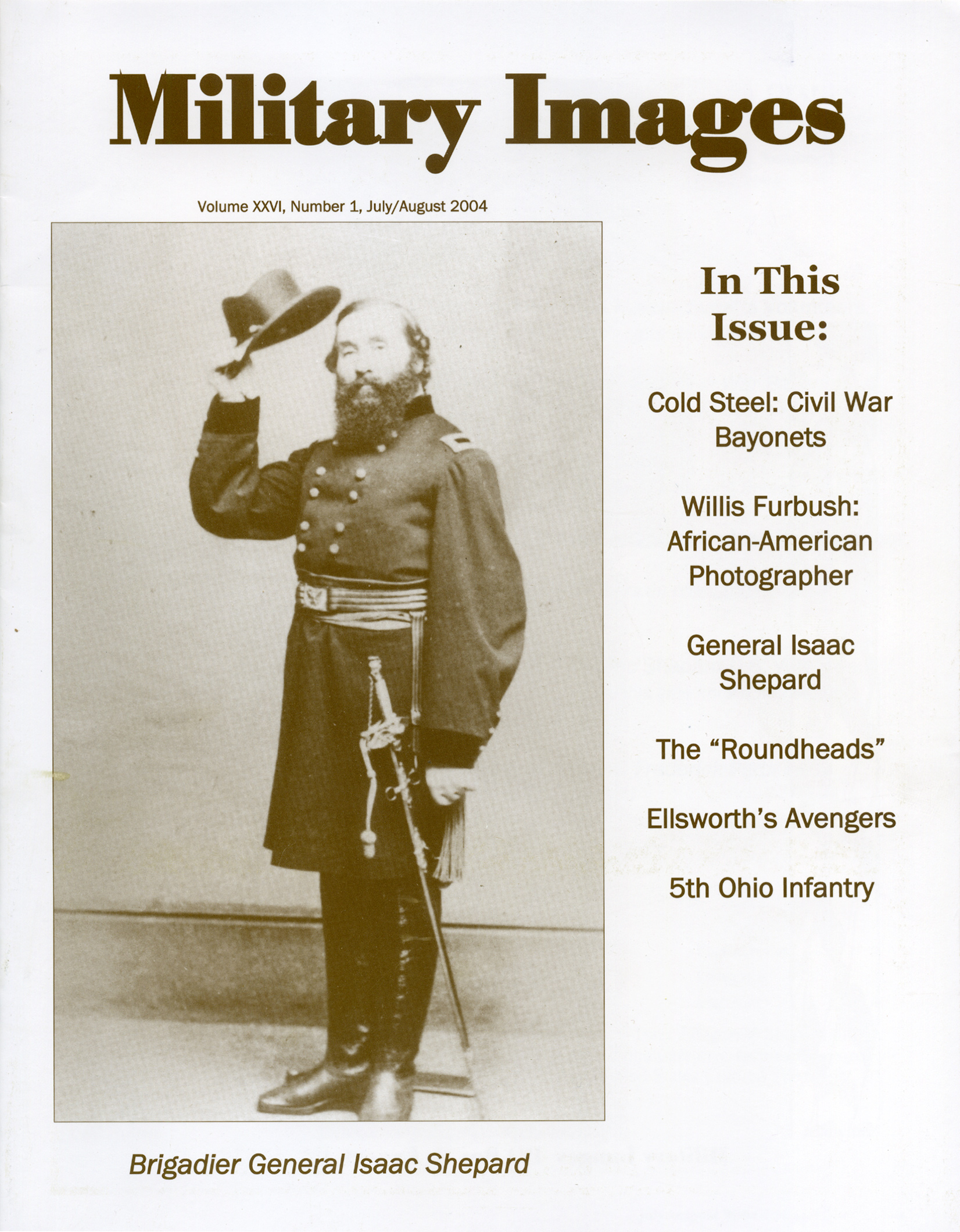
carte de visite from the Al Fleming collection is a portrait of Brig. Gen. Isaac Fitzgerald Shepard of Massachusetts.

Table of Contents (p. 1)

Editor’s Desk and Mail Call (p. 2)
The editor is pleased to report the publication of Silver Shadows Before the Storm: The American Military Daguerreotype by longtime MI contributor Dr. William Schultz, and observes the passing of image collector David W. Charles.

Passing in Review (pp. 3-4)
Two books are reviewed and recommended. Silver Shadows Before the Storm: The American Military Daguerreotype (a section of The Daguerreian Annual 2002-2003) by Dr. William Schultz and A Summer in the Plains with Custer’s 7th Cavalry: The 1870 Diary of Annie Gibson Roberts (Schroeder Publications) by Brian C. Pohanka.

Four Yanks (pp. 6-8)
Vignettes and portraits of 1st Lt. Joseph N.T. Levick of the 70th New York Infantry, 3rd Lt. Winslow Bradford Barnes of the U.S. Revenue Cutter Service, Pvt. Perry Stevenson of the 20th Indiana Infantry and Hospital Steward Marion Shafer of the 7th Michigan Cavalry.

Charles A. Kidder, 53rd Massachusetts Infantry by William Gladstone (p. 9)
The author notes that one of the advantages of the carte de visite format is that they could be mailed in envelopes and that the backs could be used for notes. Pvt. Kidder did so, and the front and back of his portrait are shown here.

Cold Steel: A Sharp Look at Civil War Bayonets by Mike Fitzpatrick (pp. 10-15)
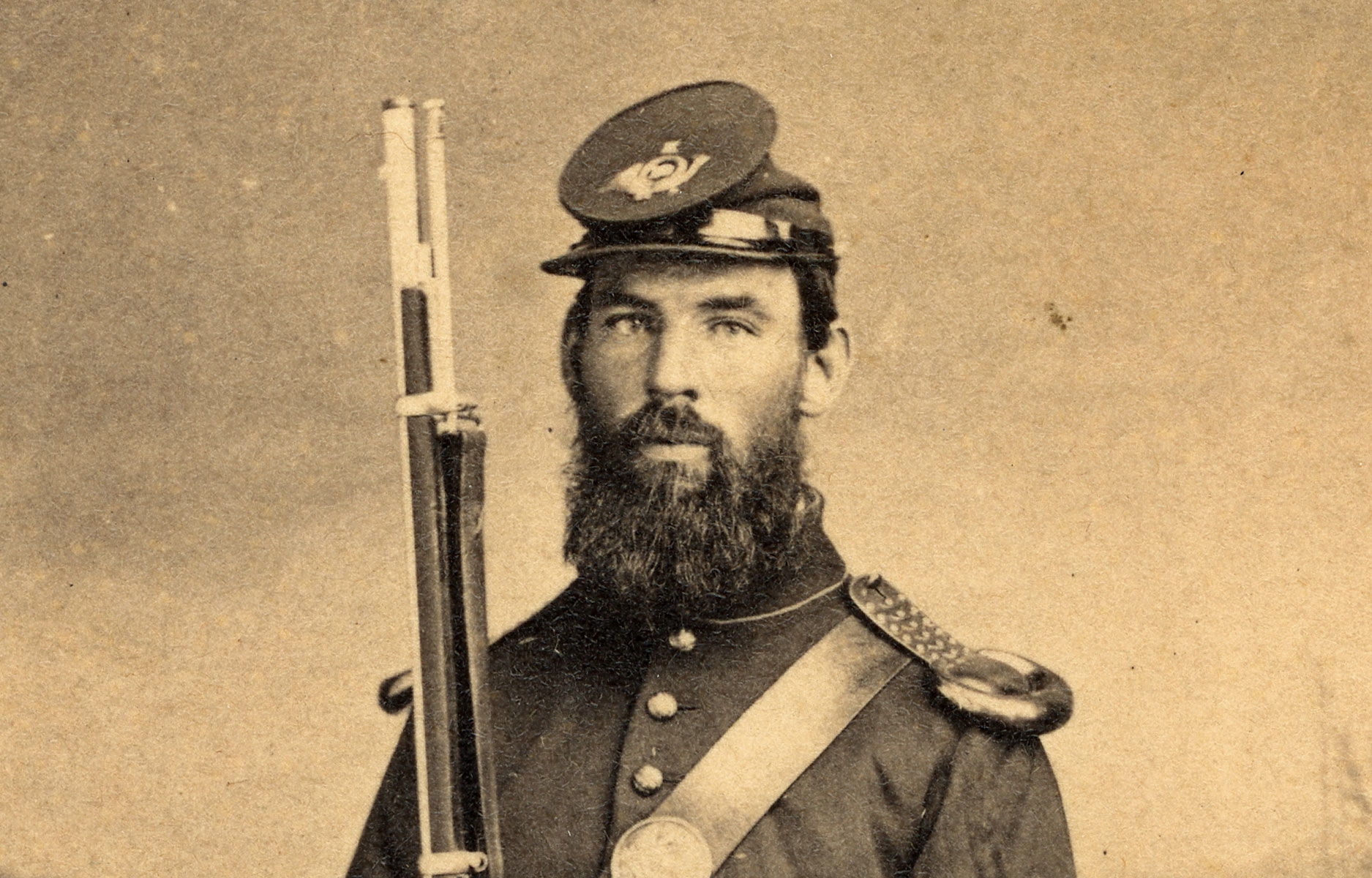
The author explores the origins of the bayonet, its use in combat and how they largely obsolete by the Civil War period. The text is illustrated with seven portraits of Union soldiers, one of which is identified as Daniel D. Diehl of the 88th Indiana Infantry.

The 5th Ohio Cut-Out Badge by David Neville and Ken Turner (pp. 16-17)
An exploration of the five-pointed star symbol of the 12th and 20th Corps badge is illustrated by a portrait of Col. John Halliday Patrick and a group view of 1st Lt. Wilson Gaither, Capt. Krewson Yerkes, 1st Sgt. James Richey and two unidentified soldiers.

Willis Hines Furbush: African-American Photographer, Soldier and Politician by Douglas Wilson (pp. 18-23)
The author explains how the purchase of a carte de visite of an unidentified Ohio soldier with a photographer’s back mark of W.H. Furbish led to a journey of discovery about the life and times of the Willis Hines Furbush (1839-1902). Born a slave in Carroll County, Ky., he was once owned by famed naturalist John J. Audubon. At some point, Furbush gained his freedom and became a photographer. He also served in the 42nd U.S. Colored Infantry. The story is illustrated with a post-war portrait of Furbush and several images of members of the 48th Ohio Infantry, including Lt. Col. Joseph Lindsey, who owned the bookstore in which Furbish’s gallery operated and Corp. Thomas Wissinger. Also pictured is a tintype of an unidentified African-American soldier and a photo of the Smith & Wesson Model No. 3 Russian revolver he carried.

Isaac Fitzgerald Shepard, Brigadier-General U.S. Volunteers (pp. 24-25)
A brief biography of Shepard (1816-1889) is illustrated with five portraits of him in uniform, including one with his wife and daughter.

Roundheads: Corporal Frederick Petit and The Boys of Co. C by Michael Kraus (pp. 26-32)
Raised as the “Roundhead Regiment,” the 100th Pennsylvania Infantry included among its number Frederick Petit. He had his baptism under fire at the Battle of South Mountain and Antietam. He survived these fights and continued on to participate in various engagements. His luck ran out after a sharpshooter killed him in July 1864 along the front lines at Petersburg, Va. Three portraits of Petit illustrate the text. Also included is a selection of images of several members of the regiment: Adj. Samuel G. Leasure, Capt. Thomas Hamilton, 2nd Lt. Isaac W. Cornelius and 1st Sgt. George Fisher, Sgt. Elisha J. Bracken, Sgt. William Smiley and Corp. Phineas Bird, Corp. Samuel Addison White, Pvt. Calvin Stewart, Pvt. Samuel Cleeland and Pvt. Hiram Gill. A selection of Roundhead army corps pins is also pictured.

Uniforms & History by Michael J. McAfee (pp. 33-34)
In “The 44th Regiment, N.Y.S. Volunteer Infantry, “Ellsworth’s Avengers,” McAfee profiles the regiment and describes the uniforms. Portraits of an unidentified infantryman, Pvt. John F. Chase, Pvt. Scott Munson and Color Sgt. James B. Stormes illustrate the text.

Stragglers: Yankees (pp. 35-37)
Selections include two Yanks with fists drawn, Pvt. Oscar W. Stier of the 13th Iowa Infantry, a Union cavalryman with a Colt Model 1851 revolver, Pvt. Franklin Bates of the 3rd New York Light Artillery with a fly on his coat and Jewish soldier Emanuel Lehman of the 127th Pennsylvania Infantry.

Sutler’s Row (pp. 38-39)

 The Last Shot (p. 40)
A sixth-plate tintype from the Jeffery N. Brown collection pictures a Union soldier with a missing arm titled “The Cost of War.”

Finding Aid: September/October 2004

The complete issue

Vol. XXVI, No. 2
(48 pages)


Print edition: Visit our store to check availability
Digital edition: Visit JSTOR.org to purchase
Subscribe to MI
Explore the MI Archives: Browse | Advanced search | Tutorial

Inside

Cover image
A carte de visite by A.J. Riddle of Macon, Ga., pictures an unidentified Confederate captain and his servant. The image is part of the collection of David W. Vaughan.

Table of Contents (p. 1)

Editor’s Desk and Mail Call (pp. 2-3)
The editor welcomes subscribers to the all-Georgia issue and proclaims this one of the best issues of the magazine ever published. He thanks David W. Vaughan for sharing his prized images. Letters include two modern-day photos of the “rocks” along Theodore Roosevelt Island across from Georgetown in the District of Columbia. Subscribers sent the images in response to an image in the May/June 2004 issue of the Georgetown Aqueduct.

Passing in Review (pp. 4-5)
Three books are reviewed and recommended. Journal of War, A Civil War Diary of the Life of William H. Hodgkins, No. 44-Company B, 36th Regiment Massachusetts Volunteers, July 23, 1862 through June 12, 1865 (RDSKS Publishing Company) edited by Robert D. Schoenthal, The Opportunity Is At hand: Oneida County, New York, Colored Soldiers in the Civil War (Schroeder Publications) by Donald Wisnoski and Fort Sam, The Story of Fort Sam Houston, Texas (Maverick Publishing Co.) by Eldon Cagle Jr.

An Introduction to Confederate Faces of Georgia and Interview with David Wynn Vaughan (pp. 6-7)
A brief history of Georgia’s military contributions to the Confederacy and a Q&A with Atlanta, Ga., collector David W. Vaughan marks the beginning of a multi-page presentation featuring images from Vaughan’s impressive collection.

Georgia Generals (p. 8)
Four men are pictured: Maj. Gen. Howell Cobb, Brig. Gen. Hugh Weeden Mercer, Brig. Gen. Edward L. Thomas and Brig. Gen. Edward Dorr Tracy.

Georgia Artillery and the Troup Artillery (pp. 9-10)
A total of 6 portraits include Pvt. George M. Harper of Cutts Battery, 11th Battalion Artillery, also known as the Sumter Flying Artillery, Pvt. Lafayette W. DeTaum of the 9th Battalion Artillery, an unidentified member of the Washington Artillery, 1st Independent Battalion and four members (pictured in three images) from the Troup Artillery: 1st Sgt. George Newton and Pvt. Albert S. Dorsey, Capt. Alexander F. Pope and Maj. Marcellus Stanley.

Georgia Cavalry (pp. 11-12)
Five portraits include Corp. William O. Perry of the Coweta Rangers, Cavalry Battalion Phillips Legion, Lt. Col. William Gaston Delony, Cavalry Battalion, Cobb’s Legion, Pvt. Thomas Byrd of the 1st Cavalry, Surg. Joseph Barnett Carlton of the 2nd Battalion State Troops and the 3rd Cavalry State Guards and Pvt. Thomas Tate of the 4th Cavalry.

Georgia Infantry (pp. 13-23)
The following named soldiers are included in this group of 36 images: 2nd Lt. John L. Ells of the 3rd Infantry, Pvt. David E. Cessar of the 1st Infantry, Pvt. Ashford M. James of the 4th Battalion Infantry, Pvt. Melanathan H. Cutter of the 2nd Battalion Infantry, Pvt. James D. Means of the 5th Infantry Reserves, Lt. Col. William Lewis Salisbury of the 5th Infantry State Guard, Capt. James Allums of the 5th Infantry State Guard, Maj. Philemon Tracy of the 6th Infantry, 2nd Lt. Lawrence C. Berrien of the 1st, 8th and 9th infantries, 1st Corp. William G.G. Raines of the 9th Infantry, Pvt. Thomas G. Wood of the 11th Infantry, Pvt. William D. Purcell of the 9th Battalion and 37th infantries, 2nd Lt. Culver of the 15th Infantry, Sgt. William D. McMickle of the 21st Infantry, Pvt. Ezekial Taylor Bray of the 16th Infantry, Pvt. Curtis Greene of the 21st Infantry, Pvt. Harry Cook of the 23rd Battalion Local Defense Troops, Pvt. Bryant G. Phillips of the 6th State Troops and 32nd Infantry, Pvt. Charles Marion McClain of the 24th Infantry, the Fincher brothers of the 43rd Infantry, Pvt. John L.T. Sawyer of the 45th Infantry, Pvt. William Polk Davis of the 49th Infantry, 5th Sgt. D.T. Carmical of the 4th State Troops and 53rd Infantry, 2nd Lt. George Washington Wood of the 60th Infantry, Capt. Moses Liddel Brown of the 7th and 66th infantries, Asst. QM Cecil C. Hammock of the 66th Infantry, Pvt. Strickland of an unknown regiment, four unidentified infantryman and five men from the 4th Infantry: Lt. Col. David R.E. Winn, Capt. Youel G. Rust, 1st Lt. William C. Wimberly, Pvt. James J. McKinley and Pvt. James Ansley.

Georgians With Fighting Knives (pp. 24-25)
Four portraits, two sixth-plate ambrotypes and two sixth-plate tintypes of soldiers brandishing edged weapons.

Other Georgia Images (pp. 26-28)
Three groupings of portraits, all unidentified soldiers, are included here. “High Fashion” features three images, “Georgia Drummer Boy” is a single portrait found in a Macon, Ga., estate, and “Georgia Cartes de Visite” feature three portraits with Atlanta and Columbus, Ga., back marks.

Georgia Scenes: Andersonville and Atlanta Stereoviews (pp. 29-30)
Five views of the stockade, a burial and graves at Andersonville and four views of the defenses and damage at Atlanta are featured here.

Our Cover Photo (p. 31)
Details of the carte de visite by A.J. Riddle of Macon, Ga., note that this is only one of six known images of a slave dressed in a Confederate uniform.

A Brief History of the Georgia Military Institute and a Study of Its’ Uniform 1851-1864 by David Wynn Vaughan (pp. 32-38)
In Part One, the author provides a history of the Georgia Military Institute, or G.M.I., illustrated with a period oil painting of the campus and a carte de visite of Cadet Lt. Thomas H. Bomar. In Part Two, he examines the cadet uniform that was closely patterned after that worn by cadets at the U.S. Military Academy, illustrated with images of a the only surviving jacket, which is owned by the Alexander H. Stephens State Historic Park near Washington, Ga. The story concludes with five portraits of unidentified G.M.I. cadets.

“Off To War:” Jesse M. Bateman, 9th Georgia Volunteer Infantry by Mike Fitzpatrick (pp. 39-41)
Subtitled “A Georgia lad and his sister experience the war years,” the author describes a recently discovered collection of four ambrotypes, three of a young girl and another of a young man. What follows is an account of Jesse’s military service based upon incomplete and contradictory military service records that ends with his wounding during the Battle of the Wilderness and a likely conclusion that he did not survive the war.

Thomas L. Hernandez: Pilot of the C.S.S. Atlanta by Roger Durham (pp. 42-43)
An unusual carte de visite of Hernandez (1821-1903) clad in what appears to be an ornate smoking jacket and cap illustrated the story of his life from his early days in Florida to his wounding and capture on the Atlanta on June 17, 1863. Captured when the Atlanta fell into enemy hands, Hernandez eventually returned to the navy and served out the rest of the war.

“My Best Dixie Blood:” Lieutenant Pinkney G. Hatchett, Co. E, 20th Georgia Infantry by Brian Boeve (pp. 44-45)
The author tells the story of Hatchett, including his participation in the Battle of Gettysburg and wounding during the fighting at Houck’s Ridge on the afternoon of July 2, 1863. Hatchett survived the war and lived until age 92. The text is illustrated with an ambrotype from the author’s collection.

Georgians: From The Collections of Our Readers (p. 46)
Three images are featured, including Pvt. Joseph P. McCann of the 9th Infantry, a man in civilian attire posed with a double-barrel shotgun and a D-Guard Bowie knife, and a half-plate ambrotype of a soldier who may have been a member of the 1st Infantry.

Sutler’s Row (p. 47)

 The Last Shot (p. 48)
A sixth-plate tintype from the David W. Vaughan collection is a scene of Dug Gap, Ga.

Finding Aid: January/February 2005

The complete issue

Vol. XXVI, No. 4
(40 pages)


Print edition: Visit our store to check availability
Digital edition: Visit JSTOR.org to purchase
Subscribe to MI
Explore the MI Archives: Browse | Advanced search | Tutorial

Inside

Cover image
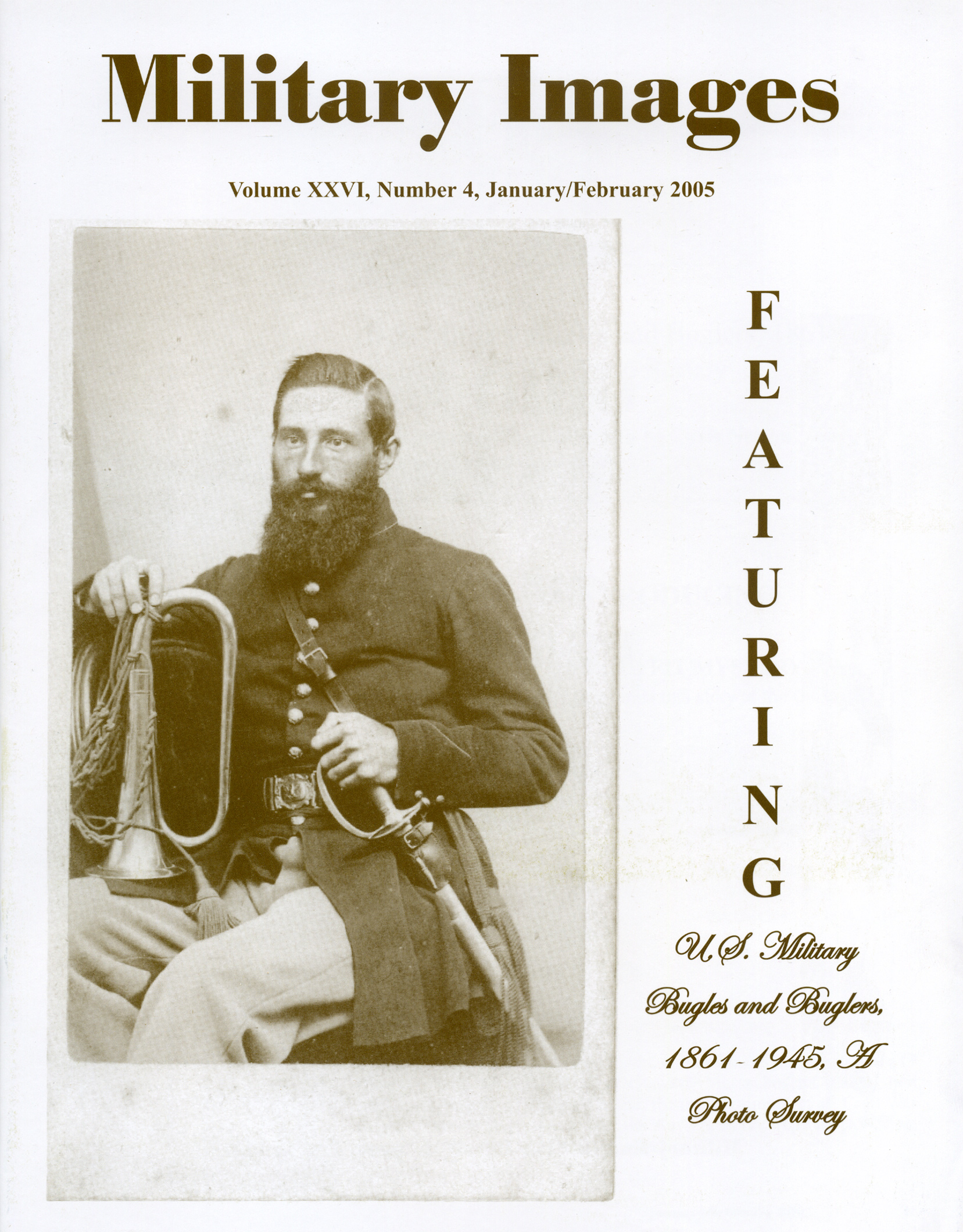
carte de visite from the Chris Nelson collection pictures G.N. Metcalf of the 6th Massachusetts Infantry holding a regulation copper bugle, the most common of all Civil War bugles.

Table of Contents (p. 1)

Editor’s Desk and Mail Call (pp. 2-3)
The editor wishes everyone a Happy New Year and introduces longtime contributing editor Chris Nelson’s collection. Representative images from his holdings compose the six-part feature photo essay in this issue. Also, a new department, The Confederate Soldier, makes it debut. A letter to the editor by Dale Nieson is an announcement that the 1865 negative index book of Nashville, Tenn., photographer Charles C. Giers has surfaced. “If you have in your archive or collection any photographs taken by this photographer in 1865 and the negative number is present on the reverse side, our helpful site visitor has agreed to look up the name of the soldier listed for that number.” Negative numbers range from 3,652 through 6,376.

Passing in Review (pp. 4-5)
Two books are reviewed. The Bowie Knife: Unsheathing an American Legend (Andrew Mowbray Incorporated Publishers) by Norm Flayderman and Brothers One and All, Esprit de Corps in a Civil War Regiment (Louisiana State University Press) by Mark H. Dunkelman.

U.S. Military Bugles and Buglers, A Photo Survey: Part One, The Civil War 1861-1865 by Chris Nelson (pp. 7-15)
A total of 21 images are grouped into three subsections. A group of 13 wartime images show various buglers. Identified portraits include Charles Eastman of the 74th Illinois Infantry and Veteran Reserve Corps, West Point bandsman Louis Bentz, Philip Konkle of the 113th Ohio Infantry and John Washington Payne of the Confederate 2nd Kentucky Infantry. A second group is two are well-known poses of the same bugler published by the U.S. Quartermaster Department. The third group includes six photographs of Grand Army of the Republic buglers.

U.S. Military Bugles and Buglers, A Photo Survey: Part Two, 1866-1897 by Chris Nelson (pp. 16-17)
A total of seven images illustrate the post war and Indian Wars period, which include an albumen photograph of a Rhode Island militia artilleryman, a Utah National Guard cavalryman, Vermont Cadet Corp. Alden Shaw and a group of buglers “taken in front of Bugle Corps headquarters” on Aug. 20, 1887.

U.S. Military Bugles and Buglers, A Photo Survey: Part Three, Spanish–American War 1898 by Chris Nelson (pp. 18-22)
A total of 16 images illustrate this relatively brief conflict. Subjects include the buglers of the 4th Wisconsin Infantry, Carl Cadman of the same regiment with his 1892 field trumpet, Matt B. Pilam of the 4th Tennessee Infantry, James T. Brown of the 1st U.S. Cavalry, a group of soldiers from Company K of the 5th Massachusetts Infantry, New York National Guard buglers and 8th Massachusetts Infantry buglers.

U.S. Military Bugles and Buglers, A Photo Survey: Part Four, 1902-1914 by Chris Nelson (pp. 23-24)
Six photos and a 1905 tobacco card show buglers at rest and in action with their instruments, including one musician at an encampment of the Grand Army of the Republic and groups at Fort Michie and also the Philippines.

U.S. Military Bugles and Buglers, A Photo Survey: Part Five, World War I by Chris Nelson (pp. 25-28)
A total of 15 images include Pvt. Kellus Buchanan with his 1894 model bugle, Fred G. Brown showing off his Model 1892, a Marine bugler, a navy bugler, and early distaff Navy bugler with her Model 1892, buglers in attendance at a double funeral somewhere in France, and a bugler with a giant megaphone at Camp Zachary Taylor in Louisville, Ky., in 1917.

U.S. Military Bugles and Buglers, A Photo Survey: Part Six, World War II by Chris Nelson (p. 29)
Two images include a 1944 Marine Corps file photo of PFC Betty Blue of the Woman’s Reserve and a WAAC bugler at Des Moines, Iowa, with her Model 1892 and giant megaphone.

The Great Scout Outfit Mystery by Jack Ringwalt (pp. 30-36)
The uniform worn by an unidentified cavalryman that appeared in the “Who are these guys” section of the September/October 2003 issue of Military Images happened to be an exact match to one purchased by the author in 1992. This begins the story of how the trooper came to be identified as Pvt. Robert Crispin of the 5th U.S. Cavalry.

Uniforms & History by Michael J. McAfee (p. 37)
In “Seventh Independent Battery, New York Light Artillery, 1861-1865,” McAfee explores the importance of buglers in light artillery batteries. The text is supported by a carte de visite of two buglers tentatively identified to the 7th.

The Confederate Soldier (p. 38)
A sixth-plate ambrotype from the Roy Mantle collection is a portrait of an infantryman dressed in a pleated battle shirt and a Southern-made kepi adorned with a tassel.

Sutler’s Row (p. 39)

The Last Shot (p. 40)
A tintype from the Paul Unangst collection pictures a mid-1870s portrait of a bugler posed with a canine friend.

Finding Aid: January/February 2006

The complete issue

Vol. XXVII, No. 4
(48 pages)


Print edition: Visit our store to check availability
Digital edition: Visit JSTOR.org to purchase
Subscribe to MI
Explore the MI Archives: Browse | Advanced search | Tutorial

Inside

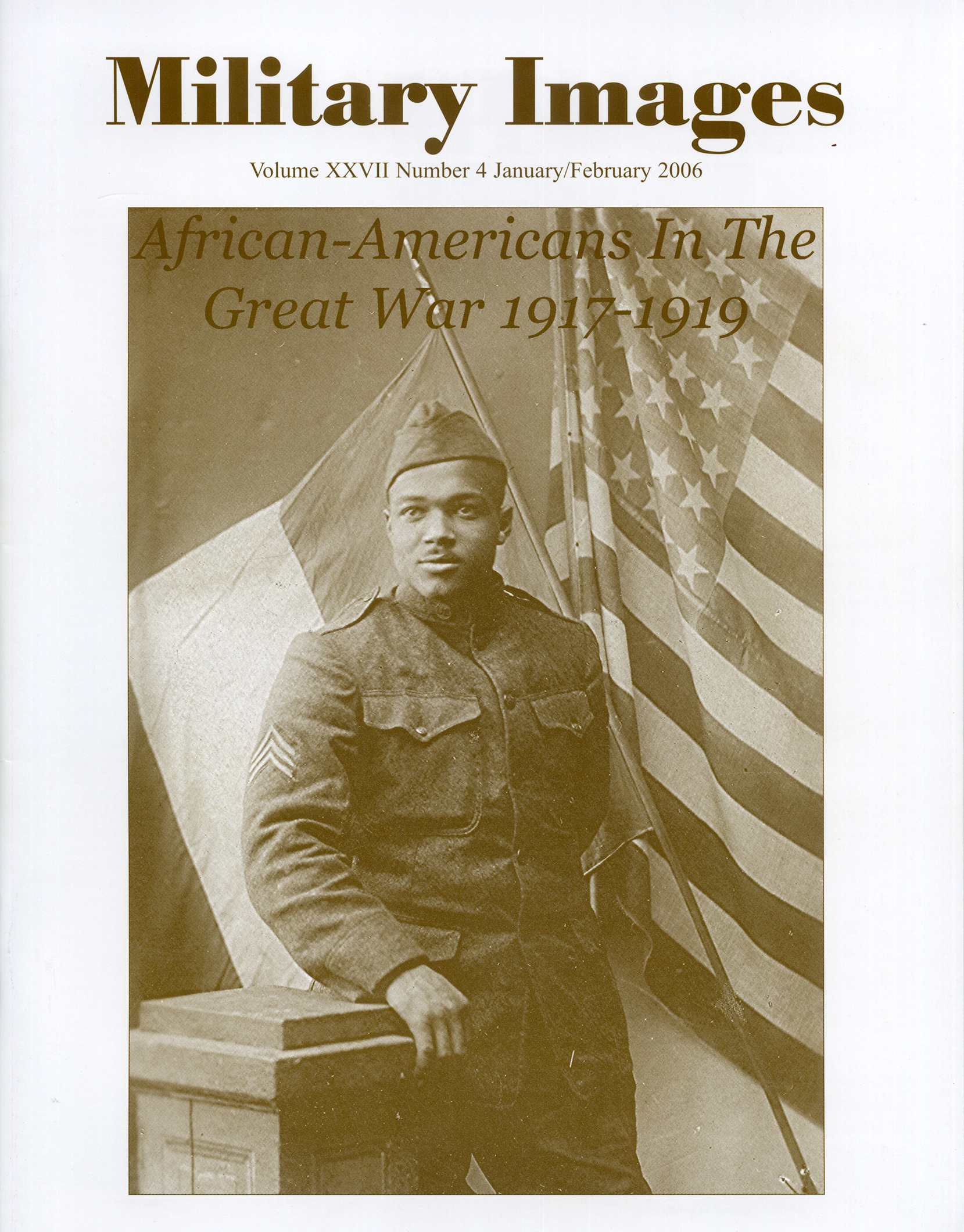
Cover image
A real photo post card from the Bruce Jarvis collection pictures a proud American soldier posed before the Stars and Stripes and the flag of France during World War I.

Inside Cover Image
An image from the Bruce Jarvis collection is a recruiting station that includes a sign that reads, “Colored Men For Infantry, Stevedore Regt., Signal Corps, Engineer Corps.”

Table of Contents (p. 1)

Editor’s Desk (p. 2)
The editor introduces the theme for this issue, African-Americans in the Great War 1917-1919, and notes that all of the images are published here for the first time, with the exception of one photograph—the most comprehensive collection of African American World War I images published in some 87 years.

Introduction to African-Americans in the Great War 1917-1919 by Thomas William Fife (pp. 4-5)
The author notes that this is “The incredible story of the more than 400,000 African Americans who served in World War One.” He explains his interest in collecting images from the period and offers a brief history of the state of American blacks during the Jim Crow era and how the administration of President Woodrow Wilson knew it needed the support of black soldiers even though it was not friendly towards people of color. Also detailed are the divisions and other military organizations composed of African Americans. Four images illustrate the text, including a real photo post card of Martin Gordon of Clinton, Ind.

Men of the 92nd Infantry (Buffalo) Division (p. 10)
A total of seven images of soldiers, including Tom L. McDonald of the 368th Infantry, Lt. Harry Peters of Atlanta, Ga. and Lt. Wesley H. Jamison of the 351st Machine Gun Battalion.

Men of the 93rd Infantry Division (pp. 16-17)
Three images of men and soldiers, all unidentified, illustrate this section.

Jewel Crawford & the 369th U.S. Infantry “Harlem Hell Fighters” (p. 11)
Two images of Jewell Crawford of Company H are pictured, including a portrait in “my yard at home” and another photo of Crawford waving with other soldiers aboard the S.S. Stockholm on Feb. 9, 1919.

The Most Famous Band in the World: James Reese Europe & The Harlem Hellfighters Band, 369th U.S. Infantry (pp. 12-14)
Three outdoor images of the band marching and performing at Aix-Les-Baines includes two well-known figures, James Europe and Noble Sissle.

Command Performance: The “Hell Fighters Band” at Chalons-Sur-Marne, France July 4, 1918 (pp. 15-17)
A series of seven French-made real photo post cards captures the excitement of a concert performed by the famed band on Independence Day

African American Doughboys with the 372nd U.S. Infantry—the “Red Hand” Regiment (pp. 18-19)
Five images include privates George Biggs and George Vernall, Corp. Charles Richardson and friends, and another image of Richardson with Sgt. George Jordan.

“Buffalo Soldiers;” Men of the United States Regular Army (p. 20)
Three portraits include James St. Mitchell of the 24th U.S. Infantry.

African American Officers (p. 21)
Four images, including a group of officers and three portraits, are all unidentified.

African American Pioneer Infantry Regiments, Stevedore Regiments & Labor Battalions (pp. 22-23)
A total of six portraits include men of Company C of the 313th Service Battalion, Company I of the 815th Pioneer Infantry, Leonard Carrol of Carval and Frank S. Clay of the 10th Company of the 302nd Stevedore Regiment, Ollie Davis of Company D of the 331st Labor Battalion and Professor S. Wells of the Headquarters Company of the 803rd Pioneer Infantry.

African American Regimental Bands, Bandsmen & Buglers (pp. 24-25)
A total of five images include the bands of the 803rd and 815th Pioneer infantries and musician George Jefferson.

African Americans in the U.S. Navy (p. 26)
Three unidentified images of sailors is accompanied by a brief sketch of African Americans in the navy.

African American Studio Portraits (pp. 27-31)
A total of 20 images includes privates “Strdr and McWilliams” of the American Expeditionary Force (AEF), Pvt. William R. Johnson, Pvt. William H. Hogsett, Pvt. G.A. Powell, Louis Jones, Thomas Lytle and a man named Davis of the Advanced Sector Service of Supply, Hobart Jones, Sgt. General T. Holman and Sgt. John D. Jones and Charles Brown of Champaign, Ill.

Armed & Ready to Meet the “Boche” (pp. 32-36)
A total of 16 images include mostly unidentified soldiers. Four men are partially identified, Floyd Davis, J.G. Popes, William Grier and Vernon Brinkly.

In the Field At Home and Abroad (pp. 37-46)
A total of 28 images feature an array of portraits and group images. Most of the men are not named. Identified soldiers include Sgt. Hez Everett and Sgt. E.E. Ross.

Sutler’s Row (p. 47)

The Last Shot (p. 48)
An image of a motorcycle dispatch rider on his Harley-Davidson with sidecar is from the John Sickles collection.

Finding Aid: September/October 1988

The complete issue

Vol. X, No. 2
(32 pages)


Print edition: Visit our store to check availability
Digital edition: Visit JSTOR.org to purchase
Subscribe to MI
Explore the MI Archives: Browse | Advanced search | Tutorial

Inside

Cover image
A young Zouave drummer boy is the featured image, taken from a half-plate ambrotype.

Editor’s Desk (p. 1)
The editor discusses the closing of publication of the magazine Incidents of the War. He reminds the readership of Military Images that smaller magazines like these provide a more substantial glimpse into topics and issues and that the continuation of small subject magazines requires the financial support of those who enjoy and read them. The editor also announces a new feature called “Uniforms and History” by Mike McAfee, West Point Museum curator and frequent contributor to Military Images.

Mail Call (p. 3)
Readers send in letters commending the magazine for past issues, contribute observations, and make some corrections. For example, Don Troiani (noted Civil War artist) identifies an image identified as a Confederate in the May/June 1988 issue as a French officer of the line between 1852 and 1867.

Passing in Review (pp. 4-5)
Seven different publications are presented for review by the readership, beginning with Gray Victory by Robert Skimkin, who wrote a novel changing the result of one battle which leads to a change in the end of the war. Next is Flags of the Confederacy: An Illustrated History by Devereaux D. Cannon, Jr. provides background on the development of the colors used by the Confederacy, including those that were eventually not adopted, as well as flags used by different states and major service branches. A Creek Warrior for the Confederacy: the Autobiography of Chief G.W. Grayson, edited by W. David Baird, was originally a family memoir which also provides insight into the Creek engagements in Indian Territory after his posting there as a Confederate officer in 1862. They Fought for the Union by Francis Lord is a reprint of the 1960 Stackpole book that summarized all aspects of the Federal army in a single volume. Next is Danger Beneath the Waves: A History of the Confederate Submarine H.L. Hunley by James E. Kloeppel, which provides some clarity to the myths surrounding the clash between the Hunley and the U.S.S. Housatonic, the first submarine to sink a surface vessel. War So Terrible: Sherman and Atlanta by James Lee McDonough and James Pickett Jones provides interesting analysis on the fighting and the leadership of both sides of this major campaign; the appendix provides insight into Margaret Mitchell’s depiction of the fighting in Atlanta, and the authors agree she did due diligence to the historical record. The edited and translated reprint of We Were the Ninth, prepared by Frederick Trautman, provides insight into the German-speaking 9th Ohio Volunteer Infantry Regiment. It is not a traditional unit history based on official reports, but recollections of many of the men who fought in that unit through the end of their enlistment in 1864, when they decided to return home.

Chasseur, Zouave, Marine: The Incredible Career of John Rapier of Louisiana vignette by David M. Sullivan (pp. 6-7)
John L. Rapier, who enlisted as part of the Louisiana Foot Rifles in April 1861 at the age of 18, had indeed an incredible military career. He began as a chasseur-a-pied, being sent to Richmond after the fighting at First Manassas in September 1861, spending the winter in Fairfax Court House, before moving to the Peninsula and taking part in the fighting at Seven Pines where he was promoted to sergeant major. After being injured at Frayser’s Farm, his unit was reorganized as Coppen’s Zouaves and went on to fight at Second Manassas, Harper’s Ferry, and Sharpsburg; they were renamed the Confederate States Zouave Battalion and Rapier earned a promotion to first lieutenant of Company B. But as the unit went into a defensive position around Richmond, Rapier requested and was given permission to join the Confederate States Marine Corps with the rank of second lieutenant with Company A at Drewry’s Bluff, eventually transferring to Company D, CSMC, at Mobile, Alabama. He was captured when Farragut’s fleet sailed into Mobile Bay, but was able to escape and return to Confederate territory by returning to his family home in Union-held New Orleans. Rapier was given command of the C.S.S. Morgan, which he held until the end of the war.

The Tennessee Bugle Boy: Nathan Dozier of Dibrell’s Brigade vignette by Mike Miner (p. 8)
The images here of Nathan Dozier, Private in the 4th Tennessee Cavalry in a ninth-plate tintype, and George Dibrell, General in the Army of the Tennessee in the only known carte de visite of him in uniform were connected by their paths in war. Originally part of the horse artillery under Nathan Bedford Forrest, by the end of the war, Dozier was bugler for Dibrell and part of the party accompanying President Jefferson Davis in his flight from Richmond.

A Watery Grave at Ball’s Bluff: A Tale of Two Massachusetts Officers vignette by Brian Pohanka (p. 9)
Reinhold Wesselhoeft and Alois Babo were both German-speaking immigrants to the United States, settling in New England. When the Civil War began, 1st Lieutenant Babo and 2nd Wesselhoeft had their images taken in a set of three cartes de visite showing them each individually and one of the two officers together. Both were attached to the 20th Massachusetts Volunteer Infantry, and in October of 1861, found themselves under heavy Rebel fire during the Battle of Ball’s Bluff. Heavy losses of about 150 men included many who drowned; Babo appeared to be shot in the waters of the Potomac and was never recovered, while Wesselhoeft was seen to try and help Babo, his body was recovered downstream a few days later. The inscription on Wesselhoeft’s grave marker in Oak Hill Cemetery includes words to honor his friend who joined him in death.

 What’s Wrong with This Picture? photo analysis by Richard K. Tibbals (pp. 10-13)
Sometimes it’s the way uniforms were distributed. Sometimes it’s the photographer who puts an incorrect era prop in a soldier’s hands to enhance an image. Sometimes it’s an individualist, who is making his own statement by how he wears his uniform. And sometimes it’s total misinterpretation by today’s collectors. The nine images presented here are examples of some of these examples for readers to learn from.

Captain Mathew Nunnaly: Letters from the 11th Georgia Infantry vignette by Keith Bohannon (pp. 14-15)
After having spent about one semester at West Point, Cadet Mat Nunnaly returned home to Monroe, Georgia, taking his place as Captain in the “Walton Infantry” commanded by George T. Anderson. The vignette traces his service from arriving at Strasburg, Virginia, to be part of Jackson’s Army of the Shenandoah, to his writing home to his sister about the devastation he found on the battlefield the day after First Manassas, his unit having missed the battle due to a train accident. Mat was a popular captain, and after falling ill during the first winter of the war in Fairfax Court House, his recovery saw him back with the 11th Georgia in camp at Centreville. They fought their first fight at Dam No. 1, where they remained until called back to Richmond. It was then on to Second Manassas, which Mat missed due to illness, a small role in Fredericksburg as pickets, and then on to the siege of Suffolk, where Mat appeared to attract the ire of General John Bell Hood when his unit retreated under heavy Federal fire. There was no court of enquiry, as the 11th moved out again, towards the second invasion of the North. Captain Mat Nunnaly was killed during the fighting at the Rose Woods and the Wheatfield at Gettysburg, and his remains were brought home to Monroe. The family used an image of Capt. Nunnaly to have a marble monument made; the only difference between the two is the belt buckle, which is of unknown type in the photograph.

Scoundrels from New York and Philadelphia: A Look at New Jersey’s Zouave Regiments unit history by Joseph G. Bilby (pp. 16-24)
Sixteen different photographic images and one engraving accompany this article that traces the two Zouave regiments from New Jersey that had long-term service during the Civil War. The 33rd (Mindill’s Zouaves) and the 35th (Cladek’s Zouaves) were both made up of toughs from New York and Philadelphia who were after the $300 bounty offered before the Federal draft was set in place in New Jersey during the summer and fall of 1863. Competent officers mixed with some hard-to-control troops made for a colorful history of each unit. Both took part in Sherman’s March on Atlanta, with the 33rd coming from XX Corps and the 35th coming from XVI Corps, consistently following Joe Johnston’s Confederates through Georgia, and then taking on John Bell Hood’s soldiers as well. The 33rd New Jersey was one of the first units to enter Savannah, while the 35th New Jersey were sent to Port Royal, South Carolina. The article provides some excerpts from some of the men, giving insight on how these rough men tried to get out of their service, what kind of private property they confiscated on their way from “Atlanta to the Sea,” and how they saw themselves as they marched victorious through the streets of the nation’s capital.

Uniforms and History (p. 25)
This first installment of “Uniforms and History” features the 9th New York Volunteer Infantry (Hawkins’ Zouaves) who served from 1861 to 1863, when they were reorganized as the 17th for the remainder of the war. Like many Zouave units, they were heavily influenced by Elmer Ellsworth’s traveling Zouave Cadets who came to New York in 1860. They did not wear red pants, but narrower blue Zouave pants and sparsely trimmed jackets without tambeaux, as shown in the image that accompanies the article; a detailed description of the Hawkins’ Zouave uniform is provided. Many of their officers had military experience, which gave the unit a favorable edge. They first fought at Forts Hatteras and Clark, Antietam, Fredericksburg, and became the provost guard at Fortress Monroe.

Stragglers (pp. 27-31)
Children dressed in the garb of the Zouave, complete with rifles, in a cabinet card image is one of several different submissions that make up the “Stragglers” feature. Others include a carte de visite that features an excellent view of the M1855 pistol-carbine, two different ninth-plate tintype of Joseph and James Cochrane, brothers who served on the U.S.S. Wabash during the Civil War, as well as two very clear sixth-plate tintypes of unidentified soldiers are some of the other images, including a carte de visite image of a sailor with some Burnside-type sideburns.

Back Image
A fine half-plate tintype of a soldier in the 127th New York Infantry shows he is prepared for winter duty.

Finding Aid: May/June 2006

The complete issue

Vol. XXVII, No. 6
(40 pages)


Print edition: Visit our store to check availability
Digital edition: Visit JSTOR.org to purchase
Subscribe to MI
Explore the MI Archives: Browse | Advanced search | Tutorial

Inside

Cover image
An image from the Roy Mantle collection pictures a youthful federal gunner posed next to a cannon.

Table of Contents (p. 1)

Editor’s Desk and Mail Call (p. 2)
The editor welcomes back to contributors to the pages of the magazine, Donald Bates Sr. and Ted Karle, and shares plans for the remaining issues of the year. A letter from Mike Fitzpatrick suggests that the soldier identified as Elzi Benson on page 34 of the March/April 2006 issue may be Eli Benson of the 7th Georgia Infantry.

Passing in Review (pp. 3-4)
Two books are recommended: Burning Rails As We Pleased: The Civil War Letters of William Garrigues Bentley, 104th Ohio Volunteer Infantry (McFarland & Company), edited by Barbara Bentley Smith and Nina Bentley Baker, and The Civil War In Maryland: An Exhibit of Rare Photographs (Toomey Press), by Ross J. Kelbaugh.

They Were at Gettysburg: Images From the Collection of Donald Bates Sr. (pp. 5-11)
A total of seven identified Union tintypes are pictured, and each includes a sketch of the soldier’s military service. They include Maj. Gardner Walker of the 1st Massachusetts Infantry, 1st Lt. Moses Lyman Jr. of the 15th Vermont Infantry, Col. Elijah Walker of the 4th Maine Infantry, Pvt. Francis Quinn of the 40th New York Infantry, Corp. Henry G. Taylor of the 146th New York Infantry, Sgt. Ezra Brown of the 4th Michigan Infantry and Pvt. William Marshall of the 2nd Massachusetts Infantry,

Three Years with the Eighty-Third Pennsylvania by Theodore J. Karle (pp. 12-13)
William Lawrence hoped for some action when he enlisted in the 83rd Pennsylvania Infantry in 1861. He may have got more than he bargained when he was wounded at the Battle of Gaines’ Mill in June 1862 and again at Little Round Top during the July 1863 Battle of Gettysburg. He survived the war, became successful in business and died in 1919.

Pistol Packers by Mike Fitzpatrick (pp. 14-20)
The author surveys seven guns, each illustrated with a modern photograph of the weapon and a corresponding image of a soldier with a gun of the same make and model. Included is the Colt 1860 Navy and William Henry Harrison Hussey of the 2nd Massachusetts Cavalry, the Colt 1860 Army and a cavalry trooper, the Colt 1851 1st Model and an infantry corporal, the Colt 3rd Model and John Smith of an unidentified regiment likely connect to Leavenworth, Kan., a Whitney 2nd Model Navy and a cavalry trooper, a Remington Beals Army and a Union soldier and an Allen and Wheelock Sidehammer .31 Caliber Belt Model and a federal infantryman.

Shirt Tales by Mike Fitzpatrick (p. 21)
A short history of the army shirt includes basic information about the essential garment. Three portraits of Union soldiers illustrate the text.

“Straight Shooters:” U.S. Army & National Guard Marksmen of the Post Civil War Era 1880-1900 by Donald W. Harpold (pp. 22-27)
A survey of 17 images from the author’s collection begins with an overview that explains, “The last twenty years of the 19th century saw the United States Army and the state National Guard formations place a considerable emphasis on marksmanship. This ushered in an era of shooting competitions pitting the best army marksmen against one another in ‘shoots’ designed to crown the best of the best.” What follows is portraits of some of the marksmen, almost all wearing medals that mark their individual achievements.

Painted Backdrops and More (pp. 28-29)
A survey of seven real photo post cards from the Brent Musser Jr. collection feature a variety of backdrops with soldiers that include Robert C. Shappell, Frank B. Haines, Brice Abner and Herman McGovern.

Uniforms & History by Michael J. McAfee (pp. 30-31)
In the “Boston Light Artillery,” McAfee provides a short history of this artillery unit, also known as Cook’s Battery. The text is illustrated with four images including an 1861 stereoview of the officers and men, a sixth-plate ambrotype of Maj. Asa M. Cook, Ormand F. Sims and Robert L. Sawin.

Stragglers (pp. 32-36)
A total of 8 portraits include Pvt. John T. Ellis of the 2nd Indiana Cavalry, Col. Alexander Pennington of the 3rd New Jersey Cavalry, Capt. Charles S. Reisinger of the 150th Pennsylvania Infantry, a Confederate volunteer with the letters J and G on his cap and an outdoor image that owner Bruce Bonfield believes could be a band of Confederate guerrillas. Also pictured are photos of Pvt. Paul Zink, who served in the 58th Ohio Infantry during the Civil War and his son, Pvt. Charles E. Zink of the 329th Infantry, 83rd Division.

The Confederate Soldier (p. 37)
A sixth-plate ambrotype from the D.W. Owen collection may be one of the five White brothers who served in the 28th, 34th and 55th North Carolina infantries. They were the sons of James and Mary Caroline White of Lincolnton, N.C.

Sutler’s Row (pp. 38-39)

The Last Shot (p. 40)
A cabinet card from the Military Images collection is five views of Capt. Philip Reade, 3rd U.S. Infantry, made about 1893 at the World’s Fair in Chicago, Ill.

Finding Aid: September/October 2006

The complete issue

Vol. XXVIII, No. 2
(40 pages)


Print edition: Visit our store to check availability
Digital edition: Visit JSTOR.org to purchase
Subscribe to MI
Explore the MI Archives: Browse | Advanced search | Tutorial

Inside

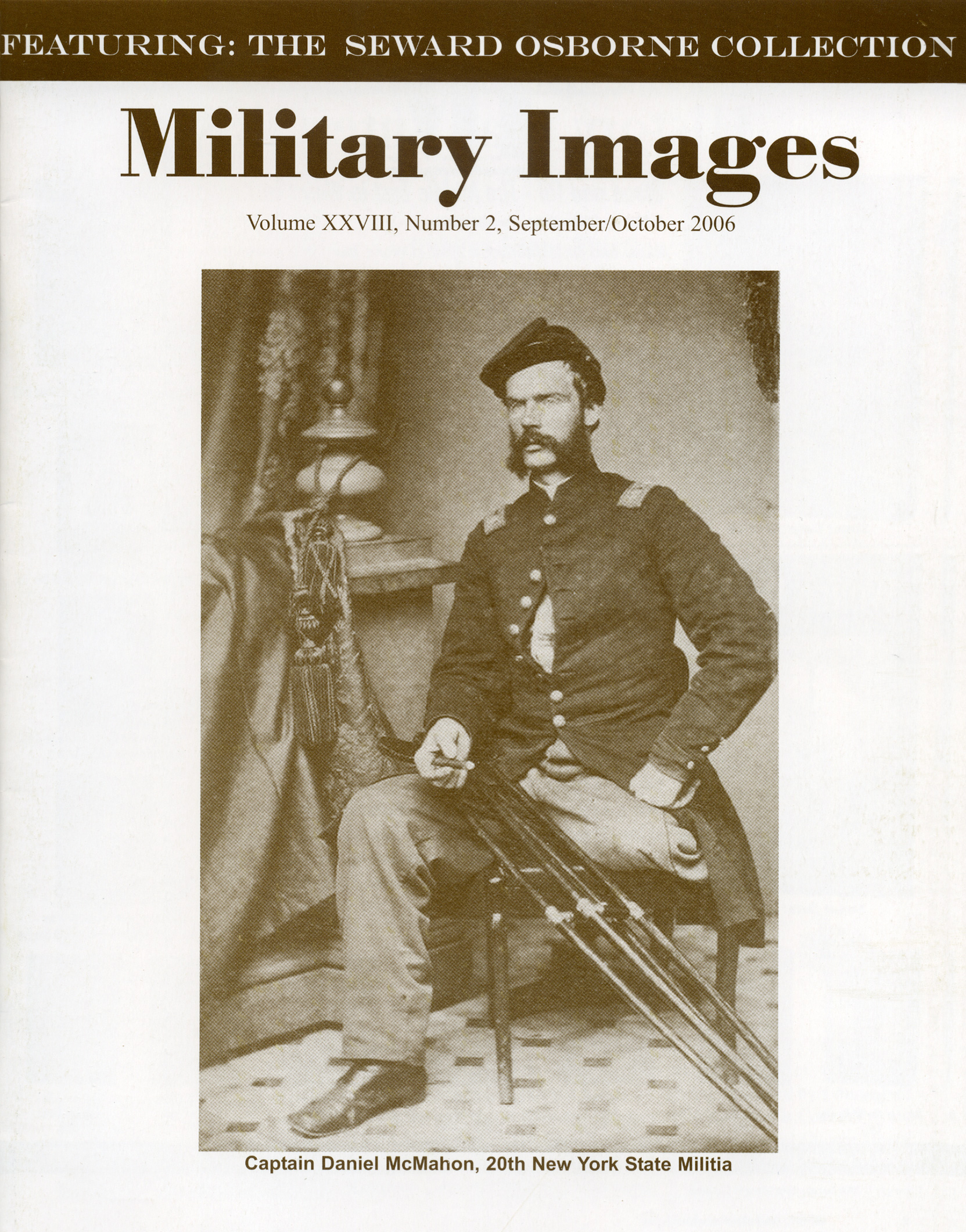
Cover image
carte de visite from the Seward Osborne collection is a portrait of Capt. Daniel McMahon of the 20th New York State Militia. He is posed here minus his left leg, which was amputated as the result of a seriously wound suffered on July 1, 1863, during the Battle of Gettysburg.

Table of Contents (p. 1)

Editor’s Desk (p. 2)
The editor introduces the cover story, a gallery of images from longtime collector and historian Seward Osborne. Also mentioned is Jack Ringwalt, who lost a six-year battle with cancer. The second of Ringwalt’s two-part story about regular army soldier Robert Crispin appears in this issue.

Passing in Review (pp. 3-4)
Two books are recommended: Disgrace at Gettysburg, The Arrest and Court-Martial of Brigadier General Thomas A. Rowley, USA (McFarland & Company, Inc.) by John F. Krumwiede and A History of the 4th Wisconsin Infantry and Cavalry in the Civil War (Savas Beatie LLC) by Michael J. Martin.

Images From The Seward Osborne Collection (pp. 5-21)
The introduction to this gallery of primarily New York soldiers notes, “Seward Osborne’s name is synonymous with fine Civil War photographs. In this photo survey Seward shares with us some gems from his extensive collection.” An interview with Osborne is followed by 57 images. Identified soldiers from the 20th New York State Militia include Hugh Donihuem Nicholas Hoysradt, Thomas Joseph Leahey, John McEntee, Daniel McMahon, James Pierce George Henry Sharpe, Joseph S. Schepmoes, Abram Sharpe Smith, William Vallet and Reuben Van Leuven. Identified soldiers from the 120th New York Infantry include Barnet Bishop, Peter Merritt, Levi Rosa and George Sharpe. Identified soldiers from the 156th New York Infantry include Philip Decker, Johannes Lefavre, Peter LeFavre, Charles Morrison, Jacob Sharpe and Isaac L. Singer. Identified soldiers from other regiments, state and federal military departments include William H. Harris of the U.S. Ordnance Department, U.S. Military Academy Cadet Jared L. Rathbone, New York Quartermaster General and future U.S. President Chester Alan Arthur, New York State Adjutant Gen. John T. Sprague, U.S. Adjutant Gen. Lorenzo Thomas with Brig. Gen. Alexander Asboth and others, Brig. Gen. James Sidney Robinson, Maj. Gen. George Sears Greene, John T. Wilder of the 17th Indiana Mounted Infantry, John S. Rosa of the 2nd Kansas Cavalry, George W. Elwell of the 35th New York Infantry, Joseph Auguste Fontaine of the 55th New York Infantry, William Patton Halsted of the 65th New York Infantry, William H. Male of the 139th New York Infantry, George Young of the 143rd New York Infantry and Frederick Stephen Wallace of the 61st Ohio Infantry. Lastly, Fox, the mascot of the 61st Ohio Infantry, is also included.

Uniforms & History by Michael J. McAfee (pp. 22-25)
In “The Twentieth Regiment, New York State Militia, 1861 ‘Ulster Guard’,” McAfee profiles one of the Empire State’s best-known militia units. The profile is illustrated with two image of the shako worn by members of the regiment and five soldier images, including lieutenants John D. Cook and Charles S. Wilkinson, and Col. George W. Pratt.

Our Scout: The Sequel by Jack Ringwalt (pp. 26-35)
Described as “The final word on one man’s search for the ‘real’ Robert Crispin, the author traces his interest in Crispin back to 1992 and how he engaged individuals along the way to reconstruct the subject’s military service in the West after the Civil War. Ringwalt goes on to record in detail the numerous watershed moments along his journey that include the acquisition of a tomahawk from Crispin’s descendants.

Stragglers (p. 36)
Three identified soldiers include Bugler James P. Campbell of the 1st Oregon Infantry, a post-war image of Col. Richard Henry Pratt when he served as superintendent of the Carlisle Indian School and a post-war image of former Confederate Joseph Wheeler as a Union brigadier general.

The Confederate Soldier (p. 37)
Quarter-plate ambrotype pictures an unidentified Alabama cavalry officer. The provenance of the image is Pell City, Ala.

Sutler’s Row (p. 38)

Back Cover Story (p. 39)

The Last Shot (p. 40)
A hard-plate image from the Roy Mantle collection is a portrait of a Confederate soldier armed with an Enfield rifle, Bowie Knife and revolver.

Back Cover
An albumen photograph from the Seward Osborne collection pictures Pvt. Philip Elmendorf of the 120th New York Infantry, posed with horses that belonged to the regiment’s colonel, George Henry Sharpe.

Finding Aid: November/December 2006

The complete issue

Vol. XXVIII, No. 3
(48 pages)


Print edition: Visit our store to check availability
Digital edition: Visit JSTOR.org to purchase
Subscribe to MI
Explore the MI Archives: Browse | Advanced search | Tutorial

Inside

Cover image
carte de visite from the Steven J. Nitch collection is the earliest known portrait of Capt. Edmund Rice of the 19th Massachusetts Infantry. Rice was awarded the Medal of Honor for Gettysburg, where he was severely wounded during Pickett’s Charge.

Table of Contents (p. 1)

Editor’s Desk (p. 2)
The editor introduces the stories of Lee and Rice in this issue and thanks MI supporters for their continued “interest in the early photographic history of our country’s rich military heritage.”

Passing in Review (p. 3)
Three books are recommended: The Confederate Army 1861-1865, Vol. I, South Carolina and Mississippi (Osprey Publishing) by Ron Field; The Confederate Army 1861-1865, Vol. 3, Louisiana and Texas (Osprey Publishing) by Ron Field and New York State National Guard (Arcadia Publishing) by Anthony Gero and Roger Sturcke.

Visions of Honor: A Special Look at Gettysburg Medal of Honor Recipient Brigadier General Edmund Rice by Steven J. Nitch (pp. 4-30)
The author, who is the general’s great, great, great grandfather, provides a biographical sketch and perhaps the definitive collection of photographs and relics that span Rice’s life and military service. Also included is a contemporary painting by artist Dale Gallon of Rice and his 19th Massachusetts Infantry locked in combat with the 14th Virginia Infantry during Pickett’s Charge at the Battle of Gettysburg.

The Confederate Soldier (p. 31)
A sixth-plate ambrotype from the David W. Vaughan collection pictures Pvt. James B. Nelson of the 6th Tennessee Infantry. Nelson served from May to October 1861.

Uniforms & History by Michael J. McAfee (pp. 32-33)
In “The 19th Regiment Massachusetts Volunteer Infantry,” McAfee profiles a regiment that had a reputation as one of the best in the Army of the Potomac, and details the uniforms worn by this band of brothers. Five cartes de visite from the author’s collection illustrate the text, including George W. Gordon of Company K, William Fletcher Rice of the 19th posed with Capt. Charles Edmund Rice of the 1st Battalion of Massachusetts Cavalry, and Arthur Forrester Devereux posed with John Hodges Jr.

Submarine Skipper: Commander James Parker Jr., U.S.N. by Gordon Harrower (pp. 34-41)
James Parker Jr., might have become one of America’s finest naval leaders during World War II. But a life of uncertainty as a submariner, a troublesome marriage and personal habits took him down a path that ended with his wife filing for divorce and his death in 1935 from what his sister described as a broken heart. The story is illustrated with numerous images of Parker, his wife, and some of the navy vessels upon which he served.

General Robert E. Lee’s 200th Birthday by Wes Cowan and Joe Moran, Cowan’s Auctions, Inc. (pp. 42-44)
Two centuries after his birth, signed photographs of Gen. Lee are prized among collectors, note the authors. A sketch of the life and military service of Lee is illustrated by four images. Three are autographed portraits, two cartes de visite and an albumen photograph. The last image is a post-war albumen of Lee and his generals. All the images were sold by Cowan’s auction with winning bids that range from $6,612 to $19,550.

 Sutler’s Row (p. 46)

Back Cover Story (p. 47)
The background of the image includes a circa 1846 daguerreotype of the same man dressed in civilian clothes.

The Last Shot (p. 48)
At first glance, the two soldiers pictured in a sixth-plate ruby ambrotype from the Ron Field collection might be considered Confederates. They are however federals from the 1st or 2nd New Hampshire infantries.

Back Cover
A selection of war memorabilia that once belonged to Edmund Rice, from the collection of Steven J. Nitch.

Finding Aid: July/August 1988

The complete issue

Vol. X, No. 1
(32 pages)


Print edition: Visit our store to check availability
Digital edition: Visit JSTOR.org to purchase
Subscribe to MI
Explore the MI Archives: Browse | Advanced search | Tutorial

Inside

Cover image
A sixth-plate ambrotype of John A. Tuttle of the “Hibriten Guards” of Company F, 26th Regiment North Carolina Troops, who was killed at Bristoe Station in October 1863.

Editor’s Desk (p. 1)
The editor introduces the tenth year of publication of Military Images, provides a hint of the content of upcoming issues, and discusses his effort to protect the “MonsterMaul” proposed at Manassas by returning his wife’s credit cards with a letter of explanation to the main retailers involved.

Mail Call (p. 3)
Letters of congratulations abound in this edition, with some readers providing bits of additional information about some past images, and with one reader providing a detailed explanation of why the publication resonates with her, such as the personal touches provided by vignettes, letters, and images that show the grit and resolve of the soldiers’ images.

Passing in Review (p. 4)
Six different publications are given rather short reviews; one is given longer treatment, beginning with Gettysburg Battlefield Commanders; A Photographic Guide by Blake Magner and Michael Cavanaugh. Although many people interested in the Civil War are aware of what the major commanders looked like, this book provides images of lesser-known and lower-ranking officers in a format this “illustrated organizational chart.” Catalogue of Civil War Photographers: a Listing of Civil War Photographer’s Imprints was compiled by George F. Witham; this first edition included over 1700 listings of photographers and the backmarks they used in their work organized by name and location. Following editions are anticipated as Witham had collected many more after publication. Next is the lengthier review of Joe Brown’s Army: the Georgia State Line, 1862-1865 by William Harris Bragg. He investigates the contradiction between centralized Confederate government as pursued by Jefferson Davis and the grip on individual states’ rights held by Georgia’s governor Joseph Brown. Bragg’s book tells the story of the military units organized to protect the railroad lines in northern Georgia, known as the Georgia State Line, which provides great detail about the men involved in the units involved. Next is Battle Cry of Freedom, the Civil War Era by James McPherson, which is part of a larger series of ten volumes. McPherson takes all the available assessments of the Civil War and provides insightful and original analysis that needs to be part of every Civil War enthusiast’s collection. Author Walter A. Clark originally wrote Under the Stars and Bars: Service with the Oglethorpe Infantry of Augusta, Georgia in 1900; this reprint is significant as this unit fought with the Army of the Tennessee, not the Army of Northern Virginia. The Civil War Campaign Medal was edited by John M. Carroll, describes the Congressional medal that was authorized in 1907, many years after the end of the war, which might explain why only 554 medals were issued after soldiers would apply. Finally, Custer and His Times: Book Three was edited by G.J.W. Urwin and Roberta Fagan who compiled fifteen articles by academics about Custer and his era, including an extensive bibliography of sources written between 1983 and 1985.

“Tha Kill So meny of us”: the 26th North Carolina Regiment at Gettysburg unit history by Greg Mast (pp. 5-11)
Beginning with a brief background of the 26th North Carolina covering its formation and eventual integration into the brigade of Henry Heth, the article traces the action that involved the regiment during the Battle of Gettysburg. The author uses excerpts from several soldier memoirs as well as nine images of members of the 26th (with short biographies), and one map illustrating the assault by Pettigrew and Brockenbrough on July 1. At the end of the day, the 26th North Carolina Regiment could only muster 216 men. The next day, the band of the regiment played to cheer the remaining soldiers, but on July 3, the 26th was led by Brigadier General J. Johnston Pettigrew as part of Pickett’s Charge. Three officers and 67 “muskets” returned.

The Blue Springs Images photo analysis by Scott Cross (pp. 12-15)
The author ties five different outdoor images showing scenes such as “Division of IV Corps, Blue Springs, Tenn.,” which shows the division of Grose’s Brigade set in order of battle, to a photographer named Sweeney from Cleveland, Tennessee, who was in that area in April, 1864. Images include Companies B and C of the 184th Illinois Infantry and the 9th and 36th Indiana.

The Marine Finds a Mate or, “Ain’t Love Grand” humor by John Stacey (pp. 16-17)
A series of postcards copyrighted in 1909 by Theodor Eismann of New York show the progression of a romance between a Marine and a young lady. Beginning with “The First-Meeting” and ending with “After the Ceremony,” the five cards shown are possibly only part of the tinted series printed in Germany. The cards were addressed to a Miss Ada Y. Miller by J.P.M., but were never mailed.

The Well-Accoutered Soldier: Army Uniforms of the Civil War, Part IX by Michael J. McAfee (pp. 18-24)
Twenty-one different images illustrate the accoutrements required by various types of soldiers in different roles as described in the introduction. Waist belts and shoulder belts that held the cartridge and cap boxes needed to fire weapons, bayonets, side arms, haversacks, knapsacks, and canteens were all among the equipment that frequently was not adequately imaged in total by photographers of the era, unless they happened to be near a camp. Officers had waist belts for their side arms and sabers. The images include the accoutrements required by musicians, including cavalry buglers, and other “quasi-military” groups. Each image includes a caption that highlights unique details and provides identification of the soldier or at least his unit.

History, Photography & the Civil War: a critical bibliography of books for buffs by Book Review Editor Philip Katcher (pp. 25-27)
From the advent of the daguerreotype in 1839, people have invested in having their images reproduced, usually for personal reasons. It was not until much later that the photograph in its many forms became to be considered an important form of primary documentation. When considering the Civil War image, having a reliable source to reference when trying to date or place an image is important for collectors, historians, and others. This article outlines and critiques the several essential volumes that those interested in Civil War photography should consider. Some are more specific (such as Cities Under the Gun: Images of Nashville and Chattanooga by James A. Hoobler) while others attempt to cover the entirety of the era (The Photographic History of the Civil War edited in volumes by Francis T. Miller). This comprehensive bibliography should assist readers in finding the best source of information to meet their needs.

Stragglers (pp. 29-30)
The first page of contributed images focuses on horses: one “riding” his cavalryman, while the other shows a National Guard officer mounted on his steed in about 1881 with his servant rides a donkey. Other images include a “Wide-Awake” boy, who campaigned for Abraham Lincoln in 1860 with a distinctive uniform consisting of rain cape, pole with whale oil lamp and flag, and a small kepi-type cap. Crowds appearing upon the news of Lee’s surrender at Appomattox are shown in a carte de visite by J.B. Hazelton of Montrose, Pennsylvania. One contributor asks for help in identifying garrison troops in his quarter-plate tintype that appears to be of the Civil War era, however the hats worn appear to be from the 1870s.

Back Image
Three different images are presented: two Philadelphians in an albumen print, two first lieutenants from about 1855 in a quarter-plate daguerreotype, and five men in a quarter-plate ruby ambrotype, some in uniform, some not, but all with cigars.

Finding Aid: May/June 1988

The complete issue

Vol. IX, No. 6
(32 pages)


Print edition: Visit our store to check availability
Digital edition: Visit JSTOR.org to purchase
Subscribe to MI
Explore the MI Archives: Browse | Advanced search | Tutorial

Inside

Cover image
The image of “Capt. Sam. J. Richardson” from the Independent Company of Texas Cavalry, complete with jaguar skin trousers with “conchos” (ball buttons) down the seams and matching holsters greets the reader of this issue of Military Images.

Editor’s Desk (p. 1)
The editor introduces the issue as the first “all Confederate” issue of the magazine, thanks to the many submissions of Rebel images by readers of MI. He also warns about another attempt to reduce the Manassas battlefield and encourages readers to contribute to the fund being raised to fight commercial encroachment of the battle site.

Mail Call (p. 3)
Letters to the editor include identifications of soldiers in images from past issues, including more information on Private Edwin F. Jemison, whose image is often used to embody the youth of the soldiery in the Civil War. The collection of images belonging to Michael McAfee in the previous issue is also lauded.

Passing in Review (pp. 4-5)
This issue features five reviews of new publications and alerts readers to recent reprints of older works they may be interested in acquiring. The first review is Forts Henry and Donelson: the Key to the Confederate Heartland by Benjamin Franklin Cooling. The author looks at the battles in their larger context of the whole war, critiques the first losses for the Confederacy as being due to lackluster generalship, and looks at the aftermath of the battles as well. Second is Gettysburg: The Second Day by Harry W. Pfanz. Lauded as a major work, the reviewer’s only complaint is that the book focuses only on the southern portion of the fighting under Longstreet and does not consider any of Ewell’s contributions. However the contribution to understanding of Gettysburg by this work is significant. Third is Judah P. Benjamin, the Jewish Confederate by Eli N. Evans; while the reviewer admits that a biography of Benjamin is a difficult task as he destroyed much of the documentation of his work for the Confederacy and did not write or discuss the war afterwards, he also outlines a number of factual errors that make this biography less than complete. The fourth book reviewed is A Generation on the March: the Union Army at Gettysburg by Edmund J. Raus, who provides a profile of all Federal units, identification of corps, commanders, origin, strength and losses, and the location of the unit monument on the Gettysburg field. The last new publication is entitled Lee’s Tarnished Lieutenant: James Longstreet and His Place in Southern History by William Garrett Piston, who attempts to analyze how Longstreet’s image declined in the years following Lee’s death and why it is unlikely to be resurrected by scholarship. The two reprintings noted are Yankee Blitzkrieg: Wilson’s Raid Through Alabama and Georgia by James Pickett Jones (1976) and Confederate Navy Chief: Stephen R. Mallory by Joseph T. Durkin as part of the “Classics in Maritime History” series published by the University of South Carolina Press.

The Whole World was Full of Smoke: Letters of J.A. Byers, 17th Mississippi Infantry edited by Hartman McIntosh (pp. 6-11)
Born in Alabama, the soldier in the ambrotype is a handsome man with a bit of a blonde cowlick, and a prolific writer of letters, many of which are printed in this feature. Including one copy showing a cross-hatched letter (where paper was saved by writing over again at 90 degrees), Private John Alemeth Byers left for Virginia with his “Panola Vindicators” from Mississippi at the age of 25. The eleven letters he wrote as a member of Company H of the 17th Mississippi Infantry were written to Sister, Father, and Uncle, and trace his journey through the war from First Manassas (when he was too ill to fight), to Balls Bluff, to the Peninsula, where he starts requesting that the family send him Gilbert (a slave) to be a body servant for him. Wounded in the hand at Second Manassas, he writes again during the February after Fredericksburg, and tells the family that he and Gilbert are doing alright in the cold. The next letter is from a year after Gettysburg, where Byers took part in fighting with Barksdale’s Brigade in the Peach Orchard, being left behind severely wounded when the Confederates returned to Virginia; he was eventually sent home on furlough once returned to the Confederacy. He sees Gilbert at this time, who seems to be working on his own as a camp cook. The letters continue from around Petersburg and then on to the Shenandoah Valley, when Byers’ unit is moved in the fall of 1864. His letters provide an interesting glimpse into the life of a Confederate soldier, as he makes comments on people known to his family, requests specific types of clothing in almost each letter, and wishes for food from home as well as more letters. The last letter is from one of his commanding officers, Capt. Jesse C. Wright, who talks about “Almuth” as a valued member of the company and describes his death as quick; his belongings were to be forwarded with Gilbert as “soon as the opportunity presents itself.”

Rebels in Halifax: Rare Images of Confederates in Canada from the collection of Al Fleming (p. 12)
They are not identified, but the men posing before the second Confederate national flag had two cartes de visite with backmarks identifying them as being made by W. Chase in Halifax. They may be escaped prisoners of war or perhaps the St. Alban’s attackers? More information would need to be found to know for certain.

Vignette: Battery Guidon Bearer, Pvt. Louis Sherfesee, Hart’s South Carolina Artillery by John Bigham (pp. 13-14)
Not many guidon bearers, North or South, survived the entirety of the war, but the subject of this vignette is an exception. With the words “Hampton’s Legion” and “Washington Artillery” sewn on it, the banner that Private Sherfesee carried as well as his photographic image from June 1861 are presented along with a brief history of his Civil War record. He was part of Hart’s Battery and described being sent out to attract the fire of Federal troops at Freestone Point on the Potomac. When Hampton’s Legion was broken up, Sherfesee was with Hampton’s cavalry under J.E.B. Stuart; the damage to the guidon was sustained at the cavalry battle at Brandy Station in 1863. His service ended with the Battle of Bentonville in 1865.

Wounded & Captured at Gettysburg: An account by Sgt. William Jones, 50th Georgia Infantry edited by Keith Bohannon (p. 15)
The vignette begins with a description of the wounded soldier arriving at his home plantation, not being recognized by his own mother. Sgt. William Moore Jones was missing a leg and spent four months of incarceration by the Union at Point Lookout. The households of two plantations, his and his uncles, turn out to welcome him home, and after recounting his service at Second Manassas, South Mountain, Antietam, and Chancellorsville, the article begin with the soldier’s own words describing the action of Semmes’ brigade, probably fighting with Kershaw’s South Carolinians on the Second Day at Gettysburg. He describes his original wound, how he insisted on surgeons from his own regiment to be the ones to remove his foot, and the fact that he was captured when it was decided that his portion of the ambulance train on the way to Williamsport would not be able to sustain a crossing of the Potomac. His description of how the Union physician who eventually came to his assistance dealt with gangrenous wounds is horrific but spellbinding, and it was this one dedicated Union surgeon who saved his life. After his exchange, Sgt. Jones was hospitalized at Chimborazo in Richmond before making his way home, arriving in mid-April of 1864.

Soldiers of the Southland compiled by Daniel Brogan (pp. 16-27)
A total of forty different images of Confederates makes up this pictorial article, from a rare antebellum daguerreotype of a South Carolina firefighter to before-and-after-the-war images of the same Confederate officer. Coming from a number of different collectors, this compilation shows the wide variety of men and uniforms that represented the South in the Civil War. One soldier is identified as “E. Cunningham, May 1861, aged 14,” showing some of the youth involved in the war. Another image is of Florida Captain Robert Knickmeyr and his wife, presenting the impact the war had on families as well as the two ambrotypes of Louisiana brothers “Uncle Jimmy Harris” and “Uncle T. Harris” who were both identified as “brothers of Grandma Finley” in the inscription on the reverse. Many of the soldiers are identified, but just as many are not, leaving the reader to wonder about the fates of the men presented in these images.

Vignettes: Five Tarheels by Greg Mast (pp. 28-31)
Each of the images in this feature includes a brief biography of each soldier, only one of which appears to have survived the Civil War. Included are a quarter-plate ambrotype of Pvt. George Washington Lyon (killed July 1, 1863 at Gettysburg), a ninth-plate ambrotype of Pvt. James Wilkerson (killed at Chancellorsville on May 3, 1863), a sixth-plate ambrotype of Pvt. William T. Blanton (died of typhoid fever on June 30, 1862), a ninth-plate ambrotype of possibly Maberry Marvin Miller (paroled at Petersburg on June 26, 1865), and a carte de visite image of Pvt. Robert Jones (died of smallpox on October 20, 1863), the image of which may be a copy of a hard photographic image.

Back Image
A Rebel looks out from under his forage cap in a ninth-plate ambrotype found in Galveston, Texas.