The feature stories and columns you’ll find in our Autumn 2024 issue. Pick up a copy or a subscription in our store.
Autumn 2024 Issue Highlights
Showcase. Interpret. Preserve.
The feature stories and columns you’ll find in our Autumn 2024 issue. Pick up a copy or a subscription in our store.
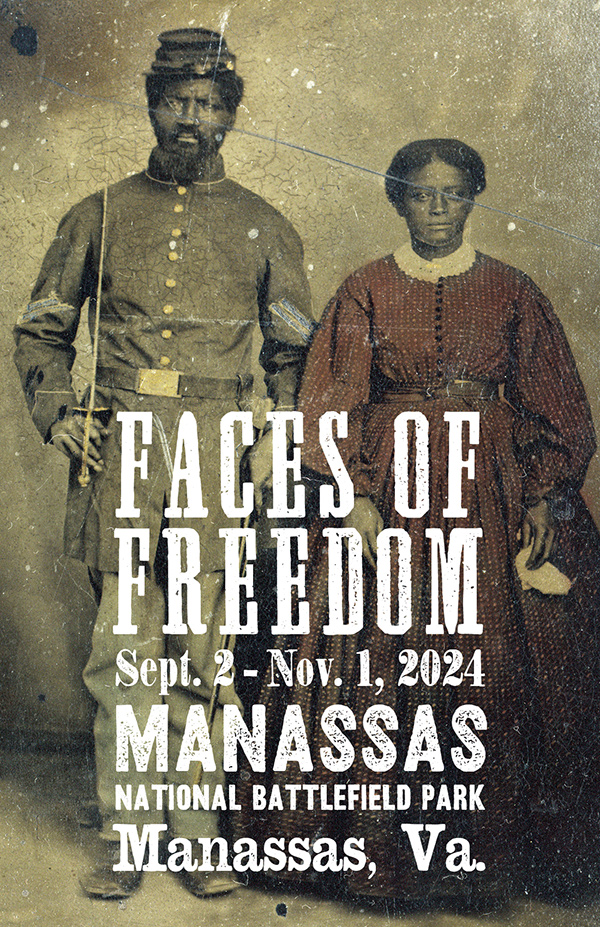
Our traveling exhibit, Faces of Freedom, is coming to Manassas National Military Park. The exhibit will be on display at the Visitor Center from September 2 through November 1, 2024.
Established in 2019, the exhibit first appeared at the Hubbard House Underground Railroad Museum in Ashtabula, Ohio. Covid paused our travels until 2024, when the exhibit moved to the Goodridge Freedom Center and Underground Railroad Museum in York, Pa.
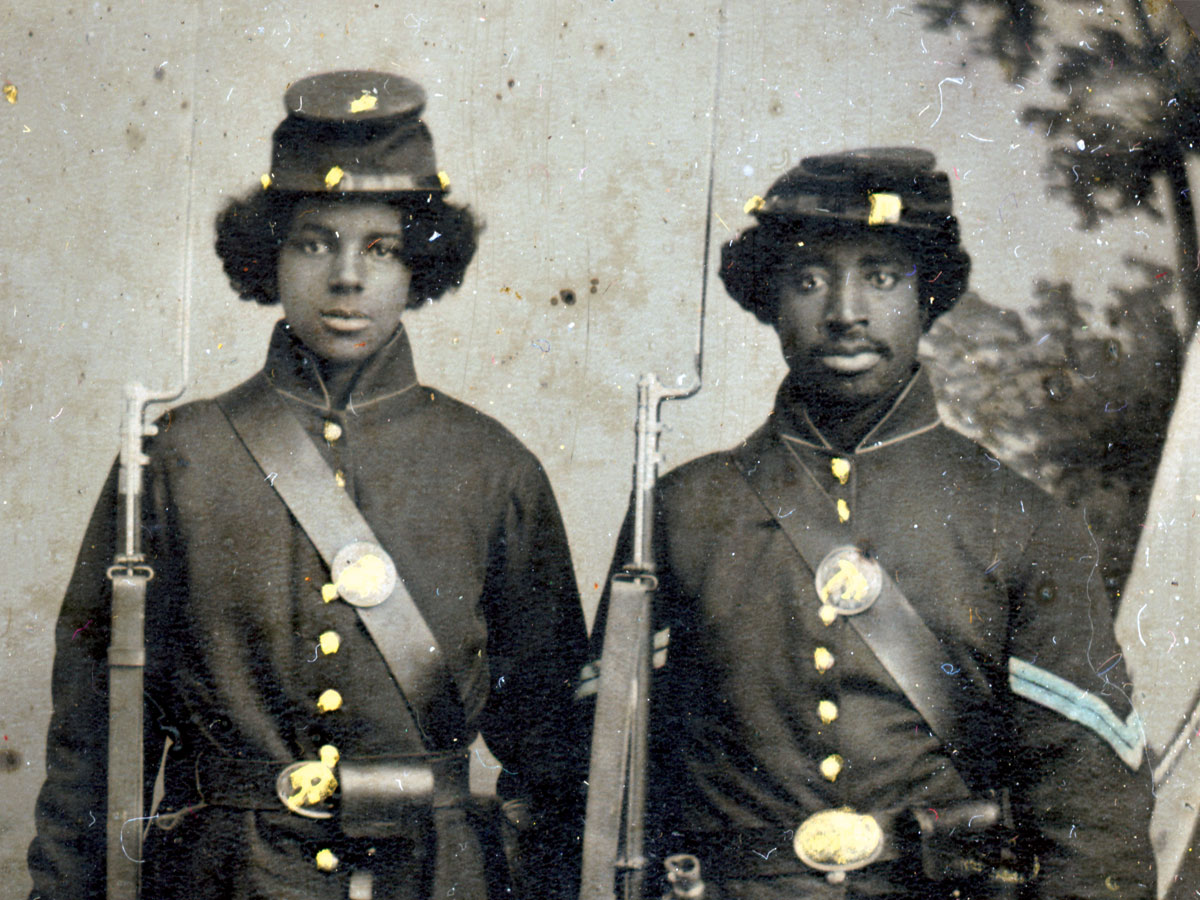
The exhibit features 37 high-quality prints of wartime portraits of Black men who served in the U.S. Colored Troops (USCT) and Navy during the Civil War. Each portrait is accompanied by a biographical sketch detailing their wartime experiences. This is a unique opportunity to honor and learn about these brave individuals, some who sacrificed their lives to make a more perfect union and others who went on to become Buffalo Soldiers.
This exhibit is made possible by Military Images. Editor and Publisher Ron Coddington observes, “This is another wonderful opportunity to share portraits and stories, and our history, with visitors to the hallowed grounds of the First and Second Battles of Bull Run.”
The images are from private collectors and public institutions.
These individuals shared images from their collections for inclusion in this exhibit: Jonathan Beasley, David E. Brown, Kevin Canberg, Glen Cangelosi, Ronald S. Coddington, Greg French, Thomas Harris, Ross Kelbaugh, C. Paul Loane, Steve Meadow, Ronn Palm, and Paul Russinoff.
Images from public institutions include the Beinecke Rare Book and Manuscript Library, Yale University; The Lawrence T. Jones III Collection at DeGloyer Library, Southern Methodist University; Gettysburg National Military Park Museum; Kansas State Historical Society; The Liljenquist Family Collection at the Library of Congress; National Archives; West Virginia and Regional History Collection, West Virginia University Libraries; and the Manuscripts, Archives, and Rare Book Library, Robert W. Woodruff Library, Emory University.
Interested in bringing Faces of Freedom to your location? Fill out this form.

A complete table of contents for the Summer 2024 issue of Military Images magazine, and information about how to purchase single issues and subscriptions.
Vol. XLII, No. 3
(80 pages)
Print edition: Visit our store to check availability
Digital edition: Visit JSTOR.org to purchase
Subscribe or renew your subscription
Explore the MI Archives:
Browse | Advanced search | Tutorial
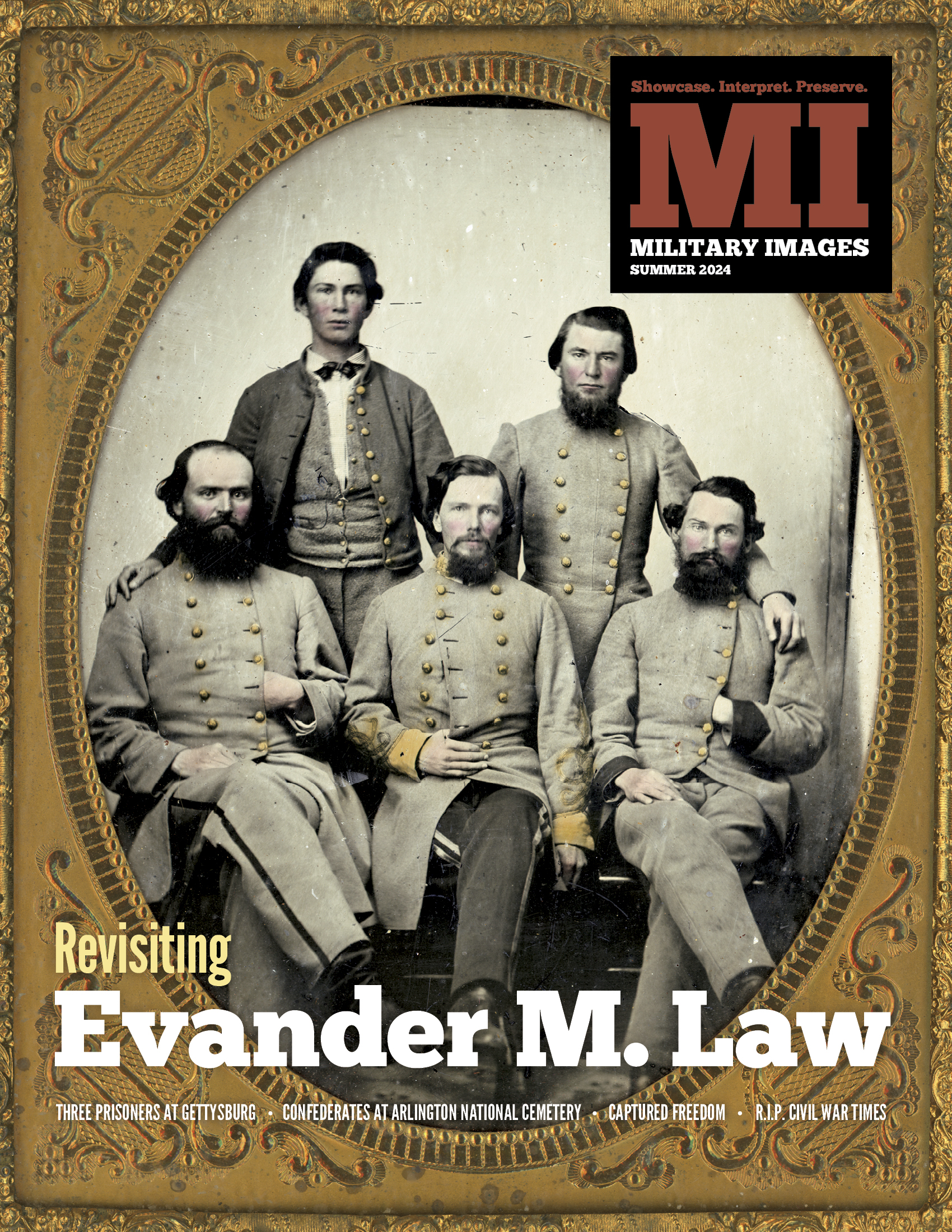
Cover
An ambrotype of Confederate Brig. Gen. Evander M. Law and his military family from the Craig and Carol Wofford Collection.
Table of Contents (p. 1)
Editor’s Desk (p. 2)
Thoughts on the demise of Civil War Times, and introducing Phil Spaugy’s new column, Of Arms and Men: At the intersection of photography and ordnance technology.
Mail Call (pp. 3-4)
Feedback includes the identification of a militiaman and a query about the actual number of Maryland Confederates.
Military Anthropologist (p. 4)
USCT Troops Commissioned and Enlisted during the Civil War, as reported in the 1866 Report of the Provost Marshal General by James B. Fry.
Passing in Review (p. 6)
Book review of Voices of the Army of the Potomac: Personal Reminiscences of Union Veterans (Casemate Publishers) by Vincent L. Burns.
Photo Sleuth by Kurt Luther (pp. 8-11)
The photographer behind the iconic photograph of the USCT drummer boy is identified after previously unknown portraits surface: Oscar F. Douglas.
Antebellum Warriors (p. 12)
Marcus Aurelius Root, renowned Philadelphia photographer, created this portrait of a U.S. Army officer. His name is currently lost in time.
Most Hallowed Ground (p. 14)
In late 1861, the results of the Civil War looked bad for the Union. Then U.S. Navy Capt. Charles Wilkes captured two Confederate enjoys on the way to Europe.
The Honored Few (p. 16)
1st Lt. William R. Parnell of the 1st U.S. Cavalry received the Medal of Honor for rescuing a fellow trooper at White Bird Canyon in Idaho Territory in 1877.
The Citizenry by Elizabeth A. Topping (p. 18)
Ellie Page and Grace Hilton participated in the U.S. Sanitary Commission’s 1864 Albany Army Relief Bazaar to raise money to support Civil War Union soldiers.
Of Arms and Men by Phil Spaugy (pp. 21-22)
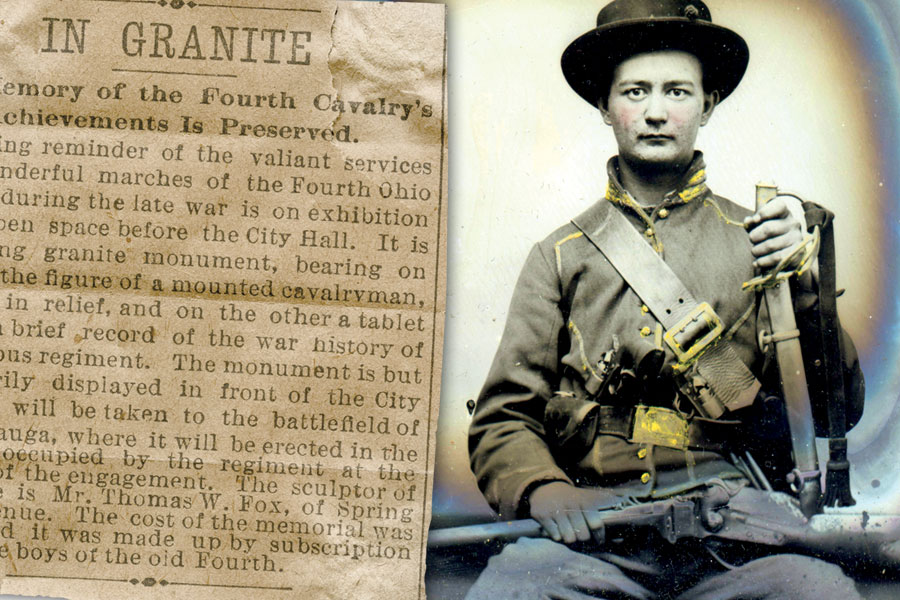
An image of a 4th Ohio cavalryman posed with Colt Army Model 1860 percussion six-shot revolvers and a Model 1859 Sharps percussion carbine with leather sling.
The Little Gamecock by Ronald S. Coddington, with images and artifacts from the Craig and Carol Wofford Collection (pp. 24-36)
The origin story and rise of Evander McIver Law, the Confederate brigadier general who led the assault on Little Round Top during the Battle of Gettysburg.
Three Confederate Prisoners at Gettysburg by Paul Russinoff (pp. 38-42)
A new theory explores the possibility that the three Confederate prisoners who posed for a photo at Gettysburg were nurses who signed the Oath of Allegiance.
Captured Freedom by Steve Procko (pp. 44–51)
An image of escaped Union prisoners and two guides who assisted them along the way has been reproduced and misidentified. Here’s the origin story of the photo.
“Very Affectionately Yours for Our Country” by Jack Hurov (pp. 55-59)
Hospital Steward Nathaniel Bryant Colman of the 17th Maine Infantry cared for wounded soldiers at the Battle of Gettysburg. He went on to be assistant surgeon.
Advocate for Confederate Burials at Arlington: Will Anderson traded West Point for Southern gray, and never surrendered by Paul Russinoff and Jim Quinlan, with images from the Elizabeth Traynor Collection (pp. 62-66)
Will Anderson, son of a U.S. Army officer killed in the Mexican War, resigned from West Point to join the Confederacy. He is buried at Arlington Cemetery.
R.I.P. CWTI: A reflection on Civil War Times magazine by William C. Davis(pp. 68-69)
William C. “Jack” Davis, the longtime editor of Civil War Times Illustrated magazine, reflects on a storied history in the wake of its demise.
Material Culture by Richard M. Milstead, PhD (pp. 70-71)
Investigating a private purchase Infantry Jacket worn by 1st Sgt. Enoch Whittemore, Jr., of the 5th Maine Infantry during the Civil War.
Women of War by Melissa A. Winn (pp. 72-73)
Though Cordelia Harvey served as Wisconsin’s First Lady for only 94 days, she played a key role as a caregiver for the state’s soldiers during the Civil War.
Vignette: Episodes of the Civil War by Scott Valentine (p. 74)
Irish immigrant George M. Wingrove of the 9th New York Cavalry suffered a saber cut and skull fracture during the action at Shepherdstown, Va., in August 1864.
Stragglers (pp. 76-77)
Images of a Confederate casualty at Missionary Ridge, a Union soldier wearing a cockade, a post-mortem of a child holding a photograph of soldiers, and more.
The Last Shot (p. 80)
Captain Henry Warren Smith of the U.S. Army arrested Abraham Lincoln assassination conspirators Mary Surratt and Lewis Powell in 1865.
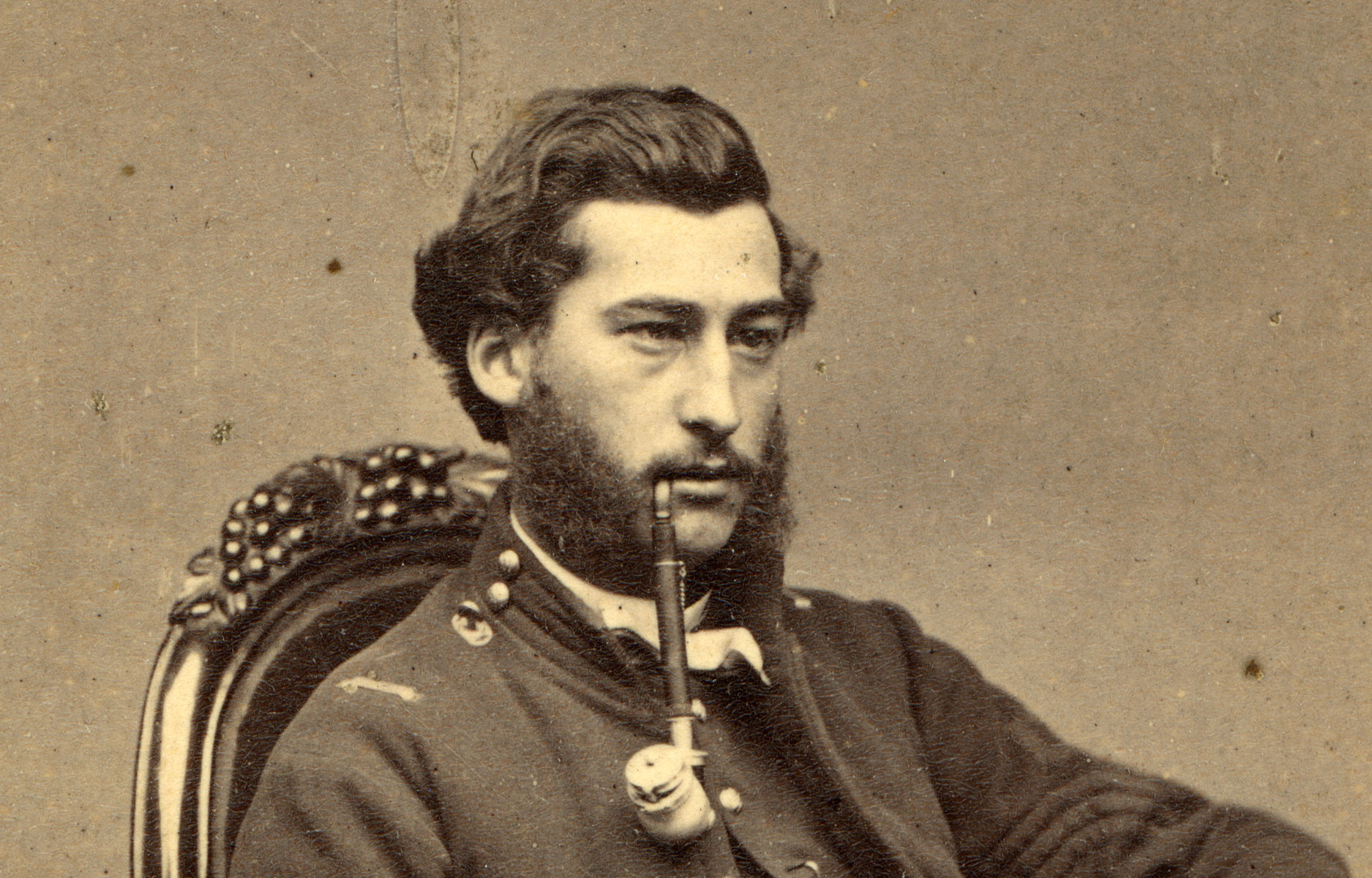
I am thrilled to welcome Phil Spaugy as a Senior Editor and columnist. His inaugural column, “Of Arms and Men: At the intersection of photography and ordnance technology,” debuts in this issue. I’ve known Phil for some years now, and he’s the trusted source I’ve turned to time and again to identify long and side arms in photographs. His knowledge, enthusiasm, and collaborative spirit are infectious. A longtime member of the North-South Skirmish Association (N-SSA), Phil has served in numerous offices, including National Commander and the Board of Directors. He has also been active with the N-SSA’s Union Guards, 19th Indiana Infantry. Phil studies arms and accouterments of federal infantry soldiers with an emphasis on his home state of Ohio, firearms of the U.S Arsenal at Harpers Ferry, and the Iron Brigade.
Phil’s inaugural column, “The Invincible Buckeyes of the 4th Ohio Volunteer Cavalry,” explores a sixth-plate tintype in the Paul Reeder Collection of an unidentified trooper. Phil details the weapons in the portrait and, thanks to a newspaper clipping tucked into the case, connects the image to Huntsville, Ala., where this image may have been taken.
Please join me in welcoming Phil and “Of Arms and Men” to MI.
As an image-driven magazine, we strive to showcase, interpret and preserve unique and compelling Civil War era portraits. We also strive to put these images into context and historical perspective.
With this in mind, I am delighted to announce that two of our stories are finalists for the 2023 Army Historical Foundation Distinguished Writing Awards. They are:
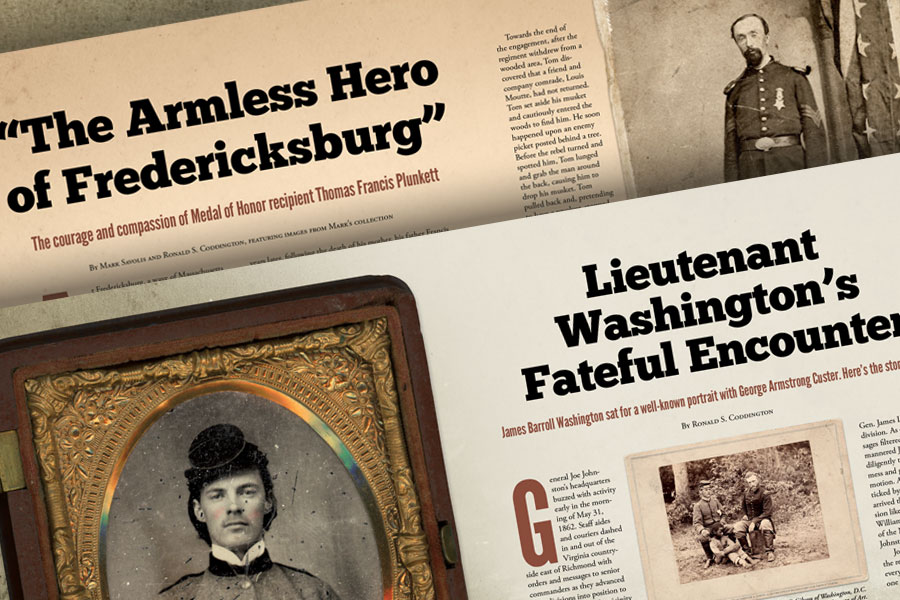
“‘The Armless Hero of Fredericksburg’: The courage and compassion of Medal of Honor recipient Thomas Francis Plunkett,” which features images from the Mark Savolis Collection.

“Lieutenant Washington’s Fateful Encounter: James Barroll Washington sat for a well-known portrait with George Armstrong Custer. Here’s the story behind it.” by Ronald S. Coddington with an image from the Bobby McCoy Collection.

In 2021, we won in our category (Journals and Magazines) for “A Savior of the Capitol,” by Paul Russinoff.
Learn more about the Army Historical Foundation.

A complete table of contents for the Spring 2024 issue of Military Images magazine, and information about how to purchase single issues and subscriptions.

Vol. XLII, No. 2
(80 pages)
Print edition: Visit our store to check availability
Digital edition: Visit JSTOR.org to purchase
Subscribe or renew your subscription
Explore the MI Archives:
Browse | Advanced search | Tutorial
Cover image
An ambrotype from the Liljenquist Family Collection at the Library of Congress features an unidentified Maryland Confederate.
Table of Contents (p. 1)
Editor’s Desk (p. 2)
Introducing a new column, Women of War by Melissa A. Winn, and a new stop (York, Pa.) for our traveling exhibit.
Mail Call (pp. 3-4)
Feedback includes more about Herb Peck Jr.’s stolen collection and praise for the magazine.
Military Anthropologist (p. 4)
When Did We Start Calling It the Civil War? A survey of names for the conflict between 1861 and 1865 on Newspapers.com reveals nomenclature changes over time.
Passing in Review (p. 6)
In Dear Uncles: The Civil War Letters of Arthur McKinstry, a Soldier in the Excelsior Brigade, Rick Barram tells the story of a young reporter-soldier.
Photo Sleuth by Kurt Luther (pp. 8-10)
Sharon Karam posted a question on the Facebook page Civil War Faces about an unnamed cadet photo, which led to a connection to the early days of Virginia Tech.
Antebellum Warriors (p. 12)
Scottish immigrants to the U.S. in the 19th century brought a rich military tradition, as evidenced by the uniform in this circa 1859 portrait of a militiaman.
Most Hallowed Ground (p. 16)
U.S. Army 1st Lt. Rufus Saxton nearly lost his life as he marched captured pro-secession militia through St. Louis. He went on to become a respected general.
The Honored Few (p. 18)
Major General Manning Ferguson Force called for a flag of truce to rally Union troops at the Battle of Atlanta. He got a truce flag instead. He was not happy.
The Citizenry (p. 20)
A circa 1871 photograph of a member of the Ku Klux Klan captured by U.S. law enforcement in Tishomingo County, Mississippi. The men turned state’s evidence.
Divided Maryland: Portraits and stories from the Jonathan Beasley Collection (pp. 23-41)
Representative portraits of the 60,000 Union and 25,000 Confederate soldiers and sailors who served in the U.S. and C.S. military forces during the Civil War.
King’s Knight to King 7 by Ron Maness (pp. 44–51)
Investigating connections between Confederate agent Caleb Huse in Europe, President Jefferson Davis and the James T. Ames Company during the Civil War.
Origins of Invalid Detachments and Invalid Corps by Bret Schweinfurth (pp. 53-55)
A series of War Department general orders issued between March and June 1863 trace the evolution of Invalid Detachments and the Invalid Corps.
Brooklyn Honors Its Boys In Blue: A history of the Brooklyn Service Medal by Richard Leisenring Jr. (pp. 56-60)
Brooklyn, New York, Mayor Alfred M. Wood championed one of the nation’s first service medals for Civil War veterans. The soldiers received the honor in 1866.
For the Sporting Man: A concise history of mail order erotica in the Civil War by Elizabeth A. Topping(pp. 62-65)
Mail order erotica tripled during the Civil War. In 1865 the government passed laws to seize and destroy pornographic photos and other images deemed obscene.
Material Culture by Ron Field (pp. 68-69)
The uniform of the First Light Infantry of Providence, R.I., dates to organization’s 1818 founding. Author Ron Field examines the dress and fatigue uniforms.
Behind the Backdrop by Adam Ochs Fleischer (p. 70)
The Caribbean Plantation Backdrop by Henry G. Pearce of Providence, R.I., features a unique scene that is open to thought-provoking interpretations.
Women of War by Melissa A. Winn (pp. 72-73)
Civil War vivandière Marie Tepe, known as “French Mary,” suffered a wound at the Battle of Fredericksburg and received the Kearney Cross for Chancellorsville.
Vignette: Episodes of the Civil War by Scott Valentine (p. 74)
Captain George Emerson of the 67th Ohio Infantry suffered wounds at Fort Wagner in 1863 and Bermuda Hundred in 1864. The second proved mortal.
Stragglers (p. 76)
Confederate veteran and artist Allen Christian Redwood of the 1st Maryland Cavalry saw much of the Civil War, as reflected in his postwar illustrations.
The Last Shot (p. 80)
A carte de visite of a Veteran Reserve Corps first lieutenant covering the lower part of his face with a book.

I am delighted to announce the debut of a new column: Women of War. It explores the life and service of women who served on the battlefield and homefront with patriotism and dedication equal to their male counterparts.
Taking on this mission is Melissa A. Winn. I’m thrilled to welcome her as a Senior Editor. Many of you are sure to recognize Melissa’s name from her career as a photographer and writer for Civil War Times, America’s Civil War, American History, and other publications. Nowadays, Melissa serves as the marketing manager for American Battlefield Trust, which does so much to preserve hallowed ground across the country. You might not know that Melissa collects Civil War photographs and ephemera with an emphasis on Dead Letter Office images and Maj. Gen. John A. Rawlins. Her passion for the Civil War and photography fuels her writing and research.
Melissa’s inaugural column features a woman who looms large in the telling of the Civil War: Marie “French Mary” Tepe, the vivandière of the 27th and 114th Pennsylvania infantries. Winn observes, “While 19th century social conventions constrained many American women to the homefront or hospitals during the Civil War, French immigrant Marie Tepe would not be obliged. Her feisty spirit drew her to the front lines from its start.” You can read the full column, “Daughter of the Regiment,” here.
Please join me in welcoming Melissa to our team, and Women of War to MI.
Military Images brings Civil War history to communities—one subscription at a time.
The Kenneth J. Bertholf Jr. Civil War History Education Program provides free subscriptions to Military Images magazine for educational use at Civil War battlefields, historic sites, museums, and related institutions across the United States.
What began with 10 pilot locations—including Gettysburg and Vicksburg—has grown steadily thanks to generous supporters. Today, more than 60 sites participate in the program, helping staff and volunteers connect more deeply with the faces and stories of the Civil War through portrait photography.
We are always looking to maintain and expand the success of this program.
Each subscription costs $30 per year, and your your contribution places Military Images magazine into the hands of those on the front lines of public history. To support this program, please visit our store to fund one or more subscriptions.
When the program was first launched, Military Images reached out to loyal subscribers for support. Among the first to answer the call was Kenneth J. Bertholf Jr., a passionate collector of Civil War artifacts, a dedicated student of history, and a generous soul. Ken not only supported the program financially, but also believed deeply in its purpose: to place high-quality visual storytelling into the hands of those sharing Civil War history with the public every day.
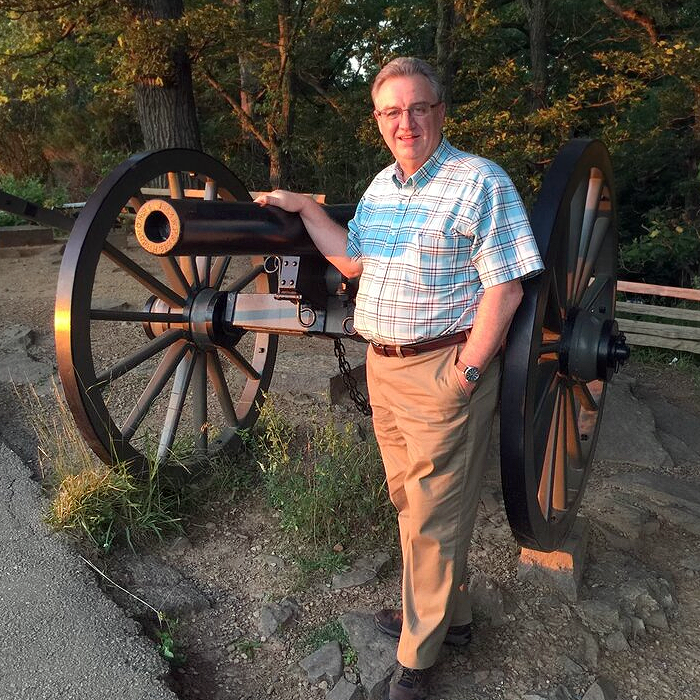
Ken passed away in 2021 at the age of 65, leaving behind his beloved family, two books chronicling the history of his hometown—Blairstown, New Jersey—and a community of friends who admired his kindness and unwavering commitment to preserving the past.
At his memorial service, his friend Paul Denver shared a moment that speaks to Ken’s commitment and support:
“The latest issue of Military Images was prominently displayed next to pictures of his beloved collection. After the funeral, Don Carter and I spoke with his wife, Bonnie, who told us that she placed that same issue in Ken’s casket for his journey home.”
This deeply moving gesture affirmed what Ken stood for—and why this program matters. To honor his legacy, we proudly named the initiative the Kenneth J. Bertholf Jr. Civil War History Education Program.
Your donation is not just a contribution—it’s an investment in historical education. It helps museum staff, park rangers, volunteers, and educators explore the personal side of Civil War history and share it with the public in meaningful ways.
Thank you for considering a gift to this important cause.
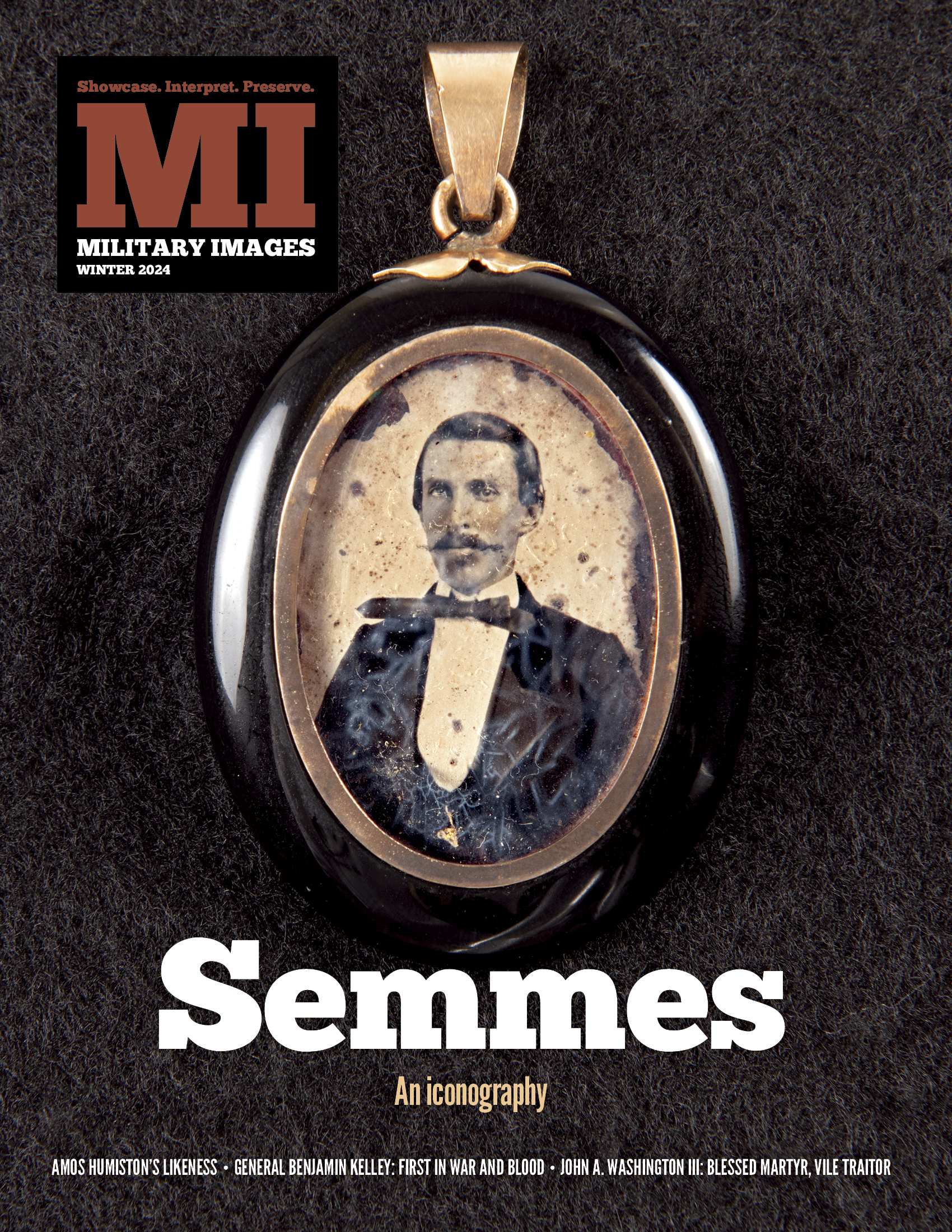
A complete table of contents for the Winter 2024 issue of Military Images magazine, and information about how to purchase single issues and subscriptions.
Vol. XLII, No. 1
(80 pages)
Print edition: Visit our store to check availability
Digital edition: Visit JSTOR.org to purchase
Subscribe or renew your subscription
Explore the MI Archives:
Browse | Advanced search | Tutorial
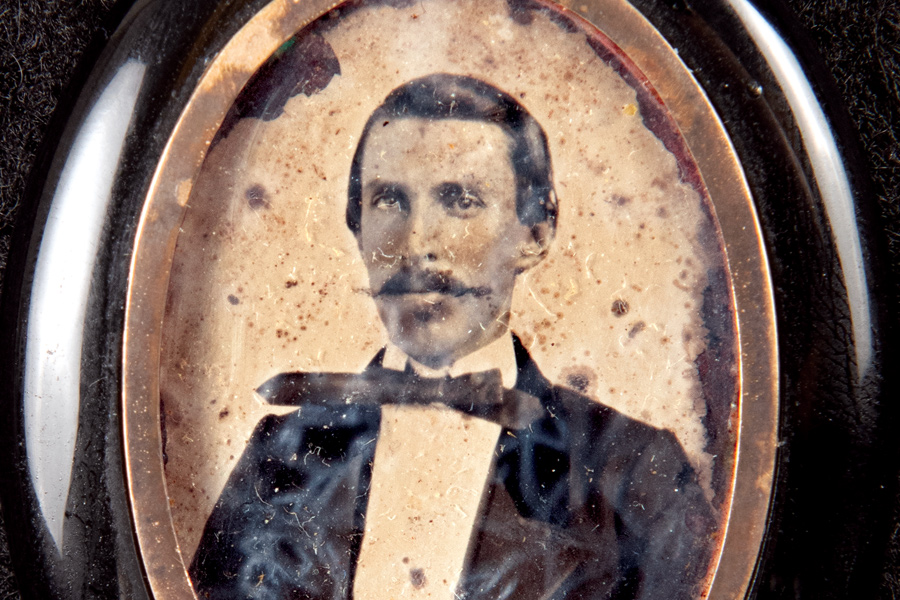
Cover image
An ambrotype from the History Center of Mobile, Ala, pictures Raphael Semmes, circa 1854.
Table of Contents (p. 1)
Editor’s Desk (p. 2)
An update about the status of Herb Peck Jr.’s stolen collection from Bruce Jackson, the Peck Family agent and spokesperson.
Mail Call (pp. 3-4)
Feedback includes praise for the story about Herb Peck Jr.’s stolen collection.
Military Anthropologist (p. 4)
Since 1979, we’ve published 6,094 identified portraits of Union soldiers and sailors.
Passing in Review (pp. 6)
A book review of The Greatest Escape by Douglas Miller, published by Lyons Press.
Photo Sleuth by Kurt Luther (pp. 8-10)
A unusual backdrop painting of a broken cannon wheel with the name CULLY’s on it leads to South Carolina and the 33rd U.S. Colored Infantry.
Antebellum Warriors (p. 12)
A man dressed in civilian clothes wears military cross-belts consistent in style with Mexican War volunteers.
Most Hallowed Ground (p. 14)
John Lincoln Clem—Johnny Clem—is well known to students of the Civil War. An 1864 carte de visite portrait him includes an interview printed on the back.
The Honored Few (p. 16)
Brigadier General Alexander Shaler received the Medal of Honor for gallantry at the Second Battle of Fredericksburg for his charge at Marye’s Heights.
The Citizenry (p. 18)
On the back of a carte de visite portrait of an unidentified woman is a list of all the places this image traveled during the war—25 stops from Rhode Island to Georgia.
Semmes: An iconography of Rear Admiral Raphael Semmes, C.S. Navy by Cliff Krainik (pp. 20-34)
Feared by the North and beloved by the South as a commercial raider, labeled a pirate in the press, and twice a best-selling author, this is Semmes’ life in images.
The Likeness of Amos Humiston by Mark H. Dunkelman and Megan Kelley (pp. 36-39)
Two keepers of the history of Amos Humiston of the 154th New York Infantry and the children of the battlefield of Gettysburg are their perspectives.
First in War, First in Blood: Benjamin Franklin Kelley, West Virginia’s first military commander by Richard A. Wolfe (pp. 40-49)
Union Brig. Gen. Benjamin F. Kelley is remembered for his 1861 victory and his 1865 capture by partisan rangers. Here’s what happened in between.
Blessed Martyr, Vile Traitor: John Augustine Washington III, Mount Vernon’s last family owner and aide to Gen. Robert E. Lee by Ronald S. Coddington(pp. 52-62)
Forced with expensive upkeep and dwindling revenue, John A. Washington III sold Mount Vernon just before the Civil War and went on to join the Confederate army.
Material Culture by Mark Elrod (p. 64)
A look at early U.S. Model 1855 Harpers Ferry Rifles carried by Charles Smedberg of the 7th New York National Guard, and brother William of the National Rifles.
Behind the Backdrop by Adam Ochs Fleischer (pp. 66-69)
A tintype of Pennsylvania photographer William Kunstman posed with his unique background that includes a real cannonball is part of his story.
Stragglers (p. 72)
Two portraits of identified Confederates, one from Texas and another from Tennessee.
Vignette: Episodes of the Civil War by Scott Valentine (p. 74)
Captain Francis R. Leeds raised a company that became part of the 28th Connecticut Infantry. Eager to fight but sick with typhoid, he died before seeing action.
The Last Shot (p. 80)
A carte de visite of a sergeant of the 108th U.S. Colored Infantry holding the Stars and Stripes.
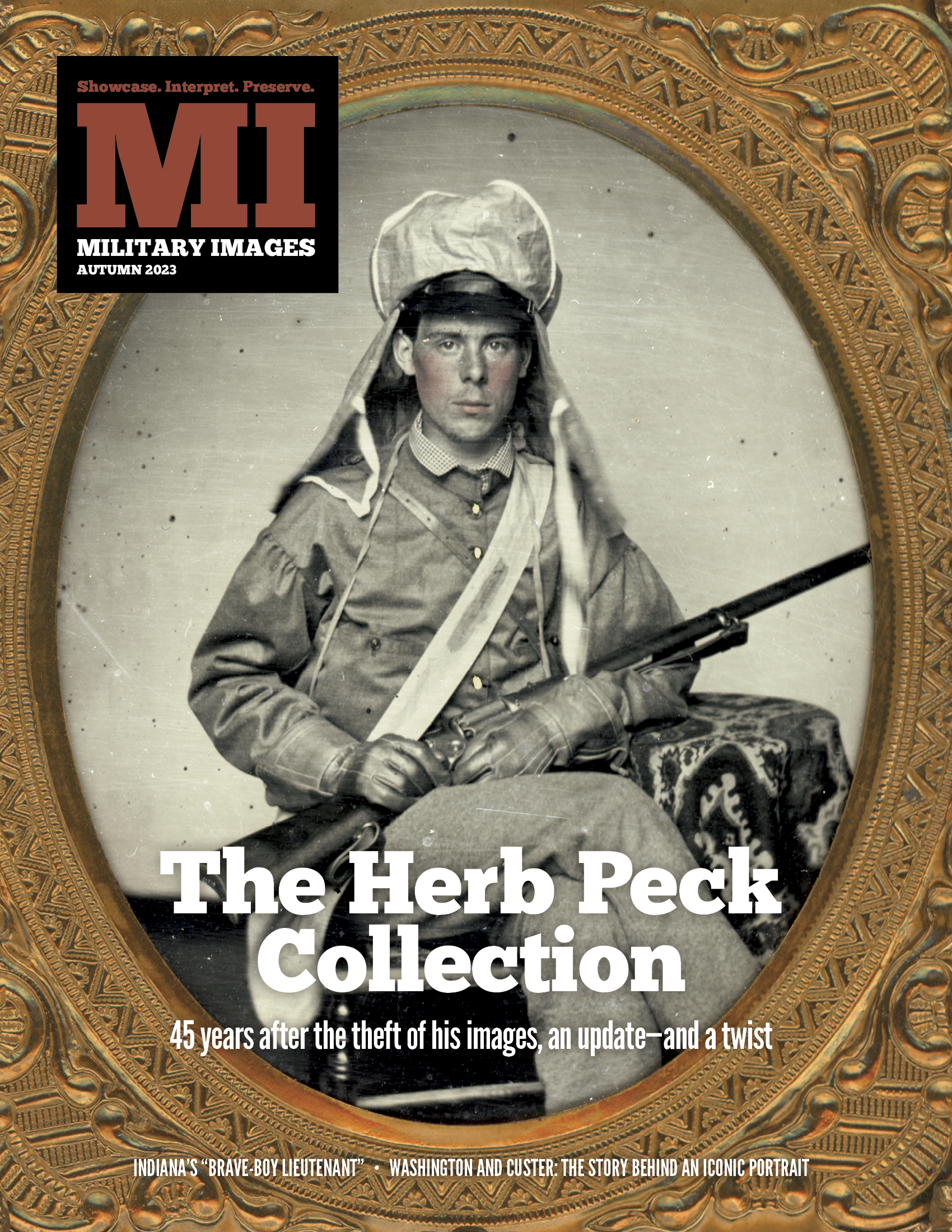
A complete table of contents for the Autumn 2023 issue of Military Images magazine, and information about how to purchase single issues and subscriptions.
Vol. XLII, No. 4
(80 pages)
Print edition: Visit our store to check availability
Digital edition: Visit JSTOR.org to purchase
Subscribe or renew your subscription
Explore the MI Archives:
Browse | Advanced search | Tutorial
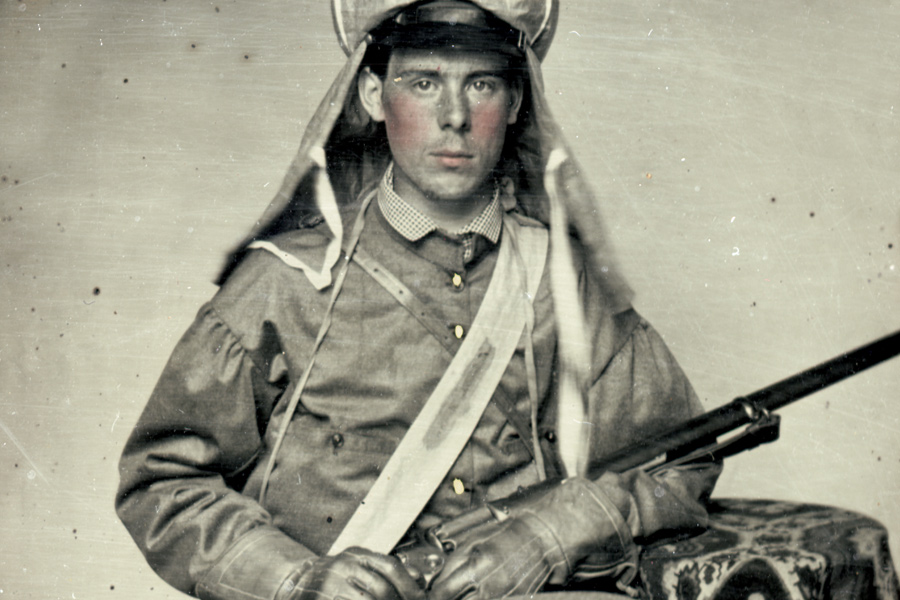
Cover image
A sixth-plate ambrotype from the late Herb Peck Jr. Collection pictures a Confederate soldier.
Table of Contents (p. 1)
Editor’s Desk (p. 2)
Announcing a new online resource of identified soldier, sailor, and other wartime images that have been published in Military Images magazine since 1979.
Mail Call (pp. 3-4)
Feedback includes praise for the “Jeff. Davis and the South!” Story in the last issue, identifying a field grade Iowa officer, and more.
Military Anthropologist (p. 4)
Since 1979, we’ve published 1,770 identified portraits of Confederate soldiers and sailors.
Passing in Review (p. 6)
A review of Groundbreakers: The History of the Northern Virginia Relic Hunters Association by Stephen W. Sylvia and Nancy Dearing Rossbacher.
Photo Sleuth by Kurt Luther (pp. 8-10)
Finding a portrait of 1st Lt. Presley Oldham Craig, the namesake of Fort Craig, one in a ring of 68 defensive forts surrounding wartime Washington, D.C.
Antebellum Warriors (p. 12)
A militia company lines up along a road in front of a house in Angelica, N.Y.
Most Hallowed Ground (p. 14)
Captain Sanford Cobb Kellogg served as an aide on the staff of his uncle, Maj. Gen. George H. Thomas.
The Honored Few (p. 16)
Francis Edwin “Frank” Brownell received the Medal of Honor for his role in the death of Col. Elmer E. Ellsworth of the 11th New York Infantry.
The Citizenry by Elizabeth A. Topping (p. 18)
Civil War era portraits of individuals posed with empty chairs memorialize the sitter. The empty chair evokes sorrow from viewers.
Fakes, Forgeries and Frauds by Perry M. Frohne(p. 20)
In this case study, Perry uses a blacklight to reveal a modern forgery of an Abraham Lincoln carte de visite.
Searching for Herb Peck’s Images: 45 years after the theft of his pre-eminent collection, an update—and a new call to action by Ronald S. Coddington (pp. 22-37)
In 1978, a break-in at collector Herb Peck’s Nashville home ended with the loss of prize images. The case went cold, then heated up. Here’s the latest.
Lieutenant Washington’s Fateful Encounter: James Barroll Washington sat for a well-known portrait with George Armstrong Custer. Here’s the story behind it. By Ronald S. Coddington (pp. 40-49)
The story behind one of the most recognizable images of the Civil War: Lieutenants George Armstrong Custer, James Barroll Washington, and an enslaved child.
“The Brave Boy-Lieutenant”: First Lieutenant and Aide De Camp Frank N. Sheets by Brendan C. Hamilton (pp. 52-55)
Frank N. Sheets of the 29th Indiana Infantry proved a model aide to Brig. Gen. Richard W. Johnson until his death at the Battle of Chickamauga.
How to Live Your Best Life: A Civil War Veteran’s Advice to the Future by Ronald S. Coddington, featuring artifacts from the Eleanor Laughlin Family Papers (pp. 56-58)
Months before his death in 1920, Civil War veteran Capt. Henry Haymond wrote a poignant letter of advice to his young great-grandson.
“Hard Cases”: Distinguished European soldiers who did not become U.S. generals by Frank Jastrzembski (pp. 60-64)
This trio of military men—Garibaldi, Klapka, and Zerman—were high on the list for Union generals. But they did not get commissions. Here’s why.
Q&A with Rick Carlile: On Obsessive Collecting Genes, Passion for CDVs, and More (pp. 66-68)
Longtime contributor Rick Carlile shares his origin story as a collector of books, baseball cards, and Civil War photographs. It’s in the genes!
Material Culture by Anthony F. Gero (pp. 70-71)
The distinctive California militia uniform of 1864-1865 featured blue cuffs and collars.
Stragglers (pp. 72-75)
Portraits include a Pennsylvania Bucktail, soldiers and civilians at recruiting headquarters in Philadelphia, and a Confederate lieutenant.
Vignette: Episodes of the Civil War by Scott Valentine (p. 76)
Assistant Surgeon Benjamin Walter Carpenter served in the 2nd and 9th Vermont infantries, and also as chief medical officer at Camp Douglas in Chicago.
The Last Shot (p. 80)
A half-plate ambrotype picturing Company D of the 2nd Tennessee Cavalry (U.S.) posed outdoors with a variety of weapons.