Clean-Shaven Young Infantryman

viper-gallery

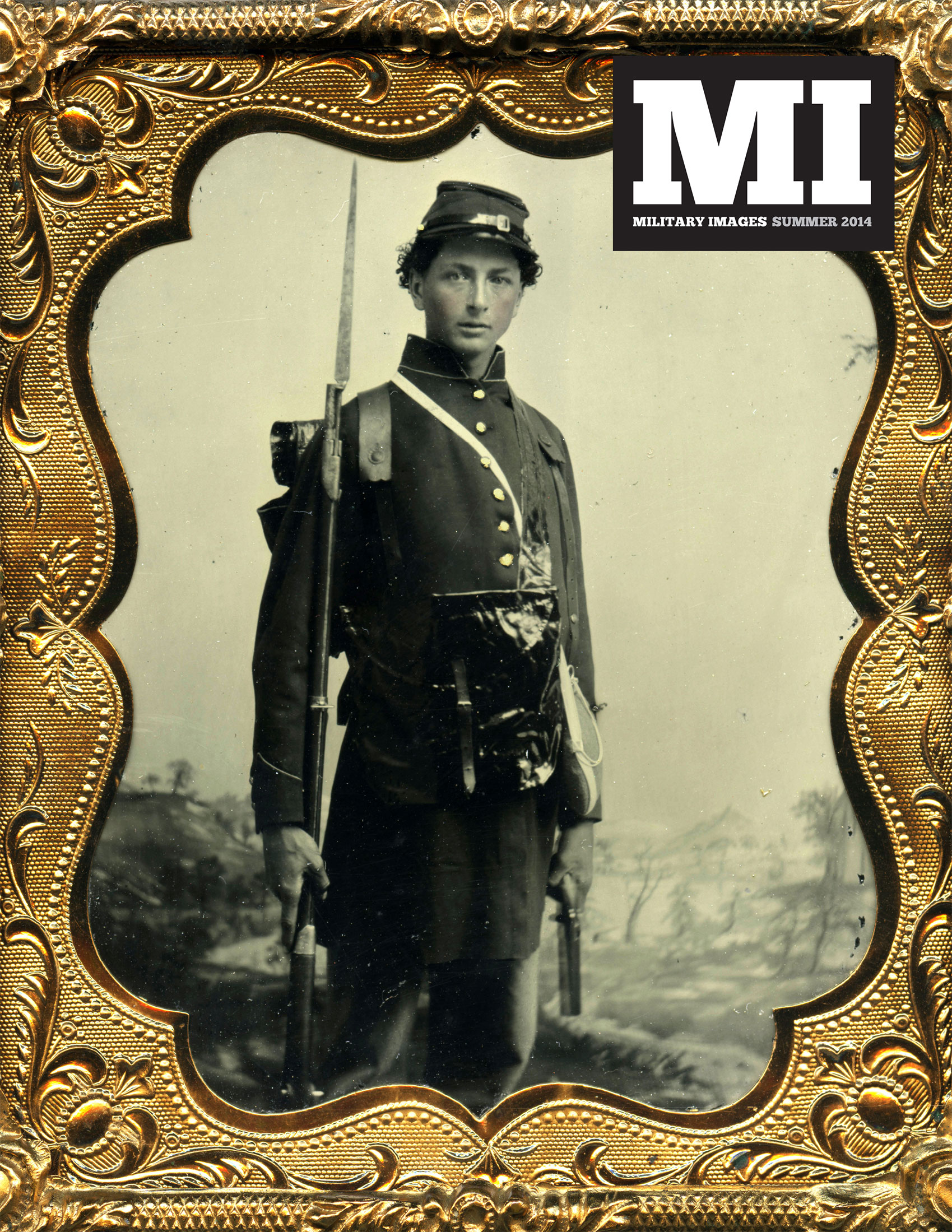
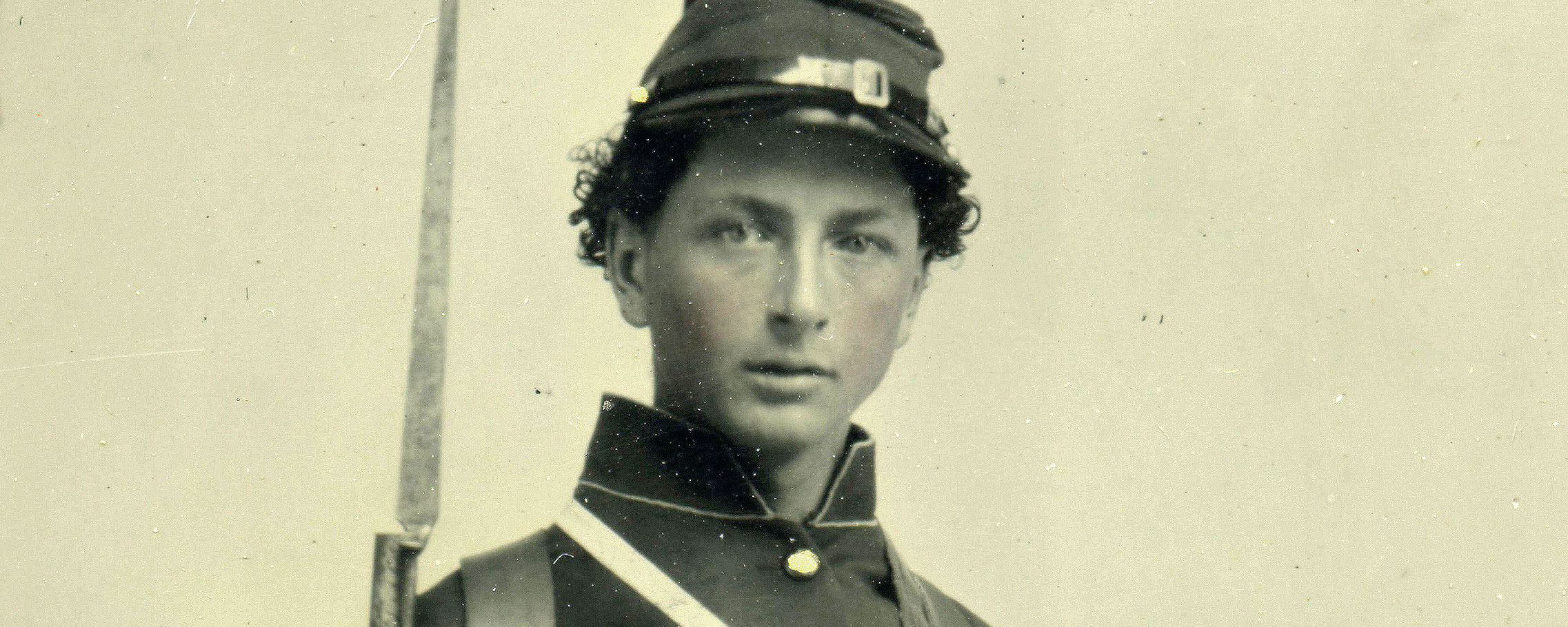
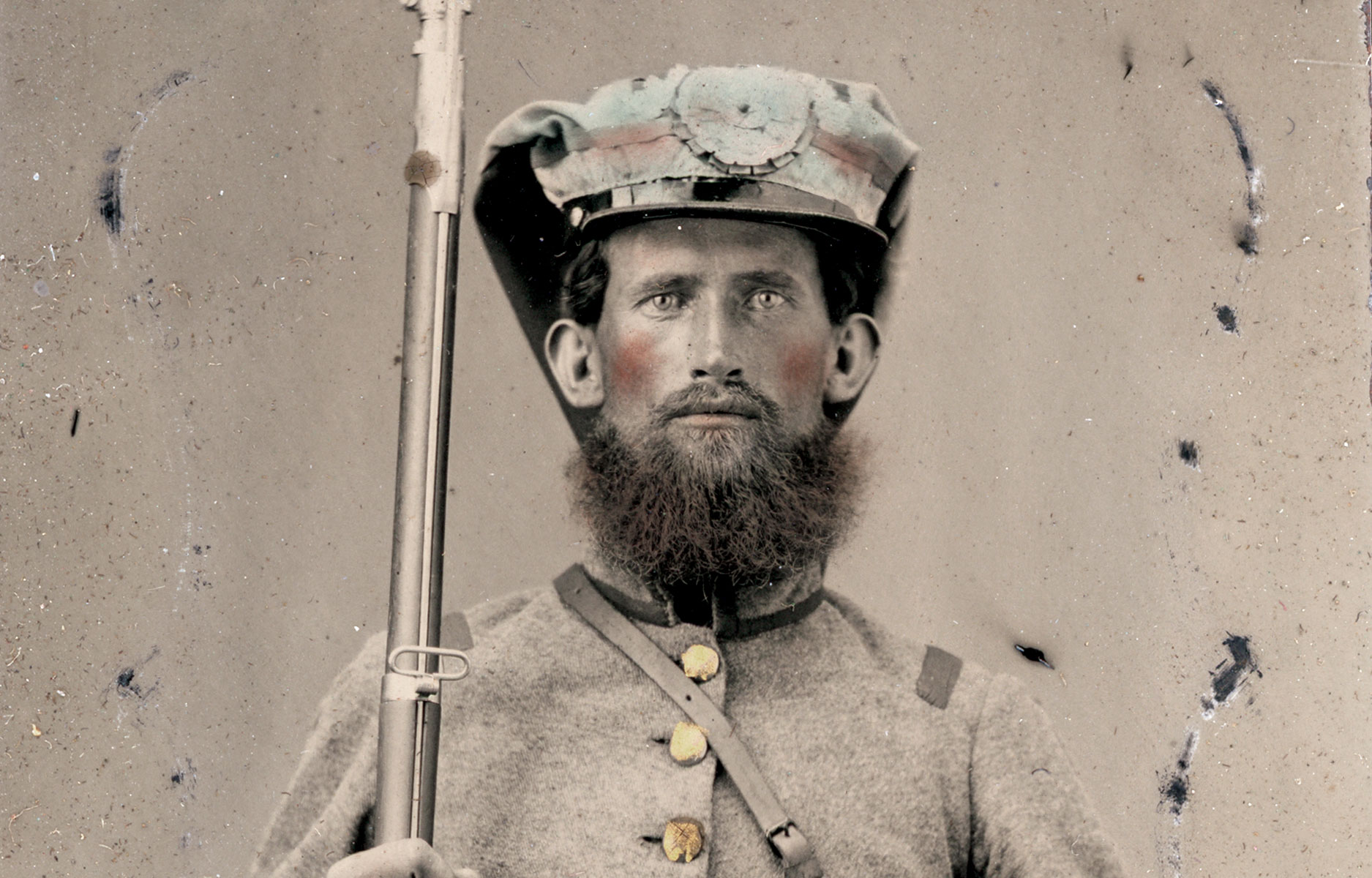
A clean-shaven young infantryman is equipped with all the trappings of war. He holds a Model 1816 conversion musket with fixed bayonet in one hand, and grips a single shot percussion pistol in the other. A regulation rubberized canvas backpack with russet leather straps and bedroll is strapped to his back, and hanging from his neck is a black-painted leather haversack and drum canteen. “What’s really striking is the backdrop: A very subtle, low-lying landscape that makes the soldier appear as if he’s marching in high country,” owner Matt Cranford declares. Sixth-plate ruby glass ambrotype by an anonymous photographer.

Summer 2014 Cover From the Matt Cranford Collection

Delighted to share the cover image for the summer issue of MI, which will be mailed next week. This sixth-plate ruby glass ambrotype by an anonymous photographer is from the exquisite collection of Matt Cranford. Representative images from his holdings are highlighted in a feature gallery.

mi-cover-32-3-summer-2014

Here’s the caption that accompanies the cover image:
A clean-shaven young infantryman is equipped with all the trappings of war. He holds a Model 1816 conversion musket with fixed bayonet in one hand, and grips a single shot percussion pistol in the other. A regulation rubberized canvas backpack with russet leather straps and bedroll is strapped to his back, and hanging from his neck is a black-painted leather haversack and drum canteen. “What’s really striking is the backdrop: A very subtle, low-lying landscape that makes the soldier appear as if he’s marching in high country,” Cranford declares.

A Cavalryman and His Lady

viper-gallery

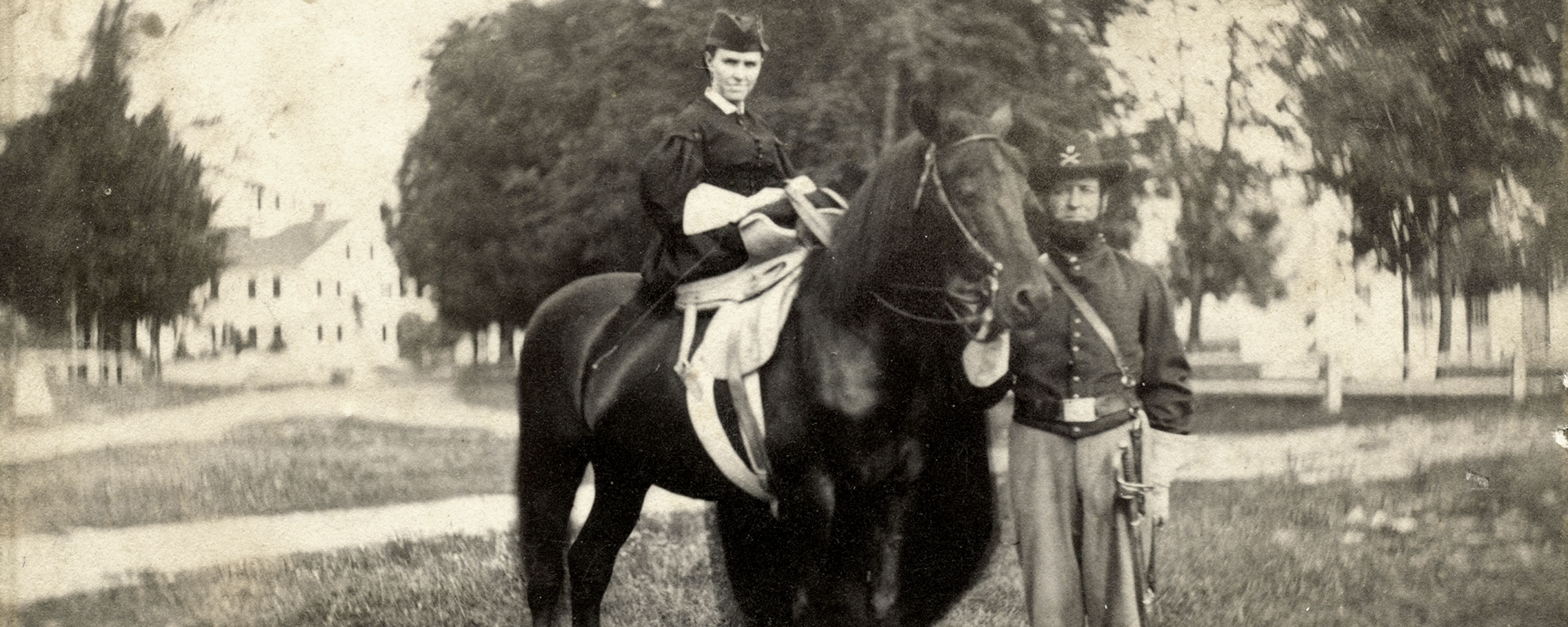
A Union cavalryman holds the bridle of a horse, upon which a lady is seated sidesaddle. Dirt roads leading to a building with a cupola and another structure are visible in the background. The trees are covered in leaves, which suggests this photograph was taken in the summer. Carte de visite by unidentified photographer, about 1862-1864.


Finding Aid: May/June 1985

1985-v6-06-vi-cover

The complete issue

Vol. VI, No. 6
(32 pages)


Print edition: Visit our store to check availability
Digital edition: Visit JSTOR.org to purchase
Subscribe to MI
Explore the MI Archives: Browse | Advanced search | Tutorial

Inside

Cover image
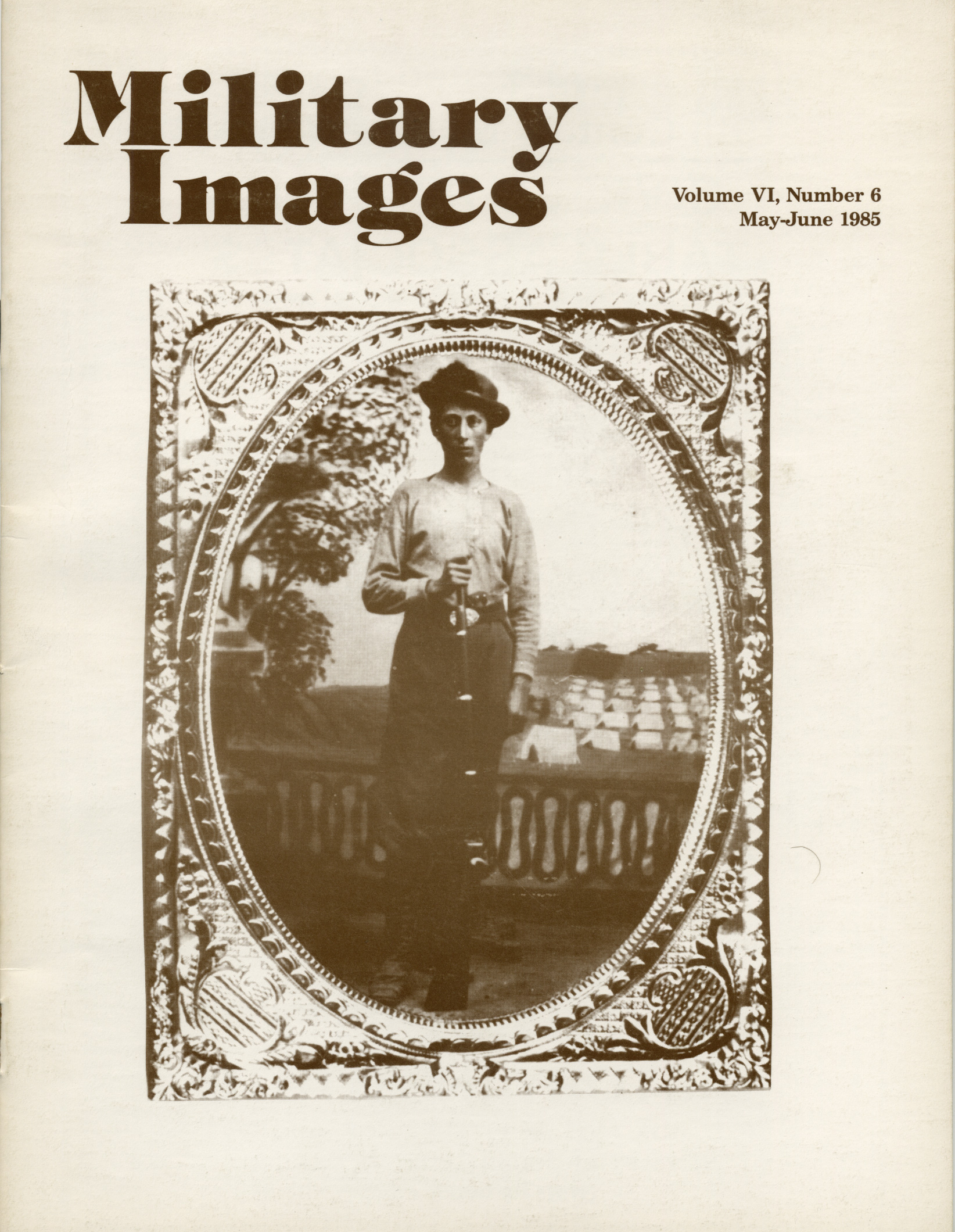
A young sharpshooter graces the cover of this issue of Military Images.

Editor’s Desk (p. 1)
A change in computer systems has led to a change in subscription codes for renewal. A listing of old and new codes is provided to allow subscribers to understand when to renew. The editor is also pleased to note that a new subscriber in Hong Kong means that Military Images has readers on all continents. He warns also that fake tintypes and cartes de visite are still showing up, and asks for readers to let the magazine know so readers are aware of who is selling them. More material from the Confederate states is also coming in, meaning more articles and vignettes from the South.

Mail Call (pp. 3-4)
The letters to the editor include a lengthy response from a reenactment group in Bristol, U.K., requesting information on the uniforms and flags of the Irish Brigade. Other notices include the offer of a research stipend, the theft of an 1852 pattern Union naval officer’s sword from Kennesaw, Georgia, and details on some of the fake images being sold by dealers.

Passing in Review (p. 5)
Three volumes are presented for review in this issues. First is Civil War Monitor, a publication that provides abstracts and an index of articles. This is a bimonthly publication edited by Joseph L. Harsh of George Mason University, and may be a helpful resource for serious researchers. Second is Army Uniforms of World War I by Andrew Mollo, which is a handbook complete with color plates and descriptions of uniforms from 16 nations engaged in World War I. The only units missing are colonial troops and volunteer organizations. Third is Militaria Magazine, a bimonthly publication in French and emphasizes World War II. The images are of high quality, and would be of interest to those readers with an interest in that era of conflict.

Georgians in Gray: A Series of Vignettes by Keith Bohannon (pp. 6-13)
Ten different images are featured in this pictorial article. Each image tells a story of a Georgia soldier, such as the three Chitwood brothers who enlisted in the “Bartow County Yankee Killers” which became Company A of the 23rd Georgia Infantry. The vignette about Pvt. William C. Bradley includes the text of a letter written home in April 1862, describing his experience early on at Yorktown, Virginia. Each story illustrates a different experience of these soldiers from Georgia.

The Saucy Battery: History of the 10th Massachusetts Light Artillery by Philip Katcher (pp. 14-15)
Led by Captain J. Henry Sleeper, the article describes the service of the 10th Massachusetts Light Artillery from its arrival in Washington for training in October 1862. Having missed the large battles at Chancellorsville and Gettysburg while chasing after John S. Mosby’s rangers from their post across the Potomac at Edward’s Ford, the unit was finally on the move in time for Auburn, Virginia in October. Moved into the II Corps under Winfield Hancock when the III Corps disbanded, they 10th was able to keep its old corps badges as it crossed the Rapidan River in early May 1864. They fought well in the Wilderness at the Battle of Cold Harbor, and Capt. Sleeper was mentioned in the New York Evening Post for his leadership there; the article also noted the 10th was known as the “saucy battery” in the II Corps. They remained in action until Appomattox, and took part in the Grand Review of the Army.

The Blue and Gray by Albert W. Haarmann (pp. 16-23)
Subtitled “… and the Green and the Black and the Red, etc.” this survey of newspapers announcing the arrivals of Union volunteer troops in Washington, D.C. Seventeen photographs of these uniforms are included to illustrate the many units which arrived between April and July of 1861. It is interesting to note how many volunteer regiments arrived wearing gray, such as all six of the Maine units that arrived at that time.

The Excelsior Banner by Randy Beck (p. 24)
Louisville, Kentucky was the site of a drill competition between the regiments of the 4th Division, 15th Army Corps as they waited for the end of their service in June 1865. The regiments of each of the three brigades would compete with one another, with the winners of each brigade competition vying to win a $300 silk banner. Colonel William Hanna of the 50th Illinois in the Third Brigade cancelled all leave and continually drilled his men, eventually meeting the 7th Iowa (1st Brigade) and the 63rd Illinois (2nd Brigade) for the final competition. Named “The Excelsior” banner after the competition, Col. Hanna returned home with the banner and had the carte de visite featured in the article taken in Quincy, Illinois.

The 13th Shot: Tragedy Aboard the U.S.S. Iowa by William Christen (pp.25-17)
Known for having fired the initial shots at Spanish vessels during the Spanish American War in 1898, the U.S.S. Iowa was taking part in targeting drill off the coast of Pensacola, Florida on April 9, 1903 when an unexpected tragedy struck. During the firing of the 13th shot that morning, the barrel of the port 12-inch gun sheared off, crashing through the deck, and killing three sailors three decks below. A few images of the Iowa are included with the article, but others are requested by the author.

Sergeant Andrew R. Denton: Vignette of the 43rd Tennessee, C.S.A. by Terri N. McGinnis (p. 28)
The couple featured with this article, Sgt. Denton and his bride, Martha, were wed on January 4, 1862, shortly after his enlistment in Company G of the 43rd Tennessee. He was elected to First Sergeant in May of 1862, and took part in the fighting around Vicksburg in 1863. It was on June 22, 1863 that Denton was wounded, dying of blood poisoning a few days later. His only child was born four and a half months later.

Stragglers (pp. 29-30)
Space allows only one image in the “Stragglers” feature in this issue. The antebellum image shows an unidentified group of men probably belonging to a target club. These were civilian clubs similar to the German Schutzenverien, which wore uniforms and practiced drill despite the fact that they were not associated with official militia. Although these groups existed after the Civil War, they were more like social clubs, rather than focusing on marksmanship.

Back Image
The American cruiser, U.S.S. Olympia, Admiral Dewey’s flagship, in harbor, Venice, Italy.

Finding Aid: March/April 1985

1985-v6-05-vi-cover

The complete issue

Vol. VI, No. 5
(32 pages)


Print edition: Visit our store to check availability
Digital edition: Visit JSTOR.org to purchase
Subscribe to MI
Explore the MI Archives: Browse | Advanced search | Tutorial

Inside

Cover image
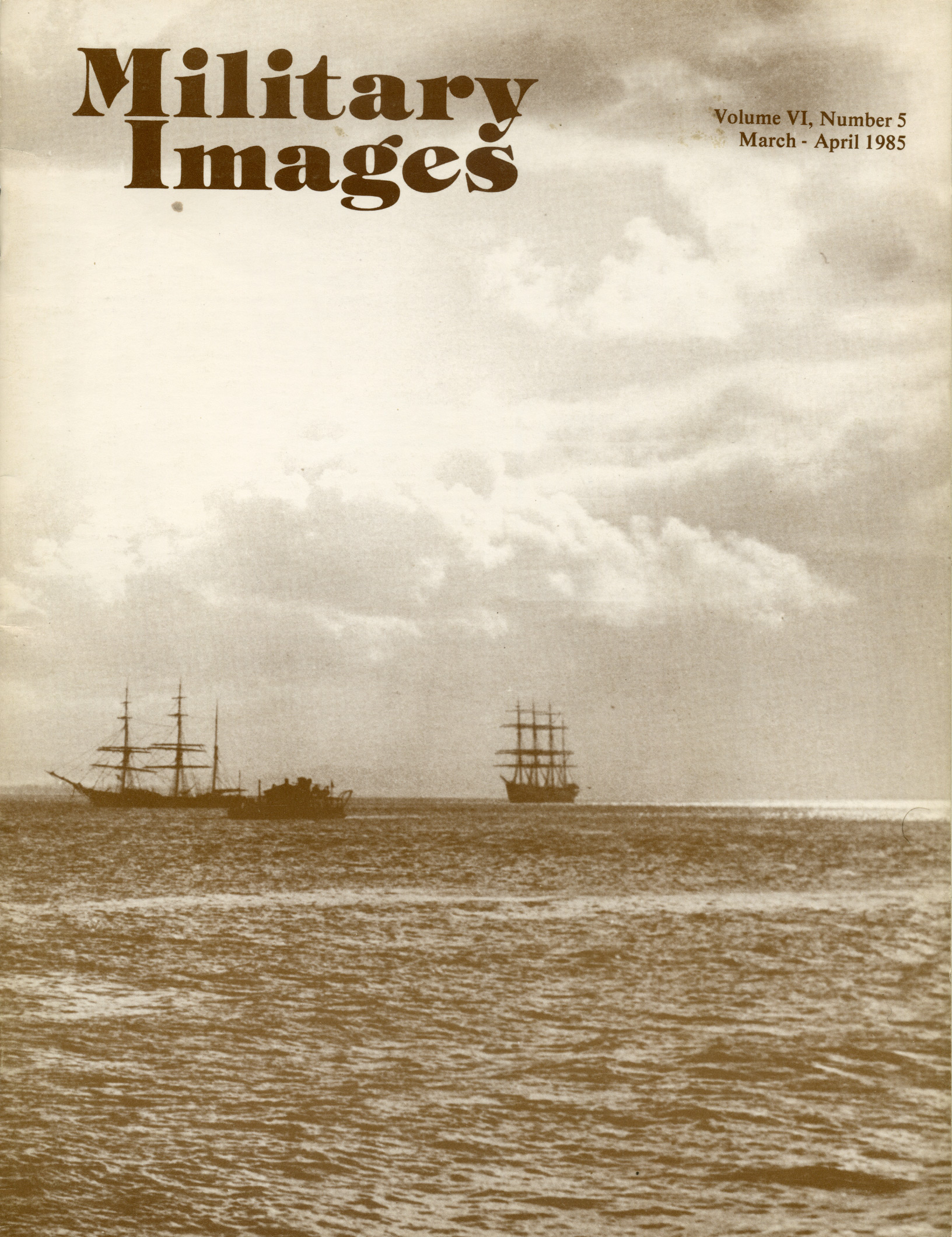
The image that is featured on both the back and cover of the current issue is of San Francisco Bay, taken about 1897 from the Bay Bridge area. The mast-less ship is the Civil War era Camanche; her history is described in more detail on page 29.

Editor’s Desk (p. 1)
The editor announces a change in staff, with Phil Katcher taking over from Bob Fulmer as Book Review Editor. A list of features planned for future issues is also included.

Mail Call (pp. 3-4)
A few interesting items are included, including an additional opinion on the color of the cuffs of the 114th Pennsylvania Zouaves, a question about the possible origin of “light-colored blobs” on an ambrotype, and another story about “Those Funny Looking Shoes” on their way towards Gettysburg. Two letters also remark on the warning by the Editor about fake reproductions, which had been found by readers in Indiana and Georgia.

Passing in Review (p. 5)
Three publications are considered for review in this issue of Military Images. The first is The Confederate Field Manual which is a reprint of the 1862 The Field Manual for the use of Officers on Ordnance Duty. With the addition of modern photographs, the volume is of interest for many, from historians to reenactors to modelers. Next is the pamphlet Why Brice’s Crossroads? by Kevin Duke, which appears to be a generalized account of the battle, possibly geared towards the battlefield souvenir market. Last is Chattanooga: A Death Grip on the Confederacy by James Lee McDonough. The reviewer notes that the author tackles many misconceptions about the campaign in clear, straightforward text, making this a highly suggested work for those interested in this aspect of the Civil War.

John Cassidy, 69th Pennsylvania by Jack McCormack (pp. 6-7)
This short vignette follows the service of Corporal John Cassidy of Philadelphia. While in winter quarters at Camp Observation near Poolesville, Maryland, the corporal was given a copy of the Manual of the Christian Soldier, a prayer book used by Catholics. The presentation of the book was commemorated on the flyleaf. Apparently, the book was lost by Cassidy during the fighting at Antietam, as the book was subsequently inscribed as such by Wm. G. Schief, who somehow got the volume back to its original owner. An additional inscription by a Virginia soldier, Michael Shannon, adds mystery to its travels, as the prayer book and the image of Corporal Cassidy were found on him after he was wounded fatally at Gettysburg. The missal shows the track of a bullet he took at the stone wall, defending against the Confederates, on July 3, 1863.

54th Virginia Infantry: a dual vignette by Keith Bohannon and Gregory Starbuck (pp. 8-9)
Two images, one of three of the four Hornbarger brothers and one of Private Uriah Crawford, tell the story of the 54th Virginia Infantry. The 54th was not part of the Army of Northern Virginia and saw most of its action in Tennessee, fighting around Preston and at Chattanooga and Missionary Ridge, also defending against Sherman’s Atlanta Campaign. Crawford was captured near Kennesaw and was eventually exchanged in March 1865, being at home on leave when the war ended. The Hornbarger brothers came through the war to all return home, all having served in Virginia’s 54th.

Images of Romanians in the Civil War by Adrian-Silvan Ionescu (pp. 10-11)
Many men of foreign origin fought or observed the American Civil War in many capacities. The author contributes the images and short biographies of four men from Romania who contributed their own efforts in the American conflict. George Pomut was a refugee from the Revolution of 1848 who had settled in Iowa and joined the 15th Iowa Volunteers at the start of the war, eventually ending the war as a brevet brigadier general. Nicolae Dunca took part in Garibaldi’s Italian army, joining the Union Army in 1861 and fighting at Bull Run; he became an aide to Gen. Fremont and was killed in action in 1862. Eugen Ghika-Comanesti was in a cavalry regiment under Gen. Fremont and was wounded in the same action at Cross Key that killed Dunca. He became a brevet captain in the 5th Regiment of Colored Troops before resigning and returning to Romania in 1863. Emanoil Boteanu was an envoy of Prince Alexandru Iaon I and attached to Gen. George Mead’s staff in early 1865; his image was taken by Alexander Gardner and shows a mix of Romanian undress uniform with American additions.

The Stockton Blues: A California Militia Company, 1856-1861 by John P. Langellier (p. 13)
Two images of the Stockton Blues are featured with a short description of the early origins of the company. One image features five enlisted soldiers with their full uniforms, including shako with pompon. The other is of Patrick Edward Conner, who was the commander of the unit, with his young son. Conner had fought in the Seminole Wars and raised the 3rd California Volunteer Regiment at the outset of the Civil War.

Lt. Edward Cantey Stockton: Vignette by David M. Sullivan (pp. 14-15)
The author brings the readers the story of Edward Cantey Stockton, whose family exemplified the maxim that the Civil War was one of “the house divided against itself.” Brought up in a New Jersey family, his mother was from a well-known South Carolina family and was cousin to Mary Boykin Chestnut. Edward Stockton eventually entered the United States Navy, and was on the U.S.S. Plymouth with Commodore Matthew C. Perry when he entered Tokyo Bay in 1853; his uniform from that voyage is pictured as part of the article. He married in 1857, and is shown in an image with his bride. A series of unfortunate events with “demon rum” would eventually end his naval career with a court martial in 1858. Upon the advent of the Civil War, Stockton was drawn to support the Confederacy and joined the South Carolina State Navy. Upon that unit’s disbanding, Stockton was offered a commission as a 2nd Lieutenant of Confederate States Marines, which was not confirmed and was terminated at the end of September 1861. Following a brief stint as a Captain in the 21st South Carolina Volunteers, he left the CSA upon receipt of an offer as Acting Master in the Confederate States Navy, which he accepted in April 1862. He was promoted to Lieutenant in February 1863, and is the only known man to have served in all three branches of Confederate military service.

Gainesville: The Iron Brigade’s First Fight by Mark Jordan (pp. 16-25)
Seventeen images and one battlemap illustrate this excerpt taken from the author’s upcoming biography of General John Gibbons, who led the “Iron Brigade” in this fight against Jackson’s “Stonewall Brigade” under the command of Maj. Gen. William B. Taliaferro. Fought between Groveton and Gainesville on the Brawner farm in late August 1862, the article describes the movement of both Federal and Confederate troops in this battle that saw the significant loss of officers and men on both sides.

Photos Sought (pp. 26-28)
A listing of images being sought by member readers is premiered, organized by state then branch of service. Other non-Civil War requests are also included at the end of the listing.

Stragglers (pp. 29-31)
This feature begins with a more detailed description of the Camanche as it appears on the cover of the issue and its service during and after the Civil War. Other images include a pair of ninth-plate ambrotypes of a militia or Confederate clergyman, one with the man asleep and the other with him looking towards heaven. A brass cockade for the 1876 centennial is shown in close-up and in an image of E.B. Ball; the cockade is “made in the style of the 1792-1810 leather fan cockade” but with embellishments made for the centennial. Also included is the hat and image of Lt. Henry M. Brewster of the 57th New York Infantry; wounded at Fredericksburg, he was in command of the bridge used by John Wilkes Booth to escape following his assassination of Abraham Lincoln.

Finding Aid: Jan./Feb. 1985

1985-v6-04-vi-cover

The complete issue

Vol. VI, No. 4
(32 pages)


Print edition: Visit our store to check availability
Digital edition: Visit JSTOR.org to purchase
Subscribe to MI
Explore the MI Archives: Browse | Advanced search | Tutorial

Inside

Cover image
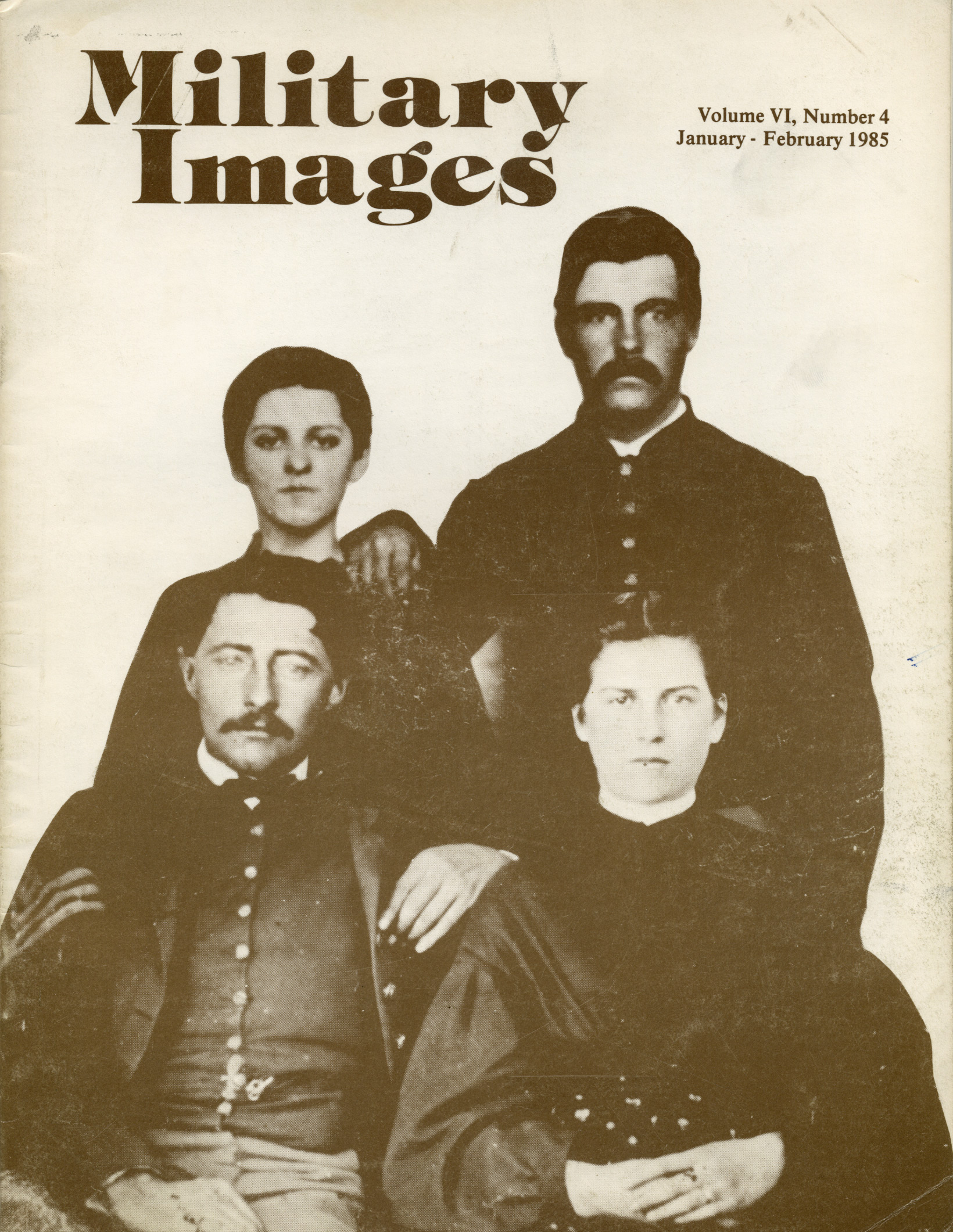
The cover image for this special issue features two couples, however not all of the individuals are identified. Sgt. Henry Stephens of the 45th Pennsylvania Volunteer Infantry stands on the right behind Ann M. Shenk.

Editor’s Desk (p. 1)
The editor warns the readership about the arrival of fake tintypes created by Mr. Walter Ward of West Alexandria, Ohio. While he does not market his reproductions as originals, many unknowing purchasers may buy them from other sellers as originals. The size of a carte de visite, the editor outlines some identifying features of these fakes.

Mail Call (p. 2)
Letters to the Editor include further information regarding articles on the 79th New York Highlanders, photographs of Zouaves, and “French Mary” Tepe. One reader had a question about markings on a weapon, which the Editor asked the readers to provide assistance.

The Girl I Left Behind Me (p. 3)
This short introductory article provides some insight into this special issue that commemorates the wives and sweethearts of soldiers in the 19th century. Women of this era were often relegated to roles played behind the scenes of history, with notable women usually taking on unusual roles. The images in this issue of Military Images feature the often unidentified women of this era with the military men in their lives.

Northern Images (pp. 4-17)
Ending with an unusual cabinet photograph probably from the 1880s that features a line of chorus girls dressed in Hussar “uniforms,” the 46 other images submitted by a variety of collectors included in this pictorial show Union couples and families from a wide range of Northern society. Some appear to be well-to-do, with the women wearing fashionable dresses, while others wear the home-spun of the less affluent. A few of the images are of fathers and daughters, mothers and sons, and family images with babies or children. Most of the individuals are not identified, leaving the viewers to wonder about the stories behind the faces.

Southern Images (pp. 19-24)
The seven Confederate images from the collection of Larry Willford are much like those of their Federal counterparts. Most are unidentified, and show a range of economic backgrounds. The first images if of a soldier with ladies who might be his sisters, while the last is of a soldier who is seen with a man who might be his civilian brother and their sister. As with the images in between, the stories are lost but the images remain to give us the real faces of the Civil War.

Post-Civil War Images (pp. 25-31)
This collection of ten images which range from the early 1870s up to the romantic photographs of a Spanish-American War soldier kissing his sweetheart provide more group images. Picnics in Arizona Territory and boating in Montana Territory show some of the relaxation that soldiers and their ladies could pursue in the latter part of the 19th century. There are a few couples images, and some that include children, like Lt. James S. Rogers and son reading a picture book together. Ending with a group photograph of the G.A.R. Ladies Drill Corps of Toledo, Ohio, this pictorial gives the sense of a more relaxed and less formal time.

Back Image
A ninth-plate ambrotype image of an unidentified soldier and his lady is presented.

Finding Aid: Nov./Dec. 1984

1984-v6-03-vi-cover

The complete issue

Vol. VI, No. 3
(32 pages)


Print edition: Visit our store to check availability
Digital edition: Visit JSTOR.org to purchase
Subscribe to MI
Explore the MI Archives: Browse | Advanced search | Tutorial

Inside

Cover image
The Fourth of July parade in Steubenville, Ohio included veterans of the G.A.R. The cabinet card photograph on the cover of this issue was taken about 1885.

Editor’s Desk (p. 1)
The editor provides additional comment on the new “Photos Sought” feature. While it appears to be very popular with readers, there were some issues that required clarification and therefore a necessity to move the due date for entries back to January 1, 1985.

Mail Call (p. 2)
A wide variety of letters are given responses by the editor: a reader asks for a distinction between battle and parade dress uniforms, the descendent of a “Vignette” subject provides additional information on his great-grand-uncle, a historian makes some particular corrections to an article, and a reader gives further information about some unique footwear. The winner of the “Name That General” contest is announced as being Brian Pohanka, with a score of 134 out of 144. Some readers had great fun with the contest, although the feeling was not entirely universal.

Passing in Review (p. 3)
Regulations and Notes for the Uniform of the Army of the United States, 1917 in Parts 1 and 2 by Jacques Noel Jacobsen are reviewed. Continuing in a series of reprinted regulations, these two parts are considered to be important resources for the “serious student of the Great War period.” Part 1 describes the uniform regulations for officers, which were still produced by tailors, requiring more detail than the items included in Part 2, which covers the regulations for enlisted personnel, which were produced under government contract. A projected Part 3 will cover the huge numbers of changes to the regulations associated with this period.

Fifteen Minutes to Live: Co. E, 33rd Illinois Infantry at Vicksburg by Richard Tibbals and Randy Beck (pp. 4-7)
May 22, 1863 was the date of General U.S. Grant’s grand assault on the Confederate fortifications surrounding Vicksburg, and the men of the 33rd Illinois were waiting for the time for their assault – 10:00 a.m. – to arrive. With uniform jackets off due to the sultry Mississippi air, the men under the direction of Captain Isaac H. Elliott moved forward, and all but one of the men serving in Company E would ended up dead or wounded. The article gives the individual stories of many of the Illinoisans who fought in this Union debacle, and has images of seven of them, including two brothers who lost their lives as a result of the fighting that day.

Johnny, I Hardly Knew Ye!: A Seires of Vignettes on the Grim Visage of War by Ronn Palm, John R. Sickles, William Gladstone, Keith Bohannon, Tom Gordon, Jr,. Howard W. Strawbridge, Wendell W. Lang (pp. 8-15)
The authors each bring the readers the image and story of a soldier who was either severely wounded or lost his life during the Civil War, some also including their words home. They include Sgt. Richard A. Charles (Co. C., 16th Pa. Cavalry), Lt. William W. Geety (Co. H, 47th Pa. Inf.), Sgt. Thomas Plunkett (Co. E, 21st Mass.), Pvt. Reuben H. Nations (Co. I, 12th La. Inf.), Lt. Jacob T. Zug (Co. H, 7th Pa. Reserves), Sgt. Preston M. Guild (Co. K, 57th Pa. Inf.), Sgt. Albert W. Corson (Co. D, 9th N.H.), and two unidentified veterans who had their images taken on a carte de visite at “Cady’s, Cobleskill, N.Y.”

The Great Pivot: Vermonters vs. Virginians at Gettysburg by Blake A. Magner (pp. 16-22)
Thirteen photographic images of the men of Vermont illustrate the story of the men who turned back Pickett’s Charge on the last day of fighting at Gettysburg. The 2nd Vermont brigade, composed of the 12th through 16th regiments under the command of General George J. Stannard had not yet seen any fighting, spending most of their nine-month enlistment in the fortifications surrounding Washington. They were sent into Virginia as the rear guard of Major Gen. John Reynolds’ First Corps and made their way across Northern Virginia, through Maryland, and into Pennsylvania. The article describes the hectic quick move that the brigade had to make on July 1, being ordered not even to break ranks for water. The movements of the different regiments on July 2 are covered as well, with written accounts by Col. Wheelock Veazey, 16th Vermont, describing what that night and next morning were like. Many of his men slept through the artillery barrage that signaled the start of the actions on July 3, indeed he himself admitted that the previous days and 24 hours without any sleep made him consider sleeping too. It was while talking with Gen. Stannard that General Winfield S. Hancock was wounded in the groin. The Vermonters ended up attacking late support for Pickett’s brigades who came up behind them, Wilcox’s Alabamians and Perry’s Floridians, pivoting to hit the Confederates with fire and then capturing them with a full run. It was for this movement that Col. Veazey was awarded the Medal of Honor in 1891.

Those Funny Looking Shoes: Unusual Footwear in the Civil War by Chris Nelson (p. 23)
Two images of Federal officers wearing “sporting” shoes made of light colored canvas with leather answers the question raised in the “Stragglers” section of the previous issue of Military Images: What are they wearing? It was a non-regulation shoe that was popular among hunters, yachtsmen, and (as was noted in one of the letters to the editor on page 2) croquet players. The author provides a short history of this shoe and its military application later in history, such as the combat boot worn by soldiers in Vietnam.

The Fort McHenry Salute by John H. McGarry III (pp. 24-25)
The end of the Civil War saw the five Rodman guns that were to be installed to protect the port at Baltimore still not in place, although they would be by the end of 1865. They remained there as a part of coastal defense and in 1903, Baltimore photographer Henry F. Rinn requested permission to photograph the huge 15” guns as they performed the salute for that year’s Fourth of July celebrations. The three images presented with the article show the guns in action, the largest muzzle-loaded artillery guns of the 19th century.

Sgt. Edward Ward: Pioneer Army Aviator by Charles Worman (pp. 26-27)
One might think that this article would be about airplanes, but they only play a small part in this story. Sgt. Ward was at one point in aviation history the entire enlisted component of the U.S. army Aeronautical Division within the U.S. Signal Corps. While admitting later in life that he was not particularly fond of flight, he was an integral part of the balloon ground crew, with which he is shown in an image taken in 1907. Ward’s career took him in and out of various aspects of balloon service until his retirement in 1930.

Stragglers (pp. 28-31)
The first of three images for this issue’s “Stragglers” feature is of the 21st U.S. Infantry Regimental band at the Golden Spike ceremony marking the meeting of the Union Pacific and Central Pacific Railroads and the completion of the transcontinental railroad. A second image of C Troop, 6th Cavalry taken at Camp Grant, Arizona in the early 1880s shows a “veritable compendium of campaign dress in a period of transition.” Lastly, a photo postcard is shared of the Maine on washday, showing laundry out to dry on the ship’s rigging.

Back Image
The final image for this issue is of an unknown Yankee cavalryman. The sixth-plate tintype shows he is more than adequately armed for the work.

Finding Aid: Sept./Oct. 1984

1984-v6-02-vi-cover

The complete issue

Vol. VI, No. 2
(32 pages)


Print edition: Visit our store to check availability
Digital edition: Visit JSTOR.org to purchase
Subscribe to MI
Explore the MI Archives: Browse | Advanced search | Tutorial

Inside

Cover image
The cover of this issue features a quarter-plate ambrotype of an unknown Confederate cavalryman.

Editor’s Desk (p. 1)
The editor takes issue with the practice of “secondhand” readers, those who enjoy Military Images by reading the issues of subscribing friends. He hopes that these readers will extend their support for MI by subscribing on their own and help the magazine to continue to thrive. Additionally, once a year the magazine will now sponsor a listing of “Photos Sought” as a new feature. Subscribers who are looking for a particular image can have their request included.

Mail Call (p. 2)
Several clarifications to information presented in past issues are included in the letters to the editor, who also explains why the magazine is not planning to become a monthly publication. Requests and offers to share images between publications and readers also are included, as are suggestions for future articles.

Passing in Review (p. 3)
Two reviews are presented in this issue of Military Images. The first is United States Military Buttons of the Land Services, 1787-1902 by Martin A. Wyckoff, which presents a system of classifying military buttons. The author is an anthropologist, and the system is geared toward the archaeologist, however the reviewer found this to be an important resource for those interested in the collection of military buttons, who could also use this classification system. The second publication is Marine Badges and Insignia of the World by Burt L. Campbell and Ron Reynolds, which has sections of the book that feature historical insignia from the U.S.M.C from 1840-1940 and a brief section featuring Confederate marine markings.

Vignette: William Catheart, Telegrapher, C.S.A. by Robert L. Hart (p. 4-5)
Having deserted the Hillsborough Military Academy in North Carolina following a request by himself and other cadets to join in the defense of Charleston in 1863, 19 year old telegrapher William Catheart was present at Fort Sumter when it took its harshest attack yet in December 1863. Regulations stated that the telegraph lines were to maintain a constant ticking while under bombardment, with which Catheart endeavored to comply despite having to move around in the burning fort several times. At one point, the telegraph key itself was damaged, and Catheart went to the extreme of putting the ends of the two wires on his moist tongue, reading messages by feeling them. The underwater lines were eventually cut, and Catheart and his supervisor, Joseph W. Kates, spent three frigid nights on a “floating mattress” to find the break. Although not holding military rank, Mr. Catheart was eventually promoted to the position of Superintendent of Military Lines, Charleston at the age of 20 in February 1864.

Tenting on the Old Campground… or Did They?: A Look at Civil War Tents by Harry Roach (pp. 6-9)
The article begins with the recognition that the tent is a constant image in the Civil War collective memory. However, as the article progresses, one soon discovers that the tent was sometimes more of a problem than one might imagine. The Sibley tent (a large conical tent with a central pole which could also hold a Sibley stove in winter) did not last long in the field, as it was cumbersome and needed to be carried by wagons. It, along with the “A” or wedge tent, became more visible in images taken of the rear as the war continued due to the number of wagons and teams needed to transport them. The d’Abri tent required two men to team up and button their tent halves together; there were no poles involved so the soldiers often used their bayonetted muskets as tent poles. Also known as the “dog” or “pup” tent – because that’s all that could fit comfortably inside of one – they were unpopular with the soldiers. Many Confederate units banned tents while in the field altogether, which meant men would bivouac without shelter, as depicted in one drawing that accompanies the article, along with six photographic images.

Brothers at Ball’s Bluff: Luther and Joseph Hapgood, 15th Massachusetts Infantry by Mark Brewer (pp. 10-14)
Two brothers from a farming community in Massachusetts enlisted in the Federal army following the attack of anti-Federal crowds upon Massachusetts soldiers in Baltimore as they made their way by train to Washington. They were like most recruits, and trained earnestly with the hope of defending their country in battle. After the Union losses at First Manassas, their training was hurried and in October, both Luther and Joseph Hapgood’s commander, Colonel Charles Devens, under orders of Colonel Edward Baker who led the brigade, led his 15th Massachusetts forward across the Potomac River to perform a reconnaissance in force a short distance from Leesburg, Virginia. More than half of the 1700 men who made the crossing were casualties, as the Confederates who had been watching the crossing began firing from the cover of nearby woods. Colonel Baker was killed trying to rally his panicked soldiers, Joseph was wounded early and made his way back to the Union side of the river for treatment, while Luther scrambled back up the southern bank to find his missing brother, only to be captured. Luther spent several months in Libby Prison in Richmond; his father was so aggrieved that he lied about his age and enlisted in the 15th Massachusetts and went south to find his son. All three survived, not without some injury, but as time went on, it was the story of the Battle of Ball’s Bluff that was most often retold to their families.

Tipton Panorama Photos of Gettysburg by Kathleen R. Georg (pp. 15-26)
Ten glass plate images taken by Gettysburg photographer William H. Tipton were taken in early l882 to assist French painter Paul Phillippoteaux in his painting of the Gettysburg cyclorama. Guided by resident William Holtzworth, the images in the ten photographs taken that day are presented in this pictorial article, paired with the resulting painted images from the cyclorama. The Tipton photographs can be dated by the wooden poles that line what was to become Hancock Avenue, a means of accommodating visitors to the battlefield while keeping the privately owned farms from being damaged by wayward carriages of visitors. The photographs are labeled with battlefield landmarks, allowing the contemporary reader to orient him/herself to the view being taken.

Vignette: Peter Kiolbassa, Galvanized Yankee by Wayne Rogoski (p. 27)
A young immigrant from Silesia, Peter Kiolbassa settled with his family in Panna Marta, Texas, not far from San Antonio. He quickly added English and Spanish to his native German and Polish, becoming a teacher at a church school prior to the start of the Civil War. He joined initially with a local cavalry brigade which was eventually added to the 14th Texas Cavalry. He was taken as a prisoner of war when General John A. McClernand’s forces stormed and took Arkansas Post in January 1863. Kiolbassa, along with several others, took the oath of allegiance to the Union, becoming “Galvanized Yankees: as a result. He was allowed to enlist in Company D, 16th Illinois Cavalry and served in both the Knoxville and Atlanta campaigns. Over time, Kiolbassa was promoted to captain of Company E, 16th U.S. Colored Cavalry, seeing action in Kentucky and Arkansas. During leave in February 1864, Kiolbassa became involved in the development of the first Polish Roman Catholic Church in Chicago, St. Stanislaus Kosta, which still stands today. Kiolabassa made Chicago his adopted home, living out the rest of his life in civic and political service to his community.

Stragglers (pp. 28-30)
A tintype of a Federal trooper holding aim on a Confederate prisoner with what appears to be a Navy Colt, an albumen image of a Confederate from Georgia tinted in butternut not gray, and a 50 year “before and after” pair of images of Elijah Tillotson of Osceola, Iowa are the more serious images shared by the readers of Military Images. The more humorous includes a Civil War era carte de visite of a soldier contemplating the appearance of an infant in a cradle and wondering “Who’s been here since Ise been gone?” along with a latrine image from around 1898.

Back Image
Five soldiers, likely from the Spanish-American War or World War One, are being taught to use cameras by a civilian.

Finding Aid: July/August 1984

1984-v6-01-vi-cover

The complete issue

Vol. VI, No. 1
(32 pages)


Print edition: Visit our store to check availability
Digital edition: Visit JSTOR.org to purchase
Subscribe to MI
Explore the MI Archives: Browse | Advanced search | Tutorial

Inside

Cover imageThis fifth anniversary issue features many of the covers of past issues. A total of 15 covers are presented on the cover and the back of this issue of Military Images.

Editor’s Desk (p. 1)
The editor congratulates the readership for the magazine’s success in a competitive market, as it is the readers who contribute to the magazine and provide the source of its success. A sampling of future articles is discussed, and the editor requests images of military men and their wives and sweethearts for another much requested pictorial of these images.

Mail Call (p. 2)
Along with applause for the magazine in general and a few articles in particular, the editor is asked to provide the address for a publication reviewed in a previous issue. Two organizations (The Friends of Fort Davis National Historic Site and the “Save the Flags” program for conservation of flags from Pennsylvania military units) request donations from the readership.

Passing in Review (p. 3)
There are three publications reviewed in this issue of MI. The first is War in the Modern Great Power System, 1495-1975 by Jack S. Levy. The work is one of political science, and attempts to use balance of power theory to more adequately determine the causation of war. Although there are some aspects of the book that the reviewer found interesting, it is not a work that would be of great interest to most readers of MI. Next is The Guns of Port Hudson, Vol. I: the River Campaign, February-May 1863 by David C. Edmonds, which outlines “the naval and military maneuvers leading up to the siege of Port Hudson, Louisiana.” The third review is of Fort McHenry: Home of the Brave by Norman G. Rukert. The author provides a thorough and engaging 200 year history of Fort McHenry, including its use as a prison in the Civil War and as a hospital during World War One. The work includes photographs, drawings, and archeological finds.

Blue Bonnets Over the Border: The 79th New York Highlanders in the Civil War by Joseph G. Bilby (pp. 5-15)
The article traces the history of the 79th New York Militia, composed of mostly Scotsmen, in their three year enlistment in the U.S. army. Beginning as a unit known as the “Cameron Highlanders” that wore kilts as part of their parade dress and tartan trousers (known as “trews”) as a fatigue item, the 79th took on Federal service in May 1861. The detailed article, which describes some of the heroic as well as some of the humorous actions of the Highlanders, follows them from their fighting under Colonel James Cameron (the younger brother of the Secretary of War, Simon Cameron) who fell at Bull Run in 1861 and their mutiny afterwards, to their service in South Carolina under Colonel Addison Farnsworth, who fell injured during the Second Battle of Bull Run. The men of the 79th were engaged in the fighting at Chantilly that saw the loss of their own General Stevens and that of General Phil Kearney. They fought with Ambrose Burnside at Antietam, and were returned to him after service at Vicksburg to follow him through Tennessee and fight at Knoxville. The Highlanders’ last fighting was in the Wilderness, being called to perform guard duty during the height of fighting at the “Bloody Angle.” After this, the majority of the regiment returned to New York, as their three year commitments were up, and the remaining new recruits were given furlough. New recruits were sought, and the new 79th Highlanders returned to Virginia, to participate in action at Petersburg, which they occupied after Lee’s retreat. A number of images accompany the article, including a side-bar vignette which tells the story of Pvt. James Berry, Company D, 79th New York Infantry.

Major Babbitt and the Alamo “Hump” by Kevin R. Young (pp. 16-17)
Most people recognize the structure of the Alamo in San Antonio, Texas by its distinctive parapet, or hump. But most people do not know is that the Alamo chapel was given that feature in 1848 when Quarter Master General Thomas Jessup rejected Major Edwin Burr Babbit’s suggestion to raze the structure and build new structures to house U.S. Army quarters in its stead. The chapel’s nave was never finished and remained without a roof from its construction in 1795. It was during a title dispute over the ownership between the Army and the Catholic Church of the old chapel that Babbitt completed the roof, which required the addition of the hump and two more windows on the second floor. Ironic then, that the men who sought refuge in the chapel during Santa Ana’s attack in 1836, would likely not recognize the structure if they saw it today with the feature that makes it so identifiable to visitors to San Antonio in our time.

Vignette: Robert C. Curry, Company K, 4th New York Infantry edited by James Paradis (pp. 18-19)
Three letters and an image of Robert C. Curry provide a unique and authentic glimpse into the life of an ordinary infantry soldier, complete with the original misspellings. One discovers that the living comrades of the deceased often pitched in financially to send the bodies back to their families, causing Curry to send home less money than he had wanted to send. In the last letter he sent a variety of rose home to Elizabeth, who he “loves … as a brother” and asks for his mother to send “refreshments” as they are “always very acceptable to me.” Robert Curry was killed in action at South Mountain, and is buried at Antietam National Cemetery.

“They were well thought of…”: The Veteran Reserve Corps, 1863-1866 by Philip Katcher (pp. 20-24)
As Confederate Lt. General Jubal Early swept down through the Shenandoah Valley and threatened the city of Washington itself, his men noted that the defenders of the city were dressed in unusual uniform, and that they appeared to be “city or town forces” preparing their defenses. Major General Robert Rodes threw out skirmishers directed to take one fortification, but were quickly and unexpectedly pushed back. What the Confederates did not know was that these were the men of the Veteran Reserve Corps. They were veterans that fought and were injured in past campaigns and although not able to perform hard marches or long exposure to the elements, they still had plenty of fight left in them, and served well in the defense of Washington. The article provides descriptions of the VRC uniforms for both enlisted men and their officers, and presents nine images, including a shot of VRC men acting as the honor guard at the reviewing stand during the Grand Review of the Army in May 1865.

Vignette: Robert Morton, 2nd Connecticut Heavy Artillery by Alan J. Sessarego (p. 25)
Two carte de visite images of Robert Morton introduce the reader to a black boy too young to serve with a rifle, and whose role in the Civil War was as a servant to Captain Robert Potter of the 2nd Connecticut. Servants and cooks from both sides of the Civil War were often these unknown black youngsters frequently seen only on the fringes of images of the time, and whose stories remain untold.

Name That General! by Chris Nelson (p. 27)
The person who can name all 144 Union generals correctly and submit their list first can win a one year extension to his/her subscription to Military Images. A set of five clues is given to start the search; answers will be presented in the next issue. The original is from a carte de visite and Military Images reproduced it at twice its actual size.

Stragglers (pp. 29-31)
The collection of straggler images begins with a full page showing a sixth-plate daguerreotype of a Confederate Zouave taken by George Cook in Charleston, South Carolina that is not from the “Charleston Zouaves.” Readers are asked to provide any identification they may have. Other images include some humorous shots such as a headless Union officer holding his head(s) in each hand, a 1890s image of a cadet from Girard College in Philadelphia, and two soldiers with unique (and unconventional) additions to their uniforms.

Finding Aid: May/June 1984

1984-v5-06-v-cover

The complete issue

Vol. V, No. 6
(32 pages)


Print edition: Visit our store to check availability
Digital edition: Visit JSTOR.org to purchase
Subscribe to MI
Explore the MI Archives: Browse | Advanced search | Tutorial

Inside

Cover image
The elaborate image of a tirailleur of the 146th New York Infantry, also known as “Girard’s Tigers,” features a Zouave style uniform known as a Turco. The unidentified soldier wears a light blue uniform with yellow trim.

Editor’s Desk (p. 1)
The editor asks the readership to participate in the goal of preserving 9000 acres around the Custer Battlefield National Monument. Only 760 of the newly released federal land will be preserved unless it is purchased and then donated to the National Park Service. The editor also notes that the article “The Famous Petersburg Photo” (January-February 1984) should have included Harris Andrews as co-author with Brian Pohanka.

Mail Call (p. 2)
The letters to the editor provide some further insight into the New Hampshire cap (which was featured in a past issue as well as the current issue of Military Images), the correct uniform of a Scot’s Guard officer, and a correction regarding the use of the word “Congressional” when referencing the Medal of Honor.

Passing in Review (p. 3)
There are four different publications reviewed for readers in this issue. First is The United States Cavalry: An Illustrated History by Gregory J.W. Urwin, a short history of the cavalry from the Revolutionary War to the single cavalry unit to see action in World War Two, including 32 color-plates and 100 black-and-white photographs. Next is The Civil War in Maryland by Daniel Carroll Toomey, who presents a detailed chronological accounting of over 280 different large and small conflicts between Federal and Confederate forces in this border state. A Battlefield Atlas of the Civil War by Craig L. Symonds, with cartography by William J. Clipson, provides readers with a way to view the flow of Civil War battles by using simple and uncluttered maps in an organized chronological format. Those who hope to use this book at a site may have trouble, as modern roads are not marked. Lastly, the recorded album Civil War Guitar: Campfire Memories by Kirk Browne is reviewed. Using an 1850 Martin guitar and with occasional accompaniment with fiddle, harmonica, and banjo, listeners get to hear a selection of songs popular with soldiers in the North and the South. Lyrics are included in liner notes, but no vocals are featured in the recording.

Vignette: 3rd Georgia Infantry, C.S.A. by Keith Bohannon (p. 5)
A reproduction of a well-known ambrotype that is often misidentified as three soldiers in Braxton Bragg’s Army of Tennessee is presented, this time with correct identification. From left to right, the author provides short biographical information about the three members of Company D, the “Madison Home Guards” from the 3rd Georgia Infantry that was part of the Army of Northern Virginia: Columbus C. Taylor who is wearing a neck scarf, James D. Jackson with a slouch hat with “3 G V” in brass letters, and James H. Porter wearing a light kepi. Both Taylor and Jackson died at Malvern Hill, while Porter’s military record ends with a muster roll notation that he was detailed to railroad service.

Ernest Hemingway in the First World War by Susan Beegel (pp. 6-8)
He was young and he was enthusiastic, and he had eyesight that would not have passed an Army physical. The article takes the reader from his first job at the Kansas City Star to his first work with the American Red Cross in Italy, and shows where his experiences with being wounded and falling in love with the nurse tending him at the A.R.C. hospital in Milan (Agnes von Kurowsky) intersects with his later writing, most specifically A Farewell to Arms. Hemingway was seriously wounded when an Austrian mortar hit the group of Italian soldiers he was conversing with. With over 200 pieces of shrapnel in his legs, Hemingway was trying to get one of the wounded to safety when he was then hit with machine gun bullets in his knee before he and the wounded man he carried were able to get to a command post. Hemingway was decorated with Italy’s Croce di Guerra and Medaglia di Valore for this act. After attempting to return to the front, Agnes was able to convince him to return stateside, which he did, finding that his story as the first American wounded in Italy had been followed back home. His legs still painful, unable to relate to people at home, unemployed, and depressed after Agnes broke their engagement, Hemingway had the material needed to begin writing some of his most memorable fiction, and led to his need to eventually return to war in Europe.

“Go East, Young Man…”: A history of the California Hundred and Battalion in the Civil War by Richard K. Tibbals (pp. 9-12)
A need for soldiers was still evident in late 1862, when Massachusetts came to an agreement with a group of men in California led by J. Sewall Reed who desired to fight for the Union in the Civil War. Because the War Department did not want to transfer men from the West to the East to fight, these 100 men agreed that their bounties from Massachusetts would be used for their transportation over Panama in December 1862; the troopers making up this unique cavalry unit known as the “California Hundred” (Company A of the 2nd Massachusetts Cavalry) would supply their own uniforms and equipment. The “California Battalion” was comprised of an additional 400 men from California who also wanted to join the fighting, and made a similar request which allowed them to follow in March 1863; they were designated as Companies E, F, L, and M. Initially, the California Hundred (soon followed by the rest of the 2nd Massachusetts) were sent to engage with the Rebels in “Mosby’s Confederacy” and in August were able to seriously wound Major John Mosby at Gooding’s Tavern. At a planned skirmish in February 1864, Mosby and his forces were able to ambush and kill five of the Californians, including Captain J.S. Reed, the organizer of the Hundred. Other actions of the California Hundred and Battalion included protecting Washington, D.C. from the assaults of Jubal Early, action in the Valley under the command of Phil Sheridan, the battle held at Saylor’s Creek, and the surrender at Appomattox Court House. Several images of command officers and unknown troopers accompany the article, along with a photograph of their encampment during the winter of 1863-4 in Vienna, Virginia.

Whipple’s Patent Military Cap by James Stametelos (pp. 13-15)
The Fall 1983 catalog for the Stametelos establishment “Sutler’s Wagon” included an example of what was called “that Crazy Cap” in the Volume V, No. 4 issue of Military Images. This article in this issue of MI provides patent drawings, several current photographs of the cap being worn, and a contemporary view of a “Yankee stalwart” wearing the cap. A drawing from Frank Leslie’s Illustrated Weekly from 1862, which shows how the common error of thinking the soldiers of the 4th New Hampshire Infantry wore pith helmets began, is also included in this detailed history of an unique piece of military gear.

More Zouaves and Chasseurs by Carol Villa (pp. 16-21)
The third pictorial of the uniforms inspired by French colonial troops in North Africa is presented, with 27 different images. Two vivandieres from Zouave units are included as well.

From Bull Run to San Juan Hill: Unit History of the 71st New York National Guard by Ronald Beifuss (pp. 22-28)
With the vast majority of the images from the Spanish-American War in 1898, the 25 images in this article illustrate the history described in the article, which begins with the origins of the militia regiment in the era of the “Know Nothings” and reaction to a great influx of immigration into the New York City of 1849. Reenlistments after the three-month initial enlistments expired shortly after Bull Run in 1861 led to the renaming of the organization as a National Guard unit, which was called into action on a number of occasions. After the Civil War, the regiment was used to quell riots, but did not see significant action again until the Spanish-American War when they were part of the 1st Brigade of the 1st Division. On July 1, 1898, the 71st prepared to engage the Spanish at San Juan Hill, which the article describes in some detail; many of the images were taken by Lt. Herbert True of Company L, commander of the pioneer company for the brigade.

U.S. Navy Machinist’s Mark, 1881 by John A. Stacey (p. 29)
With the gradual replacement of a sail navy by steam powered vessels, the insignia of this new navy needed to be updated. In 1881, the use of a screw propeller with an anchor began as the insignia of a U.S. Navy Machinist. In 1886, an eagle and chevrons were added to designate the wearer as a petty officer. An image taken between 1881-86 by one of the crew of the U.S.S. Ranger (identified on the hatband of one sailor) reveals the use of the insignia on the lower part of a coat sleeve. The insignia image was magnified for clarity.

Index to Articles, July 1979-May 1984: The First Five Years of MI (pp. 30-31)
Article titles and authors are indicated for each issue.

Back Image
Miss Katherine Andrews wears her Y.M.C.A. uniform along with an insignia of the 23rd Infantry Regiment, 2nd Division from World War One.