Finding Aid: November/December 2008

2008-v30-03-xxx

The complete issue

Vol. XXX, No. 3
(48 pages)


Print edition: Visit our store to check availability
Digital edition: Visit JSTOR.org to purchase
Subscribe to MI
Explore the MI Archives: Browse | Advanced search | Tutorial

Inside

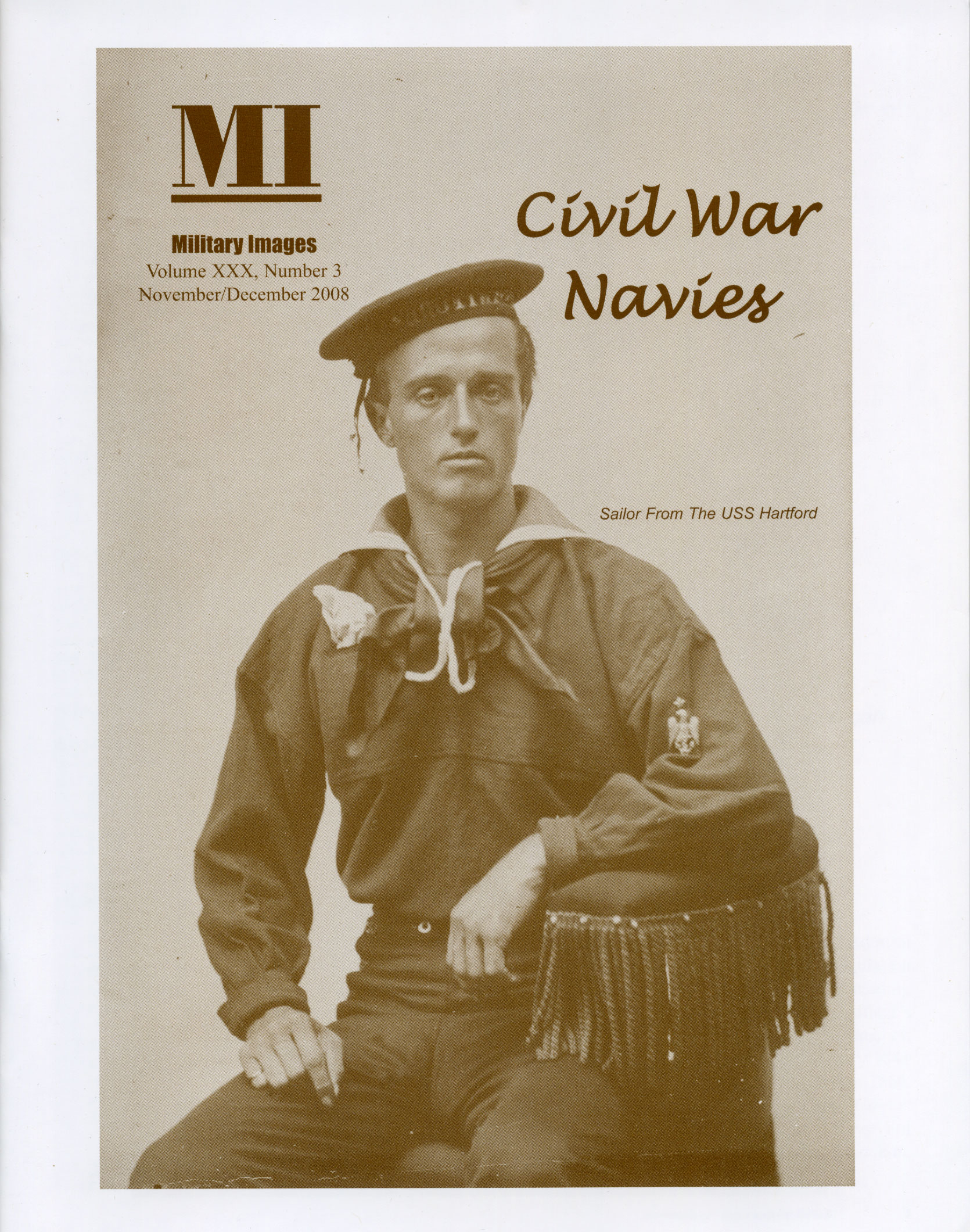
Cover image
carte-de-visite-sized tintype of a petty officer, most likely a boatswain, aboard Adm. David Farragut’s flagship Hartford from the Steven Karnes collection.

Inside Cover Image
A carte de visite by Samuel Cooley from the Richard Rosenthal collection pictures the shell damaged gun turret of the ironclad Passaic.

Table of Contents (p. 1)

Editor’s Desk (p. 2)
The editor notes that nearly 16 years have passed since MI published an issue dedicated entirely to the navies of the Civil War. More than 100 images are collected here.

A Letter From Ron Field (p. 3)
The author shares his experience of learning that an image in his collection is a fake that was purchased on eBay. He hopes that his experience will serve as a warning to other collectors and urges that we continue sharing images with the collecting fraternity to surface other possible fakes.

Civil War Sailors in Blue From the James Stokes Collection (pp. 4-24)
A total of 58 Union sailor portraits, mostly cartes de visite, are included in this expansive gallery. All of the subjects are enlisted men, and only one is identified: Seaman Edward H. Kenney of the Housatonic and New Ironsides. One of the most unusual images is a carte de visite of a young woman dressed in naval style attire.

Civil War Sailors From the Collections of Our Readers (pp. 25-37)
Another large gallery, mostly cartes de visite, features 27 Union and Confederate portraits of enlisted men and officers. Identified sailors include Landsman David Cesar of the Confederate gunboat Isondiga, Cmdr. Austin Pendergrast of the Congress, Water Witch and Nyack, Acting Ensign James Jordan of the Nyack, Landsman Freeman MacArthur of the Florida and Queen, Marcus (Mark) Lewis of the Michigan and Silver Lake, Confederate Lt. George T. Sinclair, Confederate Midshipman Richard H. Bacot of the Arkansas, Chicora and Neuse, Acting Master’s Mate William H. Gray of the Hastings and Juliet, Landsman Albert H. Angell of the Catskill, Seaman Alex Fraser Jr. of the Choctaw, Confederate 1st Lt. Charles Manigault Morris, Acting Ensign John R. Russ of the Aroostook, a sailor identified only as Milo Johnson, Seaman William H. Ayles of the Ohio, Colorado, Minnesota, Brandywine and Young America, Sailors William Ramsey and William Brune of the Frolic, Sailor James O. Ormand of the Benton and sailor George M. Early.

More Photographs of the U.S. Steamer Michigan (pp. 38-40)
Images from the Ted Karle collection include four images of the Michigan, which is the first iron-hulled warship in the U.S. navy. Also included are two portraits of men who served on the vessel. One of the men is identified: Pilot William Hinton.

Back Cover Story: Hubbard Taylor Minor Jr., Confederate States Navy (p. 41)
Minor began his service in the 42nd Tennessee Infantry in November 1862. He left the army eight months later to accept a commission as an acting midshipman and went on to serve the rest of the war in Savannah, Ga., and Charleston, S.C. A leg wound suffered during the capture of the Union gunboat Water Witch on June 3, 1864, was perhaps the highlight of his war service. Minor died in 1874. The story is illustrated with a carte de visite portrait of Minor from the collection of David W. Vaughan.

Uniforms & History by Michael J. McAfee (pp. 42-45)
In “Sailors: their uniforms and the collecting of their portraits,” McAfee highlights the distinctive and varied uniforms of the Union navy and reflects on his own collection of images. A total of eight portraits illustrate the text, including two identified photographs: Chaplain Thomas G. Salter and his son, Timothy G.C. Salter.

Sutler’s Row (p. 46)

The Last Shot (p. 48)
An “action” shot of crewmembers exercising with a 12-pounder Dahlgren howitzer on the deck of the monitor Lehigh. The image, a carte de visite by E.G. Fowx of City Point, Va., is part of the Steven Karnes collection.

Inside Back Cover
An unidentified sailor wearing a cap and shirt emblazoned with the name of his vessel, the Essex. The carte de visite by Excelsior Gallery of Memphis, Tenn., is part of the collection of James Stokes.

Back Cover
A carte de visite of Confederate States Navy Midshipman Hubbard Taylor Minor Jr. by Howell & Brown of Savannah, Ga., is part of the David W. Vaughan collection.
Finding Aid: January/February 2009

2009-v30-04-xxx

The complete issue

Vol. XXX, No. 4
(40 pages)


Print edition: Visit our store to check availability
Digital edition: Visit JSTOR.org to purchase
Subscribe to MI
Explore the MI Archives: Browse | Advanced search | Tutorial

Inside

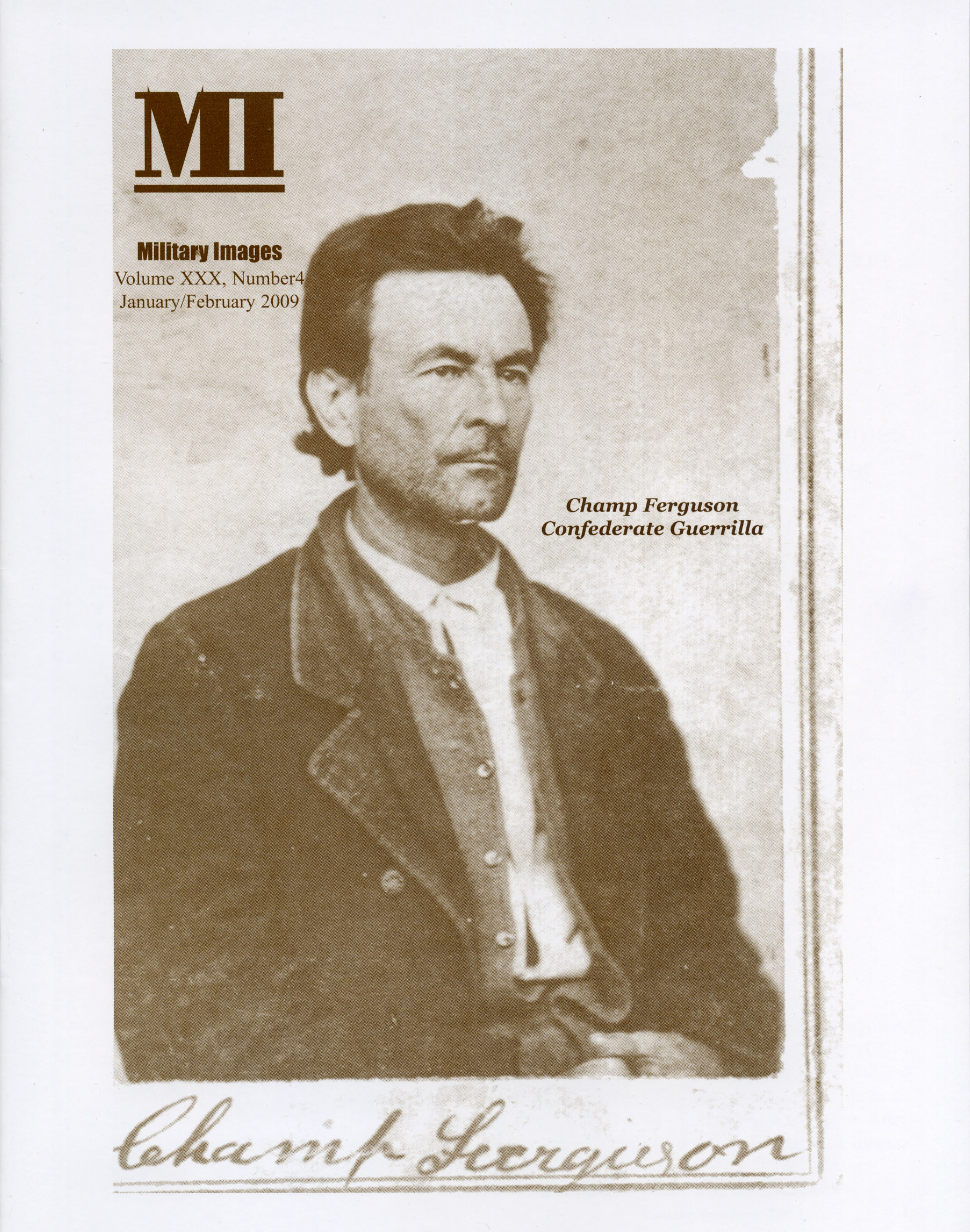
Cover image
A rare, signed carte de visite of Confederate guerrilla leader Champ Ferguson from the John Sickles collection.

Inside Cover Image
A carte de visite from the Steven Karnes collection features a company of Union soldiers, including a drummer and fifer playing their instruments. The company and location is not known, nor is the photographer identified.

Table of Contents (p. 1)

Editor’s Desk, Inside and Inside Back Cover Details (p. 2)
The editor wishes everyone a great summer. Though the issue was mailed in the summer, the issue date is in the winter. The gap relates to problems with frequency of issues.

Images From the Collection of Jason Puckett (pp. 3-15)
A total of 13 Civil War images, 10 Union, 2 Confederate and one allegiance unknown compose a gallery of representative photographs from the Jason Puckett collection. Three of the subjects have airtight identifications, Lt. William D. Sullivan of the 147th New York Infantry and

A New Hampshire Tribute by Mark Flenard (pp. 16-17)
Two soldiers from Company C of the 2nd New Hampshire Infantry are pictured in a portrait that was found by the author in an antiques shop. Though men were originally nameless, the author identified them with the help of the American Civil War Research Data Base. Benjamin F. Chase was killed on July 2, 1863, at the Battle of Gettysburg. Norton R. Moore died on Aug. 29, 1862, at the Second Battle of Bull Run.

Numbers Prevailed: Lieutenant James Johnston, Company E, 121st New York Infantry by Scott Valentine (pp. 18-19)
Wounded multiple times during the Civil War, James Walter Johnston suffered a bayonet wound in action during the dramatic assault at the Mule Shoe Salient during the horrific fighting at the Battle of Spotsylvania.

Marsh M. Patrick, 154th ‘Senior’ Tennessee Infantry CSA (p. 20)
A full-plate tintype from the John Walsh collection pictures Lt. Col. Marsh M. Patrick in an early war militia uniform and shako with plume. Patrick began his war service as captain of Company H, also known as the Crockett Rangers. He later advanced to lieutenant colonel.

The Charlestown City Guard by Ron Field (pp. 21-23)
The City Guard was organized in Charlestown, Mass., in the fall of 1850 and became Company H of the 5th Massachusetts Infantry during the Civil War. A history of this company and its distinctive uniforms are included, and the text is illustrated by an 1857 image that is a composite of portraits of every member of the organization. Two other portraits, an ambrotype of Samuel R. Brintnall and a daguerreotype identified only as “Watson,” are also included.

The Confederate Soldier (p. 24)
An unidentified cavalryman with two holstered Colt Navy .36 caliber revolvers, and a third drawn and prominently displayed, is pictured in a carte de visite copy portrait with a Springfield, Tenn., back mark from the John Sickles collection.

Uniforms & History by Michael J. McAfee (pp. 25-33)
In “The Way They Looked,” McAfee considers the average soldier of the Union army. The narrative features a group portrait of an officer and nine enlisted men. A total of 16 more portraits, all cartes de visite from the author’s collection, show a variety of poses, back drops, uniform styles and equipment. Identified images include Thomas Doughty and John Hollings of the 82nd Pennsylvania Infantry; William Hull, Christopher Soies and John Woodward of the 12th Connecticut Infantry; Thomas Hughes of the 149th Indiana Infantry; William Leiby of the 47th Wisconsin Infantry; Philip M. Roberts of the 102nd New York Infantry; Frank Benedict of the 124th New York Infantry and Clarence E. Wilson of the 2nd New York Infantry.

Stragglers (pp. 34-37)
Six images—5 Union and 1 Confederate—contributed by readers compose this issue’s collection. Included is a carte de visite of an African American soldier, a sergeant who served in the 9th Wisconsin Infantry, a Corps of Engineers officer, a private with a Model 1861 musket, a Confederate cavalryman and a Union cavalaryman.

Sutler’s Row (p. 38)

The Last Shot (p. 40)
In this circa 1920 postcard an African American woman poses with a Mexican War era Model 1842 percussion pistol. A garbled message on the back of the postcard says she is threatening one Loretta for taking her man or son. Although a non-military image, notes the editor, the presence of a military firearm in the picture makes for an interesting subject.

Inside Back Cover
An unidentified member of the Continental Morgan Guards, Company K, 5th Virginia Infantry is the subject of a sixth-plate ambrotype from the Mahlon Nichols collection.

Back Cover
Principal Musician William Melford of the 7th U.S. Infantry Band stands with his bugle in this circa 1898 photograph from the Chris Nelson collection. The 7th was composed of African American troops. Melford was a major influence on Kansas City jazz.

Official Word on Magazine Mail Times

readingA number of you have asked why your issue was taking so long to move through the mail system.

According to the U.S. Post Office, the estimated time is 9-18 days—but all bets are off during the holidays, and when bad weather sets in.

You may recall the issues were sent bulk mail from Hanover, Pa., on Dec. 20, and at least two subscribers received their issue last Saturday, 24 business days after the mailing.

Thanks to Sheridan Press, the company that prints Military Images, I have a communication from the postal representative in Hanover. The representative details how an issue moves from the post office in Hanover to Arlington by truck to be processed for delivery:

All Periodicals that leave Hanover come here to Harrisburg P&DC – Processing and Distribution Center. The sack label then determines where the mail is transferred to from Harrisburg. If the mail is in a 5 Digit or 3 Digit sack the mail is then sent on transportation to the Distribution center for the zipcode on the sack label. If you are talking about Arlington VA 22205 – and the sack was labeled to either 5 Digit or 3 Digit Arlington – the mail would be loaded on a trailer to send to Southern MD 207. Then from their they would work the mail to go to Arlington 22205 and it would then go to the ADC/SCF office for zipcode 22205 which would be Northern VA 220. Here they would do the actual separation to Arlington and the mail would then go to Arlington to be delivered. The maximum time frame the mail can be held at each office is 3 days. Remember 1st class and Priority are worked first and then Periodicals and then Standard Mail.

So you would be looking at coming to Harrisburg could be held here for a maximum of 3 days then to Southern MD 207 for maximum 3 days – then to Northern VA 220 for a maximum of 3 days and then to Arlington VA for a maximum of 3 days – should be no more than 12 days from mailing until delivery. The standards are 9-18 days for Periodicals depending on where you are mailing to.

Now if the piece was in a MXD sack then you have to add from Harrisburg to (all mixed sacks from Harrisburg go to DV Daniels NJ to be processed) then you start the same process – which would be adding another 3 days until the time frame of 12 days for approximately 15 days. If the 1st class and priority volumes are light then the periodical mail will move faster – if the 1st class and priority mail volumes are heavy you can see the approximate 15 days for delivery.

The time frame you are looking at was over the Christmas Holiday which is the heaviest 1st class and priority time of the year this would then cause delays of the mail pieces. Also you have to take into consideration any weather related delays as this mail is trucked and does not fly. We have had terrible winter weather on the East Coast which also delays the mail delivery.

Finding Aid: March/April 2009

2009-v30-05-xxx

The complete issue

Vol. XXX, No. 5
(40 pages)


Print edition: Visit our store to check availability
Digital edition: Visit JSTOR.org to purchase
Subscribe to MI
Explore the MI Archives: Browse | Advanced search | Tutorial

Inside

Cover image
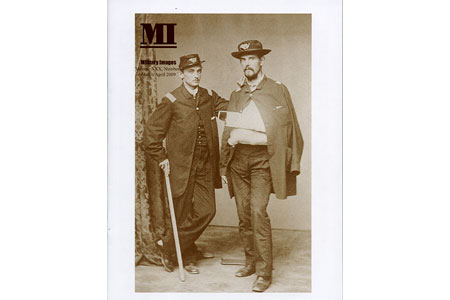
A carte de visite from the Don Ryberg collection pictures Capt. Alexander A. McRoberts, left, and Capt. Charles W. Gibbs of the 44th New York Infantry. Both men were wounded in battle and show evidence of their injuries. McRoberts uses a cane to steady himself from a wound received at Gaines’ Mill, Va., on June 27, 1862. Gibbs, severely wounded at the Second Bull Run on Aug. 30, 1862, has his left arm bandaged and reinforced by a splint.

Inside Cover Image
A sixth-plate ambrotype from the David W. Vaughan collection is a portrait of an unknown Confederate sergeant. The photograph was obtained from a Virginia estate.

Table of Contents (p. 1)

Editor’s Desk, Front and Back cover details (p. 2)
The editor wishes everyone a Happy Holiday season.

Captain Jacob Voorhees, 58th Indiana Volunteer Infantry by Matthew Rector (pp. 3-7)
Jacob Everest Voorhees (1838-1907) is pictured in seven photographs that range from a portrait of him in civilian clothes made prior to his enlistment in 1861 to him in uniform to several post-war photographs. Voorhees began his war service as a second lieutenant in Company E in November in 1861. Not long afterwards, he was detached to serve in the Pioneer Brigade of the Army of the Cumberland. He served in this capacity at the Battle of Stones River, where members of the brigade repulsed numerous Confederate assaults. Voorhees survived the fight and the rest of the war. He mustered out as a captain in November 1864.

Inside the Sutler’s Tent (pp. 8-9)
An unusual carte de visite from the Matthew Rector collection features five men inside a sutler’s tent. One of the gents is Abraham P. Voorhees, a Terre Haute, Ind., merchant and the father of Jacob Voorhees of the 58th Indiana Infantry.

Confederate Images from the Collection of Domenick Serrano (pp. 10-17)
Eight ambrotypes and tintypes of Southerners in gray include one identified soldier, James Buchannon McCutchan of the 5th Virginia Infantry. He was wounded in the head at Chancellorsville on May 3, 1863, and was captured at Morton’s Ford, Va., on Feb. 7, 1864. He was sent to Fort Delaware and released on June 12, 1865.

William A. Hammond, Surgeon General, United States Army (pp. 18-19)
A quarter-plate daguerreotype by the studio of Mathew Brady is a portrait of Asst. Surg. Hammond shortly after he entered the U.S. army in June 1849. The image is part of the collection of Jules Martino. A brief sketch of his Civil War service accompanied by a wartime portrait is included.

Captain Gabe Alexander 2nd Kentucky Cavalry, C.S.A. by John Sickles (p. 20)
In the autumn of 1862, noted Confederate Col. John Hunt Morgan recruited Alexander, who became captain and commander of Company H of the 2nd. The company was detached to stay in Kentucky and ride south to divert Union troopers while Morgan embarked on his infamous raids of 1863. Alexander eventually joined the notorious raider Sur Mundy, and died in late July 1863 after being shot in the head by federals of the 12th Ohio Cavalry.

Soldier Poets in Gray by John Sickles (pp. 21-24)
Three poems include “Toast of Morgan’s Men” by Capt. Patrick Henry Thorpe of the 2nd Kentucky Cavalry, “The Letter That Came Too Late” by Col. William S. Hawkins of the 11th battalion Tennessee Cavalry and “Morgan’s War Song” by Brig. Gen. Basil Duke. The trio of poems are illustrated with wartime cartes de visite from the author’s collection.

Uniforms & History by Michael J. McAfee (pp. 25-30)
In “Army Chaplains,” McAfee describes the origins of the plain uniform worn by Union men of the cloth and illustrates the text with 11 portraits. The identified images include Thomas Mooney of the 69th New York State Militia, Sullivan Weston of the 7th New York State Militia, Augustus Woodbury of the 1st Rhode Island Infantry, John Pierpont of the 22nd Massachusetts Infantry, John Harvey of the 62nd New York Infantry, Edward Lord of the 110th New York Infantry, Peter Franklin Jones of the 1st New York Infantry, Lyman Bliss of the 51st New York Infantry and Louis Napoleon Boudrye (also spelled Beaudry) of the 5th New York Cavalry.

The Confederate Soldier (p. 31)
A hard plate image from the David W. Vaughan pictures a young volunteer armed with a musket and revolver and wearing a Corsican cap.

Stragglers (pp. 32-37)
Eight images—5 Union, 1 Confederate, 1 pre-war and 1 post-war—contributed by readers compose this issue’s collection. Included is an ambrotype believed to be Corp. Charles Davis Jr. of the 20th New York State Militia, a carte de visite believed to be noted poet and author Col. Charles G. Halpine, Pvt. John VanAkan (also known as VanAiken) of the 20th New York State Militia, E.M. Longbothan of the 11th Alabama Cavalry and Will Mosher Clark of the 65th New York Infantry.

Sutler’s Row (p. 38)

The Last Shot (p. 39)
A Union trooper grips his cavalry saber and is armed with what appear to be a pair of Starr Arms Co. Single Action 1858 Army revolvers. The hard plate image is part of the Marty Schoenfeld collection.

Inside Back Cover
A quarter-plate tintype from the Steven Karnes collection features a Wisconsin soldier armed with a converted Model 1816 musket and a pocket bible.

Back Cover
A carte de visite from the Karl Sundstrom collection shows Confederate guerilla leader Champ Ferguson and his Michigan guards. Ferguson was later convicted of war crimes and hung. His likeness was featured on the front cover of MI, Volume XXX, Number 4.

Finding Aid: May/June 2009

2009-v30-06-xxx

The complete issue

Vol. XXX, No. 6
(48 pages)


Print edition: Visit our store to check availability
Digital edition: Visit JSTOR.org to purchase
Subscribe to MI
Explore the MI Archives: Browse | Advanced search | Tutorial

Inside

Cover image
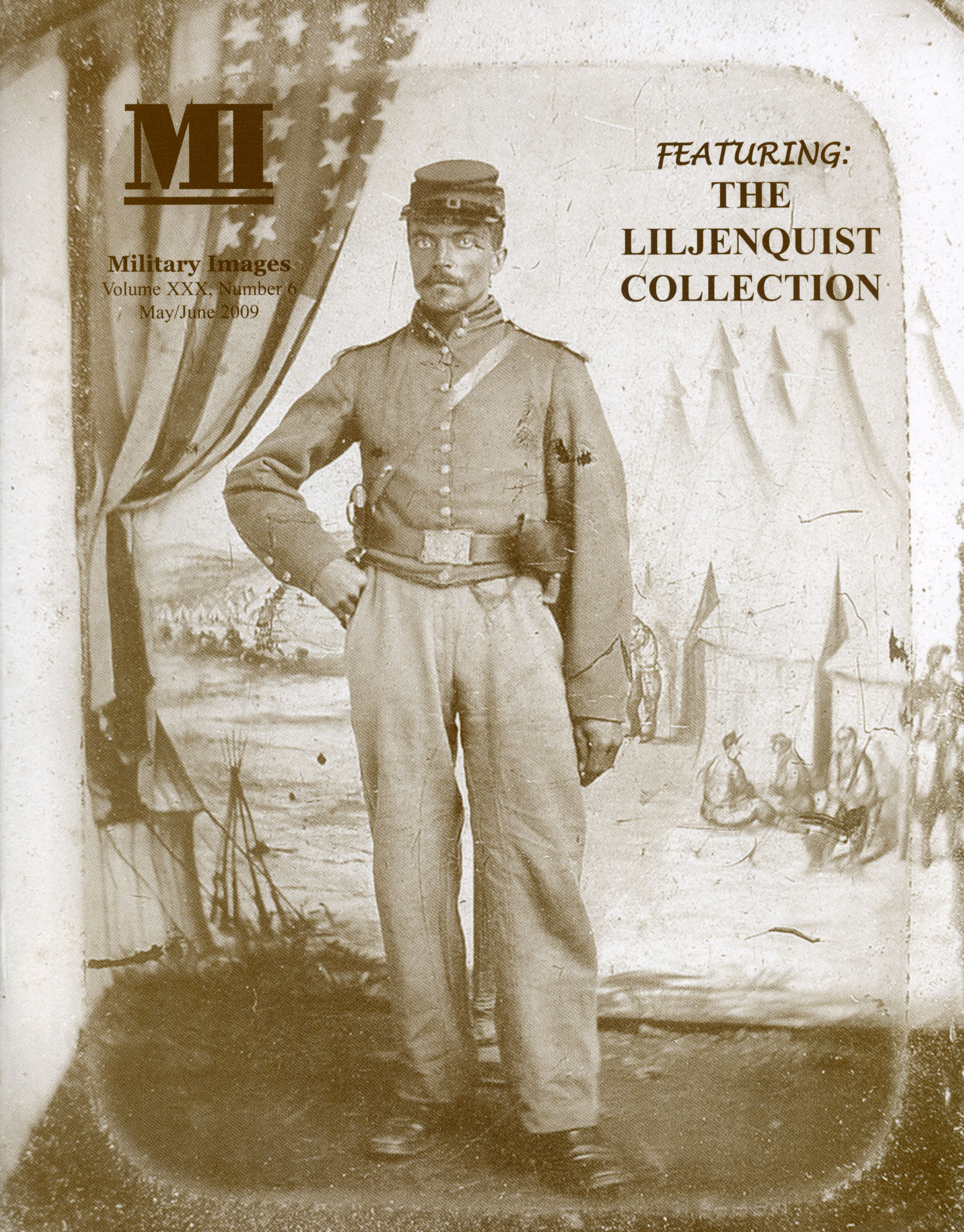
A quarter-plate ambrotype from the Liljenquist Family Collection at the Library of Congress features an African American artilleryman poses in front of a camp scene backdrop. He wears a shell jacket with shoulder scales and is armed with a holstered revolver.

Inside Cover Image
A half-plate ambrotype from the Liljenquist Family Collection at the Library of Congress features two Confederate soldiers in semi-military garb. One soldier totes a single-shot pistol and the other a Ben McCullough Colt revolver.

Table of Contents (p. 1)

Editor’s Desk (p. 2)
The editor presents a selection of Civil War photographs from the Liljenquist Family Collection. Acquired by the Library of Congress in 2010, the collection of more than 700 images of soldiers in blue and gray.

Front and Back cover details (p. 3)
Additional information is provided about the images pictured on the front and back covers.

Legacy: The Liljenquist Family Collection of Civil War Photography at the Library of Congress (pp. 4-38)
A total of 36 images are displayed. In most cases, each page is dedicated to a single photograph. All the images contain very brief captions that include a 5-10 word title and the photographic format. Identified soldiers are featured in nine of the images.

A Chain Letter Solves a Chasseur Mystery by Ted Karle (pp. 39-40)
The author, who has long been puzzled by the gold chain that hangs from the front of coats worn by many French-inspired Chasseur uniforms, believes he has discovered their purpose. According to an 1861 soldier letter purchased by Karle, the chain held a priming wire. Corp. Henry W. Warren of the 18th Massachusetts Infantry penned the letter in December 1861. Three Chasseur images illustrate the story.

Uniforms & History by Michael J. McAfee (pp. 41-43)
In “Sometimes You’re Right…Sometimes You’re Not!” McAfee reflects on the frustration of finding so many unidentified photographs, and shares two experiences where he tentatively identified Union soldiers. As the headline suggests, success can be hit or miss. And in McAfee’s case, downright embarrassing.

The Confederate Soldier (p. 44)
A sixth-plate ambrotype from the Liljenquist Family Collection at the Library of Congress pictures a young Confederate soldier with a tin drum canteen and drinking cup.

Sutler’s Row (p. 39)

The Last Shot (p. 48)
George and Samuel Detrick are pictured in civilian clothes in a sixteenth-plate tintype in the shape of an oval broach. George served in the 23rd Ohio Infantry and was killed in action at South Mountain, Md., on Sept. 14, 1862. Samuel, who served in the 63rd Pennsylvania Infantry, survived the war.

Inside Back Cover
A ninth-plate ambrotype from the Liljenquist Family Collection at the Library of Congress features two Union soldiers sharing a good smoke.

Back Cover
A ninth-plate ambrotype from the Liljenquist Family Collection at the Library of Congress features a Confederate artillerist uniformed in a gray shell jacket with red trim on the cuffs and a gray cap with a red hatband.

Finding Aid: July/August 2011

2011-v31-01-xxxi

The complete issue

Vol. XXXI, No. 1
(40 pages)


Print edition: Visit our store to check availability
Digital edition: Visit JSTOR.org to purchase
Subscribe to MI
Explore the MI Archives: Browse | Advanced search | Tutorial

Inside

Cover image
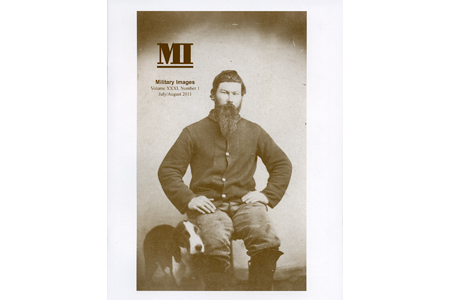
A carte de visite of a Union soldier and his canine companion from the Steve Karnes collection.

Inside Cover Image
A sailor with a Krag rifle, posed in front of a painted backdrop, from the Jules Martino collection.

Table of Contents (p. 1)

Editor’s Desk (p. 2)
The editor introduces two new departments, Vignette from the Naval War, 1861-65, by historian Ron Field, and a selection of unidentified images titled What’s My Name?

Front and Back cover details (p. 3)
Additional information is provided about the images pictured on the front and back covers.

What’s My Name? Unidentified Images From The David W. Vaughan Collection (pp. 4-11)
A total of 8 images, a combination of hard plates and cartes de visite, pictures Union and Confederate soldiers whose names have become separated from their likenesses. Included in the grouping are five Confederate officers, two images of Union officers and a portrait of a Native American dressed in a double-breasted federal frock coat.

Colonel Frank Wolford, 1st Kentucky Cavalry USA by John Sickles (pp. 12-12)
Wolford, who organized the 1st in the summer of 1861, was among a contingent of Union officers who accepted the surrender of John Hunt Morgan on July 26, 1863. Upon his surrender, Morgan gave his silver spurs to Wolford. Less than a year later, Wolford was dismissed from the army after publicly criticizing President Abraham Lincoln. Two portraits of Wolford illustrate the profile, both from the author’s collection.

Morgan’s Commissary Officer by John Sickles (pp. 14-15)
A carte de visite of Kentuckian Theodore B. Boyd (1834-1909) is accompanied by a summary of his military service. A staff officer to generals John Breckenridge and Braxton Bragg, Boyd eventually joined the staff of John Hunt Morgan. He was captured with Morgan in July 1863 and spent the rest of the war in the Confederate officer’s prison at Fort Delaware, Del.

The Many Faces of Captain Henry Blake Hays, 6th United States Cavalry by David M. Neville (pp. 16-17)
Four images of Hays, who served as ordnance officer on the staff of Maj. Gen. Alfred Pleasonton, are pictured. Each image is accompanied by a brief caption.

William N. Brady: Master of the Yard by Ron Field (pp. 18-20)
Brady (1809-1887), a career navy officer, served two stints as the master of the Brooklyn Navy Yard: From 1843-1853, and again from 1858-1865. Newspaper reports described him as “a cool head to attend to and direct anything,” and a man of “precision and energy.” He is perhaps best known for his 1841 book for early-career American naval officers, The Kedge Anchor, or Young Sailors’ Assistant. Two portraits illustrate his story.

Midshipman Nathaniel Prickett of the Brazil Squadron (p. 21)
In 1850, two years after midshipman Prickett sat for the daguerreotype shown here, he died in Rio de Janeiro while on duty with the Brazil Squadron. Image from the David W. Vaughan collection.

Disaster @ Fort Monroe (pp. 22-23)
An image of a 12-inch coastal gun and its crew at Fort Monroe was taken prior to 1910. On July 21 of that year, an accidental gun explosion at the fortress killed an undetermined number of men.

William C. Armor, Aide-De-Camp, 2nd Division, 20th Army Corps by David M. Neville (pp. 24-25)
William Crawford Armor (1842-1911) served on the staff of Maj. Gen. John White Geary. Armor survived wounds below the knee at Antietam and in the right hand at Chancellorsville. He went on to participate in the campaigns of Chattanooga, Atlanta, Savannah and the Carolinas. He ended the war as a captain with a brevet, or honorary rank, of major. The profile is illustrated with portraits of Armor and Geary.

Passed From His Sight: An Incident in The Military Career of Captain Augustus Michaelis by Scott Valentine (pp. 26-27)
Michaelis, the captain and commander of Company I of the 45th New York Infantry, was eyewitness to an unusual event in his Virginia camp during the early evening of May 2, 1863. A huge stag emerged from a wooded area, soon followed by a menagerie of wild animals. This surreal scene was followed by gray soldiers and the rebel yell—and thus began Michaelis’s Chancellorsville experience. A carte de visite of Capt. Michaelis is part of the author’s collection.

Uniforms & History by Michael J. McAfee (pp. 28-29)
In “Just Before the Battle…,” McAfee examines the uniforms of the 8th New York State Militia at Bull Run. A portrait of an unidentified sergeant from the regiment and a Mathew Brady image of men from the 8th titled, “Arlington Heights July 16th 1861” is included.

Stragglers (pp. 30-36)
A grouping of seven images submitted by readers is included in this installment of the popular department, including a bugler from the 1st Delaware Cavalry, a soldier in the 10th Ohio Independent Company Sharpshooters, a federal sergeant major and two young Confederate soldiers.

Sutler’s Row (p. 39)

The Last Shot (p. 40)
A tintype from the Jules Martino collection features two injured men—one is missing an arm and the other has a gauze-like wrapping of brace around his neck.

Inside Back Cover
A carte de visite of a Civil War band with a fort in the background by itinerant photographer C.G. Blatt of Bernville, Pa., is part of the Donald Bates Sr. collection.

Back Cover
A woman holds an image of a soldier housed in a composition frame. The soldier is probably her husband. This tintype is part of the Liljenquist Family Collection at the Library of Congress.

MI’s New Look Extends to Renewal Form

renewalThe redesign that debuted with the current issue of the magazine has impacted all other materials associated with the publication. This includes the renewal form, which is being mailed today to those who have expired subscriptions.

The renewal form is a challenge from a design perspective. There are a number of details to communicate, and clarity is essential. Before beginning the task, I prepared by collecting renewal forms and invitations to subscribe forms from other publications.

Armed with samples, I set about creating the new form shown here. The final version is divided into two sections. The upper two-thirds states the price and describes highlights of the new MI, which includes the redesigned magazine and web site. The bottom third is a detachable return slip which is returned with payment in a self-addressed stamped envelope included with the form.

The biggest change, aside from the new look, is the placement of the free (and optional) classified ad, a long-time tradition for renewing subscribers. The free ad is still available, but the large space on the front of the return slip to enter the ten words and contact information has been reduced to a green box at the very bottom of the form. Text in the green box instructs subscribers to use the back of the return slip to enter this information. They can also email militaryimages@gmail.com.

Finding Aid: Winter 2014

2014-v32-01-xxxii

The complete issue

Vol. XXXII, No. 1
(44 pages)

Print edition: Visit our store to check availability
Digital edition: Visit JSTOR.org to purchase
Subscribe to MI
Explore the MI Archives: Browse | Advanced search | Tutorial

Inside

Cover image
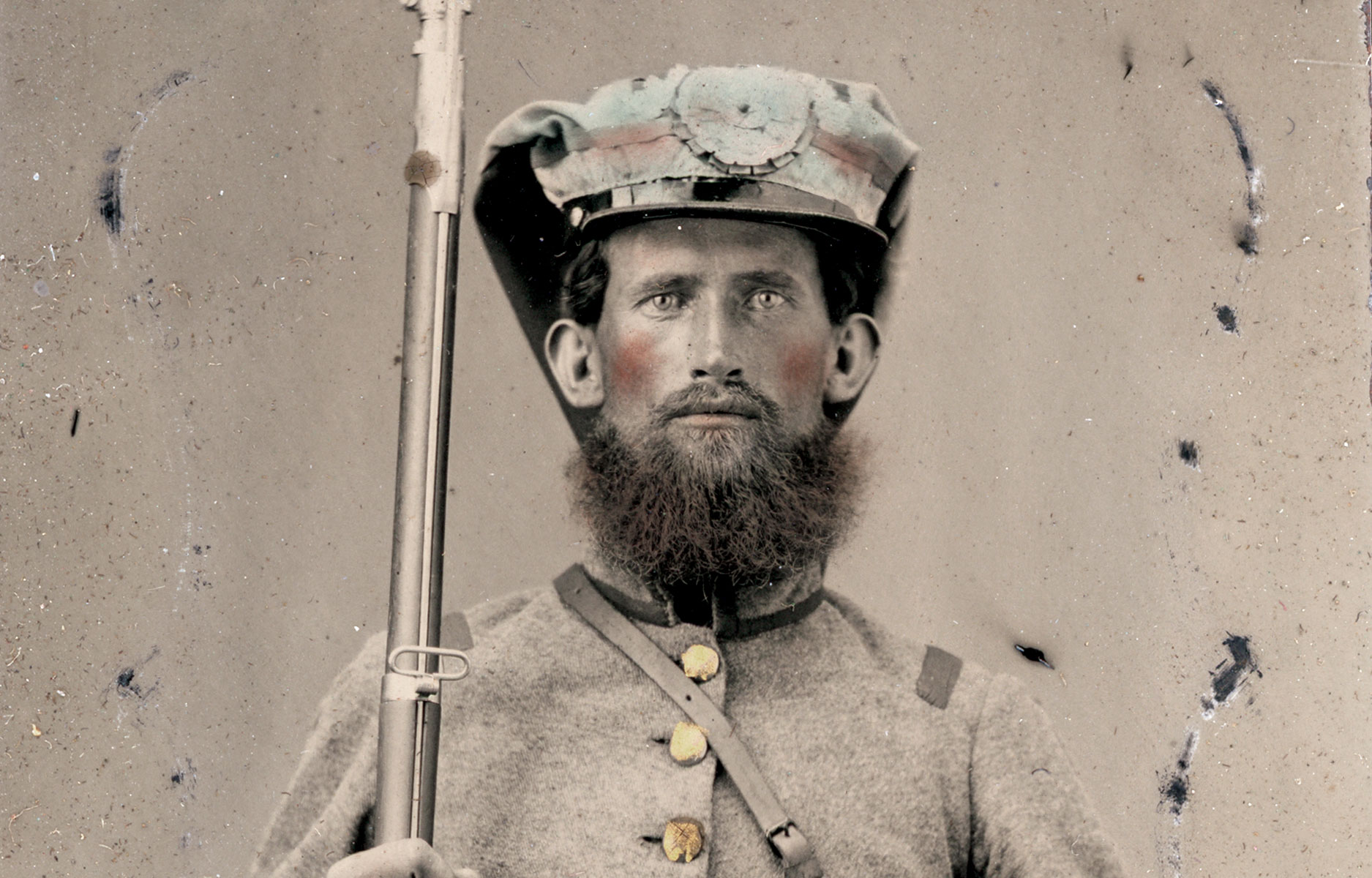
The hand-tinted image is a half plate ambrotype of Capt. James A. Holeman, Company A, 24th North Carolina Infantry, who was wounded at the Battle of Drewry’s Bluff and captured at the Battle of Five Forks.

Table of Contents (p. 1)

Editor’s Desk (p. 2)
This “Change in Command” issue features a farewell from David Neville, who introduces Ronald S. Coddington as the new editor and publisher of Military Images and thanks the “collectors and historians who contribute the wonderful photographs that grace the pages of each issue.” The incoming editor, Ronald S. Coddington, follows with a pledge to continue in the established tradition of MI and thanks subscribers for their participation in the recent survey and their valuable input, which have provided guidance for future publication changes.

Tar Heels! A Survey of North Carolinians in the Confederate Army by Greg Mast (pp. 3-12)
This Military Images feature article is an exclusive preview of Greg Mast’s recently discovered photographs of identified North Carolina citizen soldiers in advance of his second published volume of Tar Heel images. The article includes seven images detailed with individual biographies, unit histories, and descriptions of uniforms and weaponry. One very intriguing image is a possible self-portrait of “photographic artist” Capt. Abner David Peace of the “Granville Targeteers” 23rd Regiment North Carolina Troops, who saw service in a wide variety of battles. Another subject of the article is Pvt. Josephus S. Morris of “Tecumseh’s Scouts” 67th Regiment North Carolina Troops who saw duty only within North Carolina. The article’s seven subjects provide insight into the wide range of duty, background, and experiences that represent the soldiers known as Tar Heels.

Passing in Review by Ronald S. Coddington (p. 13)
The review is of Confederate Faces in Color by Shannon Prichard and Shane Kisner, a new volume that features over 300 color images of Southern soldiers, including the image of Capt. James A. Holeman, featured on the cover of this issue of Military Images.

“God Bless Gallant Old North Carolina” (pp. 14-15)
The quotation by Gen. Robert E. Lee referencing the arrival of North Carolina troops during the fighting at Appomattox, this article features five images of four North Carolina soldiers from the Liljenquist Family collection at the Library of Congress. One image has now been identified as a result of conversation on the MI Facebook page.

An Album of the Faces of the 25th USCT by Shayne Davidson (pp. 16-18)
Eighteen different gem sized tintypes of African American infantrymen serving in Company G of the 25th U.S. Colored Troops are the focus of this fascinating article. The images were originally owed by the Capt. William A. Prickett, who was nursed back to health by some of his soldiers. Capt. Prickett’s image is also included with the article. The author of the article created life-sized drawings of the men and entitled her noted 2013exhibit “Civil War Soldiers.”

Uniforms & History by Michael J. McAfee (pp. 19-23)
Fourteen images and two illustrations accompany “The Uniform Coat, Part 2: Enlisted Men” and its extensive discussion of the evolution of the 1858 frock coat for enlisted soldiers. The article discusses different variations used by state militia as well as variations in trimmings and buttons, including two features that are often not included in current reproductions of the frock.

Showdown With the Sioux by Scott Valentine (pp. 24-25)
The career of Irish immigrant, Capt. Ferdinand Edwin DeCourcy is described. DeCourcy arrived in the United States in 1857, and joined the army. He became a second lieutenant in May, 1861, with the 13th Infantry and saw action at Vicksburg. The article moves next to DeCourcy’s post-Civil War career, and begins by describing the extremes of the natural environment found on the Plains. However the focus of the article is on the defense led by DeCourcy and his soldiers against a stirring attack by Sioux Indians on Fort Cooke, Montana Territory, in 1868.

A Portrait of Lee We Were Not Supposed to See by Donald A. Hopkins (pp. 26-29)
The author challenges the generally accepted fact that two formerly known post-war images of Gen. Robert E. Lee attributed to the studio of John C. Boude and Michael Miley in Lexington, VA. Hopkins discusses the history behind a very rare image of Lee taken by C.R. Rees of Richmond. Lee had requested that Rees destroy the negative as he thought it “makes me look more like a prosperous Southern gentleman than a defeated warrior.” Rees ignored the request and the result is a fascinating single portrait with a rich history taken between November 25 and December 6, 1867. Hopkins’ discussion of the portraits’ verso documentation provides evidence that all three images were taken during the same sitting in Richmond in late 1867.

Four Decades on the High Seas: Boatswain William Long, An Englishman in the U.S. Navy by Ron Field (pp. 30-31)
The author provides an extensive history of the subject of a carte de visite of Boatswain William Long, probably taken in 1864. Long had many adventures at sea, including service as boatswain aboard the San Jacinto, which was noted for its many captures of Confederate blockade runners.

Stragglers (pp. 32-42)
Includes a wide variety of citizen soldiers through 22 different images from both the Civil War and Spanish-American War eras. A few of the unique images include a ninth-plate ambrotype of a Stonewall Brigade soldier in a case with a later newspaper clipping describing some of his service, a sixth-plate ambrotype of a Native American sharpshooter from Michigan, and a carte de visite of a Union soldier and four ladies, some of whom are dressed in military inspired clothing from the 1864 Army Relief Fair in Albany, NY.

The Last Shot (p. 44)
The ninth-plate ambrotype is of a very intense15-year-old Tar Heel, Pvt. James T. Rogers. He is shown armed with two different pistols. He enlisted with Company H of the 13th North Carolina Infantry in May of 1861 and served until discharged due to his age in August 1962. His unit was present during the Seven Days Battles.


The First Issue of MI Has Arrived!

coddington-miI was outside my home raking in the back yard when I saw the FedEx truck pull up. The delivery man stacked up several boxes, and I instantly knew they were the right size to contain the extra issues of MI that I had ordered. A few minutes later I was thumbing through the Winter 2014 issue, my first as editor and publisher. I am thrilled with the outcome, and excited about getting to work on the next issue. The best early Christmas gift!

New MI Policy Addresses Digital Scans

submission-featureI recently received a submission of a scanned historic photograph. I learned that various nicks, chips and other blemishes had been carefully removed in Photoshop. The result was a nearly pristine restored image. During an email exchange about the Photoshop work, the contributor provided the original, unmodified scan. I compared the two, and determined that Military Images should have a formal policy that addresses Photoshop use.

Since the advent of the digital era, photojournalists and other professional documentary photographers have crafted policies to preserve the authenticity of images. Curators and other museum professionals, notably at the Library of Congress, have established technical guidelines and best practices to insure the accuracy of historic photographs.

After careful consideration and after consultation with contributing editors and others connected to Military Images, I am pleased to announce the following statement summarizing MI’s position on the subject:

Military Images does not accept scans of photographs that have been digitally enhanced, and does not condone the practice of digital enhancement of historic images. Scratches, chips, nicks, cracks and other blemishes, while they may interfere with the content of an image, are also part of its history and should be preserved. Military Images will accept digitally corrected scans that have been adjusted for brightness, contrast and color.

This policy is consistent with MI’s mission to showcase, interpret and preserve historic military photographs. It seeks to provide the MI audience with the most historically accurate and reliable images consistent with current standards and best practices.

The “Submission Guidelines and Deadlines” section of our site has been updated to include this statement.