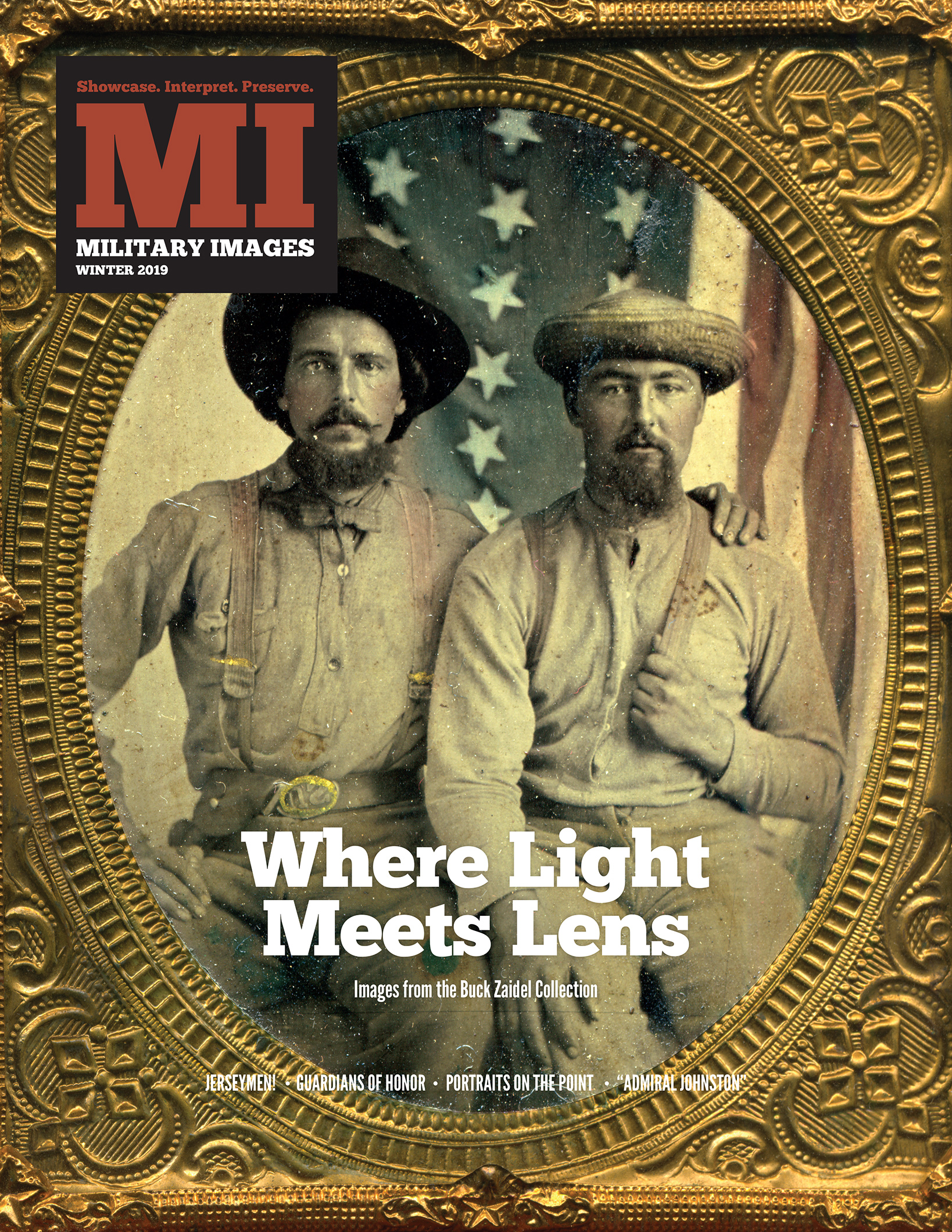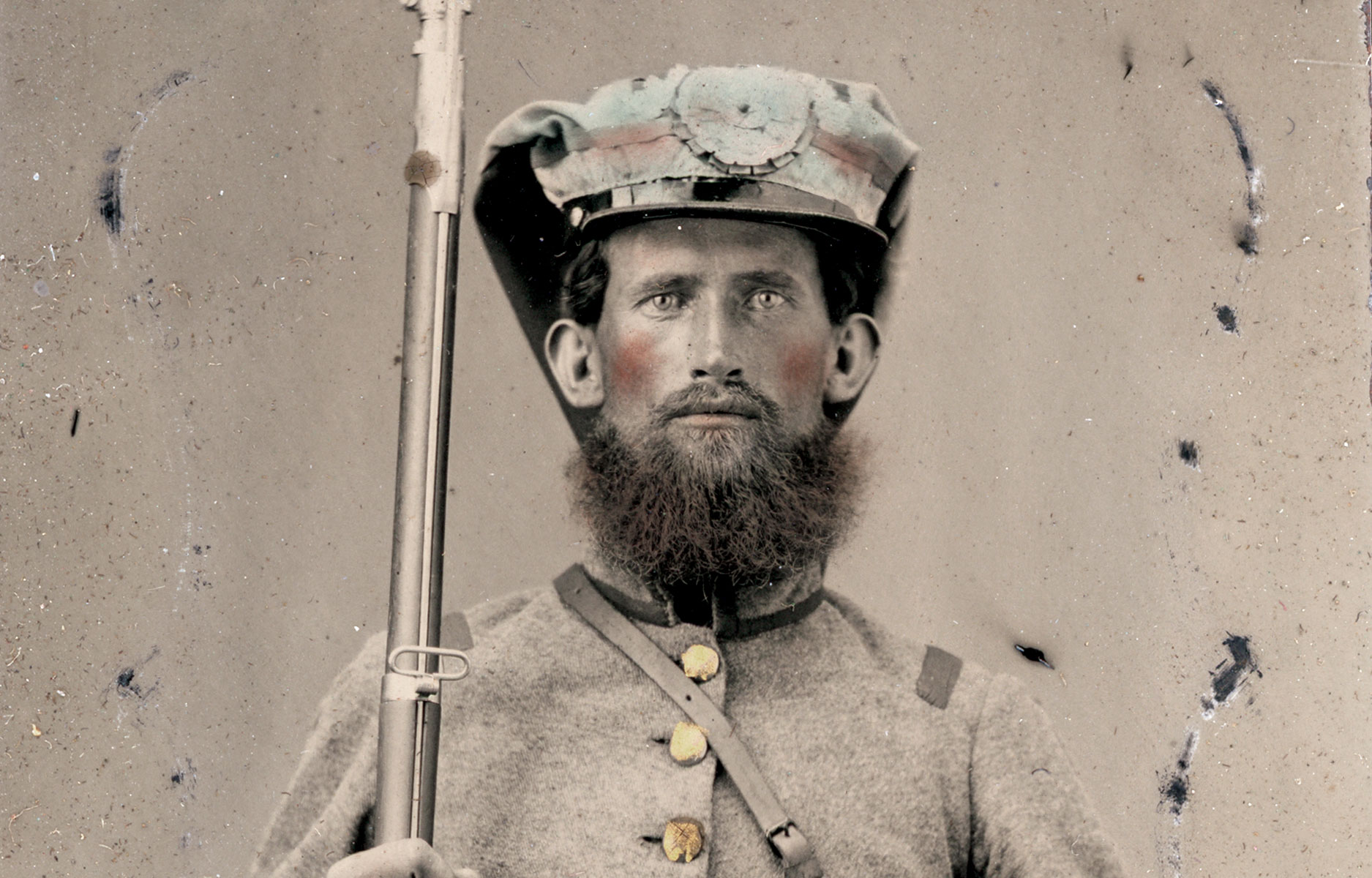

The complete issue
Vol. XXXVII, No. 3
(80 pages)
Print edition: Visit our store to check availability
Digital edition: Visit JSTOR.org to purchase
Subscribe to MI ($24.95)
Explore the MI Archives: Browse | Advanced search | Tutorial
Inside
Cover image
A sixth-plate daguerreotype from the Dr. William Schultz Collection pictures a Mexican War era enlisted man.
Download (free)
Table of Contents (p. 1)
Download (free)
Editor’s Desk (p. 2)
The editor discusses reflects on the passing of pioneer photograph collector Henry Deeks.
Download (free)
Mail Call (pp. 3-4)
Feedback includes tributes to late collectors Henry Deeks and Jim Frasca, and a note about credited photos.
Download (free)
Military Anthropologist (p. 4)
An analysis of occupations in the 1860 U.S. Census reveals the various ways in which photographers identified themselves.
Passing in Review (p. 6)
Our Brethren Are On the Field: Letters, Diaries and Remembrances From Those Who Fought and Campaigned For Chattanooga by Dick Ransom and Brad Quinlin (Mountain Arbor Press) is a book inspired by a World War II Act of Heroism.
Download (free)
Photo Sleuth by Kurt Luther (pp. 8-9)
In “Second Opinion,” Kurt discusses a new enhancement to Civil War Photo Sleuth, called Second Opinion, which allows users to gather additional feedback about a specific aspect of a photograph.
Antebellum Warriors (p. 10)
A sixth-plate ambrotype from the Rick Brown Collection is a portrait of a prototypical militiaman on the eve of the Civil War.
The Honored Few (p. 12)
Hubert Anton Casimir Dilger, a captain in the 1st Ohio Light Artillery, fought a delaying action at the Battle of Chancellorsville for which the government recognized his actions with the Medal of Honor.
Most Hallowed Ground (p. 14)
James Downey, a private in the hard-fighting 2nd Ohio Cavalry, survived numerous operations during the war. His luck ran out on April 1, 1865, during the Battle of Five Forks. Wounded in action, he succumbed to his injuries in Washington, D.C., and was laid to rest in Arlington National Cemetery.
The Citizenry (p. 16)
Almost nothing is known about the life of Diven Glover, save one significant detail: She was an enslaved woman. Her photograph, as well as the man, who owned her, Capt. George Frederick Glover of the 43rdd Alabama Infantry, are pictured here.
From Vera Crux to Mexico City: A survey of Mexican War era portraits of West Pointers, Regulars and Volunteers by Dr. William Schultz (pp. 18-28)
Representative images include future President Franklin Pierce and career military men who went on to become generals during the Civil War, including the Union’s Richard Delafield, George H. Gordon, William A. Nichols, Charles F. Smith, George H. Thomas, and Confederates Dabney H. Maury and John S. Williams.
Glinting Cutlasses and Flashing Revolvers: Ensign Abner Stover’s Civil War by Ronald S. Coddington, featuring images and artifacts from the Herman Kinder Collection (pp. 30-36)
Ensign Abner Stover’s navy service began on the Union blockade off the coast of Georgia aboard the gunboat Water Witch. It ended in a trip to a prison camp after a night attack by Confederate forces ended in the capture of the vessel. He told the story of his capture and imprisonment in a previously unknown diary.
A Tale of Two Steamers by Ron Field (pp. 38-40)
A pair of spectacularly tinted sixth-plate tintypes picture an Eads-class gunboat and other vessels. Two of the steamers, the Edward Walsh and the Hamilton Belle, are identified. Senior Editor Ron Field examines their service along the Mississippi River, and recognizes that little scholarship has been written about the contribution of these workhorses to the war effort.
Cadet to Boy Colonel: The life and service of North Carolina’s Henry King Burgwyn, Jr. by Dave Batalo and Rusty Hicks with Ronald S. Coddington (pp. 42-46)
Henry King Burgwyn, Jr., of the 26th North Carolina Infantry left Virginia Military Institute after the war began and rose in rank to become colonel of the 26th North Carolina Infantry. He led his men into action on the first day of the Battle of Gettysburg and suffered a mortal wound in the thick of the action against Wisconsin troops of the Iron Brigade. Burgwyn’s story is illustrated with three likenesses of him, two photographs from his pre-war days at VMI and a portrait painted in 1904.
President Lincoln’s Bodyguard for a Day: Sgt. H. Paxton Bigham’s Gettysburg experience by Paul Russinoff (pp. 48-51)
Hugh Paxton Bigham has a unique connection to the Battle of Gettysburg. A local farmer from who grew up close to town, he participated in some of the earliest action during the days leading up to the engagement. Months after the fight, he served as personal bodyguard to Abraham Lincoln during his historic Gettysburg in November 1863 to dedicate the Soldier’s Cemetery.
Dwelling in Peace in the Land of the Spirits: Pvt. Admiral Coon’s portraits reveal a family’s pain and sorrow by Paul D. Mehney and Charles Joyce (pp. 52-56)
Portraits of Pvt. Admiral T. Coon of the 137th New York Infantry with his sister and nephew speak to the separation that affected hundreds of thousands of families in the North and South. In Coon’s case, a wound suffered at Gettysburg proved mortal—and deprived his sister of a brother and a nephew of an uncle.
Profiles of Union Soldiers in the Thick of the Fight for Petersburg by Scott Valentine (pp. 58-61)
A collection of five portraits of infantrymen from the author’s collection, each accompanied by narrative of the subject’s experience during the Petersburg Campaign, highlight the challenges of the brutal operations. They include George C. Case of the 57th New York, Frank H. Kempton of the 58th Massachusetts, Arthur V. Coan of the 146th New York, Samuel S. Foss of the 8th Connecticut and John M. Gilfillan of the 39th New York.
PIPs (Photos in photos) from the Doug York Collection (pp. 62-65)
Portrait photographs of individuals posed with a photograph of someone else are uncommon. Yet they were made throughout the 19th century. We offer a selection of representative images from the collection of Doug York.
Pre-Imposition Tax Stamps by Scott Vezeau (pp. 66)
It is well-known to collectors that the federal government taxed photographs to pay for the Civil War. It is a mistake, however, to conclude that tax-stamped images do not exist beyond the official date parameters. The author makes his case with four cartes de visite.
Optics: Military men with field glasses and telescopes (pp. 67-73)
Field glasses and telescopes loomed large in the Civil War. Used by soldiers and sailors to gain an edge over their enemies, it comes as no surprise that numerous references to this essential accouterment appear in period writings—and in photographs.
Educator, Photographist and Prisoner of War: David Heckendorn’s journey as an approved Army of the Potomac photographer by Sidney Dreese, with images from Diane Mazze (pp. 74-75)
Had the war never happened, David Heckendorn might have had a long career in the school system of Union County, Pa. But it did, and Heckendorn, an amateur daguerreotypist, became an approved photographer for the Army of the Potomac. He was captured in Virginia and spent three months in Richmond. He fell ill after his return home and died before the end of the war.
How Much Could Camp Photographers Earn In a Day? A Lot. (p. 76)
A soldier in the 63rd Indiana Infantry wrote a letter to his father chock full of financial details and practical information about photographers in the vicinity of their camp near Bull’s Gap, Tenn., in the spring of 1864. The father no doubt appreciated the intelligence, for he was a practicing photographer. Historian Kraig McNutt researched the letter from the Indiana State Manuscripts Collections.
Stragglers: Distinctive Images from MI contributors (pp. 74-79)
Union and Confederate images include Maj. William McIntosh Arnold of the 6th Georgia Infantry, a non-commissioned Union officer standing in front of an elaborate back drop, a soldier dressed in a red uniform jacket, 1st Lt. Mims Walker of 4th Alabama Infantry and the staff of Brig. Gen. Evander Law, James Madison Crozer of the Confederate 6th Kentucky Cavalry, and more.
The Last Shot (p. 80)
A carte de visite from the Michael J. McAfee Collection has portraits pasted to both sides—on one, an image of a woman with her husband’s sword, the Stars and Stripes and the family dog, and on the other side a vignette of the same dog.