Finding Aid: Winter 2021

Vol. XXXIX, No. 1
(80 pages)

Print edition: Visit our store to check availability
Digital edition: Visit JSTOR.org to purchase
Subscribe to MI
Explore the MI Archives:
Browse | Advanced search | Tutorial

Inside

Cover image
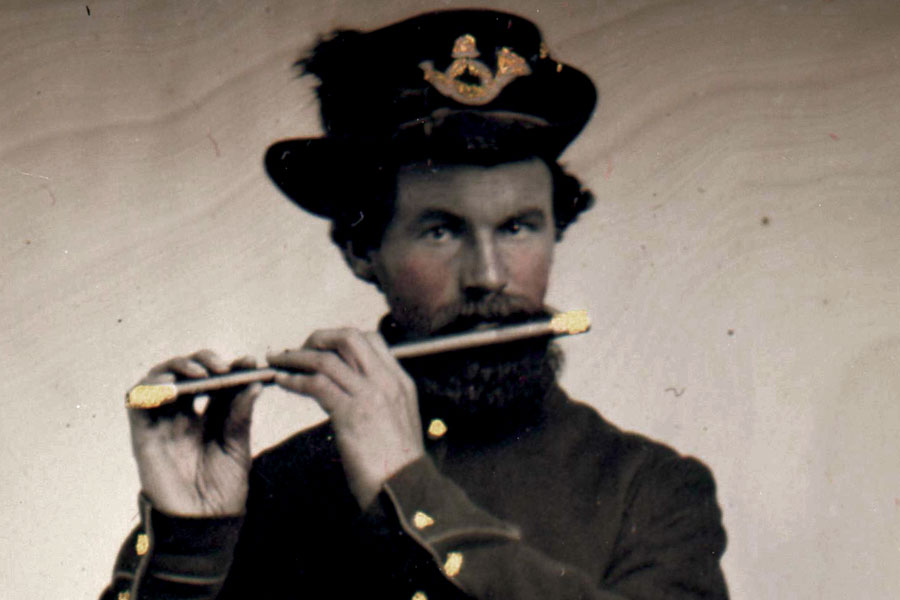
A quarter-plate tintype from the Rick Brown Collection of American Photography pictures an infantry fifer standing with his fife.

Table of Contents (p. 1)

Editor’s Desk (p. 2)
In “Musings on Interpretation,” the editor discusses the word in the middle of the publication’s motto: Showcase. Interpret. Preserve.

Mail Call (pp. 3-4)
Feedback includes praise for Ron Maness’s story about James Taylor Ames, “Agent of the Cotton War,” the identification of a soldier pictured in a post-mortem portrait, and an opinion on modern colorization of antique photographs.

Military Anthropologist (p. 4)
A tree map diagram displays the number of casualties in the major battles of 1861. The numbers were originally reported in Lt. Col. William F. Fox’s Regimental Losses in the American Civil War.

Passing in Review (p. 6)
The trio of books reviewed include the latest volume of Colonels in Blue (McFarland & Company, Inc.) by Roger D. Hunt, American Citizen (Sunbury Press, Inc.) by Benjamin E. Myers, and Civil War Hard Images, Volume 2—Union (SoldierCollectibles.com) by Ben L. Pauley and Chris Anderson.

Photo Sleuth by Kurt Luther (pp. 8-9)
In “Identifying an Officer Pictured in a Library of Congress Negative,” Luther recounts a journey of discovery that included stops along the way at the Medford Historical Society and Museum in Massachusetts and the MOLLUS-Mass Civil War Collection at the U.S. Army Heritage and Education Center at Carlisle Barracks, Pa.

Antebellum Warriors (p. 10)
A sixth-plate daguerreotype from the Paul Reeder Collection features a mounted trooper dressed in a uniform with a decidedly Hussar influence.

The Honored Few (p. 12)
Sergeant Henry F.W. Little of the 7th New Hampshire Infantry received the Medal of Honor for gallantry on the front lines during an attack by Confederates north of the James River in Virginia on Oct. 7, 1864. This is his story.

Most Hallowed Ground (p. 14)
During a brief period in late 1864, a father and son served as officers aboard the side-wheel steamer Quaker City. James Madison Frailey, a career navy man, commanded the vessel. His son, Acting Asst. Paymaster Leonard August Frailey, was at the very beginning of a 41-year stint in the Navy. He is buried in Arlington National Cemetery.

The Citizenry (p. 16)
In “Palms of Victory,” we meet Mary Dines, who escaped slavery in Maryland and fled to Washington, D.C., where she spent time at a Freedman’s camp and had the opportunity to sing for President Abraham Lincoln. Her story was told in the 1942 book They Knew Lincoln by John E. Washington.

Fakes, Forgeries and Frauds by Perry M. Frohne (pp. 18-20)
In “Little-Known Fraud: The Remounted Albumen,” Frohne shares tips to spot cartes de visite prints that have been carefully removed from mounts and replaced on new mounts to make them more saleable.

NHV: New Hampshire volunteers during the Civil War (pp. 23-35)
Representative images and stories of 25 Granite State soldiers capture the spirit, sacrifice and contribution of New Hampshire to the Union armies in the eastern and western theaters. Among the stories included is 1st Lt. Alfred B. Seavey of the 15th New Hampshire Infantry, who picked off a Confederate at Port Hudson, La., Pvt. Mark H. Winkley, who spent most of his enlistment on detached duty as a nurse, and 2nd Lt. Charles A. Hale of the 5th New Hampshire Infantry, who fought at Gettysburg and later returned as a pioneer battlefield guide.

New Hampshire’s Distinctive Caps by C. Paul Loane (p. 36)
The Granite State provided its volunteer regiments with caps marked with the letters NHV. The author offers an overview of the distinctive cap, illustrated with a pristine example from his collection, which belonged to a member of the 15th New Hampshire Infantry.

Material Culture by Ron Field (pp. 37-42)
In “Uniforms of the Granite State,” Field examines the varied uniforms supplied to New Hampshire troops.

Fifers (pp. 43-51)
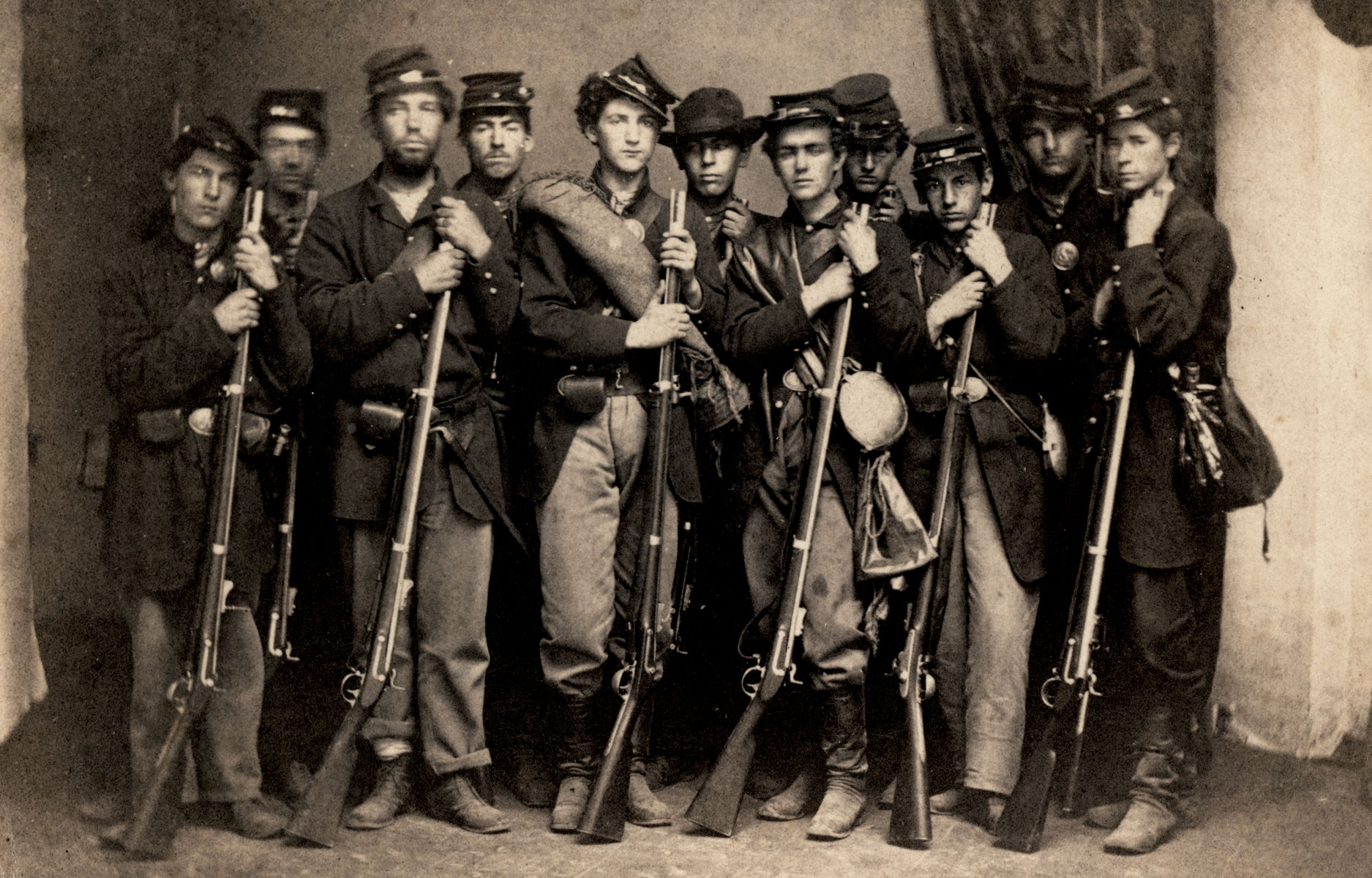
A gallery of images collected in collaboration with Editor Dale Nielsen of the Facebook group “The Image Collector” and contributions by collectors, reviewed by Contributing Editor Chris Nelson, is focused on soldiers pictured with their fifes. The majority of images are individual Union portraits. One Confederate image features a fifer posed with his instrument and a Bowie knife.

Morgan’s Lightning Strikes by Dave Batalo and Ben Greenbaum (pp. 52-56)
An unpublished likeness of George A. Ellsworth, John Hunt Morgan’s master of telegraphic communications, is featured here along with a narrative of his career as a telegrapher. Ellsworth, a Canadian national, was Morgan’s secret weapon in raids against Union outposts in Kentucky and Tennessee. Ellsworth’s gained his reputation for hacking into federal telegraph wires.

When Yellow Is Black and Blue Is White: Understanding color within the confines of the wet plate process by Elizabeth A. Topping (pp. 57-60)
Wet plate photography was sensitive only to blue light, which created significant challenges for photographers seeking to satisfy demanding consumers. To compensate for the limitations of the process, photographers needed to understand how to work within nature’s laws to create a realistic portrait, and to coach clients on what to wear and how to dress. The latter instructions proved helpful to civilians who had freedom to dress for the camera, but not as useful to military men constrained by uniforms that conformed to regulations.

Restrained vs. Martial: Masculine ideals in Civil War photographs by Austin Sundstrom (pp. 62-64)
Categorizing Civil War portraits by the way soldiers conveyed their masculinity is, according to the author, a less-traveled path in classifying such images. Here. The concepts of restrained and martial are defined, with examples of each from The Liljenquist Family Collection at the Library of Congress.

Stragglers: Distinctive Images from MI contributors (p. 65)
Included are portraits of a group of soldiers in a camp band, a hospital steward from the 9th New York Infantry (Hawkins’ Zouaves), a young clarinetist, and a view of Lawrence, Kan., two years after the devastating Quantrill’s Raid.

The Montage by Tom Glass (pp. 66-69)
Overlooked and undervalued by today’s collectors, montages of military officers and political figures of the Union and Confederacy were highly collectible during the Civil War. The author documents a dozen images of this genre.

Revealing the Hidden Beauty of an Ambrotype by Adam Ochs Fleischer (pp. 70-72)
Using a scanner equipped with a film negative feature, the author used this setting to scan an ambrotype of a sailor. The result was a scan that revealed stunning details not visible in the original image.

The 10th New York Cavalry at Gettysburg: Investigating the origins of three similar albums by Kyle M. Stetz (pp. 73-77)
Three surviving carte de visite albums filled with images of identified troopers of the 10th New York Cavalry are at the heart of this investigation. The author’s research reveals where and when they were taken, why these specific individuals were photographed, and the probable identity of the photographer.

Behind the Backdrop: Origins, artistry and photographers by Adam Ochs Fleischer (pp. 78-79)
In “The Augusta or Portland, Maine, Backdrops,” Fleischer examines the distinctive painted canvases connected to portraits of Maine soldiers.

The Last Shot by Mike Fitzpatrick (p. 80)
A ninth-plate tintype from the author’s collection pictures a young soldier with a greenback stuffed into his jacket.
Agent of the Cotton War

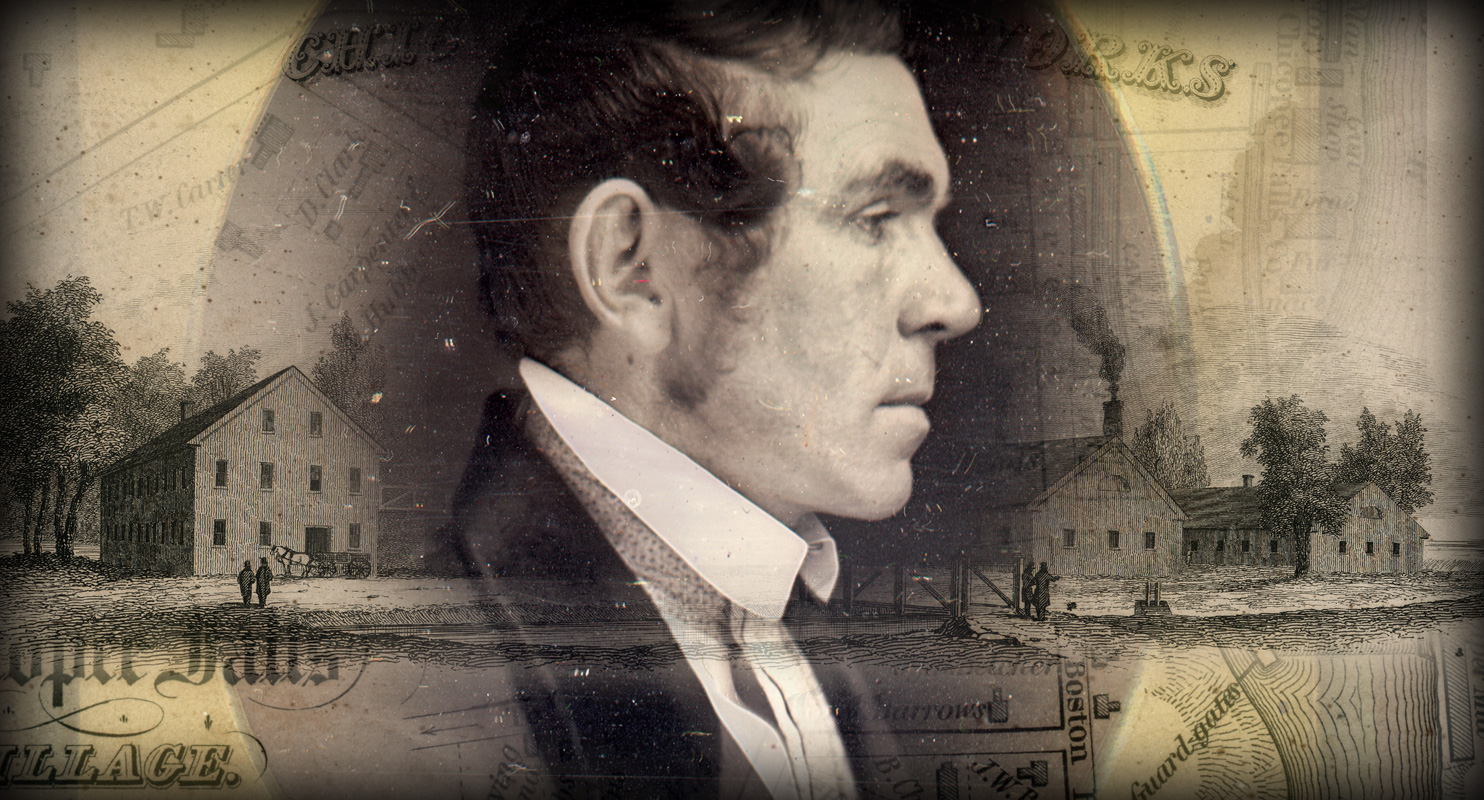
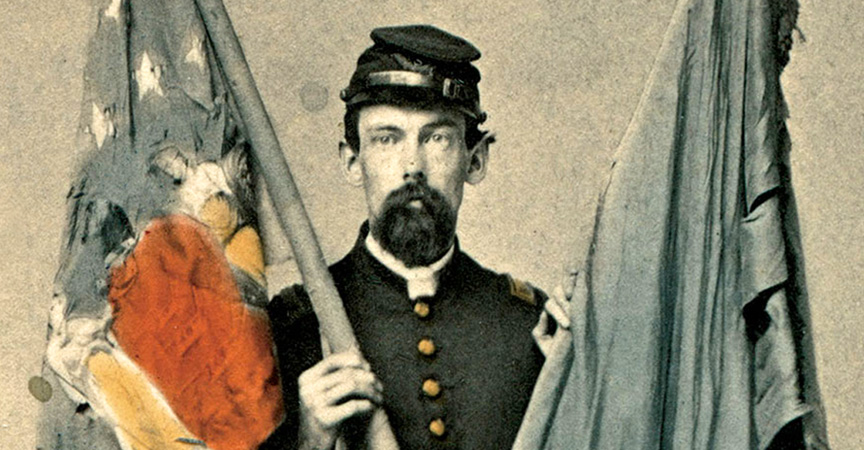
Most know James T. Ames as a New England sword maker. He was also a global manufacturer of munitions and cotton machinery with Confederate connections. This investigation into is connections involves pikes supplied to abolitionist John Brown, dealings with Great Britain and sales of weapons and machinery to the Southern states before, during and after secession. For details, see our finding aid.

Perfect Tiger

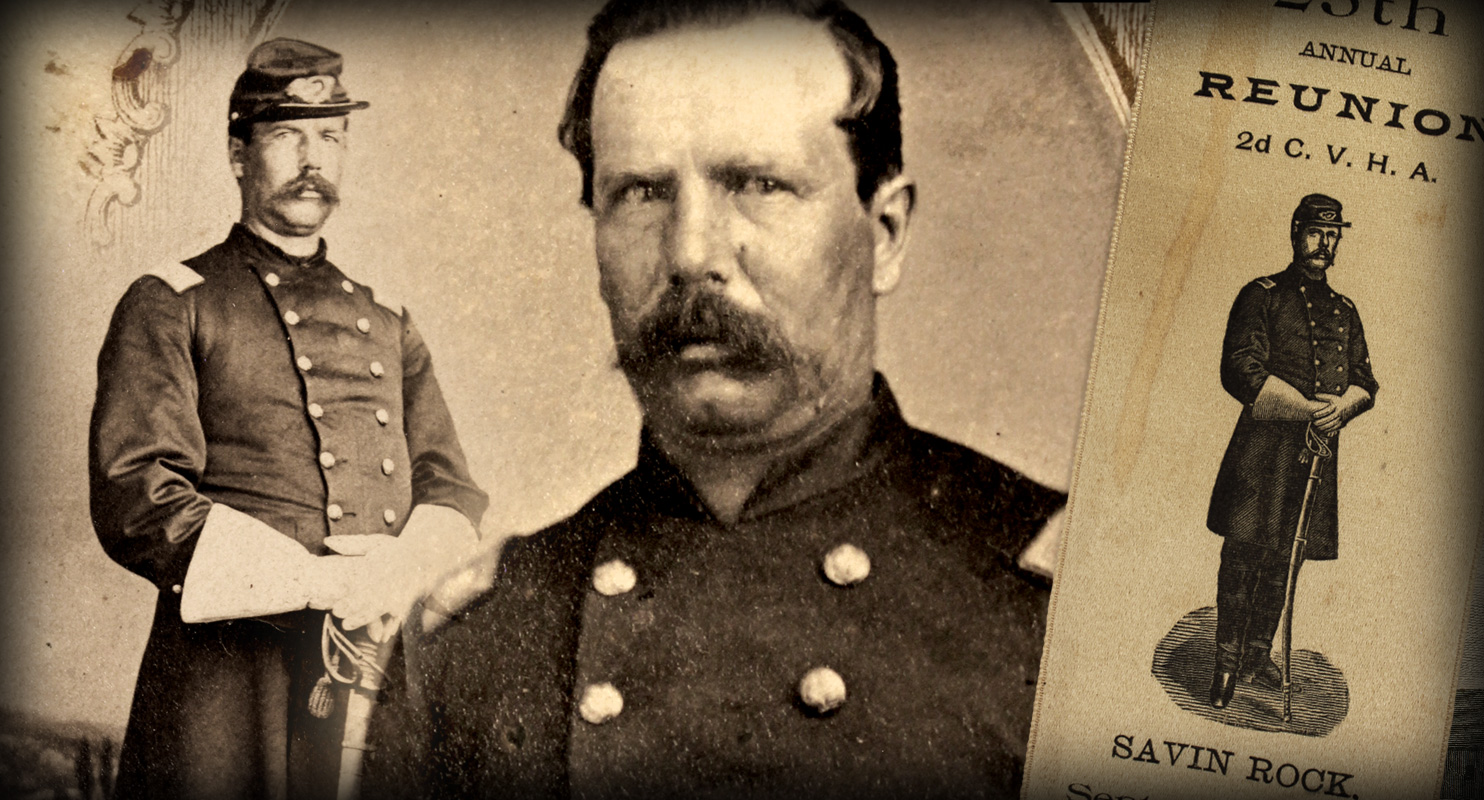
Elisha Strong Kellogg, the colonel who led the 2nd Connecticut Heavy Artillery into the 1864 Battle of Cold Harbor, was a study in contrasts. “His nature was versatile, and full of contradictions; sometimes exhibiting the tenderest sensibilities and sometimes none at all,” noted one soldier. Beloved by his men, Kellogg’s destiny rose and fell with his regiment. For details, see our finding aid.

Finding Aid: Autumn 2020

Vol. XXXVIII, No. 4
(80 pages)

Print edition: Visit our store to check availability
Digital edition: Visit JSTOR.org to purchase
Subscribe to MI
Explore the MI Archives:
Browse | Advanced search | Tutorial

Inside

Cover image
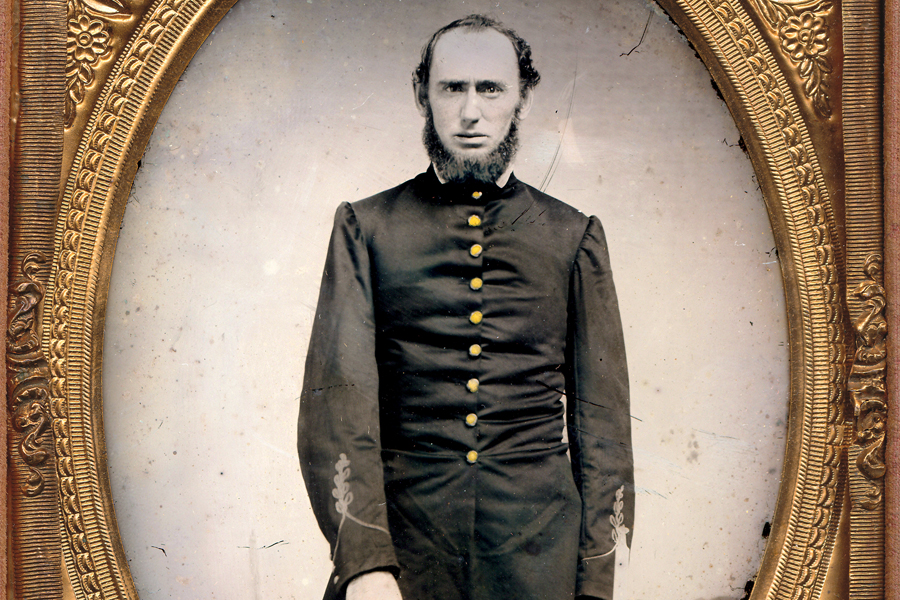
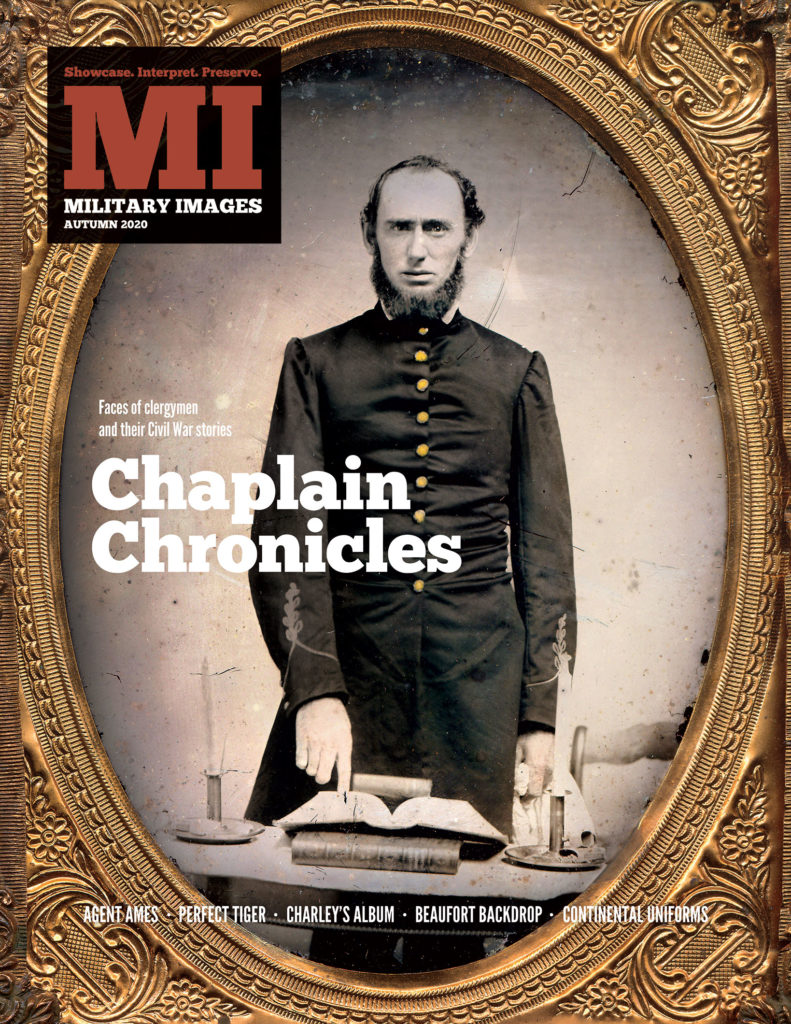
A quarter-plate ambrotype from the Dan Schwab Collection pictures Chaplain Nicholas A. Davis of the 4th Texas Infantry.

Table of Contents (p. 1)

Editor’s Desk (p. 2)
The editor puts photographs and stories of Civil War soldiers and sailors into context in “Guidebook to Our American Journey.”

Mail Call (pp. 3-4)
Feedback includes praise for Adam Ochs Fleischer’s Behind the Backdrop column, and thoughts on a lantern slide Barbara Fritchie that appeared in our summer issue.

Military Anthropologist (p. 4)
A study of 250 Civil War soldier and sailor cartes de visite taken by photographers across the country reveals six major styles of mount borders.

Passing in Review (p. 6)
MI Senior Editor Ron Field’s new book, Uniforms of the Union Volunteers of 1861: The Mid-Atlantic States, examines distinctive uniforms worn by Pennsylvanians, New Yorkers, Jerseymen, Delawareans, Marylanders and soldiers from the District of Columbia.

Photo Sleuth by Kurt Luther (pp. 8-9)
In “The Art of Photo Sleuthing,” Luther examines how paintings, long the dominant portraiture form prior to the advent of photography, are a neglected resource that should be considered when researching the identity of a Civil War soldier.

Antebellum Warriors (p. 12)
A quarter-plate tintype pictures an unusual view of a soldier wearing a Pattern 1839 “wheel cap” with a glazed linen rain cover.

The Honored Few (p. 14)
Sergeant Lester Archer of the 96th New York Infantry carried the colors of his regiment during the assault of Union forces against Fort Harrison. He planted the flag on the enemy parapet and for his action received the Medal of Honor.

Most Hallowed Ground by Carolyn B. Ivanoff, with images from the Captain Wilson French Collection (p. 16)
The zenith of Maj. William H. Hugo’s military career occurred at Gettysburg’s Peach Orchard. The low point came in the West in 1881 when he was court martialed. The story of how his highs and lows is told here.

The Citizenry by Elizabeth Topping(p. 18)
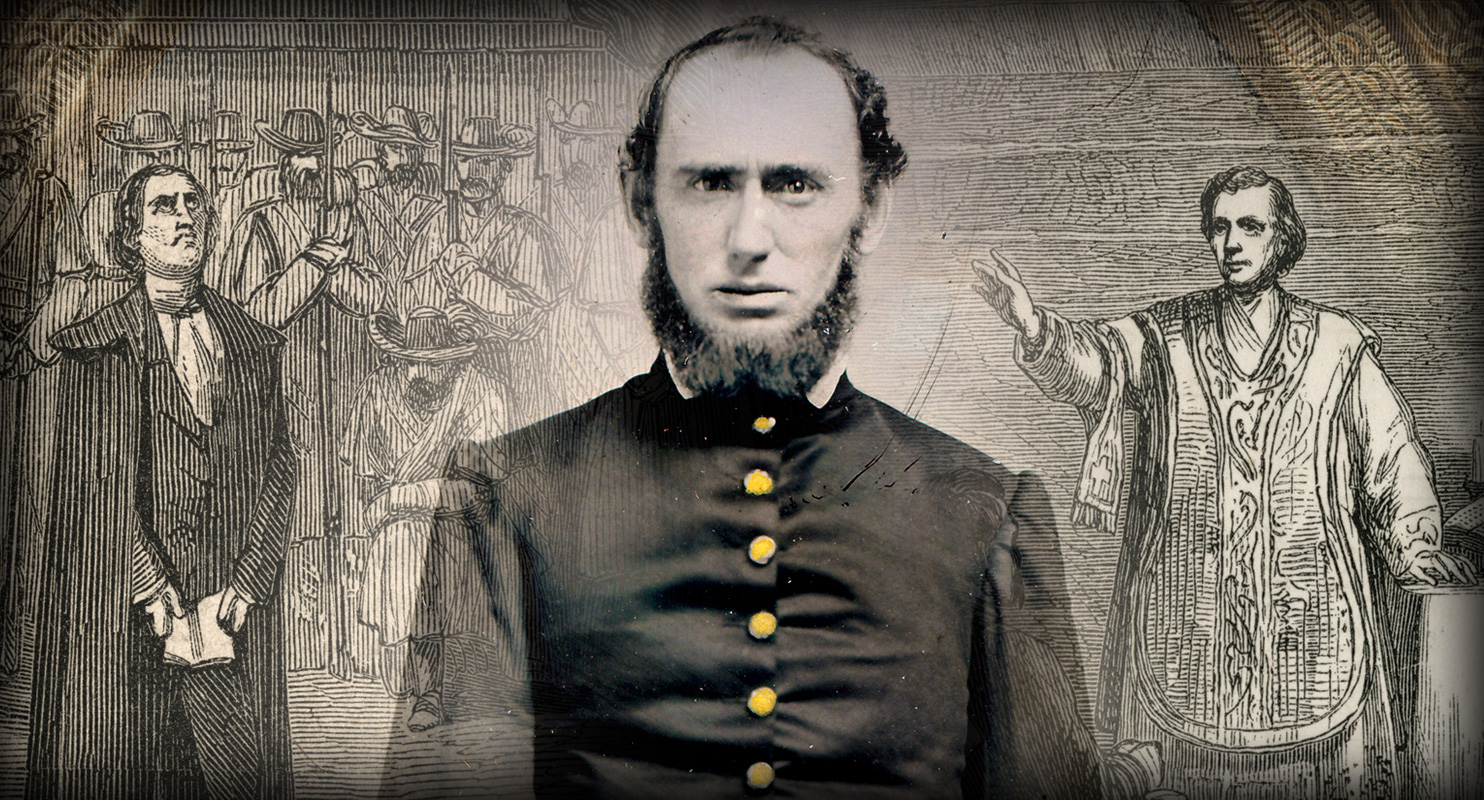
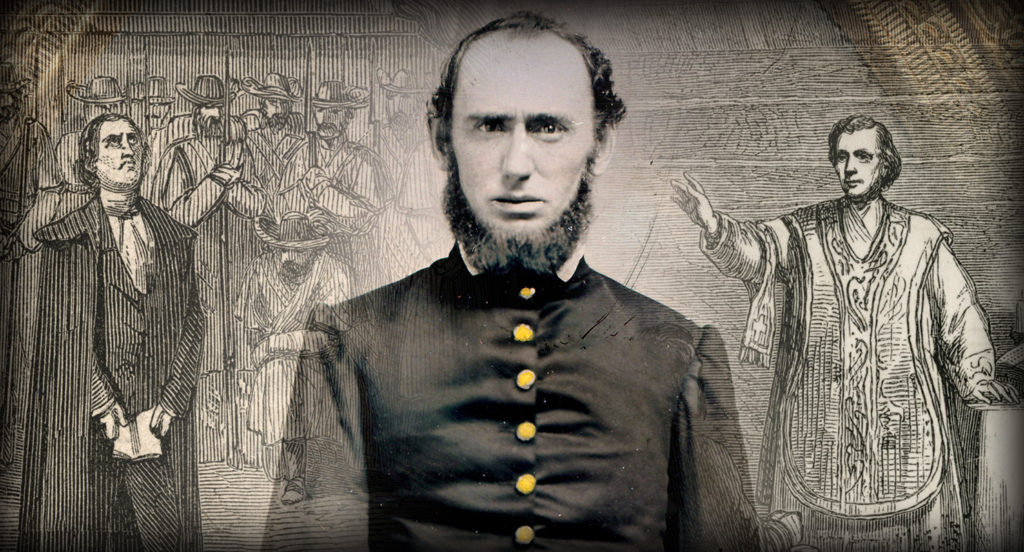
In “The Circuit Rider,” we meet Rev. Allen H. Tilton, a traveling Methodist clergyman who spread the word of God throughout central Ohio. In 1864, he traveled 7,000 miles to 100 locations across the Buckeye State.

Fakes, Forgeries and Frauds by Perry M. Frohne (pp. 20-21)
In “Bogus Modern Ink Identifications,” Frohne details how fakers add signatures and related inscriptions to dramatically increase the value of cartes de visite, and how to tell the difference between a faked signature and the real thing.

Chaplain Chronicles (pp. 23-46)
Faces of 40 Union and Confederate clergymen and their stories of spirituality, slavery, courage, caregiving, patriotism, suffering and death during the Civil War.

Agent of the Cotton War by Ron Maness, with images and artifacts from the author’s collection (pp. 48-57)
Most know James T. Ames as a New England sword maker. He was also a global manufacturer of munitions and cotton machinery with Confederate connections. This investigation into is connections involves pikes supplied to abolitionist John Brown, dealings with Great Britain and sales of weapons and machinery to the Southern states before, during and after secession.

Charley’s Album: A pocket-sized treasure recalls a Connecticut officer’s war experience by Dione Longley and Buck Zaidel (pp. 58-61)
Civil War soldiers filled uncounted albums with photographs of their pards to remember friendships forged against a backdrop of war. Time has taken many of them from us. Some survived intact, including this worn leather album small enough to slide into a shirt pocket. It holds just ten photographs—one Charley Deming’s world.

Perfect Tiger: Connecticut’s Col. Elisha Strong Kellogg by Dione Longley and Buck Zaidel, with images and artifacts from the Buck Zaidel Collection (pp. 62-66)
The colonel who led the 2nd Connecticut Heavy Artillery into the 1864 Battle of Cold Harbor was a study in contrasts. “His nature was versatile, and full of contradictions; sometimes exhibiting the tenderest sensibilities and sometimes none at all,” noted one soldier. Beloved by his men, Kellogg’s destiny rose and fell with his regiment.

Caught in the Crossfire: A surgeon in Sherman’s Army between quarreling generals by Frank Jastrzembski (pp. 67-69)
Medical Director Surg. Norman Gay incurred the wrath of Brig. Gen. Thomas W. Sweeny while trying to protect a corps ambulance, and in doing so wandered into an infamous feed between Sweeny and another general, Grenville M. Dodge. Here’s the story.

Grant After Vicksburg: Solving the mystery of who took the general’s photograph by James Bultema (pp. 70-71)
The summer of 1863 was a career-defining period for Ulysses S. Grant as his army captured Vicksburg and secured the Mississippi River for the Union. Five portraits taken of the victorious general weeks later picture Grant as he looked during the historic moment. The author shares his evidence for who he believes is the photographer who made the images.

Material Culture by Ron Field (pp. 72-76)
In “Uniforms Inspired by the “Old Seventy-Sixers,” Field examines the distinctive militia uniforms inspired by Gen. George Washington’s Continentals.

Stragglers: Distinctive Images from MI contributors (p. 77)
Included are portraits of a soldier with a unique belt, an unidentified chaplain and a sergeant who likely served in an infantry regiment that belonged to the U.S. Colored Troops.

Behind the Backdrop: Origins, artistry and photographers by Adam Ochs Fleischer (pp. 78-79)
In “Beaufort’s Mystery Backdrop,” Fleischer examines the distinctive painted canvas connected to portraits taken in Beaufort, S.C., in 1862.

The Last Shot (p. 80)
A sixth-plate tintype from the Brian Boeve Collection pictures a Confederate brandishing a revolver produced by the Starr Arms Company.

Material Culture

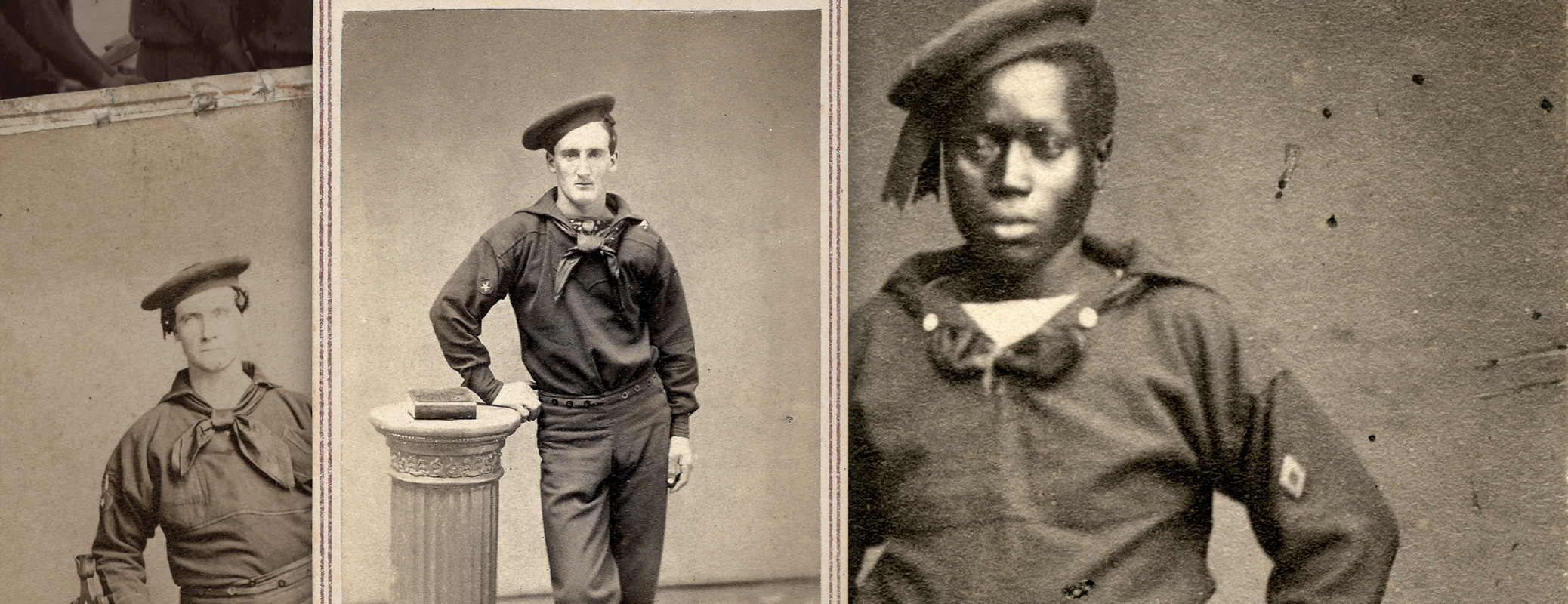
In “U.S. Navy Watch Marks, 1861-65,” Field examines the unique patches that appear on the sleeves of sailors to insure the safe operation of vessels during the war years. For details, see our finding aid.

Old Abe and the Army of the American Eagle

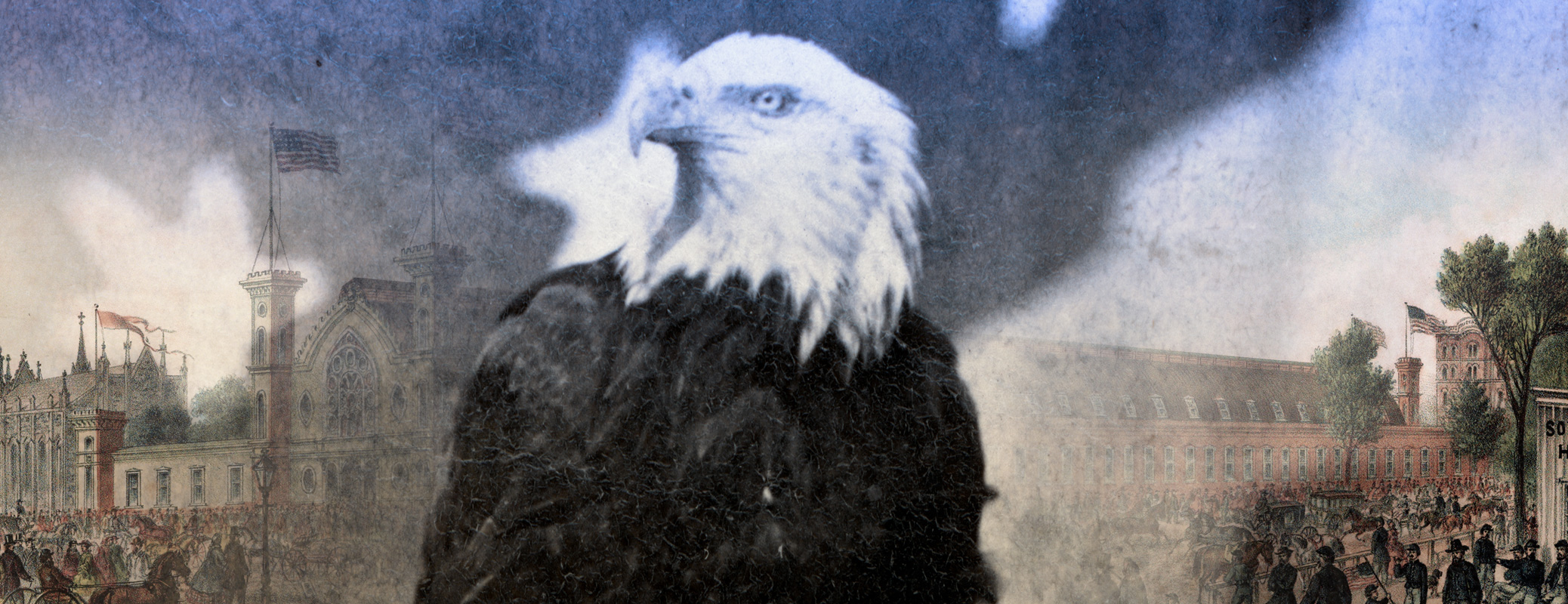
Chicago printer Alfred L. Sewell devised a novel fundraiser to support the Union army: Selling carte de visite sized portraits of Old Abe, the famed Eagle mascot of the 8th Wisconsin Infantry. Sewell targeted kids, who purchased tens of thousands of the images under the auspices of the U.S. Sanitary Commission. Children earned commissions in Old Abe’s army, and a small number received Medals of Honor for the number of images purchased. For details, see our finding aid.

America’s “Good Death”

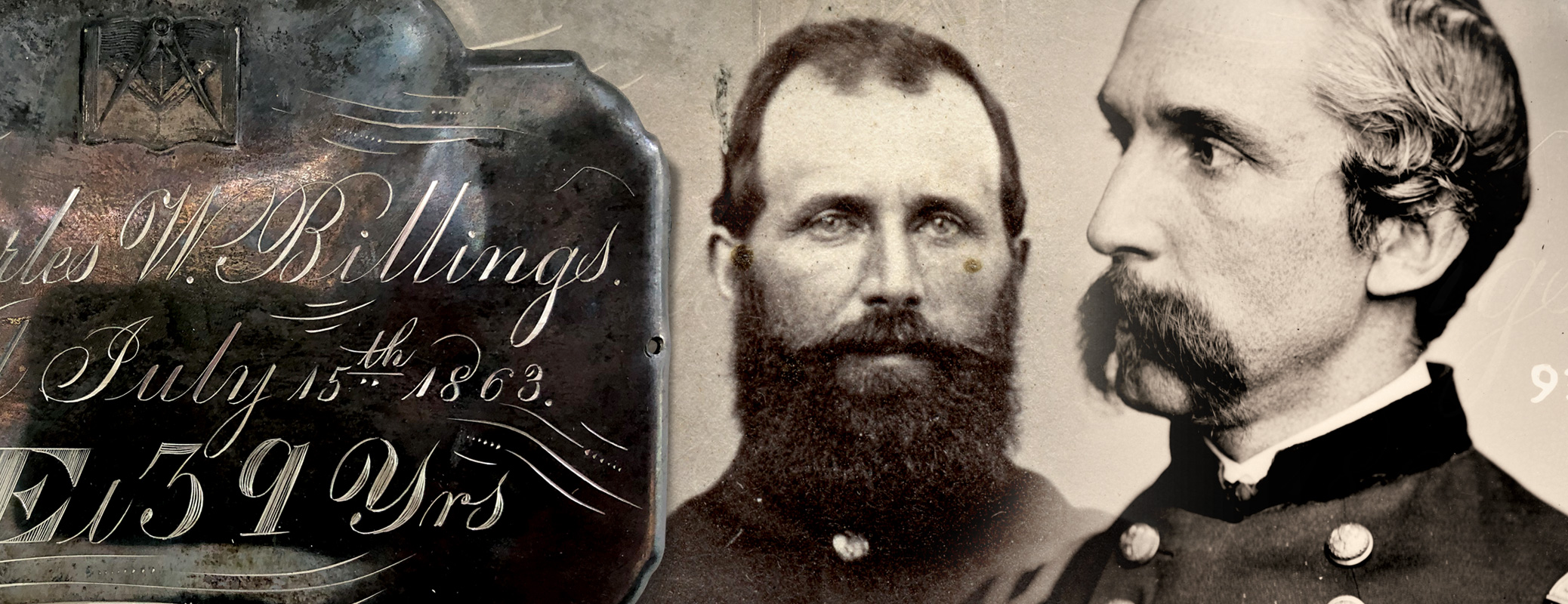
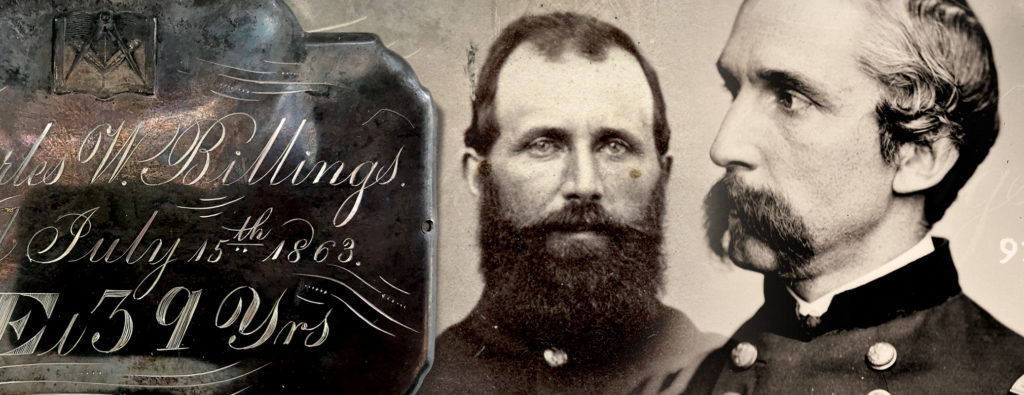
Capt. Charles W. Billings of the 20th Maine Infantry suffered a mortal wound at Little Round Top. Russinoff brings together primary sources and artifacts for the first time to tell Billings’ story, which underscores historian Drew Gilpin-Faust’s concept of “The Good Death.” For details, see our finding aid.