Finding Aid: Autumn 2015

The complete issue

Vol. XXXIII, No. 4
(60 pages)

Print edition: Visit our store to check availability
Digital edition: Visit JSTOR.org to purchase
Subscribe to MI
Explore the MI Archives: Browse | Advanced search | Tutorial

Inside

Cover image
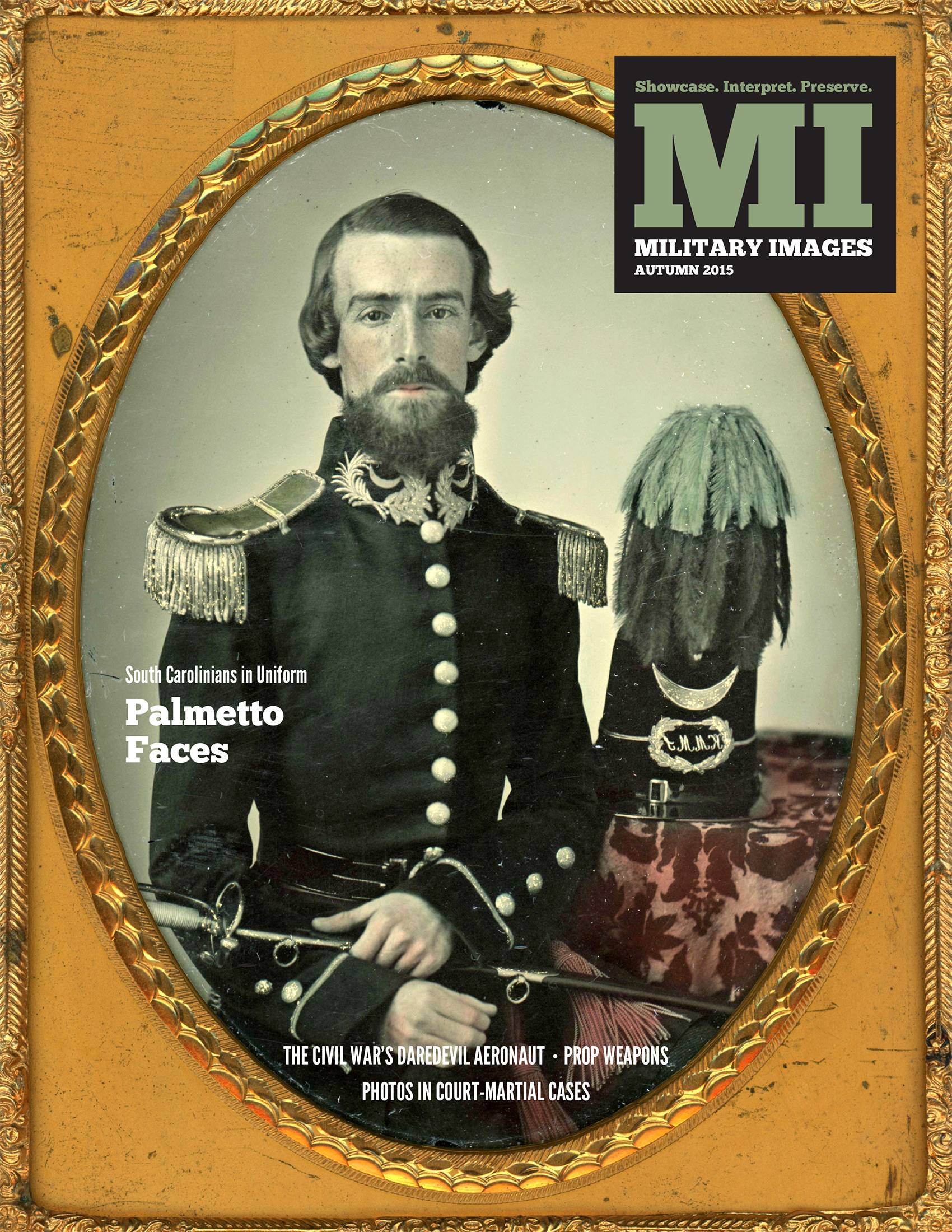
A quarter-plate ruby ambrotype of a second lieutenant is posed with his staff officer sword and plumed dress cap from the Thomas Harris Collection.
Download (free)

Table of Contents (p. 1)
Download (free)

Editor’s Desk (p. 2)
Though it may seem innocuous, the question of whether or not the musket a soldier carries or the uniform he wears actually belonged to him is a hot topic among those who study soldier portraits. At the heart of this debate lay an essential question: What is a prop?
Download (free)

Mail Call (p. 3)
Feedback includes the identification of an image from the Brian Boeve gallery (Winter 2015) as a New Hampshire soldier and a U.S. Colored Infantry officer, an image of a Union soldier from Iowa with an Abraham Lincoln mourning badge pinned to his uniform, kind words about the latest issues of the magazine, and an observation that chevrons with a star were worn by color sergeants in addition to ordnance sergeants.
Download (free)

Passing in Review (p. 4)
If you thought that the Images of America books by Arcadia Publishing trace the history of the country through vernacular photography of small towns, think again. At least 45 Civil War-related volumes are in the series. If they are all as well produced as Remembering Michigan, make room in your library for the set.
Download (free)

Palmetto Faces by Ron Field (pp. 6-17)
A survey of 22 ambrotypes, cartes de visite and tintypes of militia and volunteers from South Carolina. They were the first troops to see service in the defense of the short-lived Republic of South Carolina in 1861 and some of the last to defend the Confederate States of America in 1865. During that time, about 17,000 South Carolinians soldiers died—almost a third of its male white population of fighting age.

Love Found and Lost by Kevin D. Canberg (pp. 18-21)
154 years after war killed a budding romance between a New Hampshire boy on his way South to fight the war and a Pennsylvania farm girl began at a train station, a chance discovery brought their portraits together.

Photo Sleuth by Kurt Luther (pp. 22-25)
In “Revealed: The Identity of an Officer in an Iconic Group Portrait,” Luther describes his journey to determine the name of the white officer pictured in a lithograph of African American soldiers at Camp William Penn outside Philadelphia, Pa. The lithograph is based on a photograph that was sold by antiques dealer James Spina to an unknown collector in the 1970s. The image has not been seen since.

“Glory to Stand Upon Some Lofty Pinnacle” by Katharina Schlichtherle (pp. 26-29)
Jesse Sharpe Barnes was killed in action as he led his company in the 4th North Carolina Infantry against a redoubt during the Battle of Seven Pines. on May 31, 1862. The journey of the 23-year-old captain from political turmoil to death on a Virginia battlefield is the story of a young man changed by the instability of the times.

Armed to the Teeth? The Use of Prop Weapons in Civil War Studio Photography by Katelyn Brown (pp. 32-36)
“Few people would dispute the accepted fact that battlefield photographers of the Civil War sometimes included props—even human beings—in their photographs. Alexander Gardner famously moved corpses in his photographs at Gettysburg, and Thomas C. Roche posed his black assistant in several shots around Petersburg. As this was common practice in the field, who is to say that the studio portrait of the fierce-looking Civil Warrior armed to the teeth did not include props?” While obvious instances of props exist, a more challenging question to analyze involves the use of weapons as props.

Antebellum Warriors (p. 37)
A second lieutenant who graves the cover of this issue was an instructor at the King’s Mountain Military School in Yorkville, S.C. His identity is not known, though an examination of surviving photographs of officers who served at the school suggests that the officer went on to become one of the Confederacy’s best generals.

Mistaken Identity? Early Use of Photographic Evidence in Two Court-Martial Case for Desertion by Elena Colón-Marrero (pp. 38-40)
Two court-martial cases that arose at the end of the Civil War—one in Albany, N.Y., and the other in Springfield, Ill.—reveal how some litigants relied on more than the spoken word to determine identity. The cases of Simon Burke and William Gemmill, both tried in September 1865, used photographs as a key method to identify suspected deserters.

The Honored Few (p. 41)
Amidst the roar of battle at Trevilian Station, Va., on June 11, 1864, 1st Lt. Noble Delance Preston of the 10th New York Cavalry lay in a plowed field bleeding profusely. His courage ultimately resulted in his receipt of the Medal of Honor.

America’s Champion Aeronaut in the Civil War by Sarah Hopkins (pp. 42-44)
Bavarian-born John H. Steiner was a daredevil aeronaut who barnstormed across the United States before the war. In the Union army, he conducted the only successful balloon observations in the western theater.

From the “Star” to the “Shenandoah” by Ronald S. Coddington (pp. 46-47)
It may be fairly stated that John Grimball of Charleston, S.C., served from the beginning to the end of the war. On Jan. 9, 1861, he was part of the garrison of Fort Moultrie that drove the Union steamer Star of the West away from Charleston Harbor. He was also aboard the Shenandoah during her final cruise that ended on Nov. 6, 1865.

Uniforms & History by Michael J. McAfee (p. 48)
In “Cap Insignia: Topping It Off,” McAfee notes that U.S. Army Regulations of 1861 were very specific on what trim should be placed on the 1858 forage cap, and yet no one seemed to follow the rules.

Stragglers (pp. 49-51)
Unique images contributed by MI readers include Corp. Jacob Nicholas Haupt of the 7th Maryland Infantry, who was captured in The Wilderness and sent to Andersonville Prison; a light artilleryman with a seldom seen sword knot; and four cartes de visite of William K. Taylor of the 50th Pennsylvania Infantry.

Tintype Stares and Regal Airs by Isidora Stankovic (pp. 53-57)
In this essay, Stankovic examines the impact of Civil War portrait photography and soldier memorialization. “In this total war, the volunteer fighters secured a new individualized identity for the common soldier through portrait photographs.”

The Last Shot (p. 59)
A post mortem image of a gaunt Union soldier is a grim reminder of the devastation of disease in the ranks of both armies.
Finding Aid: Nov./Dec. 1980

nov-dec-1980The complete issue

Vol. 2, No. 3
(32 pages)


Print edition: Visit our store to check availability
Digital edition: Visit JSTOR.org to purchase
Explore the MI Archives: Browse | Advanced search | Tutorial

Inside

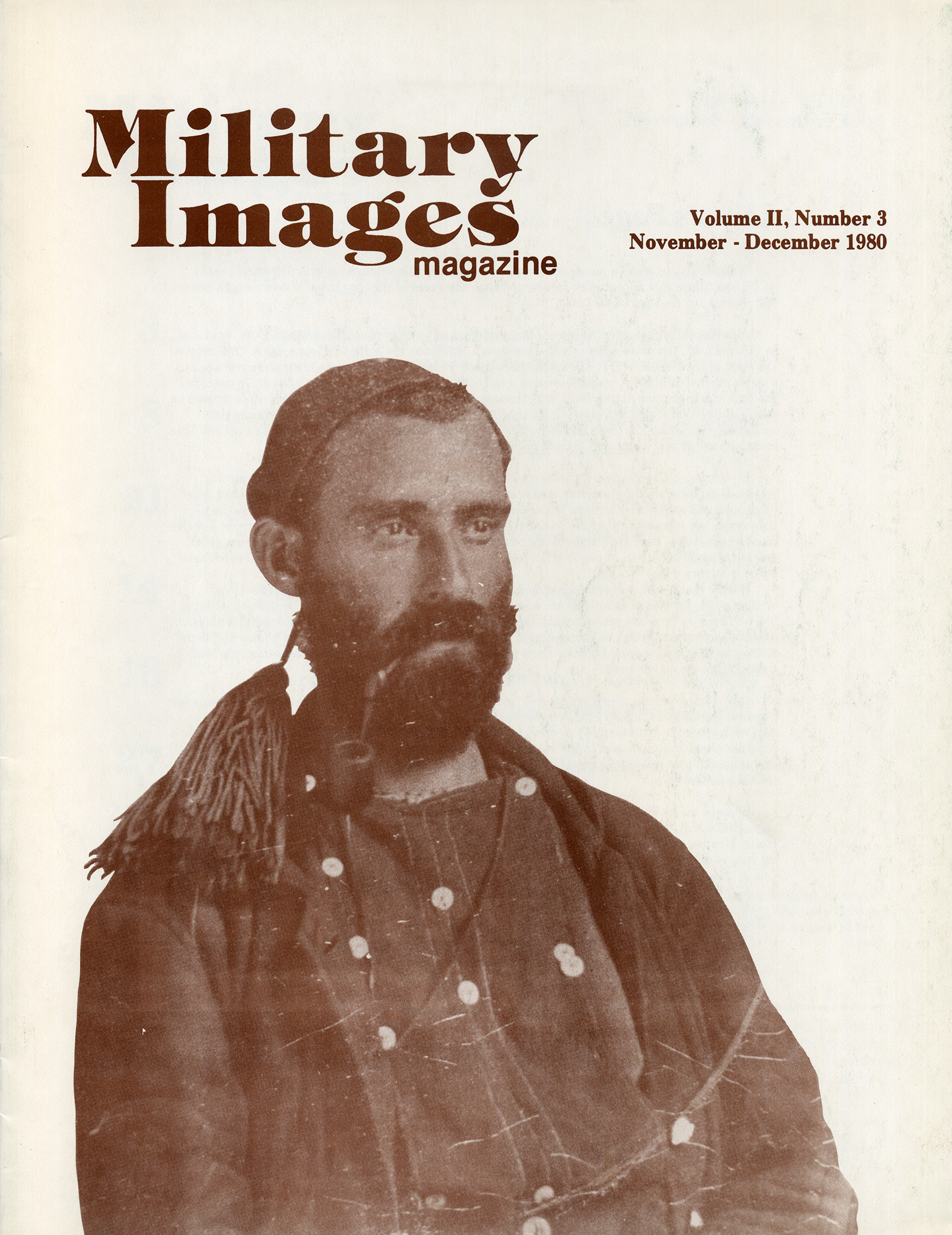
Cover Image
An unidentified Zouave from the 9th New York Infantry from a quarter-plate tintype is on the cover of this issue of Military Images.

Editor’s Page (inside front cover)
The editor responds to questions regarding the content and the goals for the publication. Articles are submitted by the readership, and therefore the range of articles reflects that process. Readers are encouraged to submit articles that feature the “American fighting man” from the advent of photography in 1839 to the outbreak of World War II in 1939.

Mail Call (p. 2)
Readers weigh in on previous issues. A new subscriber expands the reach of the magazine to Australia, while another reader provides further insight into a previous article on the Homestead Steel Strike of 1892. Another reader from the Confederate Historical Association in Brussels, Belgium identifies a mysterious upper arm chevron from a past issue as being that of a Masonic symbol.

Thomas Franlin Dornblaser: Cavalryman in the Army of the Cumberland by Jeffrey S. Mosser (pp. 3-7)
Quoting the humorous writing of the 7th Pennsylvania Cavalry trooper, the article follows the Civil War journey of Thomas Dornblaser from his enlistment as a private in October 1861 to his discharge as a sergeant in August 1865. Dornblaser served in many of the pivotal campaigns in Tennessee, Georgia, and Alabama and had a wide variety of roles as well. The article includes images of two of his close friends, the various weapons that the unit was issued, and an image of Private Dornblaser with an experimental hinged cavalry hat, an example of which is now held in the collection of the Smithsonian Institution.,

The Mier P.O.W.’s in Mexico, 1844 by Kevin R. Young (pp. 8-9)
A daguerreotype showing a group of seven men is the centerpiece of the article, which describes the 1842 expedition which led to the capture of 305 abandoned soldiers of the Republic of Texas and how those “unofficial” soldiers continued their advance against the Mexican city of Mier, and how they fared in the hands of the Mexican government. Considered to be pirates rather than military prisoners, the men had to endure harsh conditions, escape, and then the recapture of 176 of them. These men had to participate in a lottery, as every tenth man was condemned to execution. Drawing from a pot of beans, the 159 who drew white beans were marched to Mexico City, while the 17 who drew black beans were shot on the spot. Those who survived until September 1844 were granted freedom at the deathbed behest of the Queen of Mexico. The daguerreotype image is probably the first photographic image of prisoners of war, showing the four identified Texican men wearing heavy chains around their ankles and being held by three heavily armed Mexican guards. As one of the men, Wily Jones, escaped successfully in March 1844, the image predates that event, making this an important artifact of both Texas and photographic history.

The U.S.M.C. Campaign Hat, 1898-1961 by John Stacey (pp. 10-13)
The iconic Marine campaign or “field hat” was first provided to Marines after landing in Cuba to fight in the Spanish-American War in 1898. Originally, the “fore-and-aft” crease was used on the hat, with the eagle-globe-and-anchor emblem worn on both the front and the left side of the hat. With the adoption of what was later known as the “Montana peak” in the 1912 regulations, the device began to be worn exclusively on the front of the hat. Various regulations required the hats to include battalion, company, and regimental numbers for identification purposes. The difference between hats worn by enlisted Marines and their officers were slight, with enlisted men wearing a ribbon band on their version while the officers wore a double cord with a sliding keeper and acorns on each end. The article includes ten different images that illustrate the evolution of the campaign hats worn by the Marine Corps.

Find the Fake (pp. 14-15)
The staff of Military Images provides the readers with six images and challenges them to find out which are actual historical images and which purport to be. (Answers provided on page 32.)

“Every damn… rebel is on the run!”: The 15th New Jersey at the Battle of the Opequon by Joseph G. Bilby (pp. 16-26)
Ten different images, ranging from individual portraits of officers from the 15th New Jersey Infantry to scenes of Winchester and the Valley Pike, illustrate this detailed article that describes the Battle of the Opequon in that began in mid-August 1864 and ended a month later. A number of sidebar items provide more detail on the “3rd New Jersey Cavalry” as well as information on “Draftees, Substitutes, and Volunteers” in the Civil War and how they impacted this battle in particular. Told from a number of different viewpoints on both sides of the conflict, as the 15th is pushed out of Winchester at the beginning of the battle and then forces their way back in against waning Confederate forces at the end.

A Doughboy at Barton’s Hill by Bob Stephens (p. 27)
This article relates the story of the author’s father, who was awarded the Croix de Guerre for single-handedly maintaining his aid station on the battlefield while his partner, Private Avery (also awarded the Croix de Guerre), went back to the lines to get the assistance of doctors. Private Stephens treated the wounded from October 8-10, 1918, going out to locate wounded on the battlefield. He would give directions to the dugout where the aid station was located to those who could walk, and would carry those who could not, all the time putting himself in harm’s way from poison gas, machine gun fire, and artillery shelling. A photograph featuring four members of the Medical Detachment, 144th Infantry, 36th Division to include Pvt. Stephens accompanies the article.

Stragglers (pp. 28-31)
The four pages of images submitted by readers for this month’s “Stragglers” feature follow some organization. The first page has two images featuring women; one is a group photograph of four women and four soldiers taken about 1880 at Fort Benjamin Harrison, Indiana and paired with a vivandiere photographed between 1864 to 1866 on Long Island. The next page has three different tintype images of New York Zouave soldiers. Following up on a previous issue which featured an officer from a Pennsylvania “rifle” regiment, the third page includes a colonel of the “2d German Rifle Regiment” and a third lieutenant from the Massachusetts “3d Battalion of Rifles.” Finally, there are two images of shipping from New York City on the final page. A ferry boat is shown ready for impressed service into the Navy in 1861, with crew at the ready and prepared with “collapsible shields against small arms fire.” A more unique images shows cannoneers firing over the East River in 1904, with the misconceived notion that this would force over 1000 bodies lost in the General Slocum sinking to emerge.

Back Image
Three of the five Scott brothers who served in the Civil War are pictured, shown with new Enfield rifles taken from the garrison at Vicksburg. While one served in a New York Regulars unit and another is not pictured, these Iowa brothers were all in Company H of the 21st Iowa Infantry.


Finding Aid: Summer 2015

mi-cover33-3-summer-2015The complete issue

Vol. XXXIII, No. 3
(60 pages)

Print edition: Visit our store to check availability
Digital edition: Visit JSTOR.org to purchase
Subscribe to MI
Explore the MI Archives: Browse | Advanced search | Tutorial

Inside

Cover image
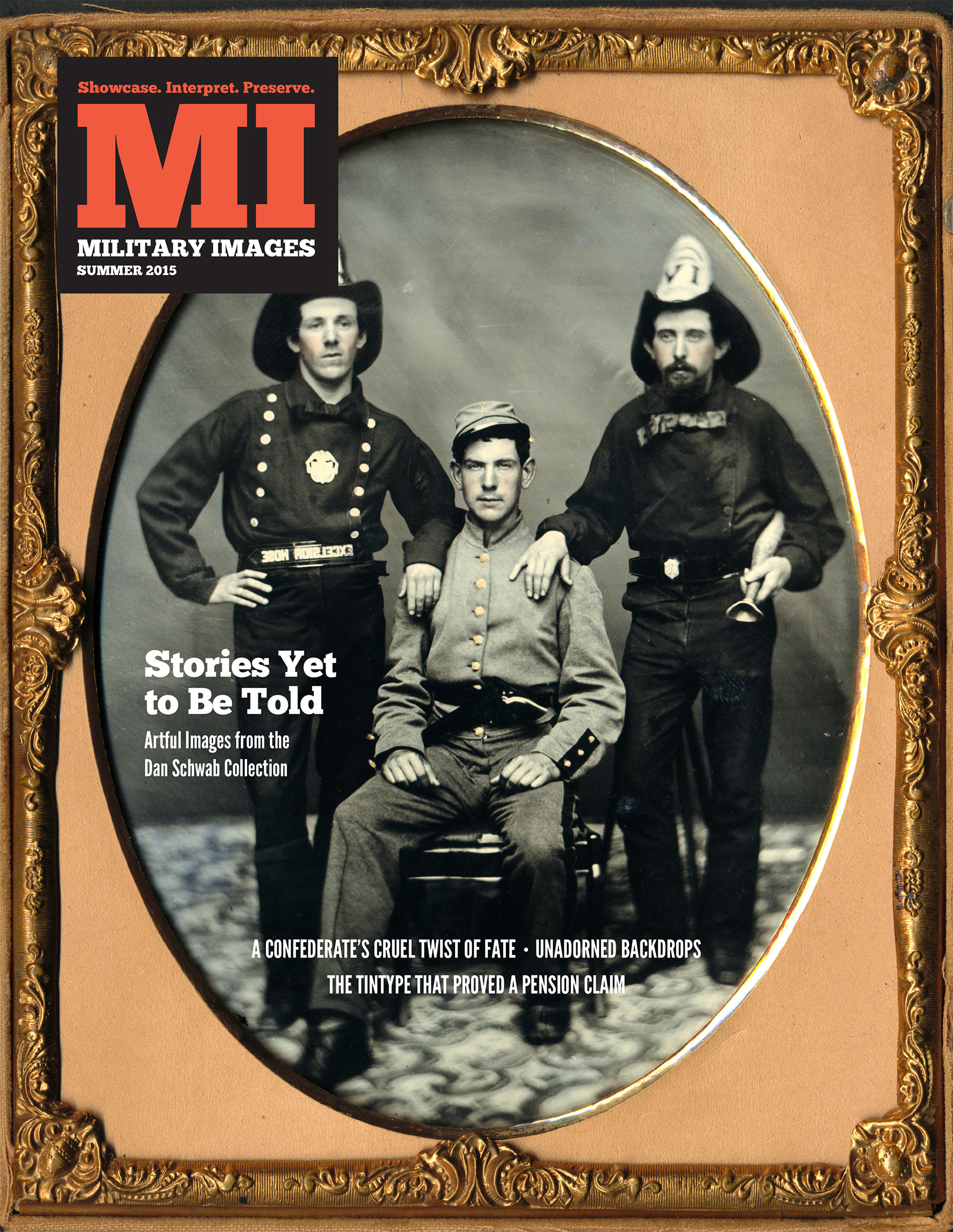
In this half-plate ambrotype from the Dan Schwab collection, two firemen flank a Northern recruit in this early war image likely taken in Buffalo, N.Y.
Download (free)

Table of Contents (p. 1)
Download (free)

Editor’s Desk (p. 2)
Newly colorized photographs can be helpful to our understanding of Civil War images and can help attract interest in the period, but you will not find them in MI.
Download (free)

Mail Call (p. 3)
Feedback from the previous issue includes a final update about the Pennsylvania soldier holding a stuffed grouse, an addendum to the Assassination Sympathizers photograph, and a correction to the gallery of nurse images.
Download (free)

Passing in Review (p. 4)
“Prominent Historians Focus on Memorable Photographs in Lens of War” is a review of the new book by J. Matthew Gallman and Gary W. Gallagher.
Download (free)

Stories Yet to Be Told (pp. 5-24)
A feature selection of artful images from the collection of Dan Schwab. “When I hold an image in my hand,” Schwab observes, “I know that the soldier in the image unquestionably at one time held that very piece of tin or glass in his hand as well. He most likely took great care of it so that it could be sent home to his parents, siblings, wife or a sweetheart.”

They Laid Down Their Lives for the Flag by Candice Zollars (pp. 25-28)
The story of the 6th U.S. Colored Infantry from training at Camp William Penn to the front lines at Petersburg, Va., and the end of the war in North Carolina.

Unadorned Backdrops (pp. 31-34)
Photographers in camp and other temporary locations usually left their elaborately painted backdrops at home in the studio and used whatever they had on hand to frame soldier portraits.

The Honored Few (p. 35)
During the Battle of Fair Oaks, Va., in 1862, Union Surg. Gabriel Grant risked his life to save the wounded—and received the Medal of Honor.

Cruel Twist of Fate by Scott Valentine (pp. 36-37)
Confederate surgeon Richard Walter Scott Martin of Virginia is imprisoned with the men he was sent to save after a failed raid on Memphis, Tenn., by cavalrymen commanded by Nathan Bedford Forrest.

“Headquarters for Pictures” by Steven Karnes and Ronald S. Coddington (pp. 39-42)
The life and times of Tennessee photographer Theodore M. Schleier is the first in an occasional series Civil War Image Makers. Schleier’s galleries in Memphis and Knoxville cranked out a high volume of soldier portraits during the war years.

The Tintype That Proved a Pension Claim by Andrew L. Slap (pp. 44-45)
In 1923, David Warrington posthumously supported his youngest daughter with a photo he had taken almost 60 years earlier.

Antebellum Warriors (p. 46)
“The Hero of Little Round Top,” Maj. Gen. Gouverneur Kemble Warren, pictured as a lieutenant of cadets at West Point at the end of the 1849 summer break.

Photo Sleuth by Kurt Luther (pp. 47-49)
Choosing the right tool is essential for any job, and Kurt Luther details what you need to carry in your digital research toolkit. “These digital tools, along with print materials, can help uncover more and greater photo mysteries than either alone, but only if we understand how and when to use them.”

Stragglers (pp. 50-56)
Confederates dominate this issue, and include a trio of infantry officers, a North Carolina officer killed at the 1864 Battle of Piedmont, Va., and a Tennessee father and son who served their home state and the Southern cause.

Uniforms & History by Michael J. McAfee (p. 57)
The uniforms of the The 1st Regiment, Philadelphia Reserve Brigade (Gray Reserves), a unique home guard brigade formed in 1861.

The Last Shot (p. 60)
Joseph C. White of the hard-fighting 12th Mississippi Infantry poses with an artillery short sword and a placard upon which is written a phrase that leaves no doubt about his loyalties—”Jeff Davis and the South!!!”

Finding Aid: Winter 2015

01-coverThe complete issue

Vol. XXXIII, No. 1
(60 pages)

Print edition: Visit our store to check availability
Digital edition: Visit JSTOR.org to purchase
Subscribe to MI
Explore the MI Archives: Browse | Advanced search | Tutorial

Inside

Cover image
A Confederate with a decidedly defiant expression is ready for action in this sixth-plate tintype from the Brian Boeve collection.
Download (free)

Table of Contents (p. 1)
Download (free)

Editor’s Desk (p. 2)
New Changes for a new volume include a description of design modifications, the inclusion of two new departments (The Honored Few, images of Medal of Honor recipients, and Photo Sleuth, a column by Kurt Luther that offers real-life accounts on the research trail) and access to digital version of MI.
Download (free)

Mail Call (p. 3)
Feedback from the previous issue includes details about the Carolina Mountaineers uniform, praise for young authors in MI, and the identification of the Union soldier pictured in The Last Shot.
Download (free)

Passing in Review (p. 4)
“Tribute to Alabamians Is a Tentative First Step” is a review of 150 Faces of Alabama Confederates on the 150th anniversary of the Civil War by Willis Downs.
Download (free)

Faces of Nobility and Honor (pp. 6-30)
A feature selection of images from the collection of Brian Boeve, a longtime MI contributor who has collected Civil War portraits for 25 years. “To look into the eyes of these noble men and honor their sacrifice is the fuel that drives my passion to collect Civil War images,” he observes.

Rally Round the Flag, Boys! (pp. 32-39)
The tattered remnants of the colors of the 23rd Ohio Infantry are one of the cartes de visite of Union patriots posed with regimental banners and national flags from the collection of Rick Carlile.

Antebellum Warriors (p. 40)
Samuel Stillman Parker Sr., a New York militia officer, did not serve in the Civil War, but two of his sons did. Samuel Stillman Parker Jr. (1840-1910) and Sewell Augustus Parker (1843-1936) enlisted in the 87th New York State Militia as privates in the autumn of 1861. They transferred to the 40th New York Infantry, also known as the “Mozart Regiment,” in September 1862.

Photo Sleuth by Kurt Luther (pp. 41-42)
In his inaugural column, Luther discovers a never-before-seen wartime photograph of his great-great-great uncle, Oliver W. Croxton of the 134th Pennsylvania Infantry, with good old-fashioned legwork and a generous portion of serendipity.

Stragglers (pp. 43-48)
Included in this selection of images from MI subscribers is Stanford L. Jessee of the 29th Virginia Infantry, who suffered a mortal wound in the chest during the Battle of Middle Creek, Ky. His last reported words: “‘Tell my friends I died a soldier at my post. I have done all I can do and will soon be in a better world than this.’”

Uniforms & History by Michael J. McAfee (pp. 49-50)
In this issue, titled “Service, War and Veteran Stripes: True Badges of Distinction,” West Point curator Mike McAfee examines the 1851 regulations that called for the use of a half-chevron to mark years of service in the U.S. army, and shows several variations on how the stripes were displayed on uniforms during the Civil War.

“Ugly as the Devil” by Ron Field (pp. 51-55)
A field guide to Havelock hats in the Civil War explores the origins and development of what generally became known as the “Havelock hat” or “Improved Military Cap.”

The Honored Few (p. 56)
Irish-American Michael Emmet Urell received the Medal of Honor for gallantry at the Battle of Bristoe Station, Va.

Hellion in Blue by Hailey House (pp. 57-58)
Every regiment had its share of good-natured rowdies, and in the 165th New York Infantry, William J. Walker proved himself a man not to take himself too seriously.

The Last Shot (p. 60)
Col. Milton Cogswell (1825-1882) strikes a Napoleonic pose as he stands in front of the Stars of the Stripes. The West Point-educated officer is remembered for his role in attempting to save the Union army after the death of Col. Edward D. Baker during the 1861 Battle of Ball’s Bluff.

Finding Aid: Autumn 2014

mi-cover-32-4-autumn-2014

The complete issue

Vol. XXXII, No. 4
(60 pages)

Print edition: Visit our store to check availability
Digital edition: Visit JSTOR.org to purchase
Subscribe to MI
Explore the MI Archives: Browse | Advanced search | Tutorial

Inside

Cover image
Quarter-plate tintype by an anonymous photographer of Henry A. Wiggins of the 10th Massachusetts Infantry from the Paul Russinoff collection.
Download (free)

Table of Contents (p. 1)
Download (free)

Editor’s Desk (p. 2)
Guest editorial by Harry Roach. The founder of Military Images, Roach served as editor from 1979 to 2000.
Download (free)

Mail Call (p. 3)
Feedback from the previous issue includes the identification of a column of troops as members of the 22nd U.S. Infantry on a practice march in the Yellowstone River Valley near Fort Keogh, Mont., in 1896.
Download (free)

Passing in Review (p. 4)
“Myths That Can Be Told and Touched” is a review of Smithsonian Civil War, edited by Neil Kagan and Stephen G. Hyslop.
Download (free)

One Soldier at a Time (pp. 5-22)
A gallery of Civil War images from the collection of Paul Russinoff features 18 tintypes and ambrotypes of Union and Confederate soldiers. The title for the gallery is taken from a quote Paul used to describe the research he does for every identified photograph in his collection: “You could say I’m learning about the Civil War one soldier at a time.”

Hail! Glorious Banners (pp. 23-27)
If a Union soldier’s photo album embodied the visual record of his Civil War experience, the album’s heart and soul was the image of the colors under which he and his comrades fought. This selection of distinctive cartes de visite comes from the collection of Rick Carlile.

An Epic Battle for the Yorktown Cup by Nicholas P. Ciotola (pp. 28-31).
Jerseymen led by Civil War veterans took home the coveted prize at the 1881 centennial competition. The honor was presented by Maj. Gen. Winfield Scott Hancock, who had been asked to select the unit that showed the “best military appearance,” and present its members with an ornate, sterling silver vase.

Personalized Accouterments (pp. 33-38)
Inscribing the names, rank and regiment on a portrait photo was a common practice used by a Civil War soldier to record his identity. But for a tiny percentage of soldiers, an autograph was unnecessary—their personalized accouterments performed the same function. A selection of images of soldiers with names added to caps, canteens and other equipment.

Life and Limb by Hailey House (p. 39)
A series of photographs commissioned by German-American inventor Dietrerick W. Kolbe in 1864 made the case for an innovative prosthetic design. The images, all cartes de visite, showed how the leather and steel arms and hands were technical marvels—and they helped Union veteran amputees to a better life.

Life Behind the Iron Shield by Shelby Crouse (pp. 40-42).
Union Navy officer William Frederick Keeler recalls his experiences the good, bad and ugly experiences he endured as paymaster on the famed ironclad Monitor.

Uniforms & History by Michael J. McAfee (pp. 43-45)
In this issue, titled “In Forage cap or kepi? (Maybe fatigue cap would be better),” West Point curator Mike McAfee explains the origins of the terms, and suggests their proper usage.

Antebellum Warriors (p. 46)
Featured in this issue is a quarter-plate ambrotype of Lt. Vincent Marmaduke attired in the uniform of the Hamtramck Guards, a local militia company in Shepherdstown, Va.

Stragglers (pp. 47-55)
Images submitted by the MI audience in this issue includes a Southern patriot with a pleated shirt and Enfield musket, a sixth-plate tintype of Jacob R. Brinker of the 104th Pennsylvania Infantry, and a ninth-plate tintype of a woman dressed in the uniform of a Union private. Stragglers appears regularly in MI.

Sgt. Branch’s Lucky Day by Scott Valentine (pp. 56-57)
Sgt. Charles Franklin Branch of the 9th Vermont Infantry barely escapes capture in North Carolina. His story begins, “On an early winter’s morning in 1906, a Civil War veteran looked out the window of his Amherst, Mass., study, and stared at a storm looming on the distant horizon. Sleet sputtered against the window …”

The Last Shot (p. 60)
This issue features a carte de visite of a Union soldier with his feet propped up on a chair.

Finding Aid: Nov./Dec. 1985

1985-v7-03-vii

The complete issue

Vol. VII, No. 3
(32 pages)


Print edition: Visit our store to check availability
Digital edition: Visit JSTOR.org to purchase
Subscribe to MI
Explore the MI Archives: Browse | Advanced search | Tutorial

Inside

Cover image
The Sprach brothers, William Elias and Bennett, grace the front cover. Both served in Company B, 1st Battalion, North Carolina Sharpshooters and enlisted in early November 1864. A brief biography of the brothers is found on page 1.

Editor’s Desk (p. 1)
The editor admits that he should have been aware of the identity of a mysterious Zouave unit; Military Images associate editor had already identified the unit as the Philadelphia Fire Zouaves in a 1983 publication. The mail generated by the previous issue is also mentioned.

Mail Call (pp. 2-3)
The mail regarding the identification of Zouaves was extensive. One image was identified as a member of the Heath Zouaves, a post-war unit in the Pennsylvania National Guard. Other letters discussed the potential identification of other units as well. Other readers were able to identify additional images from recent issues of Military Images as well. There was also a great deal of reaction from readers regarding the editor’s views on the situation in Nicaragua. The letters included a very strong resentment of the editorial and a few others that wrote in support, reflecting the overall 4:1 response in favor of the editor’s sentiments.

Passing in Review (p. 4)
Two publications are reviewed for this issue. The first is U.S. Armored Cruisers: A Design and Operational History by Ivan Musicant. The author describes the twelve ships of this class, built between 1888 and 1905, providing the reader with an exceptional view of what these unique ships were like. A photograph of the gun crew from the armored cruiser Montana is included, with some descriptions of their insignia. The second publication is U.S. Grant: the Man and the Image by James G. Barber, produced as a catalog from the exhibit of Grant’s items at the National Portrait Gallery in Washington, D.C. Some lesser-known images, such as a tintype copy of a 1843 daguerreotype, are included.

Vignette: Joseph Newton Spence, North Carolina State Troops by Bob Jones (p. 5)
The author is the great-grandson of the subject, who enlisted in the 7th North Carolina Volunteer Infantry Regiment, Company F (“The State Guards”) just days before North Carolina seceded from the Union in 1861. Joseph Newton Spence was part of the coastal defenses of North Carolina until taken as prisoners in February 1862. Paroled in August, Spence returned home to Pasquotank County until March 1863, when he joined the 8th North Carolina State Troops as part of Company A. He took part as Color Corporal in fighting at Drewry’s Bluff, the Bermuda Hundred, and Cold Harbor, taking a bullet in the ankle in an attack against Fort Harrison. His furlough from the General Hospital, Camp Winder, Richmond in October 1864 was the last item in his official service record, suggesting that he did not return to the army, like many others at that point in the war. The image accompanying the vignette was taken by George Cook in Charleston, South Carolina, in early 1863 with Spence’s return to Confederate service.

Antebellum Photography, Part VI by Michael J. Winey (pp. 6-19)
A total of 21 different images make up this pictorial article. There is a wide variety of uniforms shown in these images, from an ambrotype of a militia man wearing a Continental type uniform that harkened back to the Revolutionary era to ambrotypes of the elaborate uniforms of militia men from both New York and Virginia. As is often the case with antebellum images, most of the names and histories of the subjects are unknown, however many of the images are of men whose histories can be traced. This would include Samuel Cooper, who was the Adjutant and Inspector General of the Confederacy; the article includes an 1852 image of Cooper as Colonel and Adjutant General of the U.S. Army. Another image, probably from 1847 or 1848 depicts Captain Benjamin Stone Roberts, 1st Regiment of Mounted Rifles; he rose to the rank of brigadier in the service of the U.S. Army during the Civil War. The final image of the article is the only one that is not of a single subject, depicting the 7th Regiment, New York State Militia shortly before the advent of the Civil War.

The Big Picture: Four Views of the Military, 1873-1901 (pp. 16-19)
This pictorial article features four different images with groups of soldiers, beginning with traditional views of Massachusetts National Guardsmen and several civilians in front of their armory and Company M, 1st Infantry, Illinois National Guard on parade down Michigan Avenue during Chicago’s Memorial Day parade in 1901. Two other images show units during more relaxing times. An image taken in 1873 is of an afternoon of croquet at Fort Bridger, Wyoming, while the merry-go-round at Mount Gretna amusement park provides the setting for a summer encampment photograph of some of the guardsmen from the Pennsylvania National Guard in 1885.

Vignette: “Irish Johnnie” Delaney, 107th Pennsylvania Volunteer Infantry by Richard Matthews (pp. 20-21)
The youthful face in the image accompanying the article is a newly commissioned 2nd lieutenant, holding a presentation sword given to him on June 30, 1865 by the regiment with which he fought from the beginning of the war when he enlisted in January 1862. Emigrating from County Galway in Ireland in 1853, “Irish Johnnie” Delaney was just 13 years, 8 months, 14 days when he enlisted. He was thought captured at Second Bull Run, but made his way out of being surrounded to return to his unit later in the day. Johnnie was shot at Antietam after picking up the regimental colors in the cornfield there. He was made corporal at 15, severely wounded in the right leg in fighting at Gettysburg on July 1, 1863, and wounded once more in the leg during the Petersburg assaults of June 17-18, 1864. As sergeant in February 1865, “Irish Johnnie” was in command of Companies I and D at Hatcher’s Run and it was through his example that several men of Company C were saved from the brush fires that broke out, threatening to burn wounded men still on the field alive. For this action, John Delaney was presented with the Medal of Honor. He was not yet 17 years of age.

The Buckeye Vanguard: History of the 49th Ohio Infantry by Richard Mann (pp. 22-25)
This short article, accompanied with nine images of soldiers from the 49th Ohio Volunteer Militia, outlines the various points of action taken by this unit from its inception outside of Tiffin, Ohio in July 1861, introduction to General Robert Anderson at Louisville, Kentucky in September, to its mustering out of service in Victoria, Texas in November 1865. The images of the men of the 49th include three brothers, Isaiah, Henry, and George Terry, all of whom were killed as a result of fighting with the unit saw action at Stone’s River, Pickett’s Mills, and Atlanta. The 49th was also involved at Shiloh, Chickamauga, and Franklin. After the war was over, they were assigned to the 80,000 man expedition to Texas led by General Phil Sheridan.

In the Advance: A Month in the Life of a Signal Officer by Richard K. Tibbals (pp. 26-27)
As the Chief Signal Officer for the 17th Army Corps, the records kept by Captain Lucius M. Rose provide a glimpse into the kind of action undertaken by a signal corps unit during the Civil War. Having already been seriously wounded at Fort Donelson, and hindered for a while with a bout of typhoid fever, Capt. Rose was leading the 17th when General William Tecumseh Sherman set out for Vicksburg with 26,000 troops. The excerpted notes show a spirited force that rode reconnaissance ahead of the main force from February 3 to March 3, 1864.

Vignette: A Scot in the Confederacy by David M. Sullivan (pp. 29)
Archibald Stuart Johnston arrived from Glasgow, Scotland in Mobile, Alabama in 1856, hoping to make his fortune. And he did, creating a flourishing dry goods business and becoming involved in the affairs of his adopted home, and joining the elite “Mobile Cadets” militia. He left his business when mustered into Confederate service in April 1861 as a private with the Cadets in Company A, 3rd Regiment, Alabama Infantry. However, Johnston’s service with his unit was brought to an end due to an on-going shoulder condition that limited his ability to perform field service; he was discharged in May 1862 and returned to Mobile, where he joined a local defense force known as “The British Guard” in mid-1863. The image of Johnston shows him in uniform of Mobile’s “British Guard” from that time. Taken prisoner when Mobile was occupied in April 1865, Johnston signed parole twelve days later.

Stragglers (pp. 30-31)
Three images are included in this edition of “Stragglers.” The first is an oval portrait taken of Private William A. Gerald of Company A, 46th Georgia Infantry Regiment, C.S.A. Next is a photograph taken in late May 1876, depicting the San Carlos Apache Police in their battle shirts; an inscription by Indian Agent John P. Clum identifies the photo as having been taken in Tucson, Arizona. The last image is a carte de visite of an unknown soldier wearing his hospital dressing gown, complete with large bowtie and a slippered right foot.

Back Image
The image shows a bearded antebellum militiaman wearing a shako, possibly from the “Southern Guard” in a sixth-plate ambrotype.

Finding Aid: Sept./Oct. 1985

1985-v7-02-vii1985-v7-02-vii

The complete issue

Vol. VII, No. 2
(32 pages)


Print edition: Visit our store to check availability
Digital edition: Visit JSTOR.org to purchase
Subscribe to MI
Explore the MI Archives: Browse | Advanced search | Tutorial

Inside

Cover image
The cover of the issue features a half-plate tintype of an unidentified member of the Boston fire Zouaves, Company I, 30th Massachusetts Infantry.

Editor’s Desk (inside front cover)
The editor, who is a veteran and military historian, provides his views on the increasing instability in Nicaragua.

Mail Call (p. 3)
A reader sends in thanks to the generous subscribers who share their images with his renewal, and a reader makes suggestions regarding the continuing influx of fake tintype images at memorabilia and antiques shows. Another reader provides some clarity regarding the Custer badge.

Action Aboard the Iroquois: A letter from Seaman Edgar North edited by Seward R. Osborne (pp. 4-5)
Written to his father at New Orleans on April 28, 1862, the letter describes his ship’s role in the taking of the city by Federal army and naval forces, and includes an image of Seaman North and a friend posing with two lady friends. The sailors cut the chain that the Confederates had placed across the Mississippi River as part of their defenses and were then soon subjected to fireboats and shelling. North describes the gruesome deaths of some of his comrades aboard the U.S.S. Iroquois and tells his father that he felt splintering but was not harmed. He also described the reaction of Rebel troops in the city when they passed which they scattered “in a shower of grape.” He also discussed the number of Ironclads that were under construction and had been destroyed.

A Sharp Eye by Kean Wilcox (pp. 6-9)
Thirteen various images from the collection of Kean Wilcox are presented in this pictorial article. The first is a quarter-plate tintype group image of six Union veteran soldiers enjoying some bread and wine in a relaxed outdoor setting. Most of the images are of Union soldiers with their weaponry, such as the soldier wearing his complete field pack with British Enfield or the bugler with his gridiron jacket and Zouave-style kepi. One of the images is of a Confederate wearing his battle shirt, commonly worn in the early days of the war; similarly, the “Boys of ‘61” quarter-plate ambrotype is of three young men, two wearing the smock-style blouse that many Rhode Islanders wore at that point in the conflict.

Coppens’ Louisiana Zouaves: A Louisiana Battalion in Lee’s Army by Barry I. Mickey (pp. 10-12)
They were rough and tumble, and had a reputation as hard fighting and hard drinking, having once stolen a train when their officers were not on board to take off carousing. The image shown at the start of the article shows the traditionally garbed Zouaves of Lt. Col. George Auguste Gaston Coppens, although by the time they were attached to the Army of Northern Virginia under Brig. Gen. John Bankhead Magruder, they were wearing the more traditional Confederate uniform. They fought well in 1862, taking part in Seven Pines, Malvern Hill, Second Manassas, Sharpsburg (Antietam), and other heavy fighting that left them almost obliterated at the end of the Civil War.

An Excellent Breed of Soldier: The Life of a Sergeant-Major by Barry I. Mickey (pp. 13-15)
Walter Bruce Williams was the son of slaves who had relocated to Paris, Illinois. Following the footsteps of his father, who had become a railroader after the war, it was not surprising that Bruce, pictured with his future wife Ella, followed suit, which explained his entrance into the U.S. Army just prior to the Spanish-American War. He had been assigned to the 24th Infantry, one of the units known as the “Buffalo Soldiers.” Williams took part in the assault on San Juan Hill in Cuba. Their bravest effort was as volunteer nurses at the yellow fever hospitals after eight other units refused; Bruce Williams was afflicted with typhoid fever as a result. After recovering the 24th was sent to the Philippines, spending 1899 to 1901 in conflict with Emilio Aguinaldo’s forces there; Bruce Williams, however, was serving with the regimental band in Manila. He was promoted to the rank of Regimental Sergeant-Major in 1903, becoming one of four black soldiers holding this highest non-commissioned rank in the U.S. Army. The 24th was assigned to various posts within the United States with occasional tours to the Philippines until 1916 when the 24th Infantry accompanied “Black Jack” Pershing into Mexico to catch Pancho Villa. Black troops and black officers would be soon needed in the First World War, and Williams entered an all-black Officers’ Training Camp in 1917, becoming one of 105 captains to graduate. He was assigned to the 367th Infantry of the 92nd Division – the “Buffalo Regiment” – which was awarded the Croix de Guerre for valor by the French. After his retirement at the end of September, 1919, Walter Bruce Williams then returned to active service as Master Sergeant in 1921, leading the cadets at Lincoln High School in the JROTC program in Kansas City to much success.

Warriors in Baggy Pants: Another look at American Zouaves and Chasseurs by Clothilde Chatt (pp. 16-25)
A total of 29 different images of Zouaves (or those soldiers commonly mistaken as such) are presented in this pictorial. The fourth Military Images article featuring the unique uniform begins with a brief history of the Zouave unit begun by Elmer Ellsworth in 1869 and then shows a mystery image of six Zouaves whose regiment is unknown. One pair of images is of Henry K. Dikeman who was part of New Jersey’s d’Epineuil Zouaves, a unit that was mustered out early due to their unruliness. Apparently, Dikeman enlisted in another Zouave unit and then deserted less than three weeks later. Other images in the collection are identified while others are not; some wear recognized uniforms while others can be mistaken as Zouaves. Even children were pictured wearing uniforms based on the dashing Zouave. A carte de visite image from after the war depicts an Ellsworth-style uniform worn by a youngster, identified on the back as a “Captain of the New York Soldiers Orphanage. Major by Brevet.”

Indiana Zouave: Vignette by Kean Wilcox (p. 28)
The serious soldier in the quarter-plate ambrotype image shows Oliver S. Daugherty of Co. E, 11th Indiana Infantry, “Wallace’s Zouaves” taken on April 28, 1862, three weeks after taking part in the Battle of Shiloh. The vignette describes the first and second uniforms worn by Wallace’s Zouaves, as well as the background of its distinctive commander. After serving at Donelson and Shiloh, Daugherty transferred out of the regiment to become a captain in Company K, 1st Regiment of Arkansas Volunteers, African Descent (later 46th Regiment of U.S. Colored Troops). Dissatisfied with the service, Daugherty resigned in June 1864.

Stragglers (p. 29)
Two dogs and a pig make up the “pets on parade” featured in this issue of “Stragglers.”

Passing in Review (pp. 30-31)
Four different publications are included, beginning with Custer in Photographs by D. Mark Katz. The book has two reviews, one of which has negative comments, but does provide some points of note that signifies some unique value in the book. The other pans the book, stating that it is disorganized and does not provide sufficient identification or information to show that the author delivers what he promises. Next is With Crook in the Black Hills: Stanley J. Morrow’s 1876 Photographic Legacy by Paul L. Hedren. The author provides a photographic glimpse into the campaign of which Custer’s demise was but part. As noted by the reviewer, the result “is this small gem of a book.” Third is A Pictorial History of Civil War Era Musical Instruments and Military Bands by Robert Garafalo and Mark Elrod. Complete with a small recording, the book provides a comprehensive identification of instruments and their manufacturers, some color images of drums and equipment, and images of bands and uniforms. The only reviewer regret is that it is not hard covered. Lastly, From Manassas to Appomattox by General James Longstreet is reviewed. This reprinted volume is often considered to be dull reading, and the reviewer regrets that the general did not include insight into his reported sense of humor or provide the interesting life stories that make these types of works compelling. It is, however, a complete review of the major battles fought by the First Corps, supported by information about force strength, and gives insight into how the Confederate high command worked throughout the Civil War.

Back Image
A quarter-plate ambrotype of a young Texas rebel wearing the insignia of the Ordinance Department.

Finding Aid: July/August 1985

1985-v7-01-vii

The complete issue

Vol. VIII, No. 1
(32 pages)


Print edition: Visit our store to check availability
Digital edition: Visit JSTOR.org to purchase
Subscribe to MI
Explore the MI Archives: Browse | Advanced search | Tutorial

Inside

Cover image
Second Lieutenant Kenyon Ashe Joyce from the 6th U.S. Cavalry is the subject of this image, taken in about 1900.

Editor’s Desk (p. 1)
The editor announces this current issue as the “long-awaited all-cavalry issue.” It features a mix of biographies, unit histories, insignia, uniforms, and many items submitted by the readership. There was such a huge response, that another cavalry issue is in the works for 1986. Upcoming will be another issue on Zouaves and Chasseurs as well as a feature on National Guard uniforms from 1870-1900.

Mail Call (p. 3)
The readers of Military Images submitted a number of letters, ranging from the identification of a mystery Civil War monument from a previous “Stragglers” feature to a request for how to clean images from the early years of photography (with a comprehensive response). The discussion regarding faked ambrotypes and tintypes also continues.

Vignettes: Short Biographies of American Mounted Troops by Richard Rottenbury, Wendell W. Lang, Jr., Richard K. Tibbals, and John R. Sickles (pp. 4-6)
Starting with an image of five Confederates, four of which were from Company C, 8th Texas Cavalry, the pictorial includes the images and stories of these and six other Civil War cavalrymen. Some of them died during the Civil War, such as Sgt. Lamister Milan Parks, who died in Andersonville in August 1864, while others went on to other careers, such as Lt. Col. William R. Parnell of the 4th New York Cavalry, who went on to fight in the Indian Wars of the 1870s.

“Come On, You Wolverines!”: Custer’s Michigan Cavalry Brigade by Gregory J.W. Urwin (pp. 7-15)
The history of the Michigan Brigade is illustrated with the images of 16 members of the 5th, 6th, and 7th Michigan cavalry, including one of its most illustrious commander, General George Armstrong Custer. Combined with the 1st Michigan Cavalry and Light Battery M of the 2nd U.S. Artillery, when Custer took command, the Michiganders took soon took to the field against “Jeb” Stuart three miles east of Gettysburg on July 3, 1863. Breaking Stuart’s lines with a head-first charge, Custer led the men of the 7th Michigan into the fray while units from the 5th and David Gregg’s 2nd Cavalry Division hit from the flanks. Days later, they attacked Heth’s units at Falling Waters during the Confederate retreat after Gettysburg, inflicting a great deal of damage. Other engagements are described in the article, which takes the Michigan Cavalry through fighting in the Civil War and beyond. They were sent directly after the Grand Review of the Army to Fort Leavenworth, Kansas and into action in the Great Plains until their enlistments were through. A sidebar article describes the origins of the Custer Badge, which was a solid gold Maltese cross with a brigadier’s star, inscribed with Custer’s name, these were presented only upon Custer’s personal order, making them a very sought-after distinction among the Michigan brigade’s officers.

The Pawnee Scouts: Auxilliary Troops in the U.S. Cavalry, 1864-1877 by Thomas R. Buecker and R. Eli Paul (pp. 16-19)
Seven images from the Nebraska State Historical Society illustrate the story of Pawnee who assisted the U.S. Army in its fighting against several hostile Native American tribes, including the Sioux, Cheyenne, and Arapahoe. Starting in 1864, uprisings in Indian Territory led the Army and the Pawnee, also targets of the Sioux, to join in putting down the uprisings. Eventually, these Pawnee Scouts were officially enlisted as soldiers beginning in 1866 under the command of Frank North, a civilian from the Pawnee Agency who simultaneously garnered military rank. Although provided with weaponry and uniforms like their white American counterparts, the Pawnee wore them as they desired inside the forts, but stripped to the bare minimum for recognition when about to engage in battle. Saddles and uniform boots were removed, and hats were often replaced with bandannas.

Boots and Saddles: A Survey of Images of the U.S. Cavalry from the Civil War to the Great War by Dennis Bender (pp. 20-29)
This pictorial article features 28 different images of the American cavalryman taken between 1861 and 1912. One quarter-plate ambrotype taken in 1861 features friends Alan G. Copenhaven of the 8th Virginia Cavalry, C.S.A. and Charles S. Venable, who was to eventually become an aide to Robert E. Lee. Images of the uniforms (Private Levi Scott, trumpeter of the 22nd Pennsylvania Cavalry Regiment), insignia (a farrier wears a hammer and tongs within a horseshoe on his sleeve and a first sergeant with a rare star buckle), and weaponry of all types are shown. The troopers of the Spanish-American War era are depicted in full uniform and also in parade, seen with the all-black 10th Cavalry and a troop of “Rough Riders” in Philadelphia after the war. One page shows the cavalryman with his horse in various forms, from posing with a dog in the saddle, to the horse taking a defensive position on the ground for his rider to use for protection while firing, to taking jumps on a beach in the Philippines.

Passing in Review (pp. 30-31)                                                                                   This issue of Military Images features three publication reviews, beginning with The Spanish War: An American Epic, 1898 by G.J.A. O’Toole. The reviewer found it to be a useful work, that saw Americans joining together again after the Civil War – both Fitzhugh Lee and Joe Wheeler joined as commanders for the U.S. Army. The author looks at the domestic and international concerns of the time, especially the impact of a rising Germany into the international arena. Second is Unto This Hour by Tom Wicker, a novel of the Civil War that seems to be fraught with errors that those knowledgeable about the conflict will note easily, leaving the reviewer to not recommend the book for the readership? Finally, Sons of the Morning Star by Evan Connell, is reviewed and comes away with a much different review. Written about Custer in the Indian Wars, the novelist’s approach is solid and is factually based, giving the reader an accurate account of both sides of the conflict. It should satisfy both those knowledgeable about Custer and those who want to read a balanced view of the Plains Indians and their lifestyle as well.

Back Image
Lt. W.B. Brainerd of the Chicago “Black Hussars” in 1891 is featured astride his mount.

Finding Aid: Summer 2014

mi-cover-32-3-summer-2014

The complete issue

Vol. XXXII, No. 3
(60 pages)

Print edition: Visit our store to check availability
Digital edition: Visit JSTOR.org to purchase
Subscribe to MI
Explore the MI Archives: Browse | Advanced search | Tutorial

Inside

Cover image
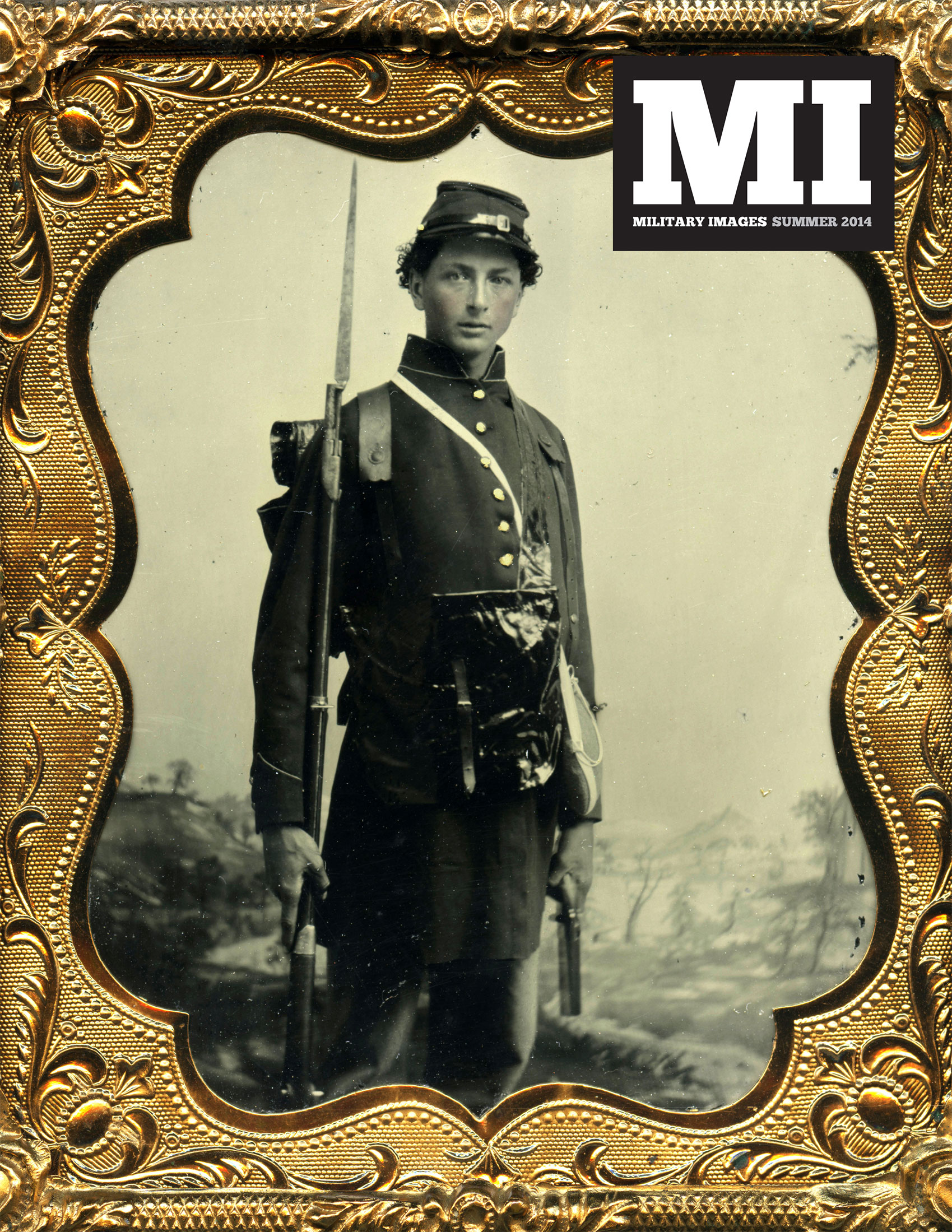
A young infantry soldier fully prepared to march graces the cover of this issue. The image is a ruby glass ambrotoype from the featured collection of Civil War images owned by Matt Cranford.

Table of Contents (p. 1)

Editor’s Desk (p. 2)
“The Scanner Light Is Always On” and Military Images will often be in attendance at Civil War and photography shows as well, following the precedent set by founding MI editor Harry Roach. Armed with a flatbed scanner and laptop computer, readers are urged to bring their own images to shows so they can be scanned and included in future issues. The magazine is also pursuing a more vibrant social media presence, providing images and education on Facebook, for example. Many of the images in the “Stragglers” section of MI are from these shows and other sources of media sharing.

Mail Call (p. 3)
Subscribers continue the discussion of whether images show photographer props or soldier property based on images from the Spring 2014 issue of Military Images. A letter provides a tentative identification of a Georgia infantry soldier. Another subscriber offers more information on the “Battle Shirt!” article, explaining how Maj. Gen. Buford’s statue at Gettysburg was based on the battle shirt he wore on the first day of fighting there.

Passing in Review (p. 4)
Lens on the Texas Frontier by Lawrence T. Jones III is reviewed. The publication includes early images from Texas beginning in 1843, and traces the development of the Lone Star State and its many different cultures.

Art of War: Fighting Men from the Collection of Matt Cranford (pp. 5-19)
Fourteen different images from the extensive collection of Matt Cranford are included in this article. Cranford describes some of the known histories behind many of the images, including one of his great-grandfather, but also explains why he was drawn to include them in his collection. He selects images that are aesthetically interesting, such as the cover image which includes a background that gives the illusion of the soldier being outdoors in nature, or the very tall and thin Confederate infantryman whose uniform evokes images of homespun. One image in the collection depicts two soldiers relaxing with their pipes, with one soldier wearing a knit cardigan. The collection also includes a few group images that give a sense of what camp life might have been like, as well as more formal poses that illustrate standard equipment as well as demonstrating a cavalry guard position.

Antebellum Warriors (pp. 21-22)
This article presents two different images, beginning with a ninth-plate daguerreotype featuring a newly graduated West Point cadet wearing his uniform as a second lieutenant of engineers in about 1854. A smaller image reveals the antebellum image to be that of the future Union Maj. Gen. James MacPherson, who was killed during the Battle of Atlanta in 1864. A second antebellum image is from a half-plate daguerreotype of a much older man wearing a uniform believed to be from the Ringgold Light Artillery, formed as a volunteer militia in 1849 by Pennsylvania veterans of the Mexican War. The ornate uniform, which includes a Dragoon dress hat with horse hair plume, is an example of a full dress uniform of the era.

Homeland Security: Civil War Style by Philip Katcher (pp. 23-26)
Readers of MI generally expect to find images of soldiers, but this interesting article traces the expansion of uniformed police forces in the North during the Civil War. The author describes the wide range of challenges that emerged while fighting a civil war with only a few major cities having police organized in a way that we would recognize today. New York City police were expected to assist the War Department in the surveillance and apprehension of spies, halting arms transfers, and capturing bounty jumpers. Police were also expected to deal with minor crimes that resulted from the war, such as juvenile delinquency and petty crimes that came from minors who were unsupervised by effectively single mothers. Through a collection of 13 images, the article highlights the different uniforms worn by police departments during the Civil War era.

In Lambent Glory: A Pennsylvania Private Fights His Last Battle by Scott Valentine (pp. 28-29)
A carte de visite of Pvt. Thomas G. Grier, 51st Pennsylvania Infantry, inspired this article, which examines the impact of yellow fever on the New Berne, North Carolina area in 1864. Pvt. Grier lost his life assisting both military and civilian victims during an outbreak of the disease.

Master’s Mates: A Primer by Ron Field (pp. 30-34)
The massive expansion of the Federal navy during the Civil War required a similar expansion of various crew members. This article explores the role of the master’s mate, focusing on the basic requirements to be considered for the role, the expectations of a master’s mate, and how the navy went about finding qualified candidates as the need for these skilled crew members grew. The article uses six carte de visite images to illustrate the discussion of what the master’s mate uniform consisted of, each with a considerable description of the uniform and a biography when possible.

Mobile Bay & Havana Harbor: A Newly Discovered Tintype of Battleship Maine Commander Charles D. Sigsbee When He Was A Civil War Ensign by Brooke Hollingsworth (pp. 35-36)
This article highlights the discovery of a new image of Capt. Charles D. Sigsbee, the commander of the battleship Maine, the destruction of which precipitated the Spanish-American War in 1898. The new image, showing a relaxed ensign leaning against a prop with one hand in his pocket, is a tintype of carte de visite size, found attached to a government document that included Sigsbee’s name and dates to sometime after Sigsbee’s 1863 graduation from the Naval Academy. Sigsbee served during the Battle of Mobile and the 1864 and 1865 assaults on Fort Fisher during the Civil War, and continued his naval career until retirement in 1907. The article also includes a photograph taken from an 8×10” negative with Sigsbee and his staff officers aboard the Texas, the command he was given after the destruction of the Maine.

Uniforms & History: Civil War Corps Badges Are Symbols of Service and Sacrifice by Michael J. McAfee (pp. 37-40)
The article outlines the origin and use of corps badges by the Union Army of the Potomac. Originally devised by Maj. Gen. Philip Kearney to allow him to clearly identify the officers under his command of the Third Division, the practice was expanded by Maj. Gen. Joseph Hooker throughout the Army of the Potomac. Eventually, the corps badge would go from a helpful way for commanders to identify their soldiers to becoming “marks of esprit de corps” that unified troops in all Union army commands. The trefoil, round disc, Greek cross, Maltese cross, and other corps badges are shown in the 11 images that accompany the article. Each image has an accompanying description of how the soldier wore his corps badge on his uniform.

Stragglers (pp. 41-56)
A wide variety of 25 different images is presented, some of which include poignant stories or unusual scenes. A pair of images, including a previously unknown carte de visite, illustrates the story of Hettie Clary Stone and her father, Brig. Gen. Charles Pomeroy Stone. A half-plate tintype from 1861 tells the story of the Taylor brothers from McLennan County, Texas, who were shortly to leave for service in the Confederate army. A carte de visite image features five soldiers of the 63rd New York Infantry with one civilian; their flags identify them as part of an Irish Brigade from the Army of the Potomac. Animals appear in a number of images, to include a cat with a Federal second lieutenant, two cavalry troopers with their mounts, and one carte de visite with a Union cavalryman leading a lady riding sidesaddle. Perhaps the most unusual image of this collection is most likely from 1898; a close-up detail from the photograph is accompanied by a lengthy description of a bicycle messenger who appears with the military unit.

The Last Shot (p. 60)
A Federal artillery soldier holds a small, uncertain girl on his lap. Most likely his daughter, the sixth-plate ambrotype asks the viewer to imagine the relationship between the toddler and the soldier and the story behind the image.

Finding Aid: May/June 1985

1985-v6-06-vi-cover

The complete issue

Vol. VI, No. 6
(32 pages)


Print edition: Visit our store to check availability
Digital edition: Visit JSTOR.org to purchase
Subscribe to MI
Explore the MI Archives: Browse | Advanced search | Tutorial

Inside

Cover image
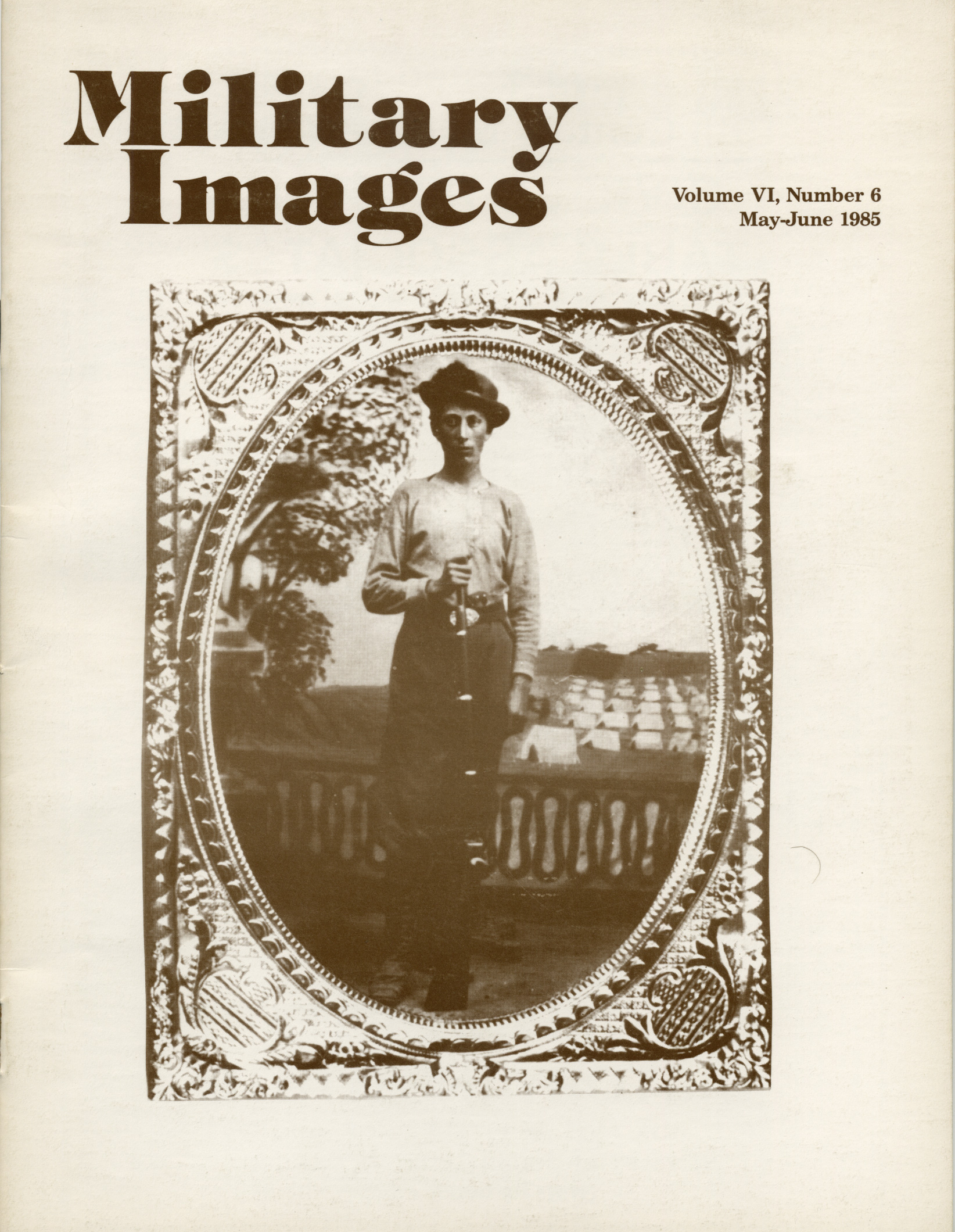
A young sharpshooter graces the cover of this issue of Military Images.

Editor’s Desk (p. 1)
A change in computer systems has led to a change in subscription codes for renewal. A listing of old and new codes is provided to allow subscribers to understand when to renew. The editor is also pleased to note that a new subscriber in Hong Kong means that Military Images has readers on all continents. He warns also that fake tintypes and cartes de visite are still showing up, and asks for readers to let the magazine know so readers are aware of who is selling them. More material from the Confederate states is also coming in, meaning more articles and vignettes from the South.

Mail Call (pp. 3-4)
The letters to the editor include a lengthy response from a reenactment group in Bristol, U.K., requesting information on the uniforms and flags of the Irish Brigade. Other notices include the offer of a research stipend, the theft of an 1852 pattern Union naval officer’s sword from Kennesaw, Georgia, and details on some of the fake images being sold by dealers.

Passing in Review (p. 5)
Three volumes are presented for review in this issues. First is Civil War Monitor, a publication that provides abstracts and an index of articles. This is a bimonthly publication edited by Joseph L. Harsh of George Mason University, and may be a helpful resource for serious researchers. Second is Army Uniforms of World War I by Andrew Mollo, which is a handbook complete with color plates and descriptions of uniforms from 16 nations engaged in World War I. The only units missing are colonial troops and volunteer organizations. Third is Militaria Magazine, a bimonthly publication in French and emphasizes World War II. The images are of high quality, and would be of interest to those readers with an interest in that era of conflict.

Georgians in Gray: A Series of Vignettes by Keith Bohannon (pp. 6-13)
Ten different images are featured in this pictorial article. Each image tells a story of a Georgia soldier, such as the three Chitwood brothers who enlisted in the “Bartow County Yankee Killers” which became Company A of the 23rd Georgia Infantry. The vignette about Pvt. William C. Bradley includes the text of a letter written home in April 1862, describing his experience early on at Yorktown, Virginia. Each story illustrates a different experience of these soldiers from Georgia.

The Saucy Battery: History of the 10th Massachusetts Light Artillery by Philip Katcher (pp. 14-15)
Led by Captain J. Henry Sleeper, the article describes the service of the 10th Massachusetts Light Artillery from its arrival in Washington for training in October 1862. Having missed the large battles at Chancellorsville and Gettysburg while chasing after John S. Mosby’s rangers from their post across the Potomac at Edward’s Ford, the unit was finally on the move in time for Auburn, Virginia in October. Moved into the II Corps under Winfield Hancock when the III Corps disbanded, they 10th was able to keep its old corps badges as it crossed the Rapidan River in early May 1864. They fought well in the Wilderness at the Battle of Cold Harbor, and Capt. Sleeper was mentioned in the New York Evening Post for his leadership there; the article also noted the 10th was known as the “saucy battery” in the II Corps. They remained in action until Appomattox, and took part in the Grand Review of the Army.

The Blue and Gray by Albert W. Haarmann (pp. 16-23)
Subtitled “… and the Green and the Black and the Red, etc.” this survey of newspapers announcing the arrivals of Union volunteer troops in Washington, D.C. Seventeen photographs of these uniforms are included to illustrate the many units which arrived between April and July of 1861. It is interesting to note how many volunteer regiments arrived wearing gray, such as all six of the Maine units that arrived at that time.

The Excelsior Banner by Randy Beck (p. 24)
Louisville, Kentucky was the site of a drill competition between the regiments of the 4th Division, 15th Army Corps as they waited for the end of their service in June 1865. The regiments of each of the three brigades would compete with one another, with the winners of each brigade competition vying to win a $300 silk banner. Colonel William Hanna of the 50th Illinois in the Third Brigade cancelled all leave and continually drilled his men, eventually meeting the 7th Iowa (1st Brigade) and the 63rd Illinois (2nd Brigade) for the final competition. Named “The Excelsior” banner after the competition, Col. Hanna returned home with the banner and had the carte de visite featured in the article taken in Quincy, Illinois.

The 13th Shot: Tragedy Aboard the U.S.S. Iowa by William Christen (pp.25-17)
Known for having fired the initial shots at Spanish vessels during the Spanish American War in 1898, the U.S.S. Iowa was taking part in targeting drill off the coast of Pensacola, Florida on April 9, 1903 when an unexpected tragedy struck. During the firing of the 13th shot that morning, the barrel of the port 12-inch gun sheared off, crashing through the deck, and killing three sailors three decks below. A few images of the Iowa are included with the article, but others are requested by the author.

Sergeant Andrew R. Denton: Vignette of the 43rd Tennessee, C.S.A. by Terri N. McGinnis (p. 28)
The couple featured with this article, Sgt. Denton and his bride, Martha, were wed on January 4, 1862, shortly after his enlistment in Company G of the 43rd Tennessee. He was elected to First Sergeant in May of 1862, and took part in the fighting around Vicksburg in 1863. It was on June 22, 1863 that Denton was wounded, dying of blood poisoning a few days later. His only child was born four and a half months later.

Stragglers (pp. 29-30)
Space allows only one image in the “Stragglers” feature in this issue. The antebellum image shows an unidentified group of men probably belonging to a target club. These were civilian clubs similar to the German Schutzenverien, which wore uniforms and practiced drill despite the fact that they were not associated with official militia. Although these groups existed after the Civil War, they were more like social clubs, rather than focusing on marksmanship.

Back Image
The American cruiser, U.S.S. Olympia, Admiral Dewey’s flagship, in harbor, Venice, Italy.