Finding Aid: July/Aug. 1981

1981-v3-01-iii-cover

The complete issue

Vol. 3, No. 1
(32 pages)

Print edition: Visit our store to check availability
Digital edition: Visit JSTOR.org to purchase
Subscribe to MI
Explore the MI Archives: Browse | Advanced search | Tutorial

Inside

Cover Image
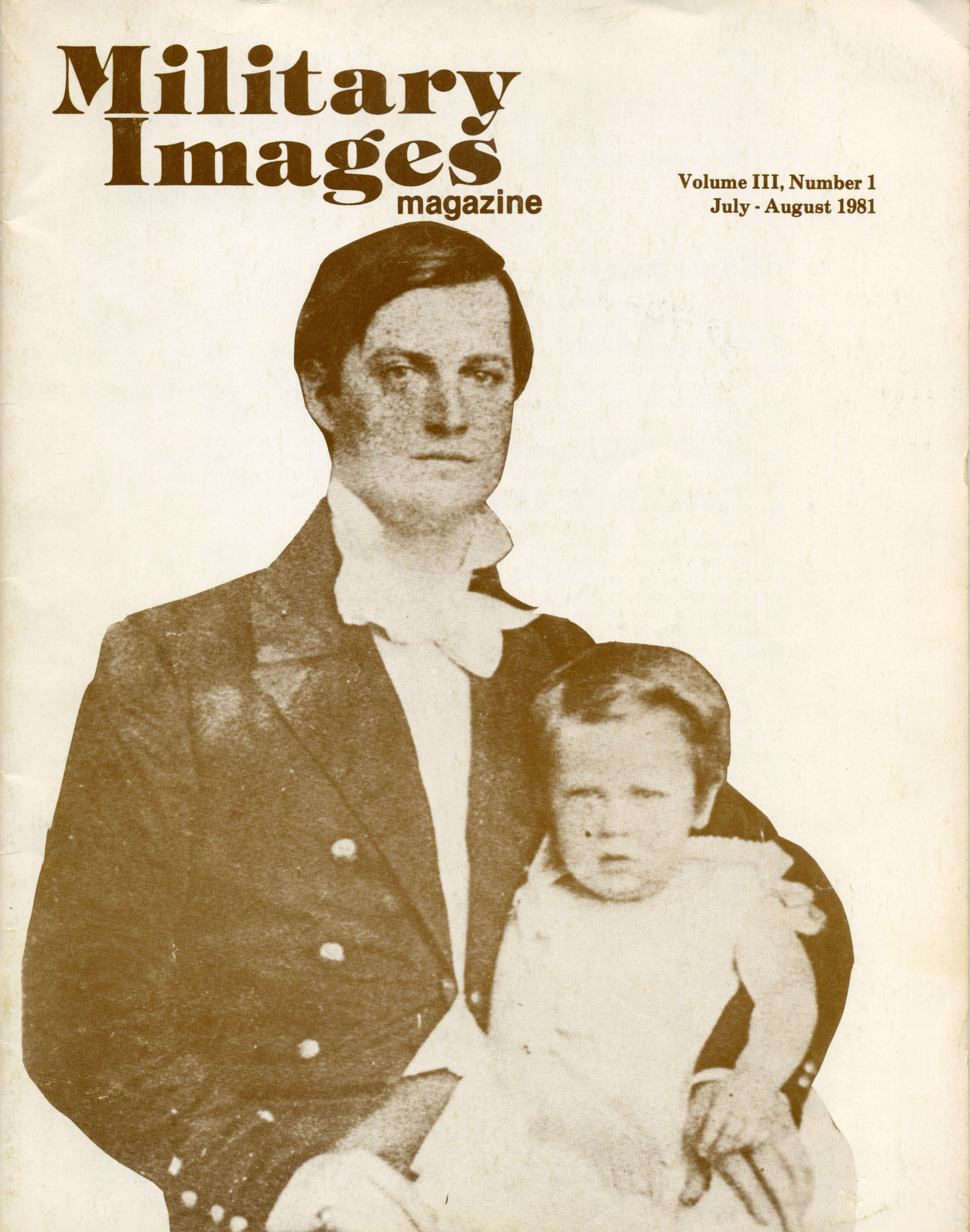
A touching portrait of 1st Lieutenant Winfield Scott Hancock with his three year old son Russell, taken in 1853.

Editor’s Page (inside front cover)
The editor explains the effect of “hard” images, such as daguerreotypes, tintypes, or ambrotypes, and how these led to what today appears to be “backwards” images and why issues of Military Images does not change these from their original appearance.

Mail Call (pp. 2-3)
The readers’ letters include several clarifications to images from previous issues. Of interest is a comparison of the obverse and reverse of two cartes de visite of Sergeant Amos Humiston, father of the “Children of the Battlefield” images from the Civil War. One is a retouched version that was used for fundraising purposes, with the addition of a beard and Army jacket.

“Galloping Jim” Parker: Cavalryman Extraordinaire, 1872-1918 by Gordon Harrower, Jr. (pp. 4-9)
Including ten images spanning the career of “Galloping Jim” Parker and excerpts from an unpublished monography by his son, the reader is treated to an overview of the life of a veteran of the Indian Wars, the Philippine Insurrection, and the Spanish-American War. Parker was also an instructor of cavalry tactics at West Point and eventually commanding the 11th Cavalry. Some of the images are postcard photographs which provide glimpses into the inspection of his cavalry units, from three day recruits to a review at the Texas maneuver camp in 1911 which features a Wright flyer overhead. Not selected to be the commander of the A.E.F. that went into France to fight in World War One, Parker organized can commanded the unit that today is known as the “Big Red One.”

U.S. Army Uniforms of the Civil War, Part II: The Sack Coat by Michael J. McAfee (pp. 10-15)
Essentially the uniform coat worn by the common soldier, the sack coat was a cheaper, mass-produced garment that was to be worn in fatigue situations. Shorter than the frock coat and without a waist seam, this four-button coat was the standard for Union soldiers. The 15 different images provided in this pictorial article show how the uniform was worn, from one “perfect fit” example to many personal alterations done by the soldiers themselves.

William Lytle and the “Boody Tinth” Ohio by James F. Neel (pp. 16-18)
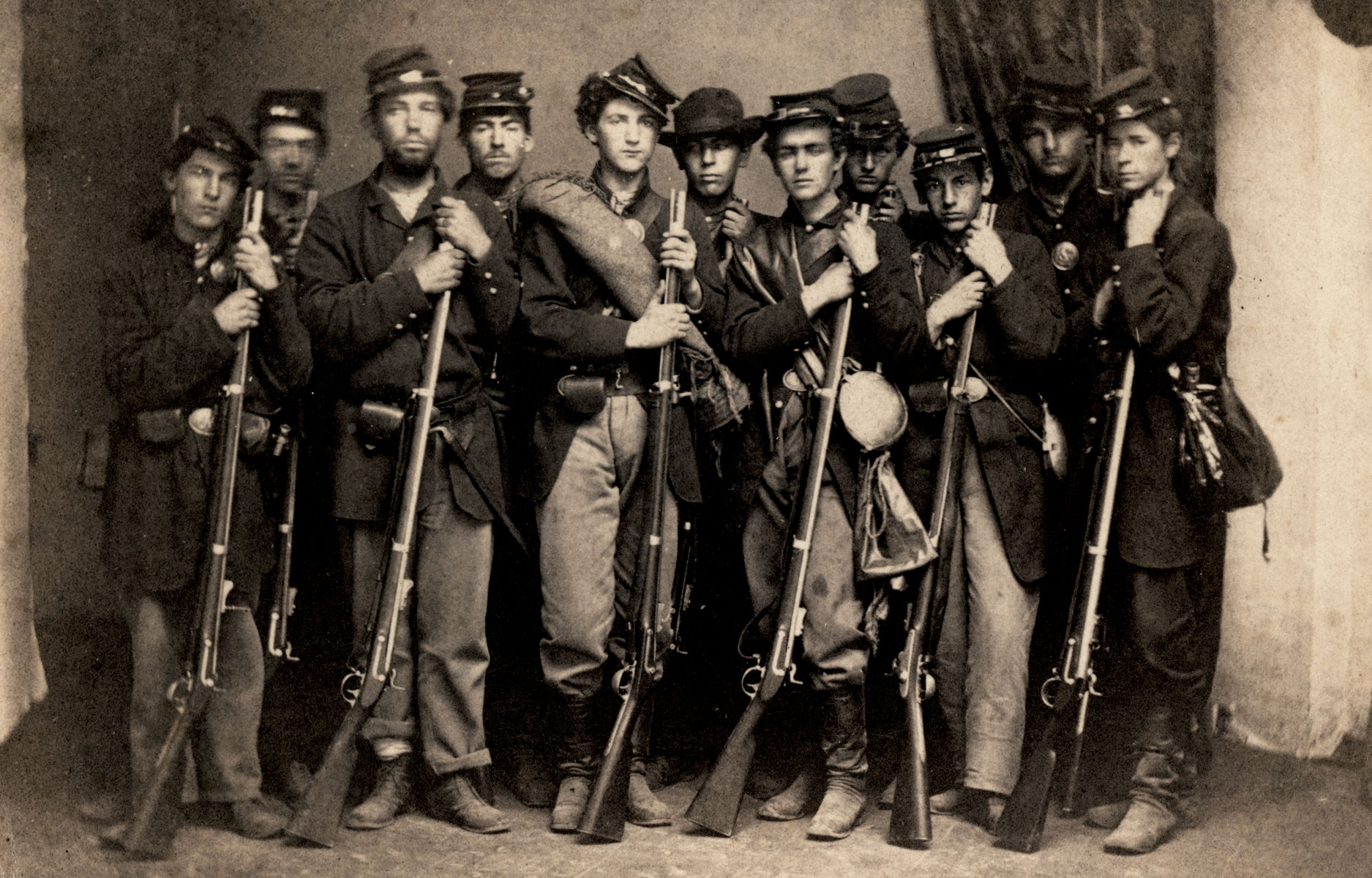
This article was inspired by a junk yard find of a photograph of ten Union soldiers with the inscription on the reverse describing it as the burial party of Brigadier General William H. Lytle, the commander of the 10th Ohio Volunteer Infantry. A graduate of West Point in 1843, Lytle became a lawyer, only leaving to serve during the Mexican War. Lytle became prominent in 1857 not for being named as major general of the Ohio militia, but as a poet, whose work “Antony and Cleopatra” gained national attention. He saw a great deal of hard action and was wounded several times in the Civil War, eventually leaving the 10th for other command although remaining particularly beloved by the “Bloody Tinth” and its Irish contingent from Cincinnati, Ohio. Upon his death during the Chickamauga campaign in October 1863, members of the 10th were selected to return their general to his home of Cincinnati for burial.

Passing in Review (pp. 19, 31)
Three books are featured for review in this issue of Military Images. First is The Horse Soldiers, 1776-1943 by Randy Steffen. This is a four volume set that covers all aspects of how the cavalry was outfitted, and is highly recommended. The second book passing in review is The Civil War Engagement at Cool Spring, July 18, 1864 by Peter J. Meaney, providing a “fully documented account” of this Virginia battle coming after the Battle of the Monocacy. Lastly is The Great War and Modern Memory by Paul Fussell, an academic work that provides insight into aspects of World War One as diverse as poetry and impact on the use of the English language to the psychology and impact of catastrophe on collective memory. Special attention is given to lesser known poets and writers, as well as the familiar, such as Siegfried Sasson or Wilfred Owen, showing a disconnect between the experience of the trenches and civilian perceptions of the experience.

Antebellum Photography in the Collections of the U.S. Army Military History Institute by Michael J. Winey (pp. 20-30)
A pictorial article with 16 images, the author selected the images for what they are able to tell the reader. The first, for example, is an outdoor daguerreotype that depicts Old Fort Howard in Green Bay, Wisconsin, taken between 1849-1852 when the fort was briefly put back into use. Not only can one see the layout of the fortification, but also uniform styles in use that date back to 1829 regulations. Other images provide detail on 1832 general officer uniforms as well as the opportunity to view younger images of well-known Civil War generals such as Major General Cadmus M. Wilcox of the Confederacy as a 2nd lieutenant and Major General John F. Reynolds as Commandant of Cadets at West Point. A group of officers serving as the U.S. military board observing the militaries of the Crimean War, including a young George McClellan, is juxtaposed with what appears to be a wedding portrait of a happy couple, a second lieutenant in dress frock with a smiling young woman at his side.

Perry’s Saints: A History of the 48th New York Volunteers by Dale S. Snair (pp. 32-35)
Focusing on the careers of two of its outstanding officers, Colonel James H. Perry and Captain James M. Nichols, the author tells the story of the 48th New Yorkers. Perry had a background not only as a veteran of the Texas army fighting against the Mexicans, but also as a minister in Brooklyn where his unit of volunteers was recruited. It was his background as a minister that led the 48th to be known as “Perry’s Saints.” Perry died suddenly at Fort Pulaski, Georgia. Nichols was a 2nd lieutenant in Company G when the unit was formed, and eventually became known as the first man to command the use of the machine gun in warfare. Although the Billinghurst-Requa gun was not a success, Capt. Nichols eventually was put in command of the 48th during the fighting at Cold Harbor in 1864 and took part in the assault at the Crater as well. Resigning his commission due to continuing fatigue from malaria, Nichols left the war, but the 48th continued on, taking part in Sherman’s campaign against Johnston.

Two Rare Photographs by Stephen Guglielmi and Mark Katz (pp. 36-37)
Two very rare images are presented for the first time to Military Images readers. A sixth-plate “crayon daguerreotype” of Brevet Lt. Col. Joseph Hooker that dates from 1849 was found in an attic of a Port Arthur, Texas home. The article provides a good deal of information regarding the photographer and the condition of the daguerreotype. In juxtaposition to “Fighting Joe” is another rare image that features “Stonewall” Jackson his adversary at Chancellorsville. This 1862 image is from a quarter-plate ambrotype of a very casual Lt. Gen. Thomas Jonathan Jackson at his camp in Winchester, Virginia, with three others.

Stragglers (pp. 38-39)
Six different images are presented. Two images feature musicians: one has young fife and drummer boys from the Civil War while the other shows a musician holding a rare 1872 pattern helmet. World War One soldiers are in one photograph taken in November 1918 wearing flash goggles and winter gear. A rare image of a Volunteer Maine Militia sailor and an officer wearing an overcoat typical of 1900 are also part of the feature.

Back Image
Confederate Corporal Dillard Crowder is pictured in a sitting pose.

Finding Aid: May/June 1981

1981-v2-06-ii-cover

The complete issue

Vol. 2, No. 6
(32 pages)

Print edition: Visit our store to check availability
Digital edition: Visit JSTOR.org to purchase
Subscribe to MI
Explore the MI Archives: Browse | Advanced search | Tutorial

Inside

Cover Image
Christian A. Fleetwood, Sergeant Major of the 4th U.S. Colored Troops, recipient of the Medal of Honor for gallantry in the Battle of Chaffin’s Farm on September 29, 1864.

Editor’s Page (inside front cover)
The editor provides remarks on the installation of the memorial dedicated to 20th Regiment, New York State Militia, in recognition of its role in the repulse of Pickett’s Charge on July 3, 1863 on the 118th anniversary of the battle.

Mail Call (p. 2)
Readers to the publication provide corrections to past issues as well as some intriguing possibilities for the technique that created a rare photograph featured in a past “Stragglers” feature.

Robert Ramsey, C.S.M.C by David Sullivan (p. 3)
Two images of the same Confederate States Marine Corps officer, Second Lieutenant Robert Ramsey are featured, allowing the reader to get a rare glimpse at the uniform worn by this branch of Confederate service. The article also gives a narrative of Ramsey’s service record, which saw him in Confederate Marine Corps service from October 1861 to July 1862. He did see distinguished service before, during, and after his stint with the Marines, but he also saw trouble, having two court-martials and several other legal charges brought against him.

Fight of the Crows: The 15th New Jersey Infantry at the Battle of Cedar Creek by Joseph G. Bilby (pp. 4-15)
The author provides a detailed accounting of the fighting in the Shenandoah Valley under General Phil Sheridan that culminated in the Battle of Cedar Creek in mid-October 1864. The reader is provided with the opportunity to read about the experiences of many soldiers from the 15th New Jersey, including officers whose images are featured in the article. Some images of the Valley that were taken at the time are also included. Most striking is the image taken of Sergeant Edwin Ulmer, which shows the scars from his hip amputation. Ulmer was one of eight men who survived this extreme surgery. A reunion photograph taken in 1907 accompanies an “Epilogue” which outlines the post-war lives of some of the surviving soldiers from the article.

Black Troops in the U.S. Military, 1862-1918 by Don Dillon (pp. 16-25)
A pictorial with 22 different images, this article ties in with the cover image and gives an overview of different aspects of black service in the U.S. military. The article is broken up into three sections and features the uniforms, individual images, and a discussion of the changes seen in how the military utilized this group of soldiers. For example, a “before and after” series of cartes de visite of Drummer Jackson were produced by abolitionists during the Civil War. The service of blacks between 1866 and 1899 included the “Buffalo” soldier and the arrival of the first black cadet at West Point, featured in an informal photograph of the Class of 1880. The era of 1900 to 1918 saw the restriction of blacks from combat service under Woodrow Wilson, but this did not keep the black soldier or sailor from participating in the U.S. military, as shown by the three photographs at the end of the article.

Passing in Review (p. 25)
Four very different books are reviewed in this issue of Military Images, beginning with Fritz Nagel’s work entitled Fritz: The World War I Memoirs of a German Lieutenant. It recounts the author’s service in a combat-support unit with humor and unexpected tales of his activities, to include smuggling his own wife into his encampment for a five-week visit. The second offering is Collection, Use, and Care of Historical Photographs by Robert A. Weinstein and Larry Booth; while not focused on military photography, it does provide an excellent guide to careful preservation of historical images. Third is the book Muddy Glory: American ‘Indian Wars’ in the Philippines, 1899-1935 by Russell Roth. The book traces the development of the American fighting force from smaller Indian conflicts to one that provided the basis for leadership in World War Two, making a parallel with the Vietnam conflict. Last is Richmond Redeemed: The Siege at Petersburg by Richard J. Sommers, a highly researched academic work which focuses on four days of fighting focusing on Cockade City in a highly readable text.

The 29th Connecticut Infantry by William Gladstone (pp. 26-27)
The author of this brief regimental history purchased five stereo photographs that led him to investigate the black unit they documented: the 29th Connecticut Infantry. The three outdoor images shown are of the unit upon their deployment to Beaufort, South Carolina in April 1864. The stereo photographs are attributed to Sam A. Cooley; other sets of the images are held by both the National Archives and the Library of Congress.

Stragglers (pp. 28-30)
This issues has a combined 14 different images submitted by various readers. Of note is a series of three that depict the same individual (James Krom of the 120th New York Infantry): prior to enlistment, about the time of his wounding at Gettysburg, and after promotion to sergeant. Another is Major Walter A. Van Rensselaer from the unit mentioned on the Editor’s Page of the current issue. A group image of what appears to be Confederates is offered with a request for any clarifying information.

Rear Image
The ninth-plate ambrotype of this soldier, Private Luther Ladd of the 6th Massachusetts Infantry, was used as a negative to reproduce this photograph. It was also used to create memorial issues throughout the Civil War. Private Ladd was killed in the Baltimore riots of April 1861 as his unit made its way to Washington, D.C.

Finding Aid: March/April 1981

1981-v2-05-ii-cover

The complete issue

Vol. 2, No. 5
(32 pages)

Print edition: Visit our store to check availability
Digital edition: Visit JSTOR.org to purchase
Subscribe to MI
Explore the MI Archives: Browse | Advanced search | Tutorial

Inside

Cover Image
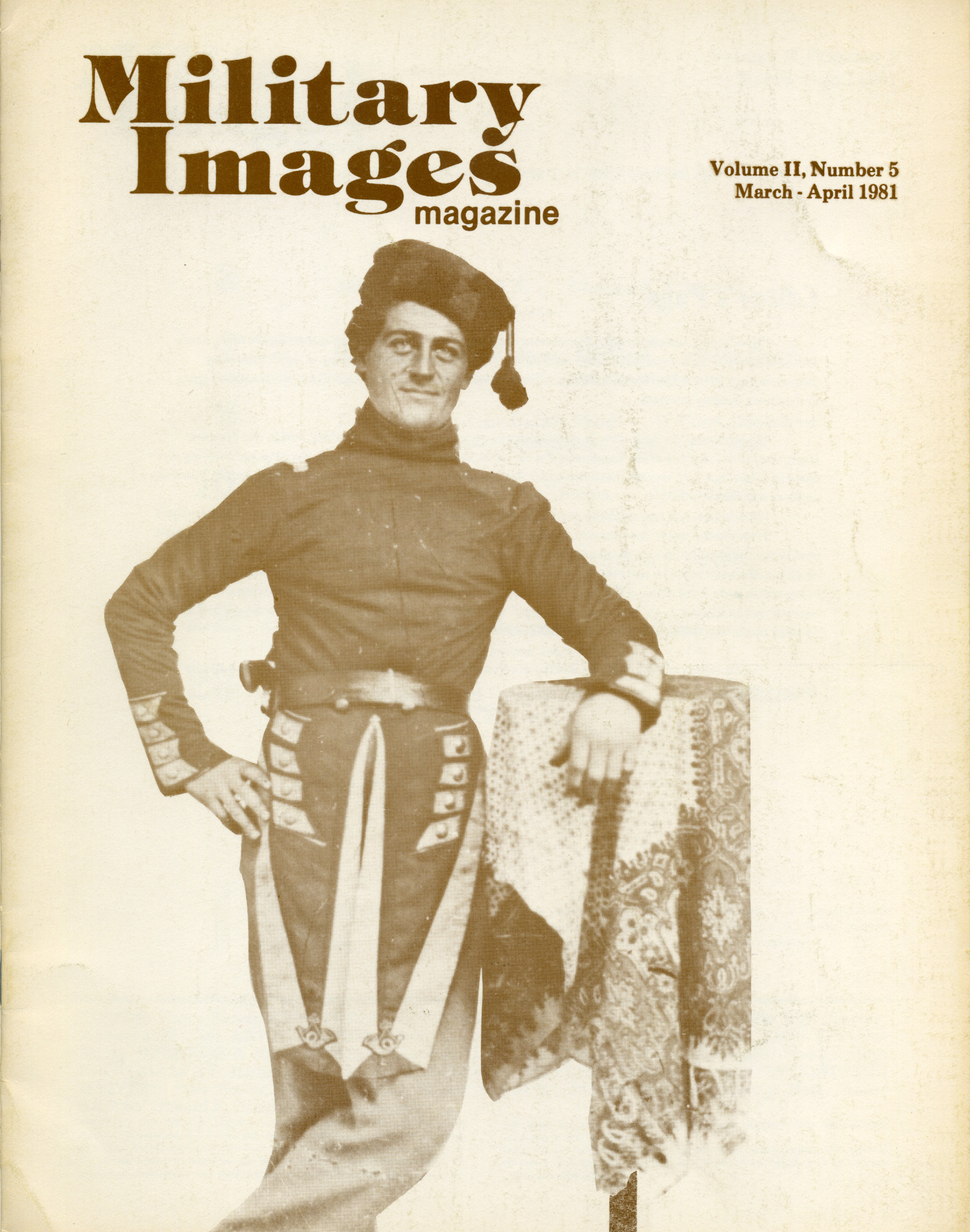
This “April Fools” issue of Military Images features a ninth-plate tintype of a Massachusetts militia man wearing his uniform backwards. It does offer the reader a very good look at the details on the back of the uniform coat.

Editor’s Page (inside front cover)
The editor explains the images found on the front and back of this month’s issue.

Mail Call (p. 2)
The readers contributed a logical solution to one of the cryptic messages found in a previous issue. Another reader writes that he was able to identify the uniform worn by an officer in a recently purchased quarter-plate tintype he had purchased based on an article he had read.

John Stocking, U.S.N: Unsung Hero of the Monitor by Charles S. Schwartz (p. 3)
Accompanied by a full-body carte de visite of Boatswain’s Mate John Stocking, the short article provides the information known about the sailor, who was swept overboard while trying to disconnect his ship, the USS Monitor, which was tied up while being towed by the USS Rhode Island.

Origins of the Confederate Uniform by Philip Katcher (pp. 4-7)
The article shows that there is a distinct European influence on the designs of the Confederate military uniform. Many components, such as the rank on the collar and the intricate lacework on the arms of the officer coat, came from the Austrian military. The lacework or braid was also called the “Austrian knot,” and was also used by the French military to designate rank on the kepi, which the Confederate military also had adopted in part and called the “French pattern.” Some aspects of the Union uniform were kept, such as chevrons for non-commissioned officers and branch of service colors; the exceptions were for the Confederate medical corps which was assigned black and the cavalry which was given yellow. While not all of the dress regulations were able to be effectively enforced, the article does provide a good deal of detail on what the intended Confederate uniform was to look like.

The Children of the Battlefield by William Gladstone (pp. 8-9)
After dying on the streets of Gettysburg, an unidentified soldier grasped an ambrotype image of three children. He was buried, and the image was turned over to Dr. J. Francis Bourns, who had carte de visite images made and saw them distributed so the identity of the fallen soldier could be made and his family notified of where he lay. Philinda Humiston was able to identify her children Franklin, Alice, and Frederick, and her husband Amos was reinterred at the National Cemetery at Gettysburg as a result. A total of five different issues of “The Children of the Battle Field” cartes de visite were issued, creating a fund to support the Soldiers’ Orphans Home in Gettysburg. The Humiston children were brought there for their education, and Mrs. Humiston was employed as matron. The article provides a great deal of information about the Humiston family, details about the different issues, and how fundraising was generated by the distribution of the children’s image.

Yerba Buena Island, California: A Look at the New U.S. Naval Training Station in 1901 by John Stacey (pp. 10-15)
Twelve different images accompany this article about the history behind the training station, the facilities that were provided to the “apprentices and landsmen” who were trained there, the ships they used, what skills they learned, and some of the demographic data about the first year. From sleeping in hammocks to doing wash as a group activity to taking a class on naval mathematics, the photographs included provide a glimpse into the life of a naval trainee at the start of a new century.

“Your affectionate son…:” The Civil War Letters of Pvt. Harley J. Hilborn, 145th Pennsylvania Volunteers by Eileen F. Conklin (pp. 16-21)
This issue of Military Images takes a touching and in-depth look at another popular kind of memorabilia, that of the personal letter written home. The letters that Private Hilborn wrote to different members of his family give the reader a great deal of insight into his life from a new recruit in September 1862 through his experiences fighting up to and including his wounding in Fredericksburg in December. He was transferred to Douglass Hospital in Washington, D.C. and wrote from his hospital bed, describing his experiences and eventually asking his father to come and see him. His father arrived the day before he died of his injuries on January 2, 1863.

Passing in Review (p. 21)
Two books are reviewed in this issue. The first is Cry Comanche by Harold H. Simpson, which provides a history of the Fifth U.S. Cavalry, receiving a mixed review. The second book discussed is the reprinting of The Twentieth Maine: A Volunteer Regiment of the Civil War by John J. Pullen.

Military Monkey Business by Don Dillon (pp. 22-25)
Keeping with the “April Fools” theme from the front cover, this pictorial features ten images of military men letting loose in one way or another. In one photograph from Japan taken between 1908 and 1913 shows sailors and a Marine sharing Kirin Lager in a “wetting down party.” Two forms of punishment are shown, with one man being guarded while being confined to the barrel of a cannon and one man “riding a rail” that was crafted to look like a horse. Different action shots of men in the Civil War staging friendly-looking fights are shown, as is one shot of a Pennsylvania National Guardsman taking aim at a “crazed Moro” at a 1909 encampment.

A Lancaster Lad Goes to War in 1898 by Clifford B. Weaver (pp. 26-27)
The adventures of Private Peter Allabach, Jr. of Company L, 4th Pennsylvania Volunteer Infantry, are the focus of this article as he made his way toward the Spanish-American War. Two photographs, likely taken at home while on furlough, complete the story.

Stragglers (pp. 28-31)
Eighteen different images comprise the “Stragglers” from this issue. An unidentified Marine officer in his immaculate dress uniform taken in Yokohama, Japan in about 1890 leads off. There are many images of Civil War POWs, including “Happy Family, Cell No. 1” consisting of Confederates captured in Morgan’s Raid and a barefoot Union soldier after his release. One of the images includes “Buckskin Charlie,” a Civil War veteran of the G.A.R, along with two other Southern Utes in a photograph taken in Colorado in the 1880s.

Back Image
The image of a soldier taken with a statue of an elephant on the table next to him reveals that he has “seen the elephant.” This was mid-19th century symbolism meaning that he has seen combat and survived.

Finding Aid: Jan./Feb. 1981

1981-v2-04-ii-cover

The complete issue

Vol. 2, No. 4
(32 pages)

Print edition: Visit our store to check availability
Digital edition: Visit JSTOR.org to purchase
Explore the MI Archives: Browse | Advanced search | Tutorial

Inside

Cover Image
A sixth-plate tintype image of a Yankee cavalry man in a sitting pose.

Editor’s Page (inside front cover)
The editor of Military Images answers the frequent concern that the magazine does not include enough articles on the Confederacy.   The editor reminds readers that the content of the publication comes from the readership, and that someone needs to write the articles with Confederate content to have it included.

Mail Call (p. 2)
The author of the cover article on the 9th Infantry and Colonel Liscum received a response from General Matthew B. Ridgway, providing further context on the history of the unit and the regard for which Liscum was held. Another helpful letter came from Rene Chartrand of Parks Canada and provided correction and context for a few images for which he held expertise.

The Narrow Escape of Francis Marion White by Ronn Palm (p. 3)
In a twist of fate between “honorable opponents” in October 1864, the competition between the “Old Ringgold” of the Union and McNeill’s Rangers of the Confederacy led to the Rangers intervening on behalf of one of their opponents against John S. Mosby’s Rangers. After being ordered to destroy a still in “Mosby’s Confederacy,” the men of the Ringgold Cavalry apprehended a Baptist minister who was one of Mosby’s men. Their commander, General Averell, ordered a court martial and hung the man, leaving his body to dangle at the side of the road. A while later, Pvt. White realized he had forgotten his saber and rode back, only to be captured by Mosby’s men and also sentenced to hang. Some of McNeill’s men were able to convince Mosby that White had nothing to do with the minister’s hanging, leaving White to be transferred eventually to Andersonville and to survive the war.

The Carson Valley Expedition of 1860 by Barry Taylor (pp. 4-6)
It began with a conflict between the Paiute Indians who were looking for some kidnapped girls and the inhabitants of a Pony Express station northeast of Virginia City. One man got away, and there was a demand for retribution from the residents there. A small informal detachment of miners, rogues, and militia eventually found the Paiutes, which killed the leader, Major William M. Ormsby and several others at the Battle of Pyramid Lake. A few stragglers made it back to Virginia City, and when the word reached California about the incident, General N.S. Clark, Commander of the Department of the Pacific, organized what became known as the Carson Valley Expedition. Eventually catching up with the Paiutes at Pinnacle Mount, the expedition was able to defeat them.

Passing in Review (p. 7)
Christopher M. Calkins’ monograph Thirty-six Hours Before Appomattox covers the lesser-known fighting at places like Sayler’s Creek, High Bridge, Farmville, and Cumberland Church, providing a wealth of information about these battles to include personal anecdotes, maps, photographs, bibliographic references, and other accumulated evidence.

American Eagles of the Great War by Charles G. Worman (pp. 8-11)
The article discusses the achievements of four Medal of Honor recipients, all of them aviators from World War I, including images of the men in France. Lt. Frank Luke was a leading American ace with a confirmed 18 victories (14 balloons, 4 aircraft) when he went missing near Verdun. His grave was located after the Armistice, with French locals telling the story of how Luke was killed while firing into a group of Germans who had surrounded his landed aircraft. Eddie Rickenbacker had been a race car driver, and had been assigned to the U.S. flying school at Issoudun due to his knowledge of gasoline powered engines. He learned to fly and by the end of the war, he had earned the most victories, with a total of 26 confirmed. Lt. Rickenbacker earned his Medal of Honor for attacking seven German aircraft on his own, downing two of them in September 1918. The last two recipients, Lt. Harold Geottler and Lt. Erwin Bleckley, were killed together as they searched for the “Lost Battalion” in the Argonne. They were charged with dropping supplies to the men on the ground, which were hard to spot visually. Geottler was flying the aircraft, while Bleckley had the role (as indicated by the half wing insignia on his uniform) of making observations. Geottler was shot by anti-aircraft fire and the plane dove and crashed, throwing Bleckley from the craft to die later from internal injury.

The Governor’s Guard: 2d New York Mounted Rifles by Robert A. Braun (pp. 12-15)
The article follows the newly formed unit as it gathered in early 1864 and prepared for war as a mounted rifle unit. Although without horses for their first seven months in the field, the Guard was on duty during the Battle of the Crater at Petersburg and took part in the expedition to destroy the Weldon Railroad. They were given mounts in November 1864 and fought until they ran out of ammunition during the Battle of Dinwiddie Court House. The last man from the unit killed in action fell at Clover Hill, less than two hours before the nearby cease-fire at Appomattox Court House.

U.S. Army Uniforms of the Civil War, Part I: The Frock Coat by Michael J. McAfee (pp. 16-21)
Descriptions of how the frock coat was worn by Federal soldiers of the Civil War are given, accompanied by seventeen different carte de visite images that illustrate each point made in the article. Examples of many variations, especially with those soldiers who were musicians, show how the frock was worn. The reader can see how buttons and double- or single-breasted frocks denoted rank, as well as how a brevet rank can be distinguished.

The Lytle Greys by Robert Kochan (pp. 22-24)
Large images of these Civil War veterans from Cincinnati, Ohio allow the reader to see how they began as Company B of the Cincinnati Zouaves Independent Militia in 1868.   When the other four companies disbanded in 1872, they were renamed “The Lytle Greys” in honor of Cincinnati native General William Lytle who fell at Chickamauga in 1863. They saw active service in the Nelsonville Coal Riot of 1874. Known as a particularly successful competition until 1877 when military law was changed in Ohio, they then were integrated into Company B, First Infantry Regiment of the Ohio National Guard. The article provides detail on their uniforms, which changed three times between 1868 and 1877.

What’s In an Ambrotype? Part I: Using the ambro as a negative by Edward Steers, Jr. (p. 25)
Part I of this article discusses the way new technology can utilize the unique qualities of the original ambrotype. These were one-of-a-kind images produced on glass, usually as a negative, and then coated or backed to create a positive or “corrected” image. These old images can be teamed with an enlarger to provide detailed prints due to their incredibly clear nature. The sixth-plate image provided by the article has gone through this process, and a detailed image, enlarged more than 60 times the original, reveals the seal of the state of Vermont on one of the buttons.

What’s In an Ambrotype? Part II: Hidden Messages by Jack E. Moore (pp. 26-27)
Part II of this investigation of the ambrotype considers what might be found not in the image, but behind the image. Taking two ambrotypes out of their protective cases in order to clean the protective glass, the author of this part found what appears to be hidden messages. Two were found behind the ninth-plate ambrotype taken of Oliver Hazard Perry, Jr. in approximately 1863. Quite cryptic and in one instance very small, the meaning of these little pieces of paper remains a mystery. The other ambrotype yielded a different kind of mystery. The artist found a paper “heart-in-hand” cut out behind a sixth-plate ambrotype of a Maryland trooper, measuring about 2-1/2” in length. With a paper heart woven into the wrist area of the hand, the silhouetted hand held the message “friendship, love, and truth I give to you my heart and hand.” The signature had been scratched out, making it unclear if the ambrotype had been a gift to a young lady, or if the paper cutting had been a gift to the young soldier.

Stragglers (pp. 28-31)
A variety of images complete this issue of Military Images, from a 1936 U.S. Army vessel (a minelayer) in the Philippines, to a vignette on a carte de visite showing Federal soldiers preparing their mess. Two unique cartes de visite stand out as well. One is of Edwin H. Stoughton as a colonel of the 4th Vermont Infantry, well before his infamous capture from his bedroom in Fairfax Court House with the rank of brigadier by John Mosby in March 1863. The other is of Major Harvey B. VanVohis of the 18th Pennsylvania Cavalry Regiment, with whiskers that rival those of General Ambrose Burnside, who was featured on page 16. An additional pair of images were of note, with one of an ambrotype in need of restoration to reverse peeling and the other consisting of a black-and-white photograph on oiled paper backed with a colored drawing of the subject, “giving it the effect of a color photograph.” An appeal for information about both of these last images was made.

Back Image
A cabinet photograph of Private Harry J. Martin of the Nevada Volunteers taken at Camp Clark in Carson City, 1898.

Finding Aid: Sept./Oct. 1980

1980-v2-02-ii-cover

The complete issue

Vol. 2, No. 2
(32 pages)


Print edition: Visit our store to check availability
Digital edition: Visit JSTOR.org to purchase
Explore the MI Archives: Browse | Advanced search | Tutorial

Inside

Cover Image
A close-up image of the belt buckle worn by the 9th U.S. Infantry, emblazoned with a Chinese dragon and the words “Keep up the Fire!” The buckle featured on the cover of Military Images is linked to the article beginning on page 26 of the current issue.

Editor’s Page (inside front cover)
A guest editorial in the form of a letter written by Roger L. DeMik of Tennessee offers insight on the connection between the understanding of the past and establishment of individual connections to history provided by photographic and future technologies.

Mail Call (p. 2)
Letters include praise from readers in the Netherlands and South Africa, as well as from a collector’s group in California. One letter identified a few errors in a previous article on the “Bucktails” of Pennsylvania, as well as thanking the magazine for its series on naval uniforms, as it allowed the reader to identify the branch of service held by his great-grandfather and thereby getting a copy of his service records from the National Archives.

Sam Hildebrand, Bushwacker by George C. Hart (p. 3)
The image of what appears to be a man wearing the Civil War uniform of a federal soldier in a quarter-plate tintype is actually the image of a Confederate from Missouri who was active in the Western theater of the war. Although not as renowned as a Mosby or Quantrill, it appears that Hildebrand’s Southern loyalty and wartime activity made it impossible for him to return to a peaceful life farming in the Midwest. He dictated his memoirs in 1870, as he was unable to read or write, and was eventually shot by a law officer in Illinois in 1872.

Diary of a Bomber: The World War One Journal of Harold H. Wadleigh (pp. 5-9)
The complete diary of Private Harold H. Wadleigh, a grenadier in the 353d Infantry Regiment, 89th Division of the American Expeditionary Forces in World War One is presented, beginning with his transport to France in May 1918 and ending with his unit crossing into German territory in December of that year. Some of the entries are short and to the point, while others provide description of the front lines, going “over the top” with his fellow soldiers, escorting a “shell shocked” comrade to an aid station, and how the soldiers in Wadleigh’s unit first received the news of the Armistice on November 11, 1918. In a relatively short space, this MI exclusive provides great insight on the front line experience of one American soldier from the “Middle West” Division.

Passing in Review (p. 9)
The magazine reviews Pickett’s Charge: A Microhistory of the Final Attack at Gettysburg, July 3, 1863 by George R. Stewart. The book is a reprint of the original 1959 work and goes into what the review calls “the author’s constant, sometimes painful, objectivity,” taking as many perspectives into account as possible and providing some very interesting pieces of information. The book is highly recommended.

Photography During the Civil War by Philip Katcher and David Scheinmann (pp. 10-15)
The article begins with a description of how daguerreotype images were made and then continues with descriptions of newer forms, such as the “hard images” or the ambrotype and tintype processes. These images had standard sizes, were usually placed in some sort of protective envelope or case, and poses were also generally very similar. Occasionally, the images were touched-up by hand, usually with rouge on cheeks and gilt paint on buttons and buckles. The images were negative images, however, and the subject would be seen in the reverse of how he or she would appear naturally; it was not possible to create copies of ambro- or tintypes. A process that used paper as a backing and provided negatives that could be duplicated allowed the advent of the carte de visite, as well as a means for the government to levy a tax. Virtually dying out by the end of the Civil War, the authors provide a few other examples of how photography was used in new and innovative ways. Seven different images illustrate the article, providing examples of what is discussed.

Survey: U.S. Marine Corps Images of George Menegaux (pp. 16-25)
The pictorial provides thirty images of U.S. Marines from between 1859 to about 1934. Many are cartes de visite of identified Maries, but others in the collection were images taken overseas at various duty stations, including in Peking. There are images of Marines in typical occupations, such as bandsmen and cooks, as well as standing at attention. Several Marines who received the Medal of Honor are included, as well as images of foreign Marines.

“Keep up the fire!” by Robert Kelchner (pp. 26-27)
This quotation, featured on the cover image of the belt buckle of the 9th U.S. Infantry, honors the final words of Colonel Emerson H. Linscum, who died rallying his troops on July 13, 1900, in during the Boxer Rebellion in Tientsin, China. After beginning his career with a three-month enlistment as a private with the 1st Vermont Volunteer Infantry at the start of the Civil War, Linscum became a career soldier. Returning to duty after serious injury in the Spanish-American War, Linscum was taking part in the international assault on the captured city when he fell. The 9th Infantry was authorized to use the belt buckle in 1923. A portrait of Col. Linscum accompanies the article, as well as three images taken outside of the Tientsin Gate.

Stragglers (pp. 28-30)
Images include the well-known, in the figure of William J. Hardee as Commandant of Cadets at West Point in the late 1850s, to the unknown, in an image of a young boy who resembles John Clem, the “Drummer Boy of Shiloh,” to a group of Ogalalla Sioux infantrymen from Fort Omaha. Unusual uniforms and insignia include a Bucktail wearing a musician’s frock coat, to an “officer of the day” wearing a Masonic tie pin, to a soldier from the Spanish-American War sporting his 7th Corps badge.

Back Image
Philippine Insurrection campaign veteran 1st Sgt. Amos Hay in his dress blue uniform graces the back of this MI issue in a crisp cabinet photograph image from about 1910.

Finding Aid: May/June 1980

1980-v1-06-i-cover

The complete issue

Vol. 1, No. 6
(32 pages)


Print edition: Visit our store to check availability
Digital edition: Visit JSTOR.org to purchase
Explore the MI Archives: Browse | Advanced search | Tutorial

Inside

Cover Image
A half-plate tintype of Pvt. William H. Harding of Ohio’s 5th Volunteer Cavalry shows the cavalry trooper astride his mount, fully equipped. The image was taken by John Winders in November 1862.

Editor’s Page (inside front cover)
The editor of Military Images assesses the first year of publication. The cost of publication and its impact on limiting the length of the magazine are addressed, as are more positive aspects of the first volume.

Mail Call (pp. 2-3)
Letters from readers include ideas for future issues and several questions or corrections about identifications of soldiers, uniforms, or equipment from recent articles.

Passing in Review (p. 3)
Two publications are given review in this issue. The first is Four Brothers in Blue by Robert Goldthwaite Carter, a republication that features the Civil War era letters set within a chronological narrative by the author. Second is New England’s Civil War Veterans by Jay S. Hoar, who provides a wealth of information regarding the identities of the last survivors of the war from New England.

Junius Peak: Texas Confederate by Robert W. Stephens (pp. 4-5)
Complete with an image of the subject, the article describes the military and law enforcement accomplishments of Junius “June” Peak of Texas. He was a runaway to the Civil War, eventually becoming a Confederate cavalryman. After the war, he returned to Texas and became a deputy sheriff, city marshall for Dallas, a member of the Texas Rangers taking on both outlaws and “marauding Indians” in West Texas.

9 July 1864: The 14th New Jersey Infantry at the Battle of the Monocacy by Joseph Bilby (pp. 6-15)
This article is the second part of a series on two New Jersey regiments that saw extensive action in the Civil War. The author describes the details of the Battle of the Monocacy which took place in Maryland between the Confederate forces of Lieutenant General Jubal Early and the Federal forces of Major General Lew Wallace outside of Frederick, Maryland. A collection of ten different images of soldiers from the 14th New Jersey Infantry accompany the article. While the Battle of the Monocacy was a Confederate victory, it delayed the Confederate troops so they were unable to advance into Washington, D.C. as planned. The author also provides an “Epilogue” where he tells the post-war stories of several men who had impact in the battle.

Naval Uniforms of the Civil War, Part IV: Enlisted men of the U.S. Navy by John Stacey (pp. 16-21)
Accompanied by 11 images from the era, including one carte de visite of a very little boy who might be a powder monkey, this article discusses the uniform regulations that were in effect before, during, and after the Civil War. The author describes several examples of how naval servicemen of various enlisted ranks were able to personalize their uniforms and explains how difficult it was for them to standardize their uniforms during the war. The article also includes a picture of stamped embroidery insignia patterns that would have been finished with embroidery by the individual sailors, as well as three finished examples, showing the degree of skill many of these sailors possessed.

“In Camp and Field”: Civil War Outdoor Views from the Collection of Robert J. McDonald (pp. 22-28)
The pictorial article includes several different types of outdoor images. Many of the items include encampments, formal and informal groups, individual soldiers, soldiers on their mounts, and others. The images give the reader a better glimpse of the daily life of a Civil War soldier by providing an outdoor context.

Stragglers (pp. 29-31)
The regular MI feature includes a wide variety of images, from a 1850-era daguerreotype of two California caballeros with rare arms to a photograph of a barbershop set-up with the Light Battery M, 7th Artillery taken in Puerto Rico in 1899 after the Spanish-American War. One of the more unusual images is a carte de visite of what is possibly a French Caribbean constabulary submitted by a reader from France. Also included is an albumen image of the U.S.S. Little Rebel with a brief history of how this Confederate gunship became part of the Federal naval arsenal.

Back Cover
Two images grace the back of the issue. The image on the left was discovered in the effects of a deceased relative and may have some connection to the Wray family of Brunswick County, Virginia. The larger image on the right is a carte de visite image of Private Washington Watson, who was 61 upon his enlistment with the 148th Pennsylvania although he stated that he was 43 years of age. A skilled lumberjack, he was discharged with a disability designation of “old age” from the Pioneer Detachment of the II Corps of the Army of the Potomac in 1865.

Finding Aid: March/April 1980

1980-v1-05-i-cover

The complete issue

Vol. 1, No. 5
(28 pages)


Print edition: Visit our store to check availability
Digital edition: Visit JSTOR.org to purchase
Explore the MI Archives: Browse | Advanced search | Tutorial

Inside

Cover Image
Indian scout Al-Che-Say, chief of the White Mountain Apache tribe, is one of several Native Americans featured in this 1890 photograph. He served as one of the most famous of the U.S. Army Indian Scouts.

Editor’s Page (inside front cover)
The editor responds to a critical letter, and outlines the purpose of Military Images, a magazine written by its readership. Rather than being a publication dedicated to the images of the Civil War, he notes the other topics covered in past issues, and requests a variety of articles from the readers.

Mail Call (p. 2)
Further investigation shows that the identity of the “Mystery Zouave” discussed in the previous issue is still a mystery, and the clarification between the American private and the Imperial Russian NCO in the Boxer Rebellion cabinet photographs from the previous issue is made. A correction is also made regarding the type of firearm identified in an image as well.

“Jack” of the 102d P.V. (p. 3)
Beginning as a scrappy firehouse mascot, a bull dog named “Jack” followed when most of the members of the Niagara Fire Company enlisted in the 102nd Pennsylvania Infantry in August 1861. The excerpted article tells the story of “Jack” and his service, accompanied by two cartes de visite of the loyal mascot dog.

Otto Scheu, R.A.: Adventures in the Regular Army at the turn of the century by Joseph Bilby (pp. 4-10)
A German immigrant arriving in the U.S. in 1887, Otto Scheu was one of the many soldiers of the Regular Army, serving in various infantry and then engineering units until his retirement 1912. The article, with images, outlines several different timeframes in Scheu’s service, from the frontier army to fighting in the siege of Santiago in the Spanish-American War to the fighting against Aguinaldo in the Philippines. The unique aspects of Scheu’s military career were the fact that his image was featured in a photograph taken of wounded soldiers in Cuba published in Collier’s Magazine in July 1898, and that his experiences as a prisoner-of-war in the Philippines (including being saved by Aguinaldo himself) were featured in the New York Journal Advertiser in December 1899.

The 20th N.Y. State Militia: A regimental history of “The Ulster Guard” by Seward R. Osborne, Jr. (pp. 11-13)
Beginning with a short history of the unit prior to the outbreak of the Civil War, the article traces the history of the “Ulster Guard” from its initial three-month service in 1861 to its first action at the Second Manassas to defending against Pickett’s Charge at Gettysburg to raising its national colors over Petersburg. The article includes three cartes de visite of the unit’s Civil War commanders, as well as a group image of the officers of the 20th N.Y.S.M. in September 1863. A poignant image of Hugh Donohue and Reuben Van Leuven from Company D shows the two friends and neighbors sitting together; the former was wounded at Second Manassas, while the latter was killed at Gettysburg.

“Mustering In”: An ambrotype in the collection of William Gladstone (pp. 14-16)
This pictorial features a half-plate ambrotype of what appears to be a mustering ceremony taken in the backyard area of a city or town. Turning the focus onto different parts of the photograph, the reader gets a deeper sense of the activity that the ambrotype captured. Surrounding a water pump and trough, the fife and drummer boy appear to be playing while a man nearby speaks, holding out his hat for emphasis. A woman on the balcony of a neighboring house watches the activity, providing us a glimpse into a part of her house, while an important looking man on a chair in the yard holds onto a dog. The ambrotype allows MI readers a glimpse into an unusual event taking place in an everyday setting.

Passing in Review (p. 17)
Two different publications are reviewed in this issue. The first review covers both volumes I and II of World War One Collectors Handbook, by Dennis Gordon, Hayes Otoupalik, and Paul J. Schulz, which is a very helpful guide for those interested in collecting or the history of World War I artifacts and memoribilia. The second review is of A Pictorial History of the Battle of Gettysburg which is unauthored and appears to be geared towards the tourist rather than the scholar.

Naval Uniforms of the Civil War, Part III: Confederate Images from the collection of John Bracken (pp. 18-21)
The Director of the Virginia Confederate Museum shared 17 carte de visite images of Confederate naval officers. With all but one subject identified, the collection ranges from Rear Admiral Raphael Semmes to several captains of blockade runners. Brief background information on each subject’s naval service is provided and unique aspects of their uniforms are indicated.

Indian Scouts of the U.S. Army by Jacques Noel Jacobsen, Jr. (pp. 22-24)
Accompanied by images of different Indian Scout units, the article discusses the history of the Indian Scout in the service of the U.S. Army, delineating between before and after 1866, when scouts were enlisted into the Army as were other members of the Regular Army. The article discusses in brief some of the more notable actions of the Scouts, including the Crow scouts working with Custer, the last campaign against Geronimo, the scouts with Pershing chasing Pancho Villa in Mexico, and the Navajo in the Pacific during World War II.

Stragglers (pp. 25-27)
Three trios of images submitted by readers are featured. The three examples of rare weapons includes a carte de visite of Capt. John McDonald Laughlin of the 104th Pennsylvania holding a model of a siege gun in his lap, possibly after the siege of Charleston in which his unit participated. The second trio highlights a group of cavalrymen, including a Canadian volunteer cavalry soldier from about 1866. The third trio is of “Three Rebs” including one serious Georgian wielding an 18” Bowie knife in the sixth-plate ambrotype.

Back Cover
The image is a sixth-plate ambrotype of Illinois infantryman Private George W. Walker from Company H of the 13th Illinois Volunteer Infantry.


Finding Aid: Jan./Feb. 1980

The complete issue

Vol. 1, No. 4
(28 pages)


Print edition: Visit our store to check availability
Digital edition: Visit JSTOR.org to purchase
Explore the MI Archives: Browse | Advanced search | Tutorial

Inside

Cover Image
This issue of Military Images features a confident Trooper Charles E. M. Gilmore of the 4th U. S. Cavalry in a cabinet photograph taken in approximately 1905.

Editor’s Page (inside front cover)
The editor responds to frequent observations made by readers regarding what appears to be “backwards” images published in prior issues. Due to the processing technology of the time, these “hard” images were very similar to a mirror image, as there was no use of a negative image that was familiar in later eras. While some subjects would reverse their cartridge boxes or sabers for the purpose of an image, the ambrotype, daguerreotype, or tintype would still have certain uniform features shown in reverse, such as buttons, belts, or insignia.

Mail Call (p. 2)
A reader appears to have identified the Zouave featured on the cover of the second issue of Military Images as Cpl. John A. Anderson of the 155th Pennsylvania Zouaves.

Patriotic Picture Frames of the Great War by Dale Biever (pp. 3-5)
The article features several examples of how images were displayed during the First World War. In a collection of nine images, the author provided a wide variety of both manufactured and homemade frames. Many of the manufactured frames could be easily changed to represent a particular branch of the service, and foreshadowed symbols more associated with the Second World War. Some of the handcrafted frames include a small life preserver and a frame made from the tip of an aircraft propeller.

Lt. Wilson’s Scrapbook by Dennis Gordon (pp. 6-11)
This article comes from a forthcoming book by the author, and uses the images taken by Lt. John E. Wilson, chaplain to the 167th and 168th Transportation Companies. Both companies saw service at the end of the First World War, which involved fighting in the Russian Civil War with the White Army and other Allied nations against the Bolshevik Red Army on the North Russian Front. Almost 800 men were assigned to these units and were responsible for maintaining and operating railroad lines in the area outside of Murmansk from April to July 1919. The photographs taken by Lt. Wilson document some of this little-known episode in American military history.

The Search for Private Beetem (pp. 12-13)
The article outlines the search for the identity of one soldier whose image was found in two different items up for sale at a flea market in Pennsylvania in 1979. By connecting a clue from each image, the carte de visite and the 4×5” albumen photograph were able to bring to life for MI readers the story of Private John W. Beetem, who served in Company L of the 13th Pennsylvania Cavalry from August 1862 to July 1865.

Bob Kelchner’s 7th Cavalry Album (pp. 14-20)
This article focuses on thirteen portraits taken from a photograph album that contained images from Troop E of the U.S. 7th Cavalry dating from 1895 to 1912. While most of the subjects are unnamed, the album allows a very interesting view of the uniforms worn by the troops during that time, which included service in the Spanish-American War and the occupation of Cuba. The article poses many possibilities for why the men wear a mix of old and new uniform components. Some of the troopers also wore uniforms that were not regulation, such as the trooper wearing a knit turtleneck sweater underneath his uniform or the soldier who modified the collar of his regulation fatigue coat to that of his own liking.

Passing in Review (p. 21)
The article reviews the newly revised A Photographic Supplement of Confederate Swords with Addendum by William. A. Albaugh, III.

Naval Uniforms of the Civil War, Part II: U.S. Naval Engineers by John Stacey (pp. 22-24)
The author of this article, the second in a series highlighting the uniforms of the Federal navy, focuses on changes in uniform regulations as shown by four cartes de visite highlighted in the article. The author also provides a great deal of information on the background of the uniform regulations for naval engineers prior to the Civil War.

Stragglers (pp. 25-27)
There is a wide variety of images in this issue, some of which have a few surprises involved. One carte de visite image appeared to be a British sailor but with some research, turned out to be probably from a theatrical production. Another fascinating image submitted by a reader was a cabinet photograph taken in Tientsin, China, during the Boxer Rebellion, depicting an American private and an Imperial Russian NCO sitting in a painted prop automobile. Even more fascinating was the fact that another image of the two was submitted by a different contributor, with the same two soldiers wearing switched uniforms.

Back Image
The image shows a soldier most likely from a Pennsylvania Zouave regiment, but wearing a wonderful striped turban with tassel, holding an unusual firearm.


Finding Aid: Sept./Oct. 1979

The complete issue

Vol. 1, No. 2
(28 pages)

Print edition: Visit our store to check availability
Digital edition: Visit JSTOR.org to purchase
Explore the MI Archives: Browse | Advanced search | Tutorial

Inside

Cover Image
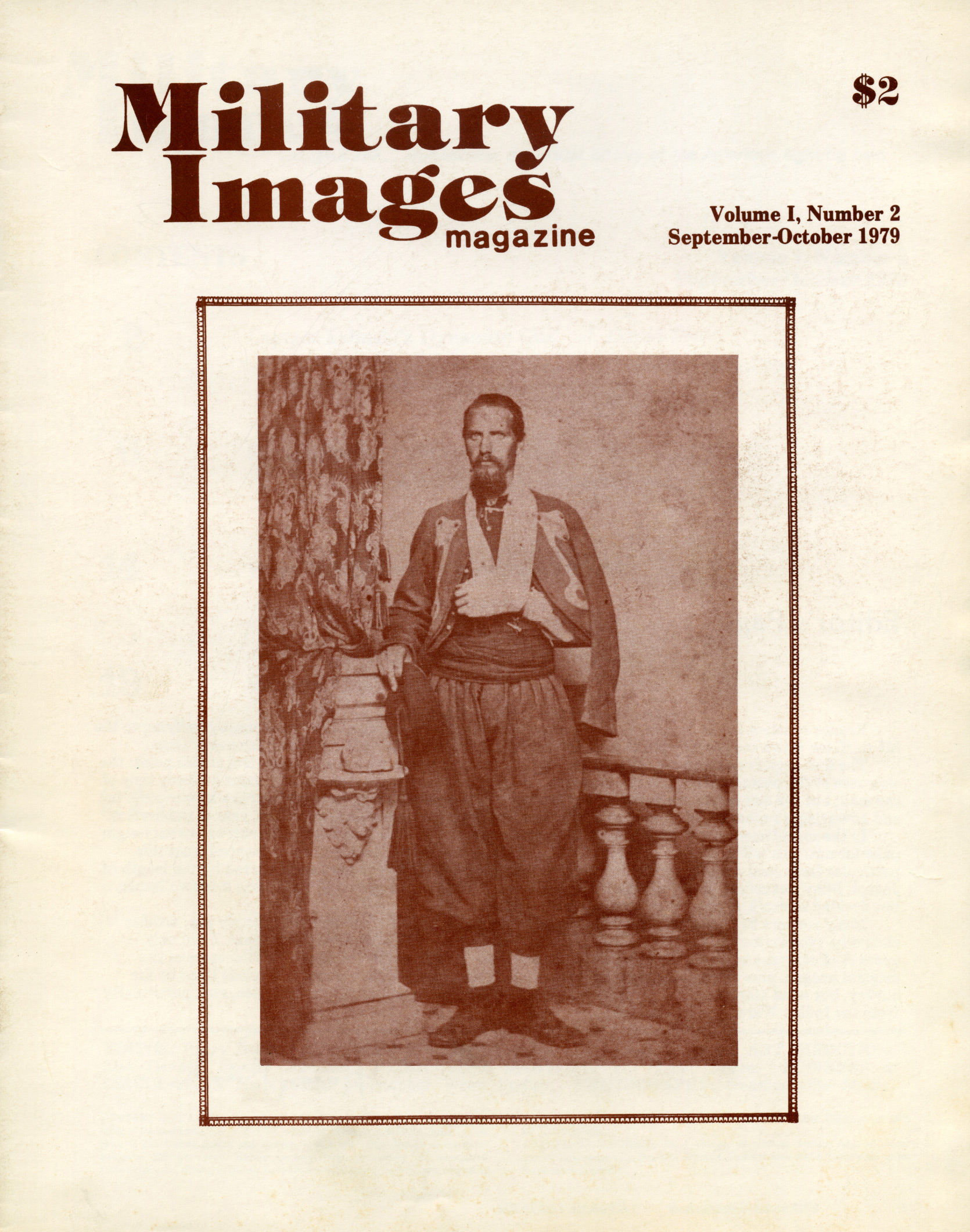
The cover of this issue features an unidentified Zouave of the 155th Pennsylvania Volunteer Infantry, who was wounded in the left arm at Chancellorsville.

Editor’s Page (inside front cover)
The editor of Military Images responded to the many positive responses for the first issue and thanked the readers. Some concerns that readers identified were addressed, and the procedure for the submission of articles was outlined. Changes in the format of this specific issue (in order to accommodate the article by Joseph G. Bilby) were explained.

Captain Zalinski’s Amazing Pneumatic Dynamite Gun by J.D. Truby (pp. 2-5)
This interesting article discusses the development of the dynamite gun, which used pneumatic pressure to fire explosive projectiles. Beginning with experimentation with an existing design, Capt. Edmund L.G. Zalinski worked with Pratt & Whitney on the project. He later found that changing the design of the missile made the weapon more effective; these changes were later seen in the design of the artillery shells used in tank-killing bazookas of World War II. Zalinski also developed an electric fuse that was used with the system. Eventually his design was adopted by the U.S. Navy and placed in the gunboat Vesuvius in 1890. The issue of accuracy was raised, as the guns were fixed; the ship itself had to move around to aim the dynamite guns. The article includes two images of the Vesuvius, with the dynamite guns which were proven to be an effective weapon during its use in the siege of Santiago in the Spanish-American War in 1898.

Savage Spring: The 15th New Jersey Volunteer Infantry Regiment at the Battle of Spotsylvania by Joseph G. Bilby (pp. 6-13)
An excerpt from his upcoming book, Trampling Out the Vintage: The Story of the 15th New Jersey Infantry, the article begins with the descriptions of two group photographs taken in March 1864. One was of the line officers of the 15th New Jersey and the other was the NCOs and First Sergeants. The article goes into detail on the stories of many of the identified men from both images during the May fighting known as the Battle of Spotsylvania. The article is accompanied by five individual images, along with more extensive narratives of their experiences. The article gives the reader a very good sense of the destructive nature of the spring 1864 campaign outside of Richmond.

What Is A Zouave? By Michael J. McAfee (pp. 14-18)
The author of this enlightening article provides a short history of the Zouave, beginning with the French Army in North Africa. While variations in uniforms grew, the Zouave regiments became effective light infantry units with the reputation of sharpshooters throughout European militaries. Their adoption by American militia companies, most notably the Zouave Cadets of Illinoisan Elmer E. Ellsworth, came in 1860, just prior to the outbreak of the Civil War. The author stresses that American Zouave uniform was generally a fanciful variation of the North African uniform although some authentic versions existed. hey varied widely from regiment to regiment, which is illustrated with one large group image and six individual soldier images, which the author uses in his discussion. The author advises collectors of Zouave images to take care that they do not dismiss images of individuals wearing standard Civil War uniforms, as they may have belonged to named Zouave regiments. He included an image of Capt. Thomas Skelding of the 10th N.Y.V.I. (the “National Zouaves”) who was wearing a frock coat with long skirts. The uniform of the Chasseur is also not to be confused with the Zouave; the indicator is the length of the skirts on the jackets, which were between 6 and 12 inches. Officer uniforms would sometimes vary from the unit’s enlisted men, and the use of the Zouave uniform did continue past the Civil War as well.

Mike McAfee’s Zouaves (pp. 19-26)
The author of the previous article showcases 48 different carte de visite images of individual soldiers wearing Zouave uniforms. This includes Col. Elmer E. Ellsworth of the 11th New York Volunteer Infantry, who popularized the Zouave uniform in the United States. There is also a carte de visite image of Francis E. Brownell, wearing a different type of Zouave uniform; Brownell shot the Alexandria, Virginia hotel owner who killed Col. Ellsworth at the start of the Civil War. Many of the soldiers wear veteran sleeve stripes or corps badges, indicating that the Zouave uniform was worn continually throughout the war.

Battle at Fismette (p. 27)
This short article describes the intense fighting engaged in by a number of infantry units from Pennsylvania’s 28th Division during World War I in August 1918 in France. Defending the town of Fismette on the Vesle River, the regiments came up against heavy German fire, including gas, extended artillery bombardments, and frequent hand-to-hand street fighting. The focus of the article is on the activity of the 110th Ambulance Company, which evacuated over 500 casualties. The grandfather of MI’s editor, serving in the capacity of wagoner, was a recipient of the Distinguished Service Cross and is pictured.

Back Image
Pictured here is Eugene Beaver of the 4th U.S. Cavalry, D Troop, is pictured on January 24, 1899. He served in the Philippines, where he contracted malaria and chronic dysentery, prompting his medical discharge in 1901. He returned to service in 1903, enlisting in the Marine Corps under a different name; he was honorably discharged in 1907 and died in 1910 at the age of 36.

Finding Aid: Spring 2014

2014-v32-02-xxxii

The complete issue

Vol. XXXII, No. 2
(56 pages)

Print edition: Visit our store to check availability
Digital edition: Visit JSTOR.org to purchase
Subscribe to MI
Explore the MI Archives: Browse | Advanced search | Tutorial

Inside

Cover image
A sixth-plate tintype from the collection of Rick Brown shows a youthful Union soldier wielding a cavalry sword and M1860 Colt revolver. The contrast between his youthful appearance and his intense gaze is captured in this image, which prominently features his weaponry.

Table of Contents (p. 1)

Editor’s Desk (p.2)
Showcase. Interpret. Preserve. This issue of Military Images reiterates the stated core mission of the publication which “is as important now as when the first issue of MI rolled off the press in the summer of 1979.” The personal portraits of citizen soldiers and the images of ordinary life 150 years ago have come to take a place in the visual history of the United States, from well-known photographic pioneers like Mathew Brady and Alexander Gardner to those of unknown or forgotten photographers. Their work still captures the imagination of collectors both old and new, remaining the focal point of Military Images today and into the future.

Lines of Fire: Iconic Images of Civil War Soldiers From the Rick Brown Collection (pp. 3-27)
This selection of 26 images is from the collection assembled by Rick over the past 15 years. The collection includes ambrotypes and tintypes that provide a study of the equipment, uniforms, and weaponry of both Union and Confederate soldiers, as well as highlighting the aesthetics and imagery of the photographs themselves. The selection provided here includes the issue’s cover image that shows a contrast between youth and determination; a Federal cavalry trooper posing with five firearms and a sheathed saber that shows the industrial potential of the North; a Union soldier likely from the 23rd New York Infantry shown prepared for the fight, with a wonderfully balanced composition between the subject and the background.

Passing in Review (p. 28)
The new publication, Faces of Fort Fisher, 1861-1864 by Chris E. Fonvielle, Jr., is reviewed.

Antebellum Warriors (p. 29)
A soldier from the Mexican War era is featured in this photograph. Various unique features found on his cap and uniform make a clear identification of his belonging to a particular regiment difficult.

A Picture of Treason: The Military Commission Trial of Maj. Henry Kyd Douglas, C.S.A. by Jonathan W. White (pp. 30-33)
The article discusses the trial of one of Thomas J. “Stonewall” Jackson’s former staff officers, Major Henry Kyd Douglas, who was tried with treason. At the suggestion of a young lady, Douglas went to have his photograph taken at the studio of Thomas L. Darnell on May 5, 1865, in Shepherdstown, W.V. His crime was returning to his friend’s home still wearing his Confederate uniform after having the portrait made. “Seldom even in these strange times has so small an act been so grossly misconstrued so greatly exaggerated so trivial a fault so grievously answerable,” Maj. Douglas told the court.

Uniforms & History by Michael J. McAfee (pp. 34-37)
The article “Zouaves of ‘64” examines the continuing use of the zouave styled uniform in a series of 9 images from the author’s collection, debunking the common belief that the zouave uniform went the way of the Havelock after the first year of the Civil War.

Battle Shirt! A Field Guide to Unusual Patterns of Civil War Shirts by Ron Field (pp. 39-44)
An examination of the various types of battle dress known as battle, hunting, Garibaldi, or fire shirts is provided. The article includes 12 images that illustrate the garment’s origins, variations in design, and different styles from both Northern and Southern regiments beyond the well-known red battle shirt of Confederate General A.P. Hill.

Stragglers (pp. 45-50)
MI subscribers have provided a wide sampling of 13 unique photographs. The feature starts off with a heartwarming story of Mary Harman, holding their infant daughter in her lap and a photograph of her husband Samuel Harman in her hand. It is paired with an image of Samuel Harman holding the tintype sent to him by his wife. Also included are two different tintypes of an unidentified Federal soldier taken at the same time, but were separated over time. Collector Matthew Fleming reunited the images after finding one in California and the other in Michigan.

A Conspicuous Target: Maj. William Ellis, 49th N.Y. Infantry, at the Bloody Angle by Scott Valentine (pp. 51-52)
The author tells the story behind a carte de visite in his collection. Major William Ellis was a Canadian serving as an officer with the rank of major in the 49th NY Infantry. A veteran of several significant battles, Ellis’ wound at the Bloody Angle in May 1864 “ranks as one of the most bizarre battlefield injuries on record.”

The Last Shot (p. 56)
This carte de visite is of Captain George Albert Gerrish of the 1st New Hampshire Light Artillery and his wife, Caroline Parker (Kimball) Gerrish. This affectionate portrait is part of the collection of Rick Brown, and is a favorite of his mother, who insisted that he add it to his collection.