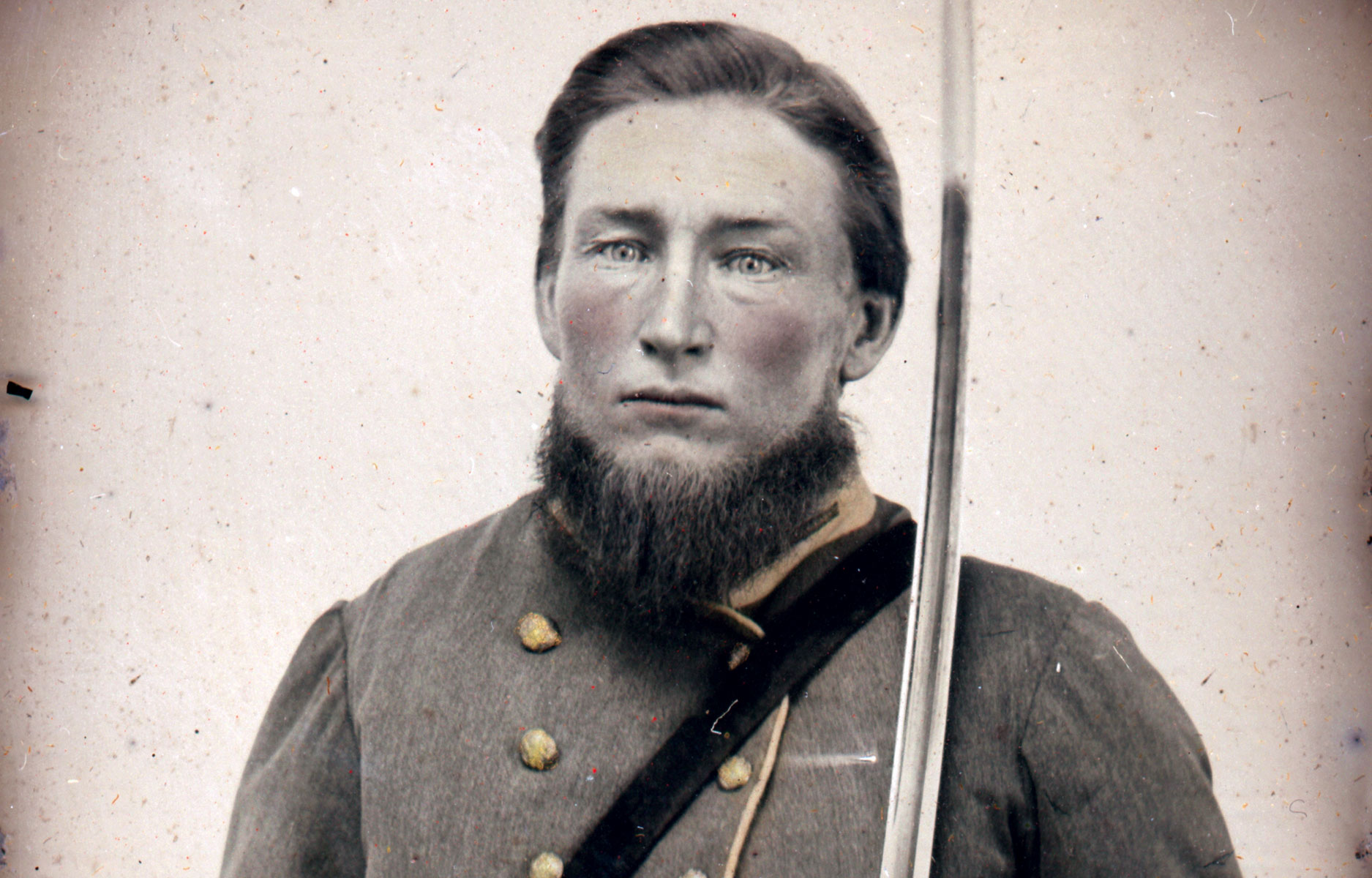
Mistaken Identity?

Two court-martial cases that arose at the end of the Civil War—one in Albany, N.Y., and the other in Springfield, Ill.—reveal how some litigants relied on more than the spoken word to determine identity. The cases of Simon Burke and William Gemmill, both tried in September 1865, used photographs as a key method to identify suspected deserters.

To learn more, access “Mistaken Identity? Early Use of Photographic Evidence in Two Court-Martial Case for Desertion” by Elena Colón-Marrero in the Autumn 2015 issue of Military Images magazine.

Go to the finding aid for this issue.
Purchase the digital edition.
Subscribe to the print and/or digital edition.

Finding Aid: Autumn 2015

The complete issue

Vol. XXXIII, No. 4
(60 pages)

Print edition: Visit our store to check availability
Digital edition: Visit JSTOR.org to purchase
Subscribe to MI
Explore the MI Archives: Browse | Advanced search | Tutorial

Inside

Cover image
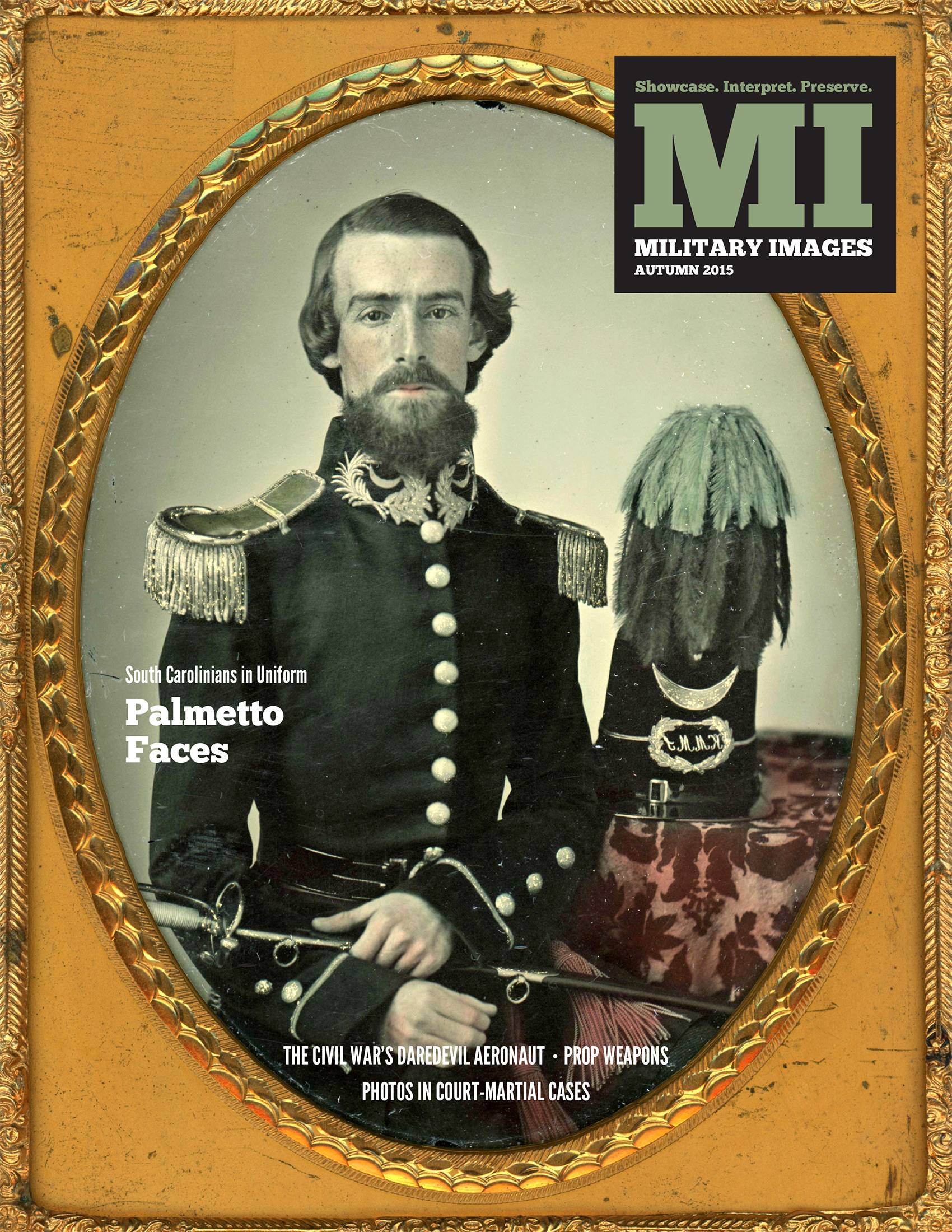
A quarter-plate ruby ambrotype of a second lieutenant is posed with his staff officer sword and plumed dress cap from the Thomas Harris Collection.
Download (free)

Table of Contents (p. 1)
Download (free)

Editor’s Desk (p. 2)
Though it may seem innocuous, the question of whether or not the musket a soldier carries or the uniform he wears actually belonged to him is a hot topic among those who study soldier portraits. At the heart of this debate lay an essential question: What is a prop?
Download (free)

Mail Call (p. 3)
Feedback includes the identification of an image from the Brian Boeve gallery (Winter 2015) as a New Hampshire soldier and a U.S. Colored Infantry officer, an image of a Union soldier from Iowa with an Abraham Lincoln mourning badge pinned to his uniform, kind words about the latest issues of the magazine, and an observation that chevrons with a star were worn by color sergeants in addition to ordnance sergeants.
Download (free)

Passing in Review (p. 4)
If you thought that the Images of America books by Arcadia Publishing trace the history of the country through vernacular photography of small towns, think again. At least 45 Civil War-related volumes are in the series. If they are all as well produced as Remembering Michigan, make room in your library for the set.
Download (free)

Palmetto Faces by Ron Field (pp. 6-17)
A survey of 22 ambrotypes, cartes de visite and tintypes of militia and volunteers from South Carolina. They were the first troops to see service in the defense of the short-lived Republic of South Carolina in 1861 and some of the last to defend the Confederate States of America in 1865. During that time, about 17,000 South Carolinians soldiers died—almost a third of its male white population of fighting age.

Love Found and Lost by Kevin D. Canberg (pp. 18-21)
154 years after war killed a budding romance between a New Hampshire boy on his way South to fight the war and a Pennsylvania farm girl began at a train station, a chance discovery brought their portraits together.

Photo Sleuth by Kurt Luther (pp. 22-25)
In “Revealed: The Identity of an Officer in an Iconic Group Portrait,” Luther describes his journey to determine the name of the white officer pictured in a lithograph of African American soldiers at Camp William Penn outside Philadelphia, Pa. The lithograph is based on a photograph that was sold by antiques dealer James Spina to an unknown collector in the 1970s. The image has not been seen since.

“Glory to Stand Upon Some Lofty Pinnacle” by Katharina Schlichtherle (pp. 26-29)
Jesse Sharpe Barnes was killed in action as he led his company in the 4th North Carolina Infantry against a redoubt during the Battle of Seven Pines. on May 31, 1862. The journey of the 23-year-old captain from political turmoil to death on a Virginia battlefield is the story of a young man changed by the instability of the times.

Armed to the Teeth? The Use of Prop Weapons in Civil War Studio Photography by Katelyn Brown (pp. 32-36)
“Few people would dispute the accepted fact that battlefield photographers of the Civil War sometimes included props—even human beings—in their photographs. Alexander Gardner famously moved corpses in his photographs at Gettysburg, and Thomas C. Roche posed his black assistant in several shots around Petersburg. As this was common practice in the field, who is to say that the studio portrait of the fierce-looking Civil Warrior armed to the teeth did not include props?” While obvious instances of props exist, a more challenging question to analyze involves the use of weapons as props.

Antebellum Warriors (p. 37)
A second lieutenant who graves the cover of this issue was an instructor at the King’s Mountain Military School in Yorkville, S.C. His identity is not known, though an examination of surviving photographs of officers who served at the school suggests that the officer went on to become one of the Confederacy’s best generals.

Mistaken Identity? Early Use of Photographic Evidence in Two Court-Martial Case for Desertion by Elena Colón-Marrero (pp. 38-40)
Two court-martial cases that arose at the end of the Civil War—one in Albany, N.Y., and the other in Springfield, Ill.—reveal how some litigants relied on more than the spoken word to determine identity. The cases of Simon Burke and William Gemmill, both tried in September 1865, used photographs as a key method to identify suspected deserters.

The Honored Few (p. 41)
Amidst the roar of battle at Trevilian Station, Va., on June 11, 1864, 1st Lt. Noble Delance Preston of the 10th New York Cavalry lay in a plowed field bleeding profusely. His courage ultimately resulted in his receipt of the Medal of Honor.

America’s Champion Aeronaut in the Civil War by Sarah Hopkins (pp. 42-44)
Bavarian-born John H. Steiner was a daredevil aeronaut who barnstormed across the United States before the war. In the Union army, he conducted the only successful balloon observations in the western theater.

From the “Star” to the “Shenandoah” by Ronald S. Coddington (pp. 46-47)
It may be fairly stated that John Grimball of Charleston, S.C., served from the beginning to the end of the war. On Jan. 9, 1861, he was part of the garrison of Fort Moultrie that drove the Union steamer Star of the West away from Charleston Harbor. He was also aboard the Shenandoah during her final cruise that ended on Nov. 6, 1865.

Uniforms & History by Michael J. McAfee (p. 48)
In “Cap Insignia: Topping It Off,” McAfee notes that U.S. Army Regulations of 1861 were very specific on what trim should be placed on the 1858 forage cap, and yet no one seemed to follow the rules.

Stragglers (pp. 49-51)
Unique images contributed by MI readers include Corp. Jacob Nicholas Haupt of the 7th Maryland Infantry, who was captured in The Wilderness and sent to Andersonville Prison; a light artilleryman with a seldom seen sword knot; and four cartes de visite of William K. Taylor of the 50th Pennsylvania Infantry.

Tintype Stares and Regal Airs by Isidora Stankovic (pp. 53-57)
In this essay, Stankovic examines the impact of Civil War portrait photography and soldier memorialization. “In this total war, the volunteer fighters secured a new individualized identity for the common soldier through portrait photographs.”

The Last Shot (p. 59)
A post mortem image of a gaunt Union soldier is a grim reminder of the devastation of disease in the ranks of both armies.
Finding Aid: Nov./Dec. 1980

nov-dec-1980The complete issue

Vol. 2, No. 3
(32 pages)


Print edition: Visit our store to check availability
Digital edition: Visit JSTOR.org to purchase
Explore the MI Archives: Browse | Advanced search | Tutorial

Inside

Cover Image
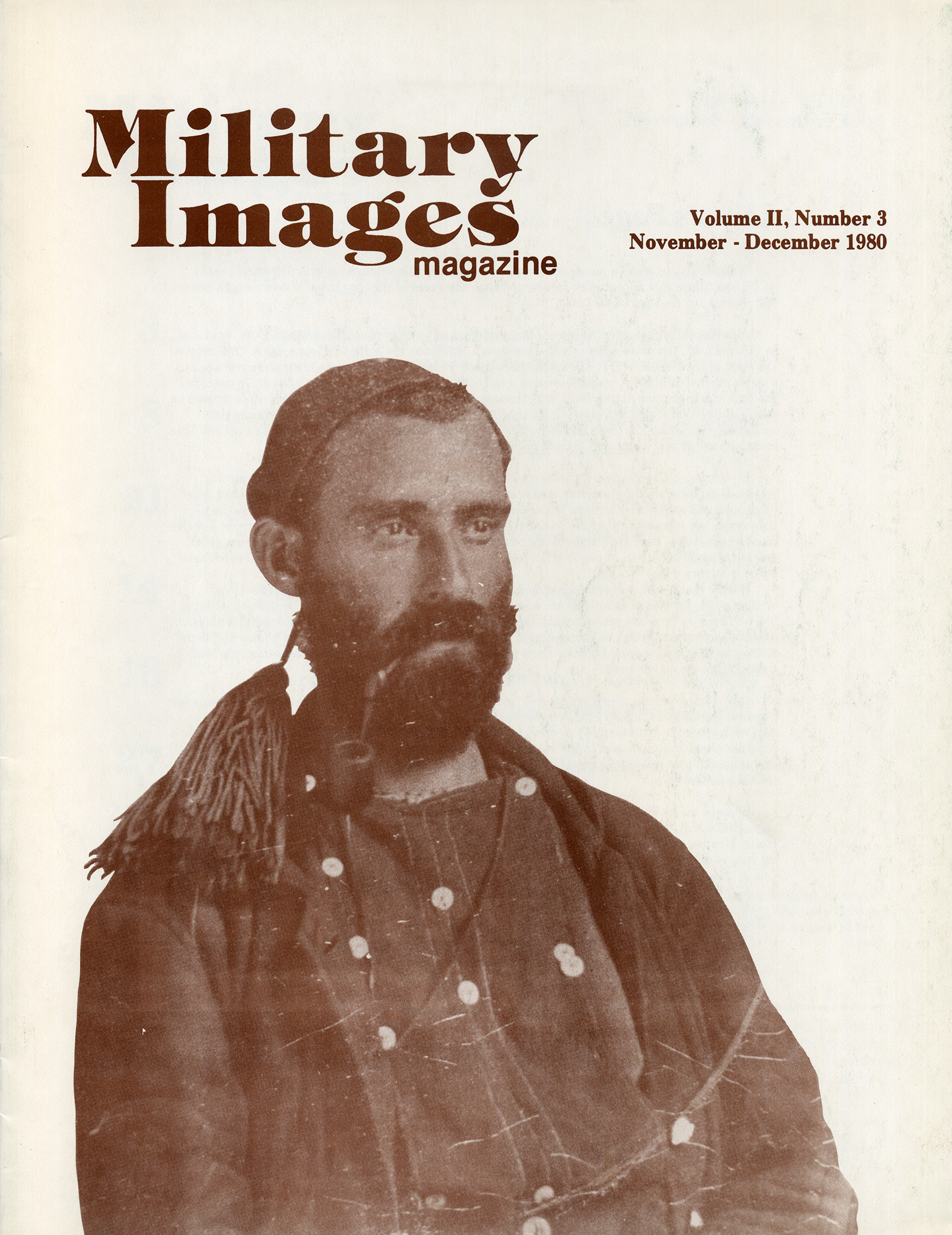
An unidentified Zouave from the 9th New York Infantry from a quarter-plate tintype is on the cover of this issue of Military Images.

Editor’s Page (inside front cover)
The editor responds to questions regarding the content and the goals for the publication. Articles are submitted by the readership, and therefore the range of articles reflects that process. Readers are encouraged to submit articles that feature the “American fighting man” from the advent of photography in 1839 to the outbreak of World War II in 1939.

Mail Call (p. 2)
Readers weigh in on previous issues. A new subscriber expands the reach of the magazine to Australia, while another reader provides further insight into a previous article on the Homestead Steel Strike of 1892. Another reader from the Confederate Historical Association in Brussels, Belgium identifies a mysterious upper arm chevron from a past issue as being that of a Masonic symbol.

Thomas Franlin Dornblaser: Cavalryman in the Army of the Cumberland by Jeffrey S. Mosser (pp. 3-7)
Quoting the humorous writing of the 7th Pennsylvania Cavalry trooper, the article follows the Civil War journey of Thomas Dornblaser from his enlistment as a private in October 1861 to his discharge as a sergeant in August 1865. Dornblaser served in many of the pivotal campaigns in Tennessee, Georgia, and Alabama and had a wide variety of roles as well. The article includes images of two of his close friends, the various weapons that the unit was issued, and an image of Private Dornblaser with an experimental hinged cavalry hat, an example of which is now held in the collection of the Smithsonian Institution.,

The Mier P.O.W.’s in Mexico, 1844 by Kevin R. Young (pp. 8-9)
A daguerreotype showing a group of seven men is the centerpiece of the article, which describes the 1842 expedition which led to the capture of 305 abandoned soldiers of the Republic of Texas and how those “unofficial” soldiers continued their advance against the Mexican city of Mier, and how they fared in the hands of the Mexican government. Considered to be pirates rather than military prisoners, the men had to endure harsh conditions, escape, and then the recapture of 176 of them. These men had to participate in a lottery, as every tenth man was condemned to execution. Drawing from a pot of beans, the 159 who drew white beans were marched to Mexico City, while the 17 who drew black beans were shot on the spot. Those who survived until September 1844 were granted freedom at the deathbed behest of the Queen of Mexico. The daguerreotype image is probably the first photographic image of prisoners of war, showing the four identified Texican men wearing heavy chains around their ankles and being held by three heavily armed Mexican guards. As one of the men, Wily Jones, escaped successfully in March 1844, the image predates that event, making this an important artifact of both Texas and photographic history.

The U.S.M.C. Campaign Hat, 1898-1961 by John Stacey (pp. 10-13)
The iconic Marine campaign or “field hat” was first provided to Marines after landing in Cuba to fight in the Spanish-American War in 1898. Originally, the “fore-and-aft” crease was used on the hat, with the eagle-globe-and-anchor emblem worn on both the front and the left side of the hat. With the adoption of what was later known as the “Montana peak” in the 1912 regulations, the device began to be worn exclusively on the front of the hat. Various regulations required the hats to include battalion, company, and regimental numbers for identification purposes. The difference between hats worn by enlisted Marines and their officers were slight, with enlisted men wearing a ribbon band on their version while the officers wore a double cord with a sliding keeper and acorns on each end. The article includes ten different images that illustrate the evolution of the campaign hats worn by the Marine Corps.

Find the Fake (pp. 14-15)
The staff of Military Images provides the readers with six images and challenges them to find out which are actual historical images and which purport to be. (Answers provided on page 32.)

“Every damn… rebel is on the run!”: The 15th New Jersey at the Battle of the Opequon by Joseph G. Bilby (pp. 16-26)
Ten different images, ranging from individual portraits of officers from the 15th New Jersey Infantry to scenes of Winchester and the Valley Pike, illustrate this detailed article that describes the Battle of the Opequon in that began in mid-August 1864 and ended a month later. A number of sidebar items provide more detail on the “3rd New Jersey Cavalry” as well as information on “Draftees, Substitutes, and Volunteers” in the Civil War and how they impacted this battle in particular. Told from a number of different viewpoints on both sides of the conflict, as the 15th is pushed out of Winchester at the beginning of the battle and then forces their way back in against waning Confederate forces at the end.

A Doughboy at Barton’s Hill by Bob Stephens (p. 27)
This article relates the story of the author’s father, who was awarded the Croix de Guerre for single-handedly maintaining his aid station on the battlefield while his partner, Private Avery (also awarded the Croix de Guerre), went back to the lines to get the assistance of doctors. Private Stephens treated the wounded from October 8-10, 1918, going out to locate wounded on the battlefield. He would give directions to the dugout where the aid station was located to those who could walk, and would carry those who could not, all the time putting himself in harm’s way from poison gas, machine gun fire, and artillery shelling. A photograph featuring four members of the Medical Detachment, 144th Infantry, 36th Division to include Pvt. Stephens accompanies the article.

Stragglers (pp. 28-31)
The four pages of images submitted by readers for this month’s “Stragglers” feature follow some organization. The first page has two images featuring women; one is a group photograph of four women and four soldiers taken about 1880 at Fort Benjamin Harrison, Indiana and paired with a vivandiere photographed between 1864 to 1866 on Long Island. The next page has three different tintype images of New York Zouave soldiers. Following up on a previous issue which featured an officer from a Pennsylvania “rifle” regiment, the third page includes a colonel of the “2d German Rifle Regiment” and a third lieutenant from the Massachusetts “3d Battalion of Rifles.” Finally, there are two images of shipping from New York City on the final page. A ferry boat is shown ready for impressed service into the Navy in 1861, with crew at the ready and prepared with “collapsible shields against small arms fire.” A more unique images shows cannoneers firing over the East River in 1904, with the misconceived notion that this would force over 1000 bodies lost in the General Slocum sinking to emerge.

Back Image
Three of the five Scott brothers who served in the Civil War are pictured, shown with new Enfield rifles taken from the garrison at Vicksburg. While one served in a New York Regulars unit and another is not pictured, these Iowa brothers were all in Company H of the 21st Iowa Infantry.


Finding Aid: Summer 2015

mi-cover33-3-summer-2015The complete issue

Vol. XXXIII, No. 3
(60 pages)

Print edition: Visit our store to check availability
Digital edition: Visit JSTOR.org to purchase
Subscribe to MI
Explore the MI Archives: Browse | Advanced search | Tutorial

Inside

Cover image
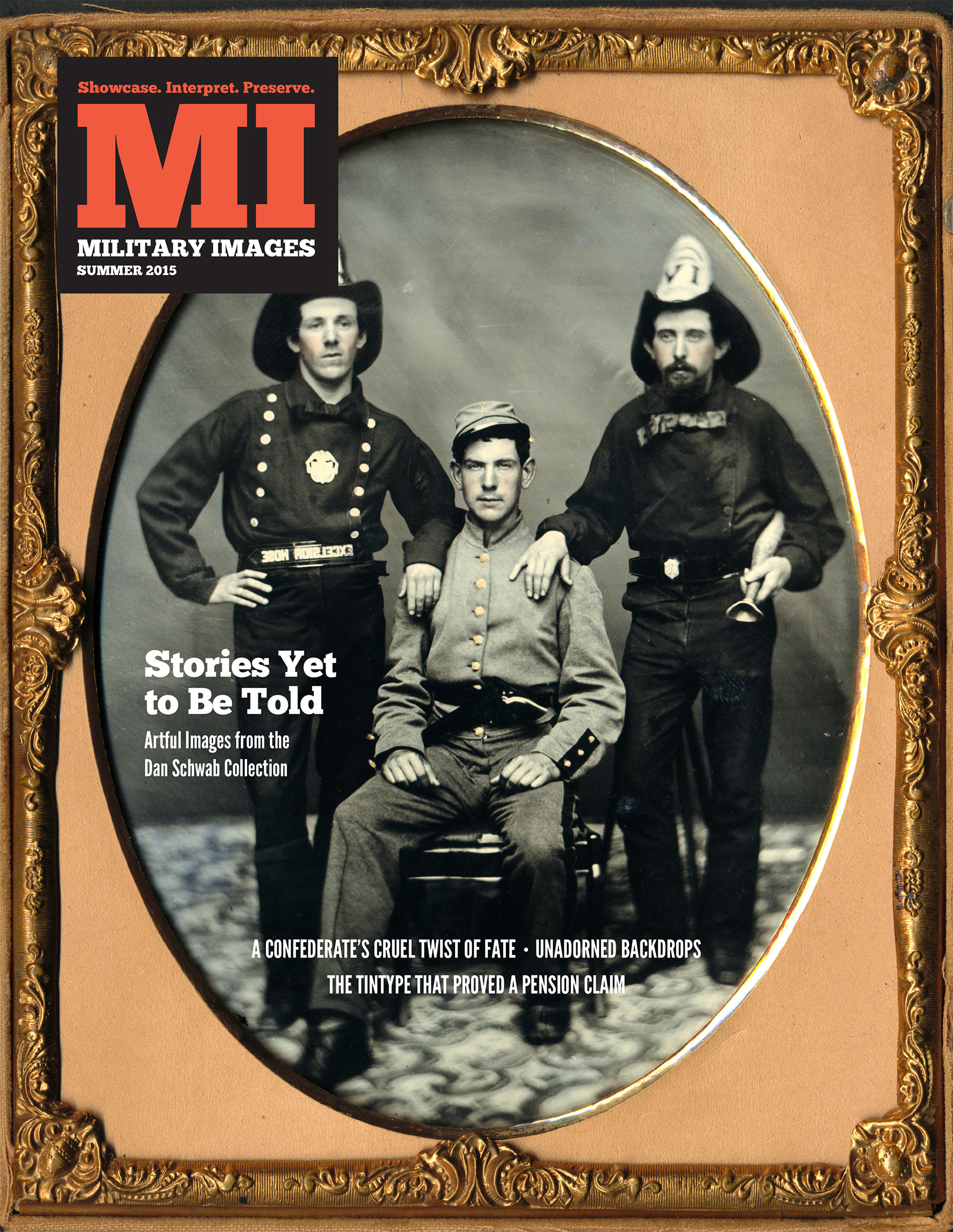
In this half-plate ambrotype from the Dan Schwab collection, two firemen flank a Northern recruit in this early war image likely taken in Buffalo, N.Y.
Download (free)

Table of Contents (p. 1)
Download (free)

Editor’s Desk (p. 2)
Newly colorized photographs can be helpful to our understanding of Civil War images and can help attract interest in the period, but you will not find them in MI.
Download (free)

Mail Call (p. 3)
Feedback from the previous issue includes a final update about the Pennsylvania soldier holding a stuffed grouse, an addendum to the Assassination Sympathizers photograph, and a correction to the gallery of nurse images.
Download (free)

Passing in Review (p. 4)
“Prominent Historians Focus on Memorable Photographs in Lens of War” is a review of the new book by J. Matthew Gallman and Gary W. Gallagher.
Download (free)

Stories Yet to Be Told (pp. 5-24)
A feature selection of artful images from the collection of Dan Schwab. “When I hold an image in my hand,” Schwab observes, “I know that the soldier in the image unquestionably at one time held that very piece of tin or glass in his hand as well. He most likely took great care of it so that it could be sent home to his parents, siblings, wife or a sweetheart.”

They Laid Down Their Lives for the Flag by Candice Zollars (pp. 25-28)
The story of the 6th U.S. Colored Infantry from training at Camp William Penn to the front lines at Petersburg, Va., and the end of the war in North Carolina.

Unadorned Backdrops (pp. 31-34)
Photographers in camp and other temporary locations usually left their elaborately painted backdrops at home in the studio and used whatever they had on hand to frame soldier portraits.

The Honored Few (p. 35)
During the Battle of Fair Oaks, Va., in 1862, Union Surg. Gabriel Grant risked his life to save the wounded—and received the Medal of Honor.

Cruel Twist of Fate by Scott Valentine (pp. 36-37)
Confederate surgeon Richard Walter Scott Martin of Virginia is imprisoned with the men he was sent to save after a failed raid on Memphis, Tenn., by cavalrymen commanded by Nathan Bedford Forrest.

“Headquarters for Pictures” by Steven Karnes and Ronald S. Coddington (pp. 39-42)
The life and times of Tennessee photographer Theodore M. Schleier is the first in an occasional series Civil War Image Makers. Schleier’s galleries in Memphis and Knoxville cranked out a high volume of soldier portraits during the war years.

The Tintype That Proved a Pension Claim by Andrew L. Slap (pp. 44-45)
In 1923, David Warrington posthumously supported his youngest daughter with a photo he had taken almost 60 years earlier.

Antebellum Warriors (p. 46)
“The Hero of Little Round Top,” Maj. Gen. Gouverneur Kemble Warren, pictured as a lieutenant of cadets at West Point at the end of the 1849 summer break.

Photo Sleuth by Kurt Luther (pp. 47-49)
Choosing the right tool is essential for any job, and Kurt Luther details what you need to carry in your digital research toolkit. “These digital tools, along with print materials, can help uncover more and greater photo mysteries than either alone, but only if we understand how and when to use them.”

Stragglers (pp. 50-56)
Confederates dominate this issue, and include a trio of infantry officers, a North Carolina officer killed at the 1864 Battle of Piedmont, Va., and a Tennessee father and son who served their home state and the Southern cause.

Uniforms & History by Michael J. McAfee (p. 57)
The uniforms of the The 1st Regiment, Philadelphia Reserve Brigade (Gray Reserves), a unique home guard brigade formed in 1861.

The Last Shot (p. 60)
Joseph C. White of the hard-fighting 12th Mississippi Infantry poses with an artillery short sword and a placard upon which is written a phrase that leaves no doubt about his loyalties—”Jeff Davis and the South!!!”

MI on Medium

mi-mediumVisit Military Images on Medium and read the first two installments of Photo Sleuth by Kurt Luther:

Medium is, according to its founders, “A beautiful space for reading and writing — and little else. The words are central. They can be accompanied by images to help illustrate your point. But there are no gratuitous sidebars, plug-ins, or widgets.”

MI is utilizing Medium’s space for words—and images! Check it out: https://medium.com/military-images

Finding Aid: Spring 2015

The complete issue

Vol. XXXIII, No. 2
(60 pages)

Print edition: Visit our store to check availability
Digital edition: Visit JSTOR.org to purchase
Subscribe to MI
Explore the MI Archives: Browse | Advanced search | Tutorial

Inside

Cover image
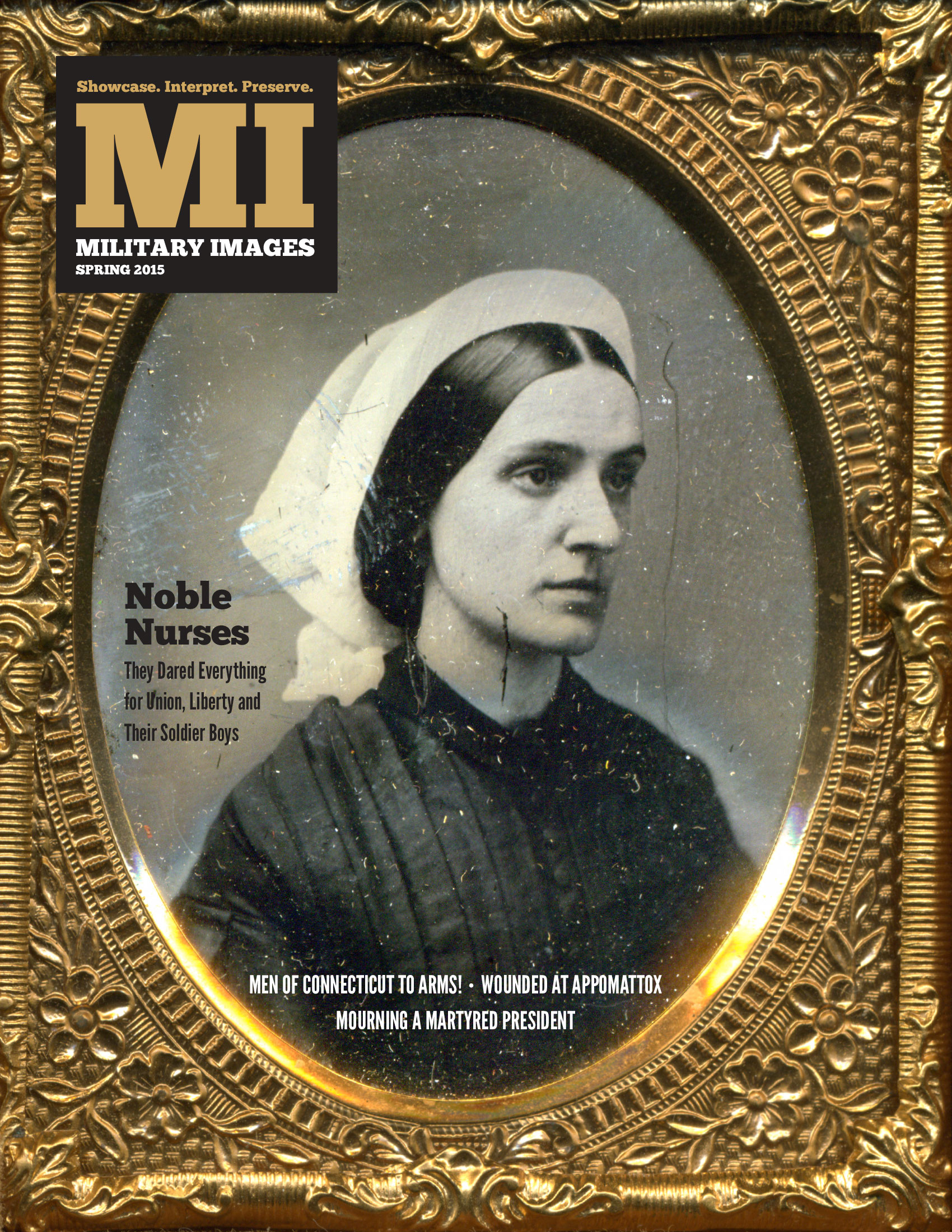
In this tintype from the Chris Foard collection, Civil War nurse Carrie Wilkins Pollard cared for sick and wounded men in Tennessee, Indiana, Kentucky and on hospital ships, and after hostilities ended she taught orphans.
Download (free)

Table of Contents (p. 1)
Download (free)

Editor’s Desk (p. 2)
“A groundbreaking gallery” describes the selection of extraordinary portraits of Northern nurses from the Chris Foard collection—the first gallery in MI history dedicated to women who served as caregivers. Included is this quote from Our Army Nurses by Mary A. Gardner Holland: “The privations and dangers which these noble characters endured called for a fortitude equal in many respects to the valor of the soldier.”
Download (free)

Mail Call (p. 3)
Feedback from previous issues includes the mis-identification of a bird, the re-identification of a pair of ambrotypes of a North Carolina Confederate in the Library of Congress, and the identification of a South Carolina militia company.
Download (free)

Passing in Review (p. 4)
“Images from Little Connecticut Leave a Big Impression” is a review of Heroes for All Time: Connecticut Civil War Soldiers Tell Their Stories by Dione Longley and Buck Zaidel.
Download (free)

Ministering Angels (pp. 5-15)
A selection of images of Civil War nurses from the Chris Foard collection. “Whether motivated by patriotism, a calling or the realization that they were needed, nurses became more skilled and confident treating the wounded throughout the entire war. These men and women were the true pioneers of American nursing,” Foard explains in the introduction. Among the images of identified nurses are Annie Etheridge, Almira Fales, Helen Gilson and “Belle” Reynolds.

Mourning a Martyred President (pp. 16-23)
150 years ago, Northern soldiers observed traditional Victorian fashions and rituals in the wake of the assassination of President and Commander-in-Chief Abraham Lincoln. This photo essay explores the practices through the lens of the citizen soldier.

Men of Connecticut! To Arms!!! (p. 24-33)
More than 50,000 sons of Connecticut participated in the Civil War, and one in 10 would not survive to tell their stories. Whatever their fate, many left behind their patriotic portraits. A representative sample of images compose this exclusive gallery from Heroes for All Time, a new book by Wesleyan University Press.

Faces of 1865 by Bryan Flanagan and Ronald S. Coddington (pp. 34-36)
The tragic fate of two men, a Confederate in Virginia and a federal in Tennessee, at the end of the war. Lt. Charles Minnegerode, an aide to Maj. Gen. Fitzhugh Lee, was shot in the chest and left for dead at Appomattox Court House on April 9, 1865. Lt. Jacob Skirvin of the 7th Indiana Cavalry and a detail of 30 of his comrades got caught in a fierce fight after they were ambushed by Confederate guerillas in Tennessee on April 3, 1865.

The Honored Few (p. 37)
Pvt. Charles A. Taggart of the 37th Massachusetts Infantry wrested a flag away from a Confederate soldier during the Battle of Sailor’s Creek, Va., on April 6, 1865. He was one of 57 men awarded the Medal of Honor for actions that day—47 of which were presented for the capture of enemy flags.

Hard Luck Regiment by Mark H. Dunkelman (pp.38-44)
The 154th New York Infantry was nicknamed the Hardtack Regiment. But justifiably, it could also have been called the Hard Luck Regiment. Perhaps its best known soldier, Sgt. Amos Humiston, became famous when he was identified by means of an ambrotype found in his lifeless hand at the Battle of Gettysburg. A history of the regiment told through the stories of five of its members.

Antebellum Warriors (p. 45)
A shako with a large red and white fountain plume and the brass crossed cannon insignia indicate that the soldier sitting next to it was an artillery militiaman who sat for his daguerreotype between 1854-1860.

Stragglers (pp. 47-51)
Included in this selection of images from MI subscribers are two Confederate images by influential photographers: A Confederate navy officer by Charles R. Rees of Richmond, Va., and an infantryman holding his Enfield rifle by George S. Cook of Charleston, S.C.

Photo Sleuth by Kurt Luther (pp. 54-55)
“Confirmation bias, in which we get fixated on a single, preferred confusion—trust me, it’s a young Robert E. Lee!—leads us to disregard any evidence to the contrary, no matter how compelling,” writes columnist Kurt Luther. He goes on to discuss, using a recent experience of his own, how to blaze a path from confirmation bias to airtight identification.

Uniforms & History by Michael J. McAfee (pp. 56-57)
Chevrons are chevrons, right? Not exactly. Mike McAfee shares a sampling of images showing soldiers wearing chevrons of a different stripe. Despite regulations, a surprising number of variations are documented in the visual record of non-commissioned officer portraits from the Civil War period.

The Last Shot (p. 60)
A quarter-plate ruby ambrotype of Christian Funk and three pals prior to his enlistment in Company H of the 210th Pennsylvania Infantry.

Spring Issue Table of Contents

Pleased to announce the lineup for the spring issue of Military Images magazine. The complete Table of Contents is shown here. The issue is scheduled to be printed and mailed today!

Details:

03-p1-tocEditor’s Desk
“A groundbreaking gallery” describes the selection of extraordinary portraits of Northern nurses from the Chris Foard collection—the first gallery in MI history dedicated to woman who served as caregivers. Included is this quote from Our Army Nurses by Mary A. Gardner Holland: “The privations and dangers which these noble characters endured called for a fortitude equal in many respects to the valor of the soldier.”

Mail Call
Feedback from previous issues includes the mis-identification of a bird, the re-identification of a pair of ambrotypes of a North Carolina Confederate in the Library of Congress, and the identification of a South Carolina militia company.

Passing in Review
“Images from Little Connecticut Leave a Big Impression” is a review of Heroes for All Time: Connecticut Civil War Soldiers Tell Their Stories by Dione Longley and Buck Zaidel.

Ministering Angels
A selection of images of Civil War nurses from the Chris Foard collection. “Whether motivated by patriotism, a calling or the realization that they were needed, nurses became more skilled and confident treating the wounded throughout the entire war. These men and women were the true pioneers of American nursing,” Foard explains in the introduction. Among the images of identified nurses are Annie Etheridge, Almira Fales, Helen Gilson and “Belle” Reynolds.

Mourning a Martyred President
150 years ago, Northern soldiers observed traditional Victorian fashions and rituals in the wake of the assassination of President and Commander-in-Chief Abraham Lincoln. This photo essay explores the practices through the lens of the citizen soldier.

Men of Connecticut! To Arms!!!
More than 50,000 sons of Connecticut participated in the Civil War, and one in 10 would not survive to tell their stories. Whatever their fate, many left behind their patriotic portraits. A representative sample of images compose this exclusive gallery from Heroes for All Time, a new book by Wesleyan University Press.

Faces of 1865 by Bryan Flanagan and Ronald S. Coddington
The tragic fate of two men, a Confederate in Virginia and a federal in Tennessee, at the end of the war. Lt. Charles Minnegerode, an aide to Maj. Gen. Fitzhugh Lee, was shot in the chest and left for dead at Appomattox Court House on April 9, 1865. Lt. Jacob Skirvin of the 7th Indiana Cavalry and a detail of 30 of his comrades got caught in a fierce fight after they were ambushed by Confederate guerillas in Tennessee on April 3, 1865.

The Honored Few
Pvt. Charles A. Taggart of the 37th Massachusetts Infantry wrested a flag away from a Confederate soldier during the Battle of Sailor’s Creek, Va., on April 6, 1865. He was one of 57 men awarded the Medal of Honor for actions that day—47 of which were presented for the capture of enemy flags.

Hard Luck Regiment by Mark H. Dunkelman
The 154th New York Infantry was nicknamed the Hardtack Regiment. But justifiably, it could also have been called the Hard Luck Regiment. Perhaps its best known soldier, Sgt. Amos Humiston, became famous when he was identified by means of an ambrotype found in his lifeless hand at the Battle of Gettysburg. A history of the regiment told through the stories of five of its members.

Antebellum Warriors
A shako with a large red and white fountain plume and the brass crossed cannon insignia indicate that the soldier sitting next to it was an artillery militiaman who sat for his daguerreotype between 1854-1860.

Stragglers
Included in this selection of images from MI subscribers are two Confederate images by influential photographers: A Confederate navy officer by Charles R. Rees of Richmond, Va., and an infantryman holding his Enfield rifle by George S. Cook of Charleston, S.C.

Photo Sleuth by Kurt Luther
“Confirmation bias, in which we get fixated on a single, preferred confusion—trust me, it’s a young Robert E. Lee!—leads us to disregard any evidence to the contrary, no matter how compelling,” writes columnist Kurt Luther. He goes on to discuss, using a recent experience of his own, how to blaze a path from confirmation bias to airtight identification.

Uniforms & History by Michael J. McAfee
Chevrons are chevrons, right? Not exactly. Mike McAfee shares a sampling of images showing soldiers wearing chevrons of a different stripe. Despite regulations, a surprising number of variations are documented in the visual record of non-commissioned officer portraits from the Civil War period.

The Last Shot
A quarter-plate ruby ambrotype of Christian Funk and three pals prior to his enlistment in Company H of the 210th Pennsylvania Infantry.

Finding Aid: Winter 2015

01-coverThe complete issue

Vol. XXXIII, No. 1
(60 pages)

Print edition: Visit our store to check availability
Digital edition: Visit JSTOR.org to purchase
Subscribe to MI
Explore the MI Archives: Browse | Advanced search | Tutorial

Inside

Cover image
A Confederate with a decidedly defiant expression is ready for action in this sixth-plate tintype from the Brian Boeve collection.
Download (free)

Table of Contents (p. 1)
Download (free)

Editor’s Desk (p. 2)
New Changes for a new volume include a description of design modifications, the inclusion of two new departments (The Honored Few, images of Medal of Honor recipients, and Photo Sleuth, a column by Kurt Luther that offers real-life accounts on the research trail) and access to digital version of MI.
Download (free)

Mail Call (p. 3)
Feedback from the previous issue includes details about the Carolina Mountaineers uniform, praise for young authors in MI, and the identification of the Union soldier pictured in The Last Shot.
Download (free)

Passing in Review (p. 4)
“Tribute to Alabamians Is a Tentative First Step” is a review of 150 Faces of Alabama Confederates on the 150th anniversary of the Civil War by Willis Downs.
Download (free)

Faces of Nobility and Honor (pp. 6-30)
A feature selection of images from the collection of Brian Boeve, a longtime MI contributor who has collected Civil War portraits for 25 years. “To look into the eyes of these noble men and honor their sacrifice is the fuel that drives my passion to collect Civil War images,” he observes.

Rally Round the Flag, Boys! (pp. 32-39)
The tattered remnants of the colors of the 23rd Ohio Infantry are one of the cartes de visite of Union patriots posed with regimental banners and national flags from the collection of Rick Carlile.

Antebellum Warriors (p. 40)
Samuel Stillman Parker Sr., a New York militia officer, did not serve in the Civil War, but two of his sons did. Samuel Stillman Parker Jr. (1840-1910) and Sewell Augustus Parker (1843-1936) enlisted in the 87th New York State Militia as privates in the autumn of 1861. They transferred to the 40th New York Infantry, also known as the “Mozart Regiment,” in September 1862.

Photo Sleuth by Kurt Luther (pp. 41-42)
In his inaugural column, Luther discovers a never-before-seen wartime photograph of his great-great-great uncle, Oliver W. Croxton of the 134th Pennsylvania Infantry, with good old-fashioned legwork and a generous portion of serendipity.

Stragglers (pp. 43-48)
Included in this selection of images from MI subscribers is Stanford L. Jessee of the 29th Virginia Infantry, who suffered a mortal wound in the chest during the Battle of Middle Creek, Ky. His last reported words: “‘Tell my friends I died a soldier at my post. I have done all I can do and will soon be in a better world than this.’”

Uniforms & History by Michael J. McAfee (pp. 49-50)
In this issue, titled “Service, War and Veteran Stripes: True Badges of Distinction,” West Point curator Mike McAfee examines the 1851 regulations that called for the use of a half-chevron to mark years of service in the U.S. army, and shows several variations on how the stripes were displayed on uniforms during the Civil War.

“Ugly as the Devil” by Ron Field (pp. 51-55)
A field guide to Havelock hats in the Civil War explores the origins and development of what generally became known as the “Havelock hat” or “Improved Military Cap.”

The Honored Few (p. 56)
Irish-American Michael Emmet Urell received the Medal of Honor for gallantry at the Battle of Bristoe Station, Va.

Hellion in Blue by Hailey House (pp. 57-58)
Every regiment had its share of good-natured rowdies, and in the 165th New York Infantry, William J. Walker proved himself a man not to take himself too seriously.

The Last Shot (p. 60)
Col. Milton Cogswell (1825-1882) strikes a Napoleonic pose as he stands in front of the Stars of the Stripes. The West Point-educated officer is remembered for his role in attempting to save the Union army after the death of Col. Edward D. Baker during the 1861 Battle of Ball’s Bluff.

MI Introduces Digital Edition

10668727_883314168360401_134158179423713816_o

Pleased to announce that the digital edition of Military Images magazine is now available. Formatted identically to the print version, it is produced directly from the master pdf files sent to the printer. Now you can enjoy all the rare and wonderful images, features and departments in every issue of MI on your laptop, tablet or phone. Single issues are now available for purchase at $7.95 each, and the downloadable pdf is yours to keep. The MI digital edition is powered by Tinypass.

Access the MI digital edition now.

Finding Aid: Autumn 2014

mi-cover-32-4-autumn-2014

The complete issue

Vol. XXXII, No. 4
(60 pages)

Print edition: Visit our store to check availability
Digital edition: Visit JSTOR.org to purchase
Subscribe to MI
Explore the MI Archives: Browse | Advanced search | Tutorial

Inside

Cover image
Quarter-plate tintype by an anonymous photographer of Henry A. Wiggins of the 10th Massachusetts Infantry from the Paul Russinoff collection.
Download (free)

Table of Contents (p. 1)
Download (free)

Editor’s Desk (p. 2)
Guest editorial by Harry Roach. The founder of Military Images, Roach served as editor from 1979 to 2000.
Download (free)

Mail Call (p. 3)
Feedback from the previous issue includes the identification of a column of troops as members of the 22nd U.S. Infantry on a practice march in the Yellowstone River Valley near Fort Keogh, Mont., in 1896.
Download (free)

Passing in Review (p. 4)
“Myths That Can Be Told and Touched” is a review of Smithsonian Civil War, edited by Neil Kagan and Stephen G. Hyslop.
Download (free)

One Soldier at a Time (pp. 5-22)
A gallery of Civil War images from the collection of Paul Russinoff features 18 tintypes and ambrotypes of Union and Confederate soldiers. The title for the gallery is taken from a quote Paul used to describe the research he does for every identified photograph in his collection: “You could say I’m learning about the Civil War one soldier at a time.”

Hail! Glorious Banners (pp. 23-27)
If a Union soldier’s photo album embodied the visual record of his Civil War experience, the album’s heart and soul was the image of the colors under which he and his comrades fought. This selection of distinctive cartes de visite comes from the collection of Rick Carlile.

An Epic Battle for the Yorktown Cup by Nicholas P. Ciotola (pp. 28-31).
Jerseymen led by Civil War veterans took home the coveted prize at the 1881 centennial competition. The honor was presented by Maj. Gen. Winfield Scott Hancock, who had been asked to select the unit that showed the “best military appearance,” and present its members with an ornate, sterling silver vase.

Personalized Accouterments (pp. 33-38)
Inscribing the names, rank and regiment on a portrait photo was a common practice used by a Civil War soldier to record his identity. But for a tiny percentage of soldiers, an autograph was unnecessary—their personalized accouterments performed the same function. A selection of images of soldiers with names added to caps, canteens and other equipment.

Life and Limb by Hailey House (p. 39)
A series of photographs commissioned by German-American inventor Dietrerick W. Kolbe in 1864 made the case for an innovative prosthetic design. The images, all cartes de visite, showed how the leather and steel arms and hands were technical marvels—and they helped Union veteran amputees to a better life.

Life Behind the Iron Shield by Shelby Crouse (pp. 40-42).
Union Navy officer William Frederick Keeler recalls his experiences the good, bad and ugly experiences he endured as paymaster on the famed ironclad Monitor.

Uniforms & History by Michael J. McAfee (pp. 43-45)
In this issue, titled “In Forage cap or kepi? (Maybe fatigue cap would be better),” West Point curator Mike McAfee explains the origins of the terms, and suggests their proper usage.

Antebellum Warriors (p. 46)
Featured in this issue is a quarter-plate ambrotype of Lt. Vincent Marmaduke attired in the uniform of the Hamtramck Guards, a local militia company in Shepherdstown, Va.

Stragglers (pp. 47-55)
Images submitted by the MI audience in this issue includes a Southern patriot with a pleated shirt and Enfield musket, a sixth-plate tintype of Jacob R. Brinker of the 104th Pennsylvania Infantry, and a ninth-plate tintype of a woman dressed in the uniform of a Union private. Stragglers appears regularly in MI.

Sgt. Branch’s Lucky Day by Scott Valentine (pp. 56-57)
Sgt. Charles Franklin Branch of the 9th Vermont Infantry barely escapes capture in North Carolina. His story begins, “On an early winter’s morning in 1906, a Civil War veteran looked out the window of his Amherst, Mass., study, and stared at a storm looming on the distant horizon. Sleet sputtered against the window …”

The Last Shot (p. 60)
This issue features a carte de visite of a Union soldier with his feet propped up on a chair.