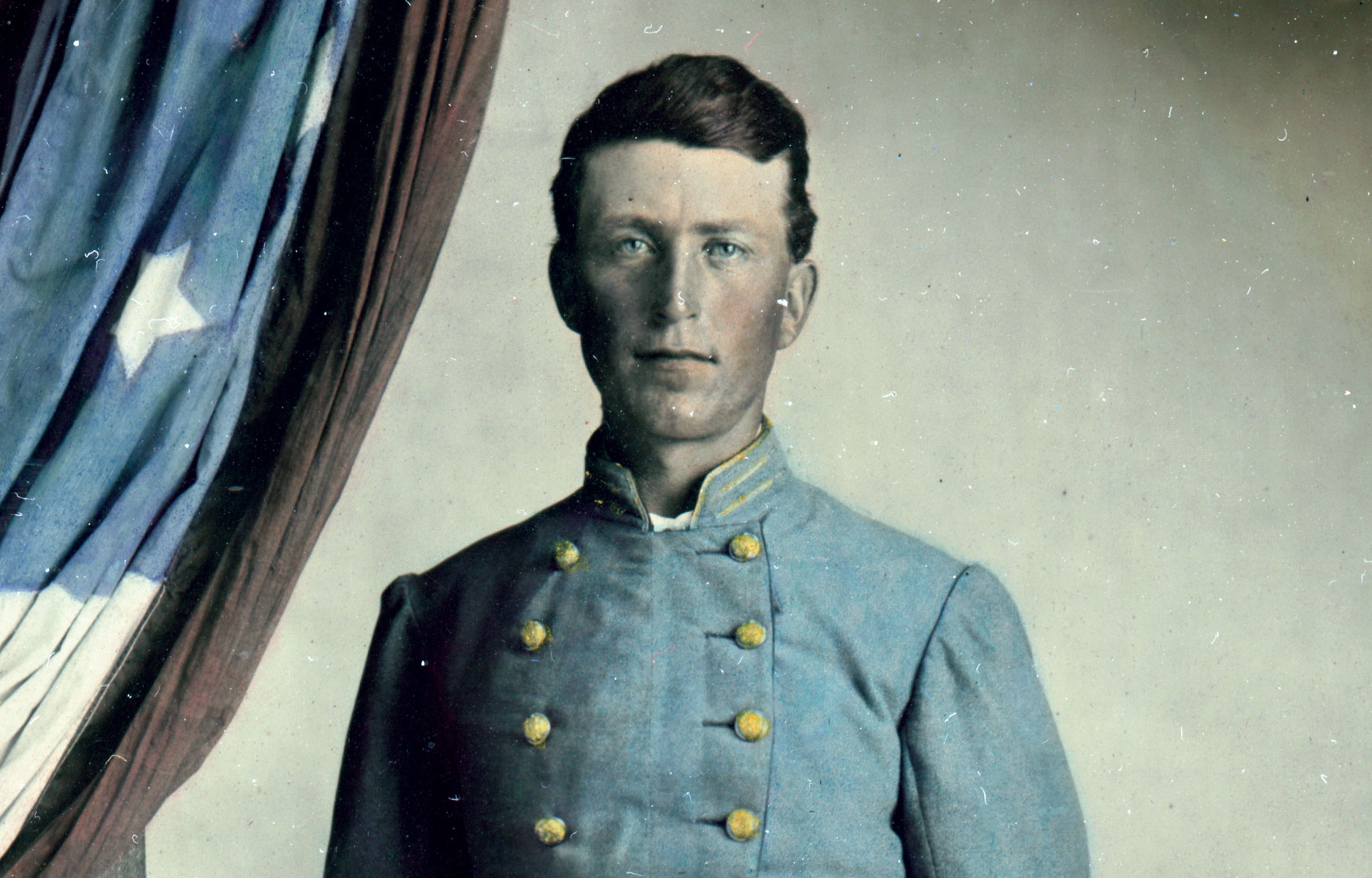
The Kenneth J. Bertholf Jr. Civil War History Education Program

Military Images brings Civil War history to communities—one subscription at a time.

The Kenneth J. Bertholf Jr. Civil War History Education Program provides free subscriptions to Military Images magazine for educational use at Civil War battlefields, historic sites, museums, and related institutions across the United States.

What began with 10 pilot locations—including Gettysburg and Vicksburg—has grown steadily thanks to generous supporters. Today, more than 60 sites participate in the program, helping staff and volunteers connect more deeply with the faces and stories of the Civil War through portrait photography.

We are always looking to maintain and expand the success of this program.

Each subscription costs $30 per year, and your your contribution places Military Images magazine into the hands of those on the front lines of public history. To support this program, please visit our store to fund one or more subscriptions.

Honoring a Passionate Collector and Supporter

When the program was first launched, Military Images reached out to loyal subscribers for support. Among the first to answer the call was Kenneth J. Bertholf Jr., a passionate collector of Civil War artifacts, a dedicated student of history, and a generous soul. Ken not only supported the program financially, but also believed deeply in its purpose: to place high-quality visual storytelling into the hands of those sharing Civil War history with the public every day.
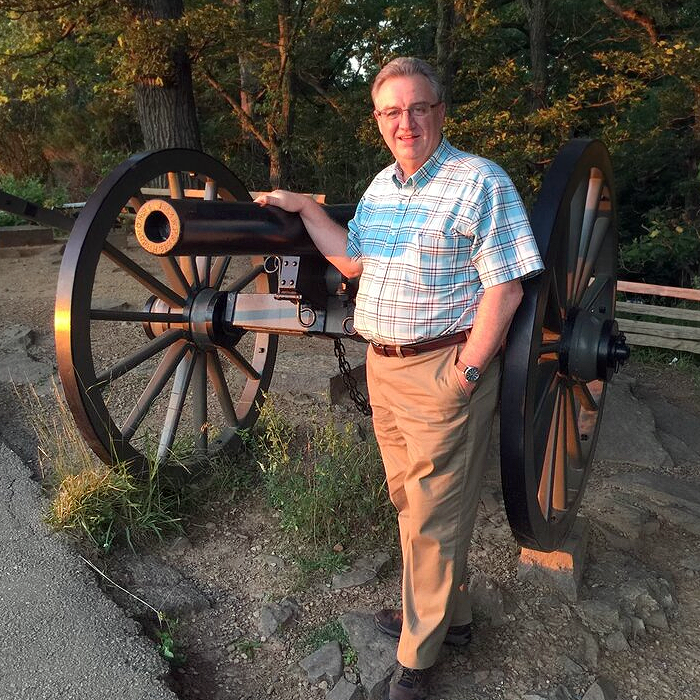
Ken Bertholf

Ken passed away in 2021 at the age of 65, leaving behind his beloved family, two books chronicling the history of his hometown—Blairstown, New Jersey—and a community of friends who admired his kindness and unwavering commitment to preserving the past.

At his memorial service, his friend Paul Denver shared a moment that speaks to Ken’s commitment and support:

“The latest issue of Military Images was prominently displayed next to pictures of his beloved collection. After the funeral, Don Carter and I spoke with his wife, Bonnie, who told us that she placed that same issue in Ken’s casket for his journey home.”

This deeply moving gesture affirmed what Ken stood for—and why this program matters. To honor his legacy, we proudly named the initiative the Kenneth J. Bertholf Jr. Civil War History Education Program.

Join Us in Sharing History

Your donation is not just a contribution—it’s an investment in historical education. It helps museum staff, park rangers, volunteers, and educators explore the personal side of Civil War history and share it with the public in meaningful ways.

Thank you for considering a gift to this important cause.

Program recipients:

National Battlefields, Military Parks & Monuments (National Park Service & Equivalent)

  • Antietam National Battlefield
  • Arlington House, Robert E. Lee Memorial
  • Appomattox Court House National Historical Park
  • Brice’s Cross Roads National Battlefield Site
  • Camp Nelson National Monument
  • Cedar Creek & Belle Grove National Historical Park
  • Chickamauga and Chattanooga National Military Park
  • Fort Donelson National Battlefield
  • Fort Pulaski National Monument
  • Fort Sumter National Monument
  • Fredericksburg and Spotsylvania National Military Park
  • Harpers Ferry National Historical Park
  • Harriet Tubman National Historical Park
  • Gettysburg National Military Park
  • Kennesaw Mountain National Battlefield Park
  • Manassas National Battlefield Park
  • Monocacy National Battlefield
  • Pea Ridge National Military Park
  • Petersburg National Battlefield
  • Richmond National Battlefield Park
  • Shiloh National Military Park
  • Stones River National Battlefield
  • Tupelo National Battlefield
  • Vicksburg National Military Park
  • Wilson’s Creek National Battlefield

National Historic Sites & Memorials

  • Boston African American National Historic Site
  • Clara Barton National Historic Site
  • Ford’s Theatre National Historic Site
  • Fort Scott National Historic Site
  • Frederick Douglass National Historic Site
  • General Grant National Memorial
  • James A. Garfield National Historic Site
  • Lincoln Boyhood National Memorial
  • Lincoln Memorial

State & Local Battlefields and Parks

  • Bentonville Battlefield
  • Columbus Belmont State Park
  • Fort C.F. Smith Park
  • Fort Delaware State Park
  • Fort Fisher State Historic Site
  • Fort Negley Visitors Center and Park
  • Mine Creek Civil War Battlefield State Historic Site
  • New Market Battlefield State Historical Park
  • Shenandoah Valley Battlefields Foundation Library

Presidential Libraries & Centers

  • Abraham Lincoln Presidential Library and Museum
  • Jefferson Davis Presidential Library
  • Rutherford B. Hayes Presidential Center

Civil War Museums & Heritage Institutions

  • African American Civil War Memorial Museum
  • The American Civil War Museum
  • Confederate Memorial Hall Museum
  • Henderson County Heritage Museum
  • Monmouth County Historical Association
  • National Museum of Civil War Medicine

Special Collections, Libraries & Archives

  • Adams County Historical Society
  • Adams County Library
  • GAR Museum & Library
  • Library of Congress
  • National Gallery of Art
  • National Portrait Gallery
  • U.S. Army Heritage and Education Center

Other Institutions & Organizations

  • Andersonville National Cemetery / National POW Museum
  • The Army Historical Foundation
  • Brice’s Crossroads Foundation
  • Lomas Center Museum
  • The Battle of Franklin Trust
Finding Aid: Winter 2024

A complete table of contents for the Winter 2024 issue of Military Images magazine, and information about how to purchase single issues and subscriptions.

Vol. XLII, No. 1
(80 pages)

Print edition: Visit our store to check availability
Digital edition: Visit JSTOR.org to purchase
Subscribe or renew your subscription

Explore the MI Archives:
Browse | Advanced search | Tutorial

Inside

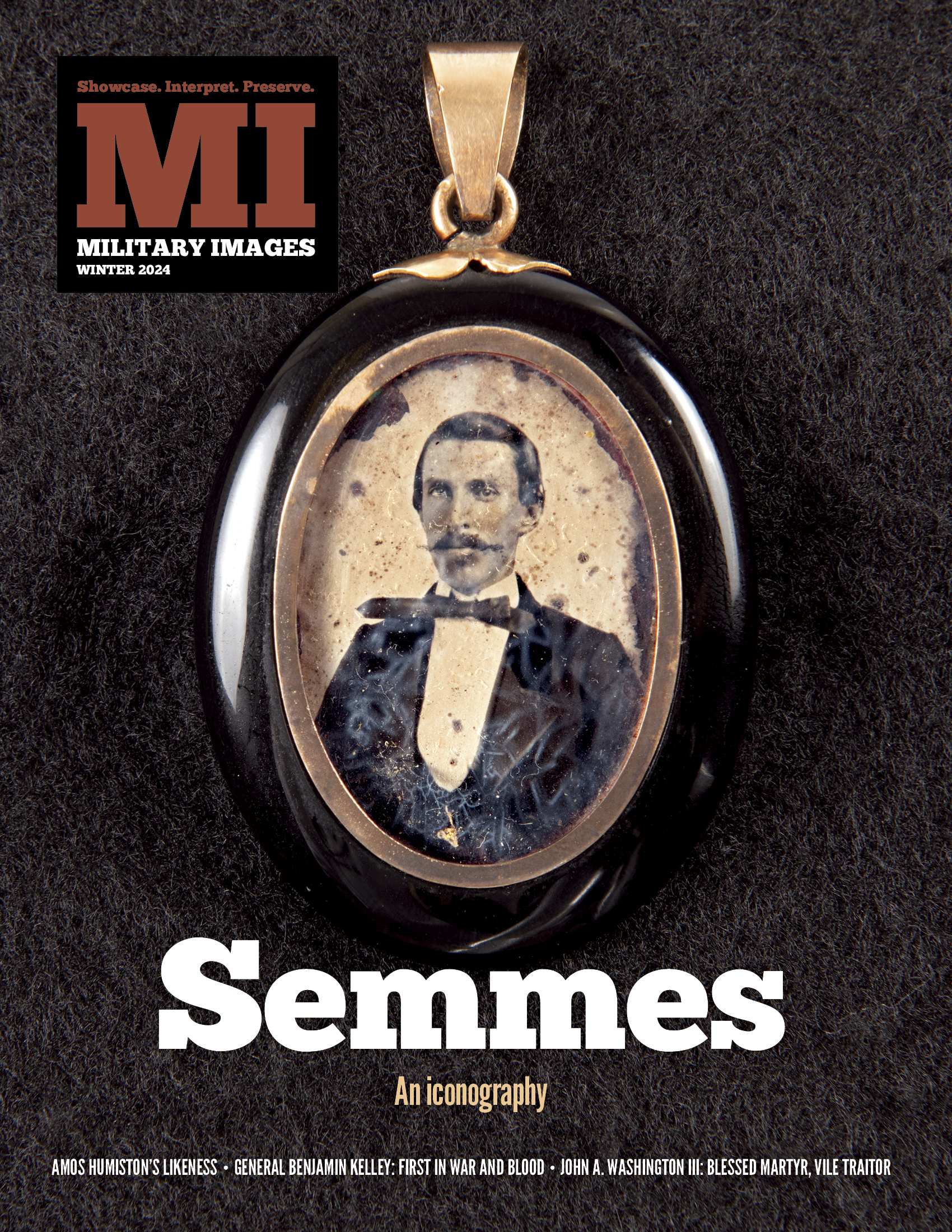
Cover image
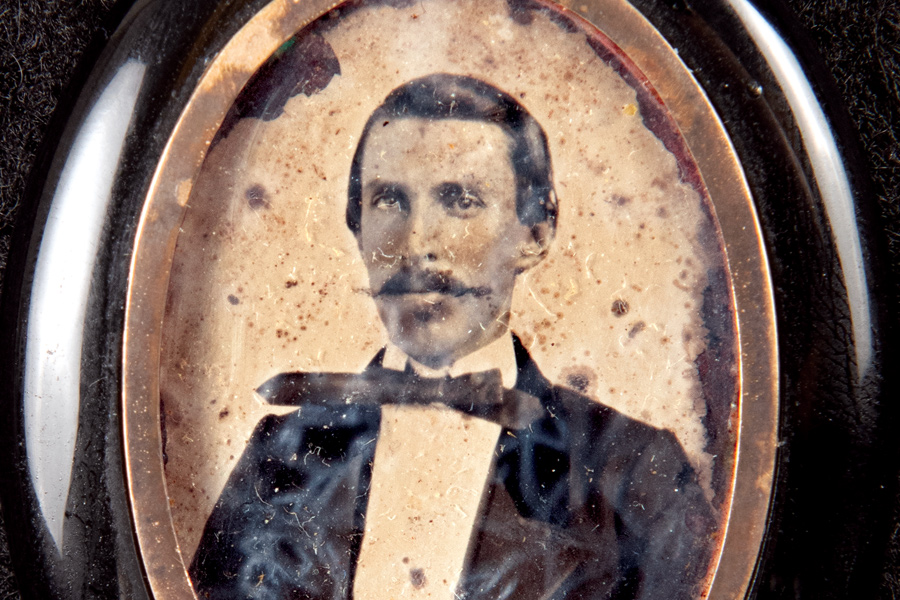
An ambrotype from the History Center of Mobile, Ala, pictures Raphael Semmes, circa 1854.

Table of Contents (p. 1)

Editor’s Desk (p. 2)
An update about the status of Herb Peck Jr.’s stolen collection from Bruce Jackson, the Peck Family agent and spokesperson.

Mail Call (pp. 3-4)
Feedback includes praise for the story about Herb Peck Jr.’s stolen collection.

Military Anthropologist (p. 4)
Since 1979, we’ve published 6,094 identified portraits of Union soldiers and sailors.

Passing in Review (pp. 6)
A book review of The Greatest Escape by Douglas Miller, published by Lyons Press.

Photo Sleuth by Kurt Luther (pp. 8-10)
A unusual backdrop painting of a broken cannon wheel with the name CULLY’s on it leads to South Carolina and the 33rd U.S. Colored Infantry.

Antebellum Warriors (p. 12)
A man dressed in civilian clothes wears military cross-belts consistent in style with Mexican War volunteers.

Most Hallowed Ground (p. 14)
John Lincoln Clem—Johnny Clem—is well known to students of the Civil War. An 1864 carte de visite portrait him includes an interview printed on the back.

The Honored Few (p. 16)
Brigadier General Alexander Shaler received the Medal of Honor for gallantry at the Second Battle of Fredericksburg for his charge at Marye’s Heights.

The Citizenry (p. 18)
On the back of a carte de visite portrait of an unidentified woman is a list of all the places this image traveled during the war—25 stops from Rhode Island to Georgia.

Semmes: An iconography of Rear Admiral Raphael Semmes, C.S. Navy by Cliff Krainik (pp. 20-34)
Feared by the North and beloved by the South as a commercial raider, labeled a pirate in the press, and twice a best-selling author, this is Semmes’ life in images.

The Likeness of Amos Humiston by Mark H. Dunkelman and Megan Kelley (pp. 36-39)
Two keepers of the history of Amos Humiston of the 154th New York Infantry and the children of the battlefield of Gettysburg are their perspectives.

First in War, First in Blood: Benjamin Franklin Kelley, West Virginia’s first military commander by Richard A. Wolfe (pp. 40-49)
Union Brig. Gen. Benjamin F. Kelley is remembered for his 1861 victory and his 1865 capture by partisan rangers. Here’s what happened in between.

Blessed Martyr, Vile Traitor: John Augustine Washington III, Mount Vernon’s last family owner and aide to Gen. Robert E. Lee by Ronald S. Coddington(pp. 52-62)
Forced with expensive upkeep and dwindling revenue, John A. Washington III sold Mount Vernon just before the Civil War and went on to join the Confederate army.

Material Culture by Mark Elrod (p. 64)
A look at early U.S. Model 1855 Harpers Ferry Rifles carried by Charles Smedberg of the 7th New York National Guard, and brother William of the National Rifles.

Behind the Backdrop by Adam Ochs Fleischer (pp. 66-69)
A tintype of Pennsylvania photographer William Kunstman posed with his unique background that includes a real cannonball is part of his story.

Stragglers (p. 72)
Two portraits of identified Confederates, one from Texas and another from Tennessee.

Vignette: Episodes of the Civil War by Scott Valentine (p. 74)
Captain Francis R. Leeds raised a company that became part of the 28th Connecticut Infantry. Eager to fight but sick with typhoid, he died before seeing action.

The Last Shot (p. 80)
A carte de visite of a sergeant of the 108th U.S. Colored Infantry holding the Stars and Stripes.

Finding Aid: Autumn 2023

A complete table of contents for the Autumn 2023 issue of Military Images magazine, and information about how to purchase single issues and subscriptions.

Vol. XLII, No. 4
(80 pages)

Print edition: Visit our store to check availability
Digital edition: Visit JSTOR.org to purchase
Subscribe or renew your subscription

Explore the MI Archives:
Browse | Advanced search | Tutorial

Inside

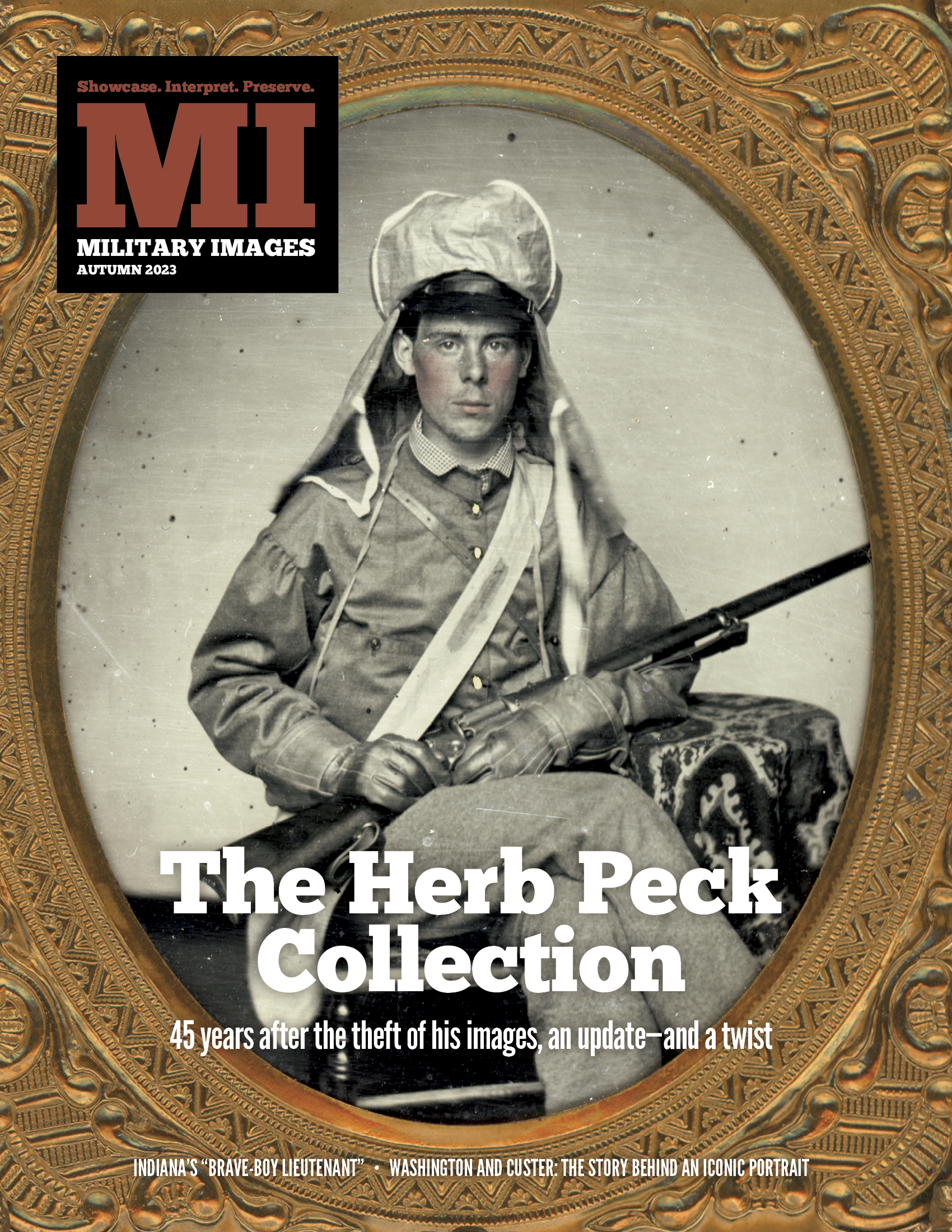
Cover image
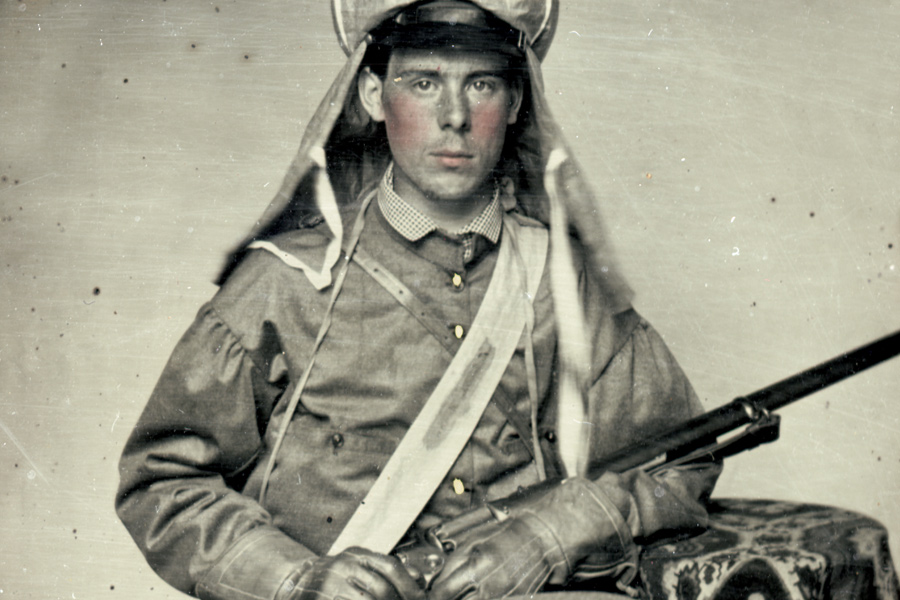
A sixth-plate ambrotype from the late Herb Peck Jr. Collection pictures a Confederate soldier.

Table of Contents (p. 1)

Editor’s Desk (p. 2)
Announcing a new online resource of identified soldier, sailor, and other wartime images that have been published in Military Images magazine since 1979.

Mail Call (pp. 3-4)
Feedback includes praise for the “Jeff. Davis and the South!” Story in the last issue, identifying a field grade Iowa officer, and more.

Military Anthropologist (p. 4)
Since 1979, we’ve published 1,770 identified portraits of Confederate soldiers and sailors.

Passing in Review (p. 6)
A review of Groundbreakers: The History of the Northern Virginia Relic Hunters Association by Stephen W. Sylvia and Nancy Dearing Rossbacher.

Photo Sleuth by Kurt Luther (pp. 8-10)
Finding a portrait of 1st Lt. Presley Oldham Craig, the namesake of Fort Craig, one in a ring of 68 defensive forts surrounding wartime Washington, D.C.

Antebellum Warriors (p. 12)
A militia company lines up along a road in front of a house in Angelica, N.Y.

Most Hallowed Ground (p. 14)
Captain Sanford Cobb Kellogg served as an aide on the staff of his uncle, Maj. Gen. George H. Thomas.

The Honored Few (p. 16)
Francis Edwin “Frank” Brownell received the Medal of Honor for his role in the death of Col. Elmer E. Ellsworth of the 11th New York Infantry.

The Citizenry by Elizabeth A. Topping (p. 18)
Civil War era portraits of individuals posed with empty chairs memorialize the sitter. The empty chair evokes sorrow from viewers.

Fakes, Forgeries and Frauds by Perry M. Frohne(p. 20)
In this case study, Perry uses a blacklight to reveal a modern forgery of an Abraham Lincoln carte de visite.

Searching for Herb Peck’s Images: 45 years after the theft of his pre-eminent collection, an update—and a new call to action by Ronald S. Coddington (pp. 22-37)
In 1978, a break-in at collector Herb Peck’s Nashville home ended with the loss of prize images. The case went cold, then heated up. Here’s the latest.

Lieutenant Washington’s Fateful Encounter: James Barroll Washington sat for a well-known portrait with George Armstrong Custer. Here’s the story behind it. By Ronald S. Coddington (pp. 40-49)
The story behind one of the most recognizable images of the Civil War: Lieutenants George Armstrong Custer, James Barroll Washington, and an enslaved child. 

“The Brave Boy-Lieutenant”: First Lieutenant and Aide De Camp Frank N. Sheets by Brendan C. Hamilton (pp. 52-55)
Frank N. Sheets of the 29th Indiana Infantry proved a model aide to Brig. Gen. Richard W. Johnson until his death at the Battle of Chickamauga.

How to Live Your Best Life: A Civil War Veteran’s Advice to the Future by Ronald S. Coddington, featuring artifacts from the Eleanor Laughlin Family Papers (pp. 56-58)
Months before his death in 1920, Civil War veteran Capt. Henry Haymond wrote a poignant letter of advice to his young great-grandson.

“Hard Cases”: Distinguished European soldiers who did not become U.S. generals by Frank Jastrzembski (pp. 60-64)
This trio of military men—Garibaldi, Klapka, and Zerman—were high on the list for Union generals. But they did not get commissions. Here’s why.

Q&A with Rick Carlile: On Obsessive Collecting Genes, Passion for CDVs, and More (pp. 66-68)
Longtime contributor Rick Carlile shares his origin story as a collector of books, baseball cards, and Civil War photographs. It’s in the genes!

Material Culture by Anthony F. Gero (pp. 70-71)
The distinctive California militia uniform of 1864-1865 featured blue cuffs and collars.

Stragglers (pp. 72-75)
Portraits include a Pennsylvania Bucktail, soldiers and civilians at recruiting headquarters in Philadelphia, and a Confederate lieutenant.

Vignette: Episodes of the Civil War by Scott Valentine (p. 76)
Assistant Surgeon Benjamin Walter Carpenter served in the 2nd and 9th Vermont infantries, and also as chief medical officer at Camp Douglas in Chicago.

The Last Shot (p. 80)
A half-plate ambrotype picturing Company D of the 2nd Tennessee Cavalry (U.S.) posed outdoors with a variety of weapons.

Free Guide to Fakes, Forgeries and Frauds

Military Images is pleased to offer a free guide adapted from a compilation of columns, “Fakes, Forgeries and Frauds: Arming you with knowledge and tools to combat counterfeit images” by Perry M. Frohne.

The columns appeared between Autumn 2019 and Autumn 2023 in Military Images. The order of the columns has been changed, and some modifications have been made to the text, for this publication.

This guide is offered as a service to photograph collectors of all levels of experience with the goal of educating and raising awareness of fake images—and giving you the tools you need to detect them. These images, created with the intent to deceive, entered the marketplace as early as the 1980s. They will always be out there. The guide will give you confidence and practical knowledge to help you avoid costly mistakes.

Perry M. Frohne is the owner of Frohne’s Historic Military. He has been investigating fake images for more than 25 years. He is a MI Senior Editor. Contact Perry at perryfrohne@aol.com.

Finding Aid: Summer 2023

A complete table of contents for the Summer 2023 issue of Military Images magazine, and information about how to purchase single issues and subscriptions.

Vol. XLI, No. 3
(80 pages)

Print edition: Visit our store to check availability
Digital edition: Visit JSTOR.org to purchase
Subscribe or renew your subscription

Explore the MI Archives:
Browse | Advanced search | Tutorial

Inside

Cover image
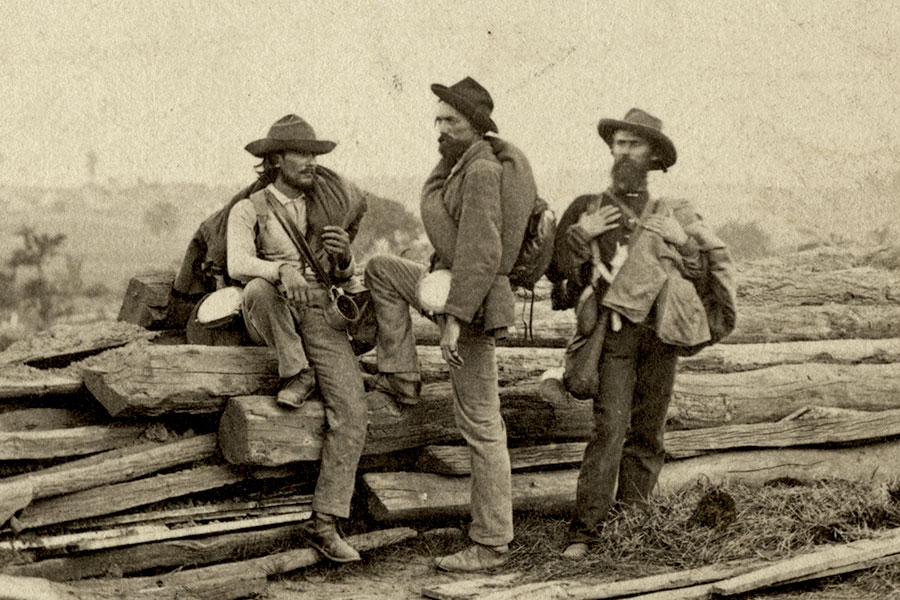
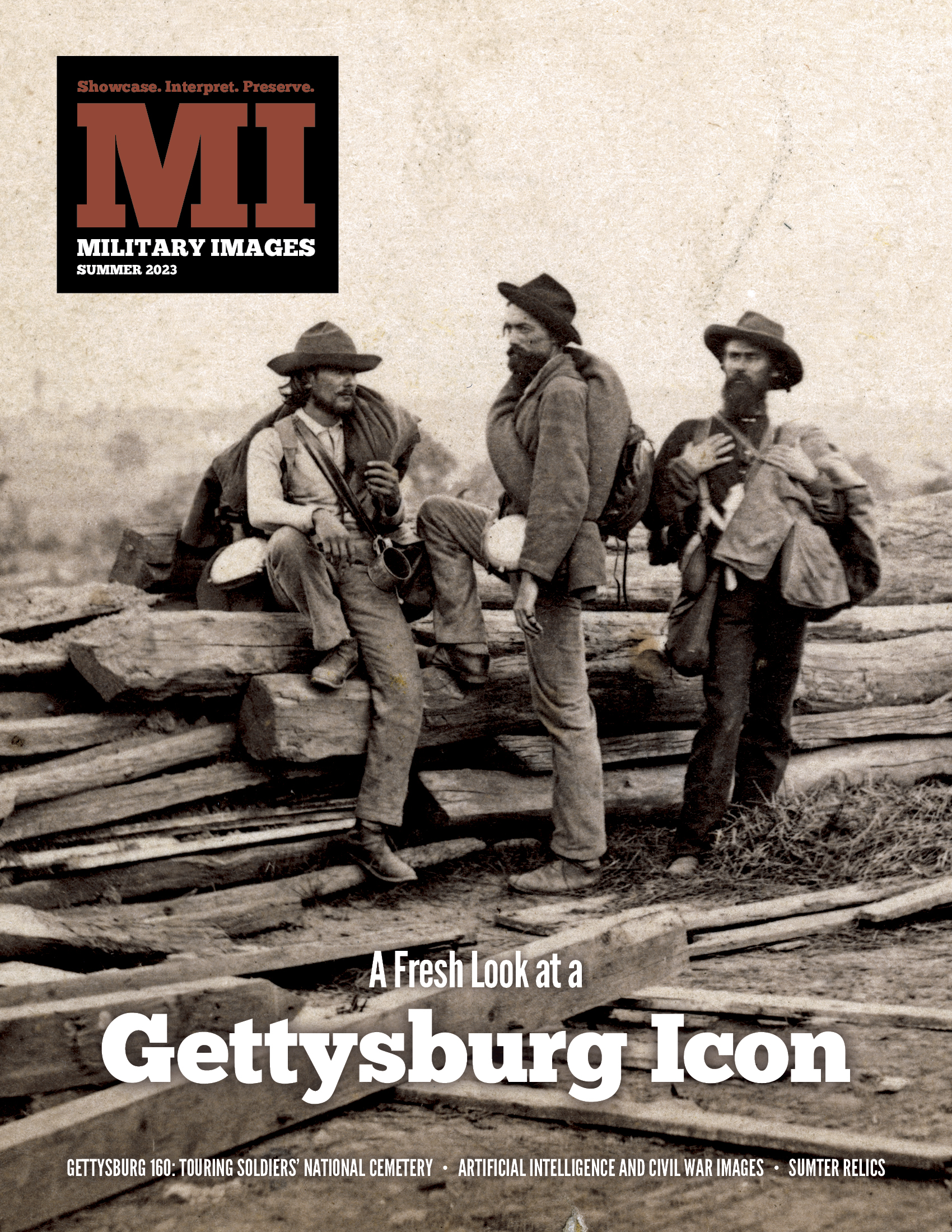
A stereo card from the Wisconsin Historical Society pictures three Confederate prisoners at Gettysburg taken in July 1863 by Mathew Brady’s photographers.

Table of Contents (p. 1)

Editor’s Desk (p. 2)
Reflections on the value of curation is tied to a new book, America’s Defining Moment: Civil War Portraits from the Collections of Brian C. Boeve and Friends.

Mail Call (pp. 3-4)
Feedback includes praise for the “Jeff. Davis and the South!” Story in the last issue, identifying a field grade Iowa officer, and more.

Military Anthropologist (p. 4)
Today, we refer to the small paper prints that became all the rage during the Civil War as cartes de visite. Back then, Americans called them card photographs.

Passing in Review (pp. 6)
A review of Gettysburg’s Love Lost Story: The Ill-Fated Romance of General John Reynolds and Kate Hewitt by Jeffrey J. Harding.

Photo Sleuth by Kurt Luther (pp. 8-10)
Introducing Backdrop Explorer, a new Civil War Photo Sleuth feature that uses artificial intelligence to identify backgrounds.

Antebellum Warriors by Dr. Charles H. Cureton (pp. 12-13)
A portrait of a Marine is dated between 1856-1859 by investigating the details of his uniform and considering its photographic format.

Most Hallowed Ground (p. 14)
William A. MacNulty, 10th New York Infantry, suffered a wound and arm amputation at Fredericksburg in 1862. He is buried in Arlington National Cemetery.

The Honored Few (p. 16)
Julius H. Stahel, brigadier general and division commander, received the Medal of Honor for gallantry at the Battle of Piedmont in June 1864.

The Citizenry (p. 18)
A carte de visite of Martha Naomi Wilcox is inscribed by her to her father, John F. Wilcox, who went off to war in the ranks of the 116th New York Infantry.

Fakes, Forgeries and Frauds by Perry M. Frohne(p. 20)
One seller of fake cartes de visite made $7,406.19 during the first four months of 2023. This is a cautionary tale and reminder for collectors to be vigilant.

Three Confederate Prisoners at Gettysburg: Exploring the vast void of an iconic photograph by Paul Bolcik (pp. 23-31)
It is one of the most recognizable—and mysterious—photographs of the Civil War. A fresh look at this July 1863 image reveals what we know, and what we don’t.

A Place of Pilgrimage for the Nation: A photographic tour through Gettysburg’s Soldiers’ National Cemetery by Charles T. Joyce (pp. 32-51)
This 21-stop tour is designed for visitors to Gettysburg who seek to learn more about the Union soldiers who fought, died, and were buried there.

Relics From the Raising of the Flag at Sumter, 1865 by Ronald S. Coddington, featuring an artifact from the Glen Hayes Collection (pp. 54-56)
A display mounted to cardboard preserves remnants of leaves and flora from the 1865 flag raising ceremony over Fort Sumter, and two related cartes de visite.

Reunion Magic Brings Together Daguerreotypes of a Philadelphia Militia Officer by George S. Whiteley IV. (pp. 58-61)
A trio of portraits taken minutes apart by master photographer Marcus Aurelius Root of Philadelphia are reunited 175 years later. Here’s the story.

A Story Hidden Beneath a Beard by Marcy E. Zimmer (pp. 62-65)
Severely wounded in the face at the Battle of Dallas, Ga., in 1864, Maj. Ephraim C. Dawes of the 53rd Ohio Infantry, survived reconstructive surgery.

Material Culture by Ron Field (pp. 66-68)
B.F. Edmands designed a unique hat to protect soldiers from the elements. It, like other early war experimental headgear, did not catch on with the troops.

Behind the Backdrop by Adam Ochs Fleischer (p. 70)
Artificial Intelligence is already changing the world in myriad ways in its infancy. This includes identifying backdrops in Civil War photographs.

Stragglers (pp. 72-74)
Portraits include a Confederate lieutenant by Charles R. Rees and Capt. Warren Griffith of the 7th Virginia and 1st Maryland cavalries.

Vignette: Episodes of the Civil War by Scott Valentine (p. 76)
Thomas S. Thorp of the 23rd New York National Guard served in the Gettysburg Campaign. The experience left him emotionally scarred and ended in suicide.

The Last Shot (p. 80)
An 1899 view of the Vicksburg battlefield by photographer John C. Coovert pictures a man making a cash deal for relics gathered by local kids.

Finalists in the 2022 Army Historical Foundation Distinguished Writing Awards

I am delighted to announce that two Military Images stories have been recognized as finalists in the Journals and Magazine category of the Army Historical Foundation Distinguished Writing Awards. The annual competition honors books and articles published in 2022.

Please join me in recognizing and applauding:

“How They Went Forth to the Harvest of Death” by Charles T. Joyce is a concise account of the diehard U.S. Regulars at the Battle of Gettysburg, a story largely overlooked in the annals of the war. Chuck reveals the trials and tribulations they endured, and illustrates the story with images from his collection, which is focused on portraits of Gettysburg participants. The story appeared in our Summer 2022 issue.

“Birthplace of the American Zouave” by Ron Field traces the origins of Elmer Ephraim Ellsworth and how he fostered Zouave mania first in Chicago, Ill., and through the rest of America during his drill tour through the states in the summer of 1860. The account is illustrated with images from several collections. The story appeared in our Autumn 2022 issue.

Chuck and Ron are senior editors of and regular contributors to Military Images.

The Army Historical Foundation, a non-profit, tax-exempt organization, is dedicated to preserving the history and heritage of the American soldier. Its goal is to promote greater public appreciation for the contributions that America’s Army – Regular, Reserve, and National Guard – has made to the nation in 248 years of service. The Foundation is the principal fundraiser for the National Museum of the United States Army at Fort Belvoir, Va.

The competition is managed by Chief Historian Matthew J. Seelinger.

A New Limited Edition Book

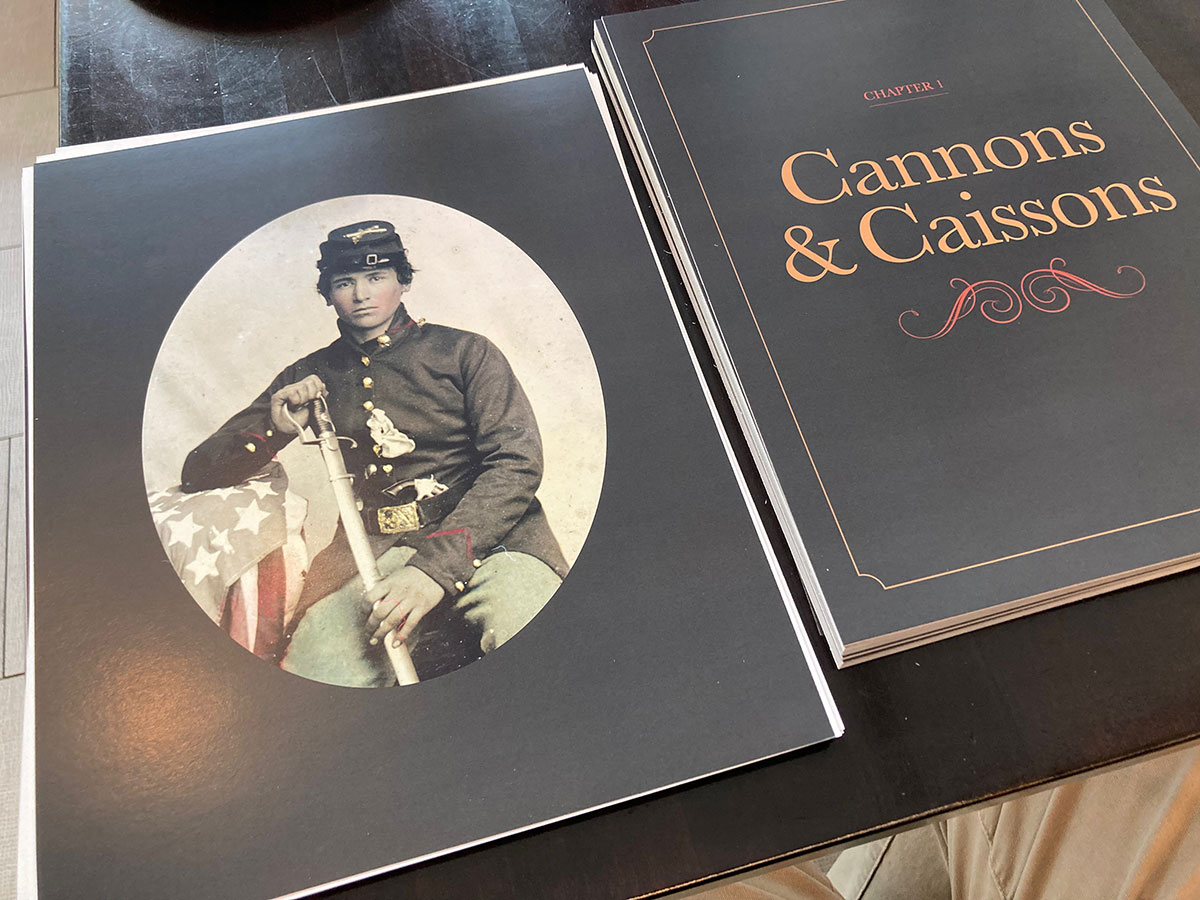
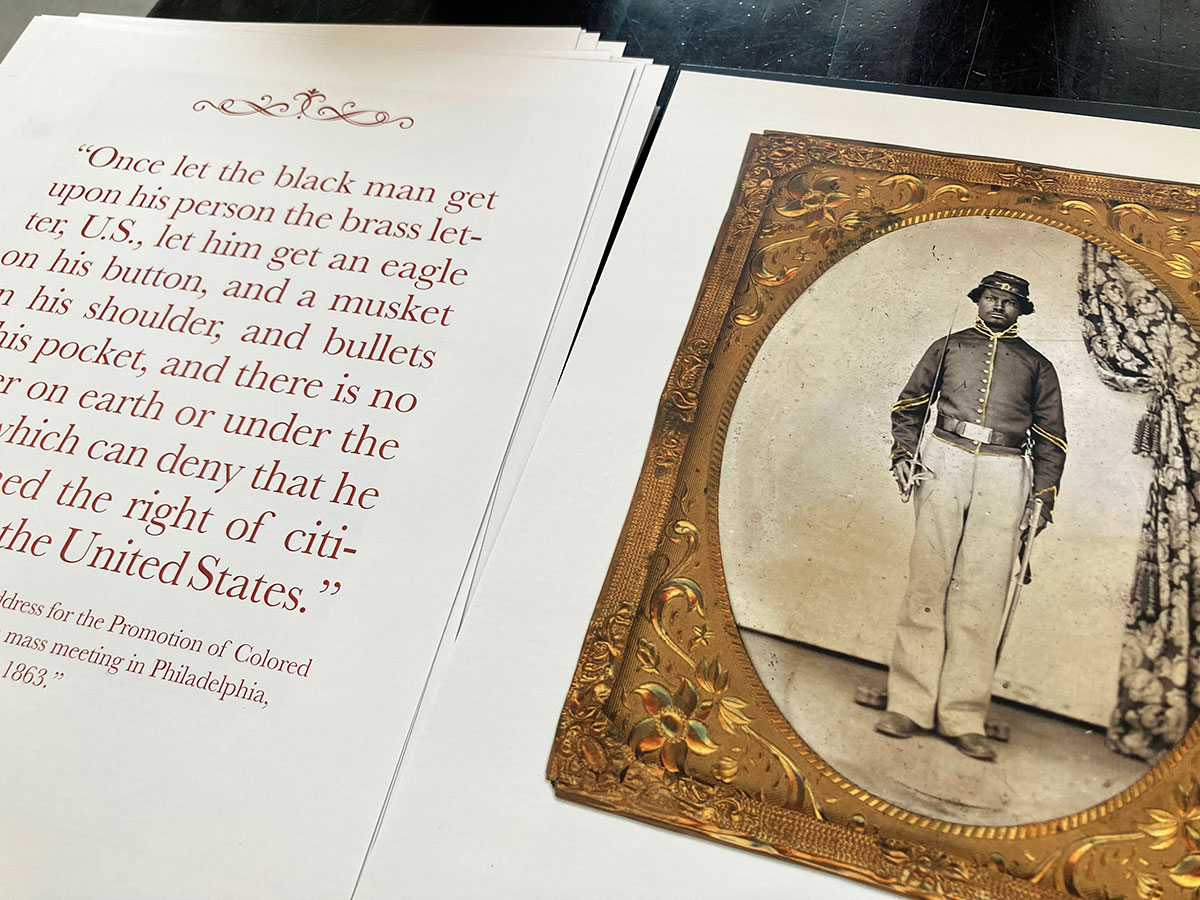
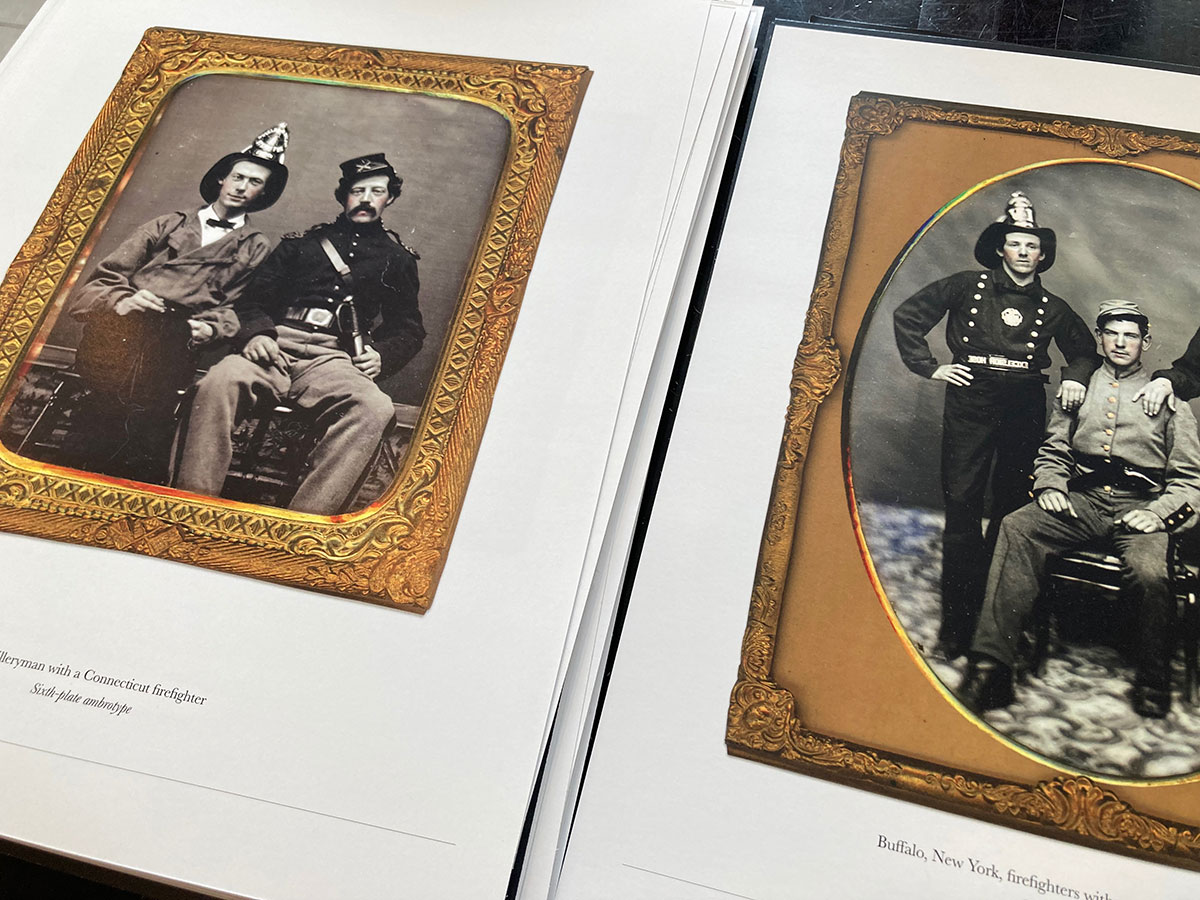
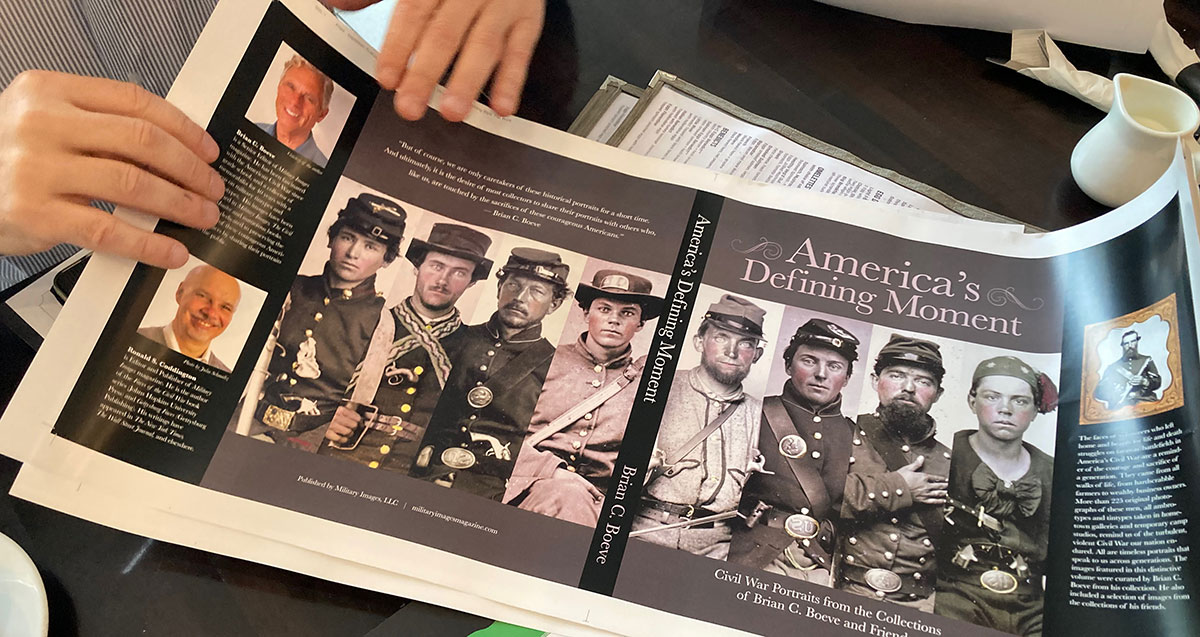
This week I met at a local coffee shop with the printer to review proof pages for a forthcoming book by Brian Boeve, America’s Defining Moment: Civil War Portraits from the Collections of Brian C. Boeve and Friends. I am overjoyed with the superb quality and high production values, as you’ll see in the photos here. It will be a museum caliber heirloom coffee table book, hard bound with dust jacket. I could not be more pleased!

Details:

  • 8.5 x 11 inches
  • Hardbound with dust jacket
  • 270 pages
  • High quality paper and full color printing
  • Limited edition: 200 copies
  • Designed and printed by Military Images

Copies and will be available at the Gettysburg Show next month (June 24-26, 2023). Pre-orders are available in the Military Images store.

Finding Aid: Spring 2023

A complete table of contents for the Spring 2023 issue of Military Images magazine, and information about how to purchase single issues and subscriptions.

Vol. XLI, No. 2
(80 pages)

Print edition: Visit our store to check availability
Digital edition: Visit JSTOR.org to purchase
Subscribe or renew your subscription

Explore the MI Archives:
Browse | Advanced search | Tutorial

Inside

Cover
A quarter-plate tintype from the Dan Schwab Collection pictures a soldier standing beside the “Jeff. Davis and the South!” placard.

Table of Contents (p. 1)

Editor’s Desk (p. 2)
Previously unpublished images of a man with the “Jeff. Davis and the South!” sign and Union musicians illustrate the ongoing voyage of photographic discoveries.

Mail Call (pp. 3-4)
Feedback includes praise for the recent Iowa issue and Adam Ochs Fleischer’s backdrops column, and a correction for a misidentified portrait.

Military Anthropologist (p. 4)
An 1861 newspaper report lists the number of ambrotypes sent by soldiers to their families at home, and from the families to the soldiers in camp.

Passing in Review (pp. 6)
A review of “Emancipation,” starring Will Smith, Charmaine Bingwa, Ben Foster and Mustafa Shakir (Apple TV).

Photo Sleuth by Kurt Luther (pp. 8-10)
A Civil War portrait is identified, and the photographer is connected to William Henry Jackson of the 1871 Hayden Geological Survey to Yellowstone.

Antebellum Warriors (p. 12)
Connecticut’s early mobilization was carried out by Maj. Gen. Thomas Guyer, who kept men and materials moving to the front lines throughout hostilities.

Most Hallowed Ground (p. 14)
Frank Wheaton began his service as an officer in the 2nd Rhode Island Infantry and ended it as a brigadier. He fought in 41 engagements. Here’s his story.

The Honored Few (p. 16)
Henry Alanson Barnum, colonel of the 149th New York Infantry, received the Medal of Honor for his courage and leadership at Lookout Mountain.

The Citizenry by Elizabeth A. Topping(p. 18)
In “America’s First Sex Symbol,” the adventures of actress and poet Adah Isaacs Menken’s life and career takes center stage.

Jeff. Davis and the South! Victory or Death! 15 takeaways from a new survey by Rick Brown and Ronald S. Coddington (pp. 20-28)
The recent discovery of a Confederate soldier posed with a “Jeff. Davis and the South!” placard inspired a fresh look at a rare group of Civil War portraits.

Men of War: Selected image groupings from the Phil McCoy Collection (pp. 30-43)
Inspired by Confederate military history in his native Kentucky, Phil McCoy focus his collection on Southern Civil War portrait photography. Here’s a sampling.

“The Armless Hero of Fredericksburg” by Mark Savolis and Ronald S. Coddington, featuring images from Mark’s collection (pp. 46-50)
The courage and compassion of Medal of Honor recipient Thomas Francis Plunkett includes seven wartime and postwar portraits of him.

An Inside Look at Baltimore’s Sanitary Fair by Dione Longley and Back Zaidel (pp. 52-59)
A cache of unknown images by a 19-year-old photographer comes to light in this gallery, and a history of the fair, which was visited by Abraham Lincoln.

From Yale to Yorktown by Joe Bauman and Ronald S. Coddington (pp. 62-66)
In youth, Eneas Munson served in George Washington’s elite Light Infantry Corps. In old age, he reminded new American generations of freedom’s fight.

Q&A with William P. Jones: Behind the Scenes with one of Find-A-Grave’s Dedicated Contributors (pp. 68–69)
Who are the stalwart individuals working with little fanfare to post portraits and other relevant information to Find-A-Grave pages? One of them is Bill Jones.

Material Culture (p. 70)
Only about 20,000 Colt Second Model Dragoon Revolvers were produced, and they are rarely seen in Civil War portraits. Here’s an example.

Behind the Backdrop: Origins, artistry and photographers by Adam Ochs Fleischer (pp. 72-73)
“The Harp Backdrop of Camp Graham” is unique to a single regiment, the Zouave 23rd Pennsylvania Infantry, at Washington, D.C., in 1861-1862.

Vignette: Episodes of the Civil War by Scott Valentine (p. 74)
In “My Darling Clementine,” Capt. Chauncey Harris, 14th New Jersey Infantry, is wounded at the Battle of the Monocacy and finds love during his recuperation.

Stragglers (p. 76)
Union soldier portraits include groups of two pards and an unpublished stereo card of the 3rd Vermont Infantry band.

The Last Shot (p. 80)
A study in Southern soldier portrait photography features and ambrotype of a man armed with Bowie knife and a Colt Root Model 1855 revolver.

Thanks from Military Images Magazine for a Great 2022

The holiday season is always a time to pause and reflect on the year, and its been a great one for Military Images magazine. I am grateful to subscribers, collectors, contributors from across the United States and the world, and our advertisers. All of you make Military Images magazine possible. I want to take a moment here to highlight some of the images we shared and stories we told in 2022.

Finding Aid: Winter 2023

A complete table of contents for the Winter 2023 issue of Military Images magazine, and information about how to purchase single issues and subscriptions.

Vol. XLI, No. 1
(80 pages)

Print edition: Visit our store to check availability
Digital edition: Visit JSTOR.org to purchase
Subscribe or renew your subscription

Explore the MI Archives:
Browse | Advanced search | Tutorial

Inside

Cover
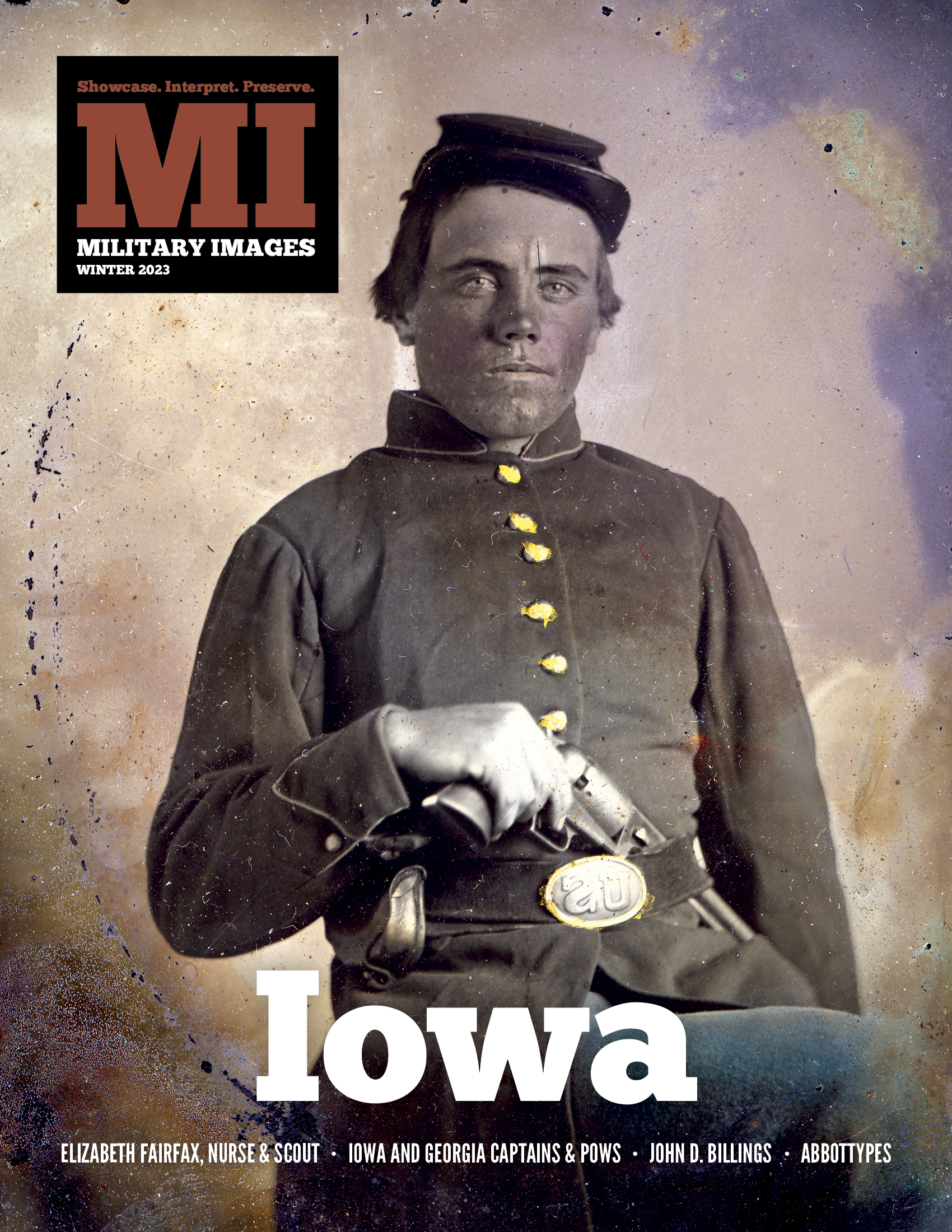
A sixth-plate tintype from the Michael Huston Collection pictures John Wesley Morton of the 19th Iowa Infantry.

Table of Contents (p. 1)

Editor’s Desk (p. 2)
“Connoisseur” is usually applied to the art historian or the sommelier. It is also an apt term to describe collectors of historic images.

Mail Call (pp. 3-4)
Feedback includes praise for the recent Illinois issue, a possible Mississippi uniform identification, and a note about Confederate Brig. Gen. Lloyd Tilghman.

Military Anthropologist (p. 4)
A survey of advertisements of photograph albums in newspapers.com from 1860 to 1869 shows the rapid rise in popularity of these items.

Passing in Review (pp. 6)
A review of The Atlanta Daily Intelligencer Covers the Civil War by Stephen Davis and Bill Hendrick (University of Tennessee Press).

Photo Sleuth by Kurt Luther (pp. 8-10)
A portrait of a soldier in the 48th New York Infantry in the Library of Congress collection had two legacy identifications. Which is correct? The author investigates.

Antebellum Warriors (p. 12)
An ambrotype of a seafarer wears a uniform that may be that of a Revenue-Marine Service sailor. Revenue-Marine became today’s U.S. Coast Guard.

Most Hallowed Ground (p. 14)
Andrew Geddes of the 8th Iowa Infantry made captain at age 18 and lieutenant colonel at 21. He went on to a regular army career that tarnished his reputation.

The Honored Few (p. 16)
1st Lt. James Hill of the 21st Iowa Infantry crossed into rebel lines and encountered enemy pickets. How he managed to escape resulted in the Medal of Honor.

The Citizenry by Ross J. Kelbaugh(p. 18)
In “a Forgotten ‘Veteran’ Remembered,” the author pays tribute to Elizabeth Fairfax, an escaped slave connected to the 26th Iowa Infantry.

Fakes, Forgeries and Frauds by Perry M. Frohne (p. 20)
A dealer’s wishful thinking to turn a portrait of a Union captain to Brig. Gen. John Buford is a lesson in getting a second opinion.

Hawkeyes! Faces and stories of Iowa Volunteers in the Civil War curated by Michael Huston and introduced by Robert Welch (pp. 23-45)
Representative portraits and stories of Iowa men who served in the Union army and fought at Shiloh and other Western Theater battles.

A Captain for a Captain: A forgotten act of honor connects two prisoners of war, one from Georgia and another from Iowaby Laura Elliott (pp. 46-48)
In 1871, a Southern captain told a fantastical tale of being released from prison on his honor to find a captured Union captain. Here’s the rest of the story.

Small Miracles: Abbottypes were a bold experiment in mass-produced wearable melainotypes and a unique snapshot of the Civil War in 1861by Ronald S. Coddington and Nick Penachio (pp. 50-60)
Anson and Charles Abbott sold 1860 presidential campaign photo buttons. It went well. After the Civil War began, they tried with military and political figures.

The Army Education of John D. Billings: A letter by the author of Hard Tack and Coffee reveals how his wartime military experience helped him become an educator by Mike Fitzpatrick (pp. 60-62)
After the Civil War ended, Union veteran John D. Billings pursued the education that eluded him before the war. Here’s how he got it, and what it meant to him.

Reminiscences of Collecting Cased Military Images, 1978-2002: Q&A with Kean Wilcox (pp. 64–67)
A large number of Civil War photos from the Kean Wilcox Collection can be found in early issues of Military Images magazine. Here’s the backstory.

Material Culture (p. 70)
The Zouave jacket worn by veterans of the 28th Iowa Infantry has its origins in New Orleans in 1863, suggests a survey of 16 surviving soldier portraits.

Behind the Backdrop: Origins, artistry and photographers by Adam Ochs Fleischer (pp. 72-73)
The author examines Civil War period portrait photographs, with the United States Capitol building and its new dome, in the background.

Vignette: Episodes of the Civil War By Scott Valentine (p. 76)
In “The Water Tiger vs. the Long Board With a Hogshead,” an Indiana soldier describes the 1862 clash of ironclad warships Monitor and Virginia.

Stragglers (p. 78)
Portraits of an uncommon cobalt blue-glass ambrotype, three coatless Union soldiers, and a photograph of a military man of unknown loyalties.

The Last Shot by Michael Huston (p. 80)
The author recounts how Civil War living history helped him pinpoint and unravel the mystery behind the identity of an ancestor in a wartime image.